Experts claim that during periods of price growth, "gray" producers become more active, as every price increase promises them additional profits, and they predict an increase in "substandard" fuel on the market.
Therefore, the Institute's experts decided to conduct an inspection of A-95 right now to find out what is being poured into our cars' tanks. And they were not wrong in their forecast – the market, it seems, is slowly but surely beginning to fill with surrogate.
This time, fuel samples were taken at gas stations of nine companies, and the experts decided to check not only large all-Ukrainian traders but also medium and small networks, since it is easier for "mixers" to penetrate there. Specifically, the list of tested companies looked like this: OKKO, BRSM-Nafta, WOG, KLO, Narodna, Olvia-Nafta, LUXWEN, ANP, and SunOil. At the stations, experts purchased "just 95", and at OKKO and WOG stations – fuel with the "EURO" prefix. At the same time, prices varied significantly – from 19.99 to 22.99 UAH.
The samples were sent to a certified laboratory, where they were tested for compliance with the relevant DSTU 7687:2015 standard (A-95-Euro5 gasoline). Let us recall that Euro standards specify requirements for both engine operation and gasoline quality, which are taken into account in new European car models. That is, to get the declared performance characteristics of the car, you need to fill it with appropriate fuel.
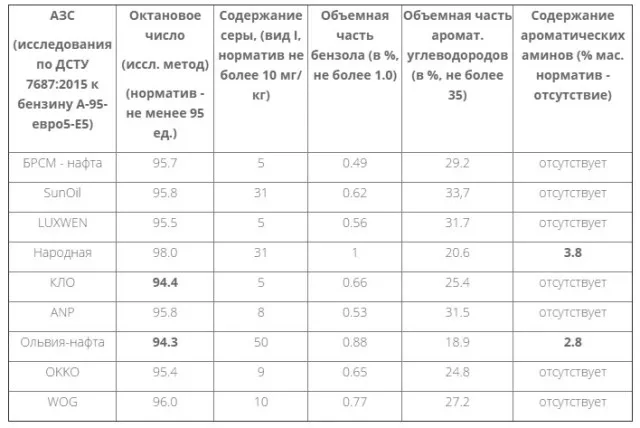
The most important conclusion obtained in the laboratory is that the quality of fuel in the country has deteriorated, and quite significantly. Of the nine samples, three turned out to be substandard (KLO, Narodna, and Olvia-Nafta), though the rest met Euro 4 and Euro 5 standards. For comparison – in the previous check, conducted at the end of last year, there were no violations at all! To be fair, the violations were not critical, but nevertheless, it would be better if they did not exist at all.
But let's take things in order. The following parameters were studied: octane number, sulfur content, volume fractions of benzene and aromatic hydrocarbons, chemical composition of gasoline, and the content of aromatic amines.
First, the most important parameter for engine operation was checked – the octane number, which characterizes the fuel's resistance to detonation – premature combustion of gasoline in the combustion chamber. Detonation is harmful to the engine not only due to increased fuel consumption and reduced power, but also due to premature engine wear from excessive loads. The octane number was measured by the research method. According to it, the standard is set at no less than 95.0 units. And here an unpleasant surprise was found – samples taken at Olvia-Nafta and KLO stations did not reach the standard (octane number – 94.3 and 94.4, respectively). The leaders had a serious "margin", ranging from 95.7 at BRSM-Nafta to 96 units at WOG.
Next, the experts checked another crucial indicator – sulfur content. If there is too much sulfur in the fuel, it leads to the formation of carbon deposits, contamination of fuel injectors, and "kills" catalysts. Moreover, the exhaust becomes "dirtier", and very dangerous oxides enter the air we breathe. DSTU for A-95 EURO requires no more than 50 mg/kg (Euro 4) or 10 mg/kg (Euro 5). There was practically no sulfur in the BRSM-Nafta sample (5 mg/kg), LUXWEN, OKKO, and WOG samples also met Euro 5, and the SunOil sample was within Euro 4 standards. The other participants also had no sulfur violations.

Another important parameter is benzene content. An increased concentration of benzene causes great harm to both the environment and the car. Not evaporating completely, benzene can wash away the oil film, leading to increased wear of engine cylinders. The new DSTU regulates the volume fraction of benzene content at no more than 1%. All met this, with the least harmful substance found in BRSM-Nafta (0.49%) and ANP (0.53%).
When checking the volume fraction of aromatic hydrocarbons, no exceedances were found. For reference – with an increase in "aromatics" content, exhaust toxicity increases, and more carbon deposits form in the combustion chamber. All participants had this indicator within the allowable limits, although a couple of years ago many would not have met the standard with such indicators.
The chemical composition showed that practically no bioethanol was present in any sample, so the standard on adding five percent of "alternative" to gasoline is clearly ignored.
But violations were found regarding the presence of aromatic amines. According to the standard, they should not be in fuel, but they were found in samples from Narodna and Olvia-Nafta stations.
And what is the result? Large networks focused on imports "hold" quality despite all the problems. Moreover, the bar they have set turned out to be quite high. But in small networks, problems are possible, although not everywhere, so chasing cheapness is not worth it.
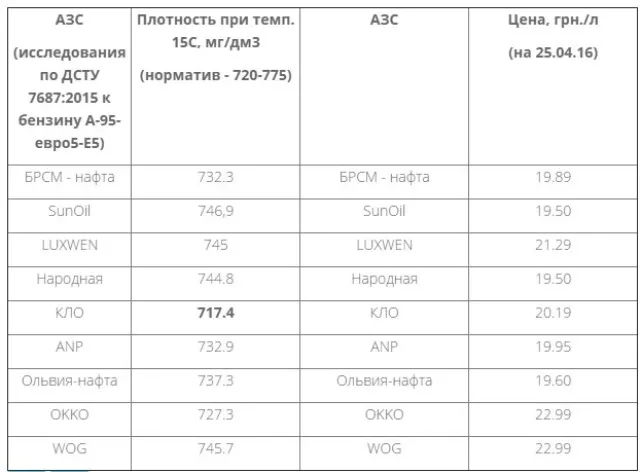
Clarification
In mid-April, the Institute of Consumer Expertise conducted a check of Ukrainian gas stations to determine the quality of A-95 gasoline sold in these networks. Overall, the results were acceptable, but there were some violations. In particular, in the sample taken at the KLO gas station network, the octane number did not reach the standard by six-tenths of a unit (94.4 with a standard of 95). It must be said that the experts themselves were surprised by the result, since no violations had been found in the KLO network for several years.
The peculiarity of the current study was that the octane number was measured by the research method, a less stringent method for determining detonation resistance. It was suggested that the research results for all samples should be rechecked, but using a more accurate method – the motor method. Fortunately, specifically for such cases, the laboratory stores so-called "arbitration samples" – sealed amounts of fuel that can be used in case of disputes.
According to the results of the clarifying study, the sample taken at the KLO network turned out to be compliant; by the motor method, its octane number was 85.6 units, with a standard of 85.6. For the other participants, the results "fell" approximately in the same ranges as in the previous study.
Motorists who fill up at the capital's KLO network need not worry about their "horses", and the Institute's management apologizes to readers. Mistakes exist to be corrected, and they provide invaluable experience.