
The task is set clearly: Mercedes E-Class, BMW "five" and Audi A6. Catch up and overtake! Or at least get close enough that sometimes you are remembered as a competitor, sometimes considered as a replacement option.
Ways? Any! Premium materials, latest developments, huge advertising budgets. Comfort? We have comfort too! Power? We have no less! All-wheel drive? We have all-wheel drive, and with clever solutions! There is even a hybrid powertrain. You have brand strength? And we... And we have pleasant prices, that's how! And we also don't mind playing on the fact that your leadership has become boring, that people want change. And also... In short, there is a desire.
Our review features six excellent E-Class sedans, five of which are all-wheel drive, and the Lexus has two motors, gasoline and electric. Three cars — Honda Legend, Lexus GS 450 Hybrid, and Volvo S80 — have just appeared on the Russian market, and the Mercedes E-Class, albeit with reservations, is also a newcomer — it underwent a facelift this year. So, we gathered in one place all officially sold all-wheel drive cars of the E segment in Russia and added the hybrid Lexus to them.
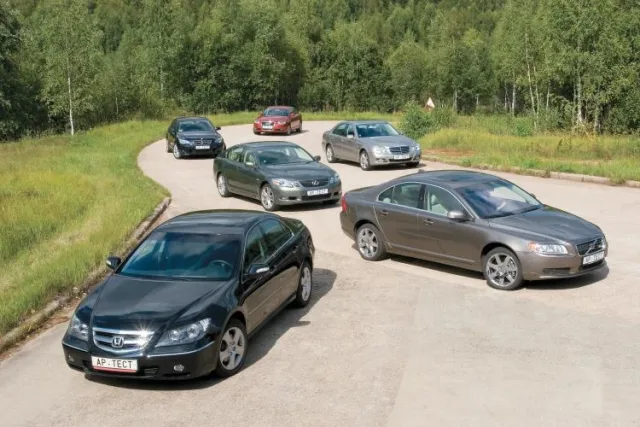
We won't dwell on the exterior for long — fortunately, each of these cars has already been presented to Autoreview readers. But look at the group photo — and you can immediately see whose "faces" are truly marked by nobility, and who is only trying to seem so...
We won't tire you with a detailed analysis of the interiors either, but we will still highlight the Audi A6 cabin: it seemed to us the most harmonious and comfortable. For example, the MMI multimedia system with a large color screen: it's much easier and more pleasant to figure out than wandering through the confusing iDrive menus on the BMW. However, the BMW also has its advantages: a sporty low seating position, a seat that literally hugs the driver — the side bolsters can be moved together and apart, adjusting the seat to fit you. The speed figures projected onto the windshield are also impressive — they seem to hover over the hood. Moreover, the BMW interior has the least decorative excesses — by the creators' design, nothing should distract the driver. It shouldn't, but it does: that very iDrive and the steering column switches without position fixation that require getting used to.
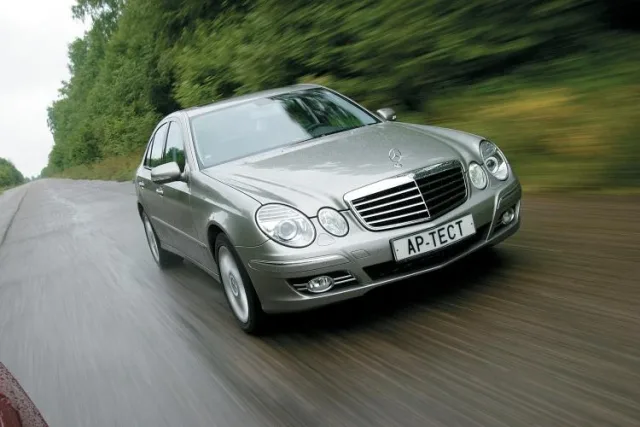
The Mercedes suspension is well suited for our roads: enviable ride smoothness and almost complete absence of pitching
The solid Mercedes interior has nothing to criticize. Well, maybe we can complain about the abundance of buttons on the center console.
 |  |
| Mercedes interior: soft lines, quality materials | The instrument panel is laconic, beautiful, and clear |
 |  |
| On the steering wheel — elegant buttons for controlling the menu, audio system, and phone | |
The Volvo interior pleases with clean lines, a pleasant color scheme, but surprises with not the most comfortable driver's seat, a floor-mounted gas pedal that makes you strain your ankle, and a modest monochrome display on the center console. However, there are no complaints about the display: all information is shown in Russian, while the other test participants are ready to communicate with the driver in almost all European languages, but not in Russian.
 |  |  |
| Mercedes seat: long cushion and huge adjustment ranges | The "glove box" closes with a key | The five-speed "automatic" pleased with logical, smooth, and precise operation |
 |  |  |
| By common opinion, the Mercedes rear seats are the best | The facelift affected not only the exterior: new suspension settings positively influenced handling and allowed the Mercedes to pass the "moose test" faster than everyone | The trunk is spacious, but the rear seat backrest is fixed rigidly |
The fact that the Lexus is not ordinary but hybrid is persistently reminded by a wattmeter in place of the traditional tachometer and a "live" diagram showing how power flows in the electromechanical transmission. You can't take your eyes off it! But you'd also like to watch the road... And you'd like to sit more comfortably: shorter drivers will complain about the insufficient range of backrest tilt adjustment (they'd like to set it more vertically), and those whom God has not deprived of height will not be pleased that the steering column moves up and down on a small lever, causing the steering wheel to be tilted forward like a bus in the upper position.
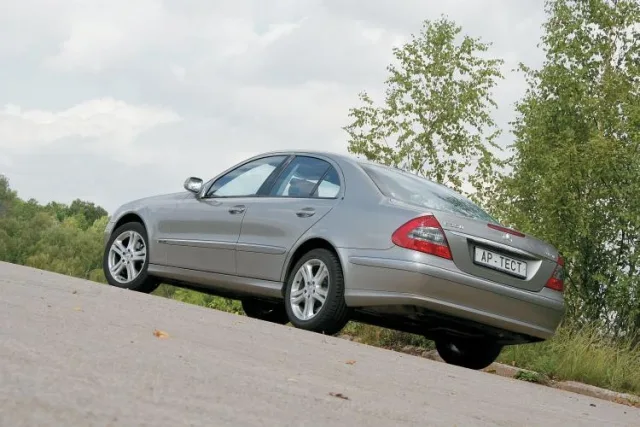
The Honda Legend is the only car with a regular key rather than a transponder key. We'll survive. Inside, there's leather, wood, excellent instruments, and even a kind of analog of the iDrive system: a rocking joystick with a rotary ring is located on the center console. It's a pity that the system is almost as confusing as on the BMW. At the same time, there are plenty of small buttons left.
What we unconditionally liked in the Honda is the driver's seat — it's a bit softer than in German cars, but holds the body well under lateral loads. The adjustment ranges may not be the widest, but a driver 190 cm tall will sit in the Honda quite decently.
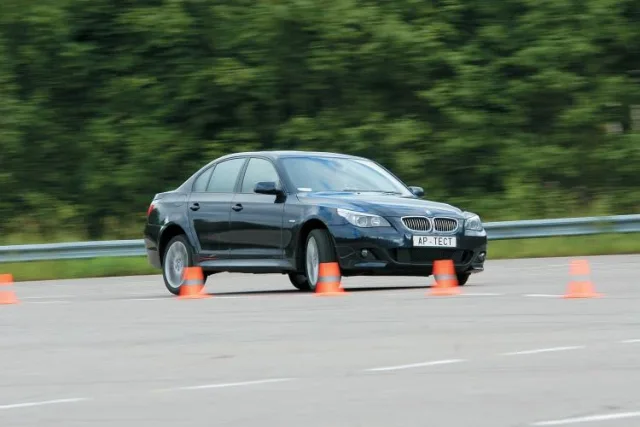
The BMW's handling is "tuned" for hot drivers and — alas! — for smooth roads. And on our highways, trajectory deviations sometimes occur
And in the back? As before, we invited our old friend from the financial and commercial sphere to be a guest expert (a special word to him), but we, the "drivers," also have some observations. In short, German cars are preferable, slightly worse are the rear seats of the Volvo, and in Japanese sedans it's not very cozy: you might just push the ceiling with your head, and in the Honda, your knees are also tight against the backrest.
 |  |  |
| It seems that the main thing in the "five" BMW interior is the iDrive system handle | To look into the "glove box," you need to bend down | The trunk volume can be increased by folding the rear seat backrests |
 |  | |
| Very laconic instruments | Seats with adjustable profile |
And the trunks of German cars are larger, and their walls are smoother. Volvo and Honda are slightly inferior to them, and the outsider is the Lexus: the cargo volume is only 280 liters, half as much as in the Mercedes or Audi! And all because of the nickel-metal hydride batteries behind the rear seat backrests. They also negated the possibilities of transforming the interior. If in the Audi or BMW the rear seat backrests can be folded and even a bulky shelving unit can be transported (although it's hard to imagine a more absurd use of these cars), then the Lexus owner, as befits the owner of such a car, will turn to a delivery service. Just like the Mercedes owner — the rear seat backrests here also do not fold.
 |  |  |
| IDrive: nice knob, but the menu is still overly complicated | Seating in the rear of the BMW is just as low as in the front |
On the dynamometer, the first thing we naturally decided to test was the Lexus GS 450h — after all, it's a hybrid! And according to the spec sheet, it's quite quick: a 296-hp V6 plus a 200-hp electric motor, together promising 0-100 km/h in 5.9 seconds. But that's only on paper. In reality, we ran it four times with varying battery charge levels, and the best result was 8.9 seconds. When the batteries were nearly depleted, the sprint to 100 km/h took as long as 11 seconds. In other words, acceleration intensity is heavily tied to how much energy is stored in the batteries. Perhaps if we had first descended a mountain a kilometer high and charged the batteries to the brim via regeneration, we could have squeezed out the claimed 5.9 seconds or at least managed 7. But neither at the test track nor in Moscow and the surrounding region can you find such long descents.
Still, let's not nitpick! In terms of ease of modulating throttle response, the hybrid Lexus is unrivaled. It's equally good in city traffic and on the highway. However, we recalled how the hybrid Lexus RX 400h crossover once flatly refused to move off on an incline. What about the GS 450h? We stopped on a 30-percent slope and tried to pull away again. No problems at all!
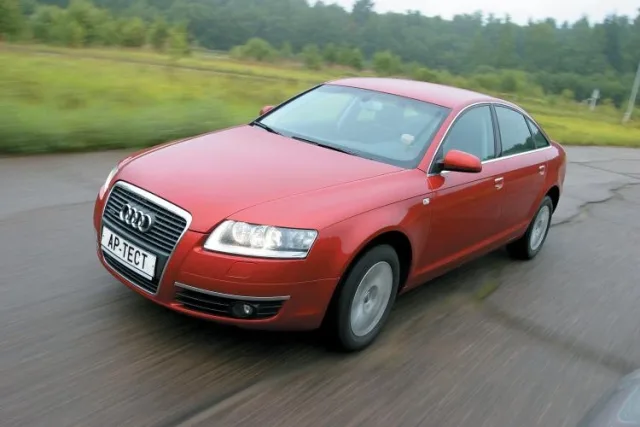
Audi's steering precision diminishes in corners with uneven surfaces
The fastest accelerating is the Volvo — it has a 315-hp V8 under the hood. It reaches 100 km/h in 7.4 seconds, and it doesn't matter whether it descended a hill beforehand or, conversely, climbed up. However, the automatic transmission occasionally stumbles during shifts...
In the updated Mercedes, the automatic works flawlessly — better than in any other sedan with a classic hydrodynamic gearbox. Although the engine here trails the Volvo's by 43 hp, driving the German car in the city is more pleasant. The Audi and BMW are also decent, but they lack the confidence in responses that the Mercedes provides. This is especially noticeable when you need to sharply press the gas at 50–60 km/h.
 |  |  |
| The Audi not only has a spacious trunk but also a full-size spare tire | The Audi's interior is very balanced and comfortable | Sport seats with leather and Alcantara upholstery — for an extra charge |
 |  | |
| The MMI multimedia system in the Audi is simpler and clearer than BMW's iDrive | The instruments are another adornment of the Audi |
Subjective brake feel differs mainly because the BMW and Lexus provide more pronounced pedal feedback. But in actual measurements, the Mercedes with its electro-hydraulic Adaptive Brake system came out best: its braking distance from 100 km/h is on average two meters shorter than the rivals'. And this is no coincidence — a year ago, the pre-facelift Mercedes-Benz E 350 showed the same brilliant result (see AR No. 10, 2005).
The Honda, however, was a pleasant surprise for us. In any situation, it gives the driver clear feedback, holds confidently and coolly at speed, and in corners it holds its line better than the others. Where competitors start to deviate from the chosen trajectory, the Honda stays on the curve. It seems the secret lies in the SH-AWD all-wheel-drive system (see AR No. 22, 2005): the loaded rear "outer" wheel literally pushes the car into the turn. If you glance at the electronic diagram at that moment, you can see that torque to that wheel indeed increases. But those watching the runs from the outside noticed that the Honda sometimes behaves nervously in corners, as if the driver is making jerky steering corrections. And that's exactly what was happening! Because the driver was distracted either by the intriguing diagram or by the road. But he should have been looking only at the road!
Half a step below are the Mercedes, Audi, and Lexus. The Mercedes delights with noble, soft, and very precise reactions to steering inputs. Leaning slightly, it confidently handles tight bends, and the driver always feels the car well. But at high speed, the Mercedes reacts a bit more sharply to road irregularities than the Honda.
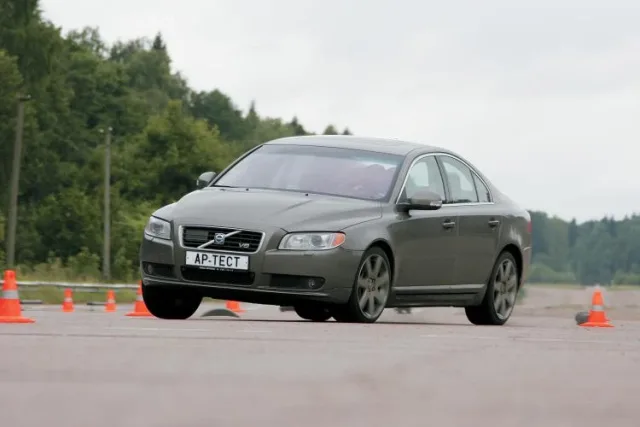
The Volvo's responses can be made quicker and more precise by switching the suspension to the "firm" Advanced mode
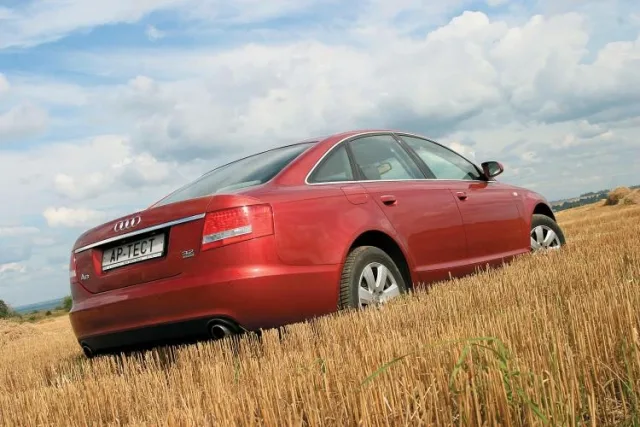
It's a sin to complain about the Audi's chassis, but the tendency toward understeer is perhaps too pronounced. Irregularities, especially at speed, cause the car to "float" on the road, vibrations and even jolts reach the steering wheel, it starts to twitch, and feedback deteriorates. In corners with poor asphalt, diagonal rocking sometimes occurs, reducing response precision.
 |  |  |
| Where have we seen similar dials before? Wasn't it in a Mercedes? | You can start the engine with the Start/Stop button without inserting the key transponder into the slot | Elegant shapes are refined by a successful color scheme. But the "wooden" steering wheel (for an extra charge) we categorically disliked |
 |  | |
| The buttons are a bit small, but the "little man" icon helps distribute airflows in the desired way | Next to the selector are buttons for changing shock absorber modes |
The Lexus is especially good at speed: it barely notices irregularities, and the driver feels the "zero" position of the steering wheel perfectly. But when driving along a gentle arc, there isn't enough feedback. And tight bends are generally contraindicated: the car shows an increased tendency to oversteer, and the non-defeatable stability control only kicks in after the driver has already started correcting the trajectory with the steering wheel.
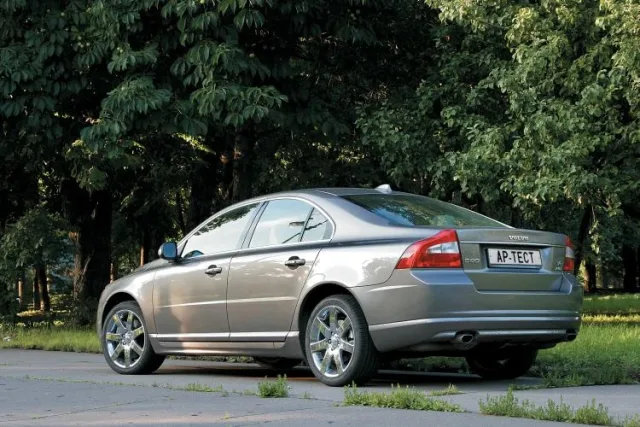
The new Volvo S80 is quite capable of delivering driving pleasure! Moreover, the power steering effectiveness can be adjusted right from the driver's seat. In the city, it's better to make the steering "lighter," and on the highway — a bit "tighter." Furthermore, you can also change the suspension firmness — three modes to choose from. It's a pity that even in the softest Comfort mode, irregularities cause the steering wheel to twitch, making the car sometimes deviate quite sharply from its course and reducing response precision during lane changes. Unlike the Mercedes and Honda, you don't want to drive faster than 160 km/h. As a result, in the "Handling" category, the Volvo ends up on the same step as... Believe it or not, the BMW!
 | ||
| On the left of the steering wheel are buttons for the "radar" cruise control settings, on the right — audio control | The parking brake on the Volvo, like on the Audi, is electrically operated | |
 |  |  |
| The Volvo's glovebox is a bit small | The trunk is smaller than the Germans', and the opening is narrower | The seats are not the most comfortable |
We are not going to dispute BMW's reputation as a driver's car. However, we see a problem in that engineers from Bavaria fine-tune the chassis with roads like those in their homeland in mind. And on our far-from-ideal surfaces, the precise front suspension geometry begins to cause deviations from the course: you can't relax either on a straight or in a corner. I won't argue that if we had stayed on a circuit track, BMW would likely have posted the best lap time. But in real conditions, on ordinary roads, the Bavarian sedan forces the driver to concentrate far more than a Mercedes or Audi, where the driver feels calmer. And if you add ride smoothness to that, the picture becomes quite clear.
And then it becomes clear that there is simply no equal to Mercedes. Here it is, the benchmark of how to tune a suspension for our realities! And here's what's interesting: having driven thousands of kilometers on both Bavarian and Swabian roads, we never noticed any serious difference in the condition of the asphalt! But the fact remains: the Mercedes suspension excellently handles small surface imperfections and perfectly dampens body sway — whether you're going 50, 150, or even 200 km/h. And no matter how banal the phrase "solid car" may seem, it best describes the feeling from this sedan. Moreover, its cabin is the quietest.
Honda and Lexus came closest to Mercedes in comfort. Honda pleases with its smoothness: both in the city and at speed, it seems to float over the asphalt, ignoring small joints and only gently rocking on large waves. Lexus, however, is let down by its low-profile tires (245/40 R18) — the car handles small bumps somewhat harshly. That said, in terms of noise insulation, Lexus is in no way inferior to Mercedes itself — silence reigns inside. And when pulling away, this silence is downright baffling: the gasoline engine rests at that moment, while the electric motor works absolutely silently.
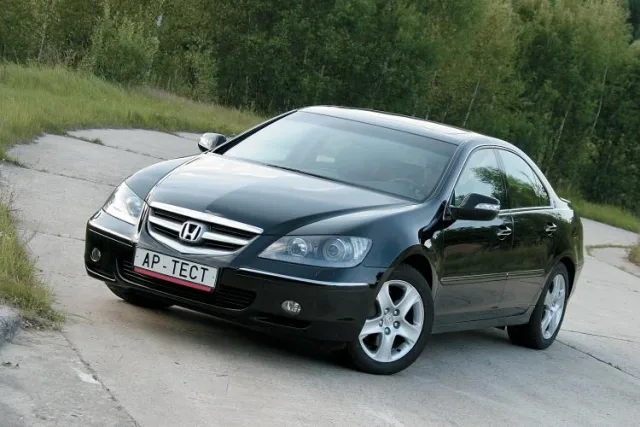
The Audi A6 is average in ride smoothness, but its somewhat noisy direct-injection engine forces us to lower its score for acoustic comfort.
Closing out our "comfort rating" are BMW and Volvo. BMW is let down by its stiff suspension, and Volvo by an engine that is too loud for its class. The driver might appreciate this aggressive growl, but passengers certainly don't. And Volvo's suspension left mixed impressions: on smooth asphalt it's fine, but hit a pothole — and unpleasant vibrations ripple through the body.
 |  |
| The blue instrument lighting in the Honda looks great, although for a sedan of this class it's perhaps a bit extravagant | In terms of trim material quality, the Honda cabin is in no way inferior to its German competitors |
 |  |
| The Honda can determine coordinates, but a DVD with an electronic map of Russia doesn't yet exist for it | The Japanese interface is no less confusing than BMW's iDrive |
So, who is the best? The best is Mercedes. Simply the best. Yes, it's quite possible that had we conducted this test in winter, when all the design features and all-wheel-drive settings would have fully manifested, the balance of power in the "Handling" discipline might have changed. But even if something had changed in the "overall standings," only the gap from the pursuers would have changed. A perfectly balanced, benchmark E-class car. And if it's expensive — well, it not only looks but also drives its money's worth! Take a ride — and you'll immediately understand. And if you don't have enough money or simply feel sorry for it, you can safely join those who claim that nearly a third of Mercedes' price is a markup for the three-pointed star.
 |  |  |
| In corners, the Honda holds better than the others and shows neutral handling — a credit to the "smart" SH-AWD all-wheel-drive transmission | The glovebox has an extra shelf for the owner's manual | The trunk has an uneven floor and walls |
 |  | |
| The seat is soft, but in corners it holds well | Between the seats is a two-flap box-armrest |
Following the leader are Audi and BMW. And what distinguishes these two brands both in character and in details, our readers already know well.
Closest to the German trio, including visually, is the Volvo S80. Although it is precisely the desire to be closer to this trio that led to the Volvo S80 losing some of its distinctiveness. At least there's no question of losing recognizability.
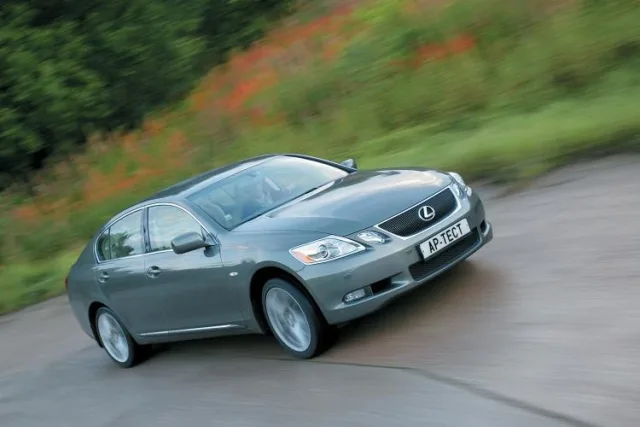
The Honda Legend, perhaps even more than the BMW 5 Series, is tailored to the driver: excellent handling and stability here coexist with the most uncomfortable rear seats. It's a matter of priorities, although in our opinion, passenger comfort should have been given a bit more attention — after all, this is an E-class sedan!
 |  |  |
| The Lexus GS cabin: without frills or a bright unifying idea, but material quality is top-notch | The backrest has a limited adjustment range | Rear passengers may complain about the low ceiling |
 | ||
| The power battery "ate" almost half of the trunk | Instead of a tachometer — a wattmeter: when the needle goes "into the minus," the power battery is charging | The screen shows a minute-by-minute fuel consumption diagram and blue "bonuses" for energy recuperation |
The hybrid Lexus also doesn't shine in passenger comfort. But this is, if you will, the most intelligent car. A car for those who save electricity and gasoline not because they lack money. And it shuts off the engine in traffic jams not because it fears not reaching a gas station. This is a car for those who enjoy the awareness that they, albeit just a little, are pushing back the energy and environmental collapse. And at the same time, it doesn't cause any noticeable damage to their quality of life. If our scoring system had categories like "fuel efficiency," "design progressiveness," or "environmental friendliness," the Lexus GS 450 Hybrid would be among the leaders. So to those who choose the hybrid Lexus — our special, ecological respect.
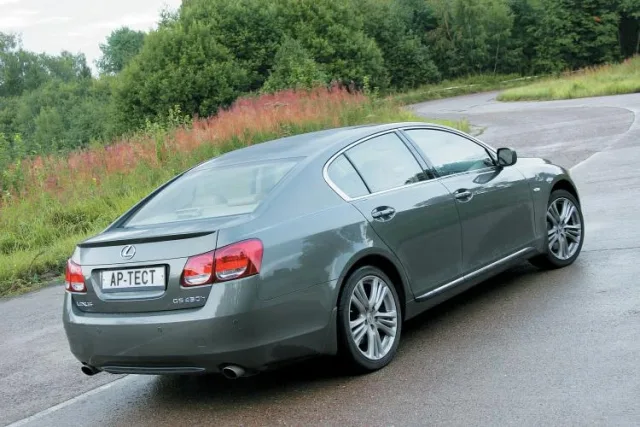
And the goals? The goals remained the same — Mercedes, BMW, and Audi. And as we've seen, it's not just about loud, well-known names. The others have to look for new means.
"Moose Test"
Tests simulating avoidance of a suddenly appearing obstacle are conducted in two stages. First, five drivers who have already familiarized themselves with the cars in normal driving modes attempt to "avoid the moose" on the first and only try at 65 km/h. Then an expert, in a series of runs, determines the maximum speed for performing the maneuver. All runs are conducted with stability control systems enabled.

During the "moose avoidance" maneuver in the Audi, two out of five drivers failed to avoid an accident. Insufficient steering feedback with a sharp drop in sensitivity hindered the maneuver, and poor directional stability caused such skids that the stability control system activated alarmingly abruptly. The tester, seeking the maneuver's limit speed, also had a hard time. The high tendency to skid forced ESP to work very aggressively, preventing the car from being kept on the desired path. A "step" in steering effort when quickly turning the wheel also interfered. Result: the lowest limit speed — 74.9 km/h.
 The situation repeated for Honda: both drivers failed to dodge the "moose." The reason was low steering sensitivity: during a sharp maneuver, there simply wasn't enough time to turn the wheel to the required angle. Although the steering was known for its informativeness, it didn't save the day. However, the run itself was quite fast — 77.6 km/h. The stability system actively fought skids, but unlike the Audi, it didn't interfere with the trajectory. Only at the very limit, when slides became quite deep, did the electronics prevent the tester from keeping the car in the corridor.
The BMW proved very reliable: all five drivers completed the task on the first attempt. Steering sensitivity dropped slightly during sharp movements, but reactions were still sufficient to correct the trajectory in time. At maximum speed, the chassis worked flawlessly: the car obeyed commands without the slightest hint of sliding, and only in the most extreme mode did skids appear, which DSC extinguished without problems. Result — an impressive 78.4 km/h.
The Lexus in normal driving pleased with excellent steering feedback, but in an emergency situation, when sharp wheel turns were needed, it felt "empty." Two drivers momentarily lost control due to this and made mistakes. The tester enjoyed "rail-like" precision in his runs, but only until the car began to slide noticeably. Then an aggressive stability system intervened, literally pulling the car off course. Result — a modest 75.7 km/h.
The Mercedes once again proved its safety: none of the five drivers hit the "moose." Reactions remained precise and predictable even in an emergency. The stability reserve was excellent: the car avoided the obstacle as if on rails.
It was here that the tester achieved the best result — 79.7 km/h. ESP gently but confidently corrected skids without interfering with maintaining the desired trajectory. True, at the limit, the steering became "viscous," effort increased, preventing faster wheel turns to extract even more.
The Volvo wasn't clear to everyone: four out of five drivers handled the emergency situation. The car wasn't as transparent as the Mercedes, but overall it was docile and predictable.
A high limit speed wasn't achieved in the Volvo. Noticeable body rolls and deep skids interfered — the suspension worked in Comfort mode, and the stability system, in combating slides, pulled the car off trajectory. Maximum — 75.5 km/h.
| Maximum speed in the "moose test," km/h | |
| Car | Speed |
| Audi A6 3.2 quattro | 74.9 |
| BMW 530Xi | 78.4 |
| Honda Legend | 77.6 |
| Lexus GS 450h | 75.7 |
| Mercedes E 350 4Matic | 79.7 |
| Volvo S80 4.4 AWD | 75.5 |
| "Moose test" on the first attempt at 65 km/h* | |
| Car | Maneuver completed |
| Audi A6 3.2 quattro | 3 out of 5 drivers |
| BMW 530Xi | 5 out of 5 drivers |
| Honda Legend | 3 out of 5 drivers |
| Lexus GS 450h | 3 out of 5 drivers |
| Mercedes E 350 4Matic | 5 out of 5 drivers |
| Volvo S80 4.4 AWD | 4 out of 5 drivers |
| * Five drivers participated in the tests | |
Boss's Voice
 Ivan Klenov, whom we asked to evaluate the cars from a rear passenger's perspective, is exactly what they call the "target audience." He is currently choosing an E-class car himself, so there was no need to persuade him to participate in the test or pay a fee. Here's what he wrote.
Why the E-class? Because such a car is equally good whether you're being driven by a chauffeur or sitting behind the wheel yourself. In both cases, you don't fear being misunderstood.
I approach the Honda. The unusual headlights, resembling laser "blasters" from childhood sci-fi films, immediately catch the eye. Compared to the previous model, the car seems more compact, making it look less "dignified" and more "personal."
Sitting in the back is surprisingly comfortable: the door opens almost perpendicular to the body. But if a person about 190 cm tall sits in front, there's no knee room left behind them.
I tried for a long time to place my arm on the armrest and finally gave up: the door handle is positioned so that you either hold onto it or press against the joint between the door and the seat back. Relaxation won't happen. Moreover, the handles are made of cheap plastic.
 |  |
| Honda: too-low ceiling creates a feeling of oppression | Lexus: you watch the "energy" cartoon... And it seems you're at the energy helm of all Russia |
 |  |
| Volvo: everything flows inside... Light interior tones seem to ease breathing | Mercedes: the first thing that catches the eye and pleases is the modern climate control unit |
The seat initially pleased me, but soon I began to fidget, seeking a comfortable position. The rear tunnel is quite high: to move from one seat to another, giving way to a third passenger, you'd have to get out of the car.
The ceiling presses down — a feeling of crampedness and oppression.
On the move, the Honda is solid but somewhat noisy.
To turn on the reading lamp, you either have to twist your shoulder (and I'm no longer twenty), or turn your whole body back. Inconvenient.
And when a Toyota Camry stopped next to me at a traffic light, I felt uneasy: the Camry has more "executive" chic.
 |  |
| Audi: rear seats upholstered in Alcantara, and that's great | BMW: from the passenger seat, it's amusing to watch the iDrive system display |
It seems the Honda is for those who prefer to be behind the wheel themselves. As a business sedan, it doesn't attract me.
I get into the Lexus and bump my forehead on the roof on the way. That's the price of coupe-like design! But inside, though cramped, it's cozy, like in a "closed" space.
The Lexus is a very quiet car. And when only the electric motor works at the start from a traffic light, the silence is such that you can hear the driver's stomach growling — again, they didn't let him have lunch!
The rear "block" of climate control is essentially just a roller for adjusting airflow and regular vents. Nothing complicated.
But the main thing — I felt like Chubais! You look at the display showing the "energy" cartoon: streams run from the engine to the battery, then from the motor to the wheels. And it seems you're at the energy helm of the whole country. To this region — we'll cut off power for debts, to this one — we'll add capacity, and about this one — a meeting tomorrow, connect me with the governor!
Now the Volvo S80. It's actually a good car — it's become fast, light, and airy. In short, liposuction did it good.
Getting in is comfortable and safe, though the door doesn't open "perpendicularly." Inside, there are smooth lines everywhere. The front panel resembles a beautiful Baltic dune: not a single sharp break or joint.
The Volvo's front seats look sporty from behind, with a high contoured backrest. But this same contour made the pockets in the backrests inconvenient. However, from the rear seat, you can control the audio system yourself without begging the driver to turn off his silly chanson.
I wanted to grumble that the rear sunshade rises manually, but I remembered: this isn't an executive sedan. In the Mercedes, for example, there are no sunshades at all — they need to be ordered separately. And the Volvo also has a power outlet for charging, say, a phone or laptop.
On the Volvo's rear sofa, you sit noticeably lower than in most competitors, but there's plenty of space: lots of air above your head, and the light interior trim visually adds space and gives a feeling of lightness. The only thing to nitpick is the somewhat short seat cushion: your legs press into the floor with your heels, and after half an hour they start to go numb.
The engine delights with its power, but at the same time constantly reminds of itself with a growl. Why such persistence?
And one more request: remove those wheels with garish shine from this magnificent car! The Volvo S80 is not the car that hip-hop lovers draped in gold chains will be chasing!
Dreaming of a new Mercedes is always pleasant — regardless of whether you have had previous models of this brand in your life.
Settling into the rear seat here is comfortable. Yes, the door opening angle is not the largest, and the roof does not impress with height, but overall the seating process is the most thoughtful and comfortable.
The modern climate control unit immediately catches the eye and pleases. The door card is traditionally beautiful: soft leather upholstery, a comfortable armrest, and a very stylish window switch block with seat heating. The seat belt design also pleased — it comes out not from the backrest but from the rear pillar, so its adjustment range is noticeably wider. And those who design Honda interiors should take a look at the Mercedes interior light: here you can even adjust the intensity of the soft lighting!
The suspension here is perhaps the most comfortable in this test. Noise insulation is also top-notch, and the engine is audible just enough not to forget it is running.
Among the drawbacks, I note the weak lateral support of the rear seats: from time to time you have to fidget to find support. And another detail. Due to the relatively low line of the front seats, the rear passenger can clearly see the front part of the cabin and involuntarily begins to feel like a co-driver, although there is a driver for that.
But the rear seats of the Audi are upholstered in Alcantara! I liked that.
Getting into the Audi is just as convenient as into the Mercedes, but the pocket on the back of the front seat disappointed. This is not a pocket but some kind of granny's string bag — all that's missing is potatoes in it!
There are sun blinds in the doors, but to unfold and secure them requires some skill.
The suspension is comfortable, but sometimes the car noticeably rocks. I think people with a weak vestibular system might have their stomach contents begging to come out.
Talking about the BMW 'five' while sitting in the back row is a bit awkward. And if someone from Autoreview colleagues is at the wheel, it is simply unbearable to be there! Every detail of the interior seems to scream: don't look around — look forward!
The rear lighting is as shabby as on the 'seven'. But there are separate blinds for the rear doors — separately for the main window and for the 'quarter window'. That is convenient.
The central armrest turned out well: it is massive, with shelves for small items and elegantly hidden cup holders, and also serves as an excellent thigh support.
However, the door upholstery looks as if parts of different Lego sets were assembled by an unskilled child's hand.
Getting into the cabin is not as handy as into the Mercedes or Audi — the door opens to a smaller angle, but sitting is comfortable. Only the somewhat stiff suspension disappoints.
From the passenger seat, it is curious to watch the iDrive system screen: it is deeply recessed into the front panel and hardly glares even in bright sun.
I would gladly admire the 'five' from the window of my office — its silhouette, reminiscent of a pagoda, is still good and unusual. But after finishing the workday, I would each time be tormented by doubts: shouldn't I send the driver home and take the wheel myself? I would even drop him off at the metro…
But is that what business-class sedans are bought for? And if not, then the result is this. The undisputed leader is Mercedes. Then in descending order: Volvo, Audi, Lexus, BMW, and Honda.
What are the prices?
Audi A6 quattro in the base trim is a 2.4 engine (177 hp) and a six-speed manual for $52,609. Standard equipment includes six airbags, stability control, climate control, power-adjustable front seats, and MMI Plus multimedia. The all-wheel-drive 'six' with a 3.2-liter engine (255 hp) is priced at $67,157, and this price includes leather interior and bi-xenon. The version with a three-liter turbodiesel (225 hp) is similarly equipped — from $71,543. For the Tiptronic automatic for both engines, an additional $2,124 is required. The modification with a V8 4.2 FSI (350 hp) costs $96,220, and the flagship Audi S6 with a 420-horsepower engine — $137,180.
For those who do not need all-wheel drive, front-wheel-drive versions with gasoline engines are offered. Audi A6 2.0 TFSI (170 hp) — $49,402. The version with a 2.4 engine is only $400 more, and the 3.2 FSI modification — $64,325. For all three versions, the Multitronic CVT is available (plus $2,120). Delivery time is no more than three months.
Warranty — 2 years without mileage limit. Audi is sold by 30 dealers in 22 Russian cities.
BMW 5 Series with all-wheel drive includes the BMW 525Xi sedans (2.5 L, 218 hp) from $69,150 and BMW 530Xi (3.0 L, 258 hp) from $93,270. Equipment is generous: the Business trim (only for BMW 525Xi) includes the Steptronic automatic, six airbags, climate control, stability control, power-adjustable front seats, leather, and bi-xenon. The Luxury version (standard for BMW 530Xi) additionally gets side airbags for rear passengers, heated rear seats, TV, CD changer, and sunroof. For navigation, BMW 530Xi buyers will pay an extra $4,880.
Rear-wheel-drive 'fives' are noticeably more numerous. The entry-level is the BMW 520d with a turbodiesel (2.0 L, 163 hp) for $51,190. The six-cylinder turbodiesel (3.0 L, 218 hp) is $11,040 more expensive. The BMW 525i in Business trim — $63,250, similarly equipped BMW 530i — $69,030. The 'five' with an eight-cylinder 306-horsepower unit (4.0 L) is sold in Luxury trim for $100,720. The luxurious BMW 550i (V8, 4.8 L, 367 hp) costs from $113,420. Waiting for the car is about three months. The lineup is capped by the extreme BMW M5 with a V10 engine (507 hp) — $158,840.
Warranty — 2 years without mileage limit. BMW is sold by 37 dealers in 26 Russian cities.
Honda Legend is available only in one trim — with a 295-horsepower V6 3.5-liter engine, five-speed automatic, and SH-AWD all-wheel drive. Equipment is rich: leather, power-adjustable front seats, DVD audio system, climate control, eight airbags, stability control, xenon. Price — $69,000. Sales started on September 1, but 'live' cars will appear only at the end of October.
Warranty — 3 years or 100,000 km. Honda is sold by 24 dealers in 14 Russian cities.
Lexus GS 450h with a hybrid system of total power 345 hp exists only in one specification: leather interior, front seats with power adjustment and heating, stability control, eight airbags, xenon, DVD changer, Mark Levinson audio system, and climate control. Price — $78,500. There are also traditional gasoline modifications. Lexus GS 300 (3.0 L, 249 hp) in Premium trim — $65,900. The same car in Executive trim (without Mark Levinson and wooden inserts on the steering wheel) is $2,700 cheaper. The flagship — Lexus GS 430 Premium (4.3 L, 283 hp) for $80,600. The order will be delivered in two months, with the exception of white and red cars: the queue for them has stretched to six months.
Warranty — 3 years or 100,000 km. Lexus is sold by 7 dealers in 4 Russian cities.
The updated Mercedes-Benz E-Class with 4Matic all-wheel drive is available with three engines and only with a five-speed automatic. The entry-level version is the E280 4Matic (3.0 L, 231 hp) from $71,720. It is advantageous to take a car of the so-called special series in a fixed configuration — $79,760. It includes leather, heated all seats (front with power adjustment), bi-xenon, stability control, climate control, and six airbags. The same car but built to order will cost noticeably more. Mercedes-Benz E 350 4Matic (3.5 L, 272 hp) — from $78,870. A similar car of the 'special series' with the COMAND multimedia system — $91,250. Prices for the all-wheel-drive E 500 4Matic (5.5 L, 388 hp) start at $103,240. The most affordable rear-wheel-drive Mercedes E 200 Kompressor (1.8 L, 184 hp) with a six-speed manual can be bought for $55,900. Mercedes-Benz E 280 with the 7G-Tronic automatic — $64,190, and in fixed configuration — $71,340. Modifications E 350 and E 500 cost from $76,320 and $99,930 respectively. At the top of the range is the Mercedes-Benz E63 AMG with a 514-horsepower 6.2-liter engine: $154,300. All three versions are equipped with seven-speed automatics. Manufacturing time to order is about two months.
Warranty — 2 years without mileage limit. Mercedes-Benz is sold by 36 dealers in 27 Russian cities.
The all-wheel-drive Volvo S80 3.2 AWD sedan, equipped with a 238-horsepower six-cylinder engine and a six-speed automatic transmission, is sold for $57,900 — a price noticeably lower than competitors. Standard equipment includes six airbags and heated front seats, with the driver's seat having electric adjustments. If you pay extra up to $62,200, the car will get bi-xenon headlights, heated rear bench, power-adjustable passenger seat, leather upholstery, and an audio system with CD changer. The flagship version S80 4.4 AWD with a 315-horsepower V8 costs $74,900 in base. The front-wheel-drive modification S80 3.2 is available from $54,900, and the cheapest — S80 2.5T with a five-cylinder 200-horsepower turbo engine — is priced at $45,900. You will have to wait for your car from two to three months.
The car is covered by a warranty for two years or 100,000 kilometers. The Volvo dealer network in Russia has 35 points in 30 cities.

| Equipment of the cars participating in the test | ||||||
| Make | Audi | BMW | Honda | Lexus | Mercedes | Volvo |
| Model | A6 3.2 FSI quattro | 530Xi | Legend | GS 450h | E 350 4Matic | S80 AWD |
| Price of base version with automatic transmission, $ | 69281 | 93270 | 69000 | 78500 | 78870 | 74900 |
| Front airbags | + | + | + | + | + | + |
| Side airbags front/rear | +/– | +/+ | +/– | +/+ | +/– | +/– |
| Inflatable curtains | + | + | + | + | + | + |
| ABS | + | + | + | + | + | + |
| Dynamic stability control | + | + | + | + | + | + |
| Adjustable suspension | – | – | – | + | – | + |
| Automatic transmission | + | + | + | + | + | + |
| All-wheel drive | + | + | + | – | + | + |
| Adjustable steering column | O* | +* | +* | +* | +* | + |
| Multifunction steering wheel | O | + | + | + | O | + |
| Shift paddles on steering wheel | + | – | + | – | – | – |
| Heated steering wheel | – | + | – | – | O | – |
| Leather/wood steering wheel trim | +/– | +/– | +/– | +/+ | +/– | +/+ |
| Central locking with keyless entry | + | + | + | + | + | + |
| Power and heated exterior mirrors | + | + | + | + | + | + |
| Power folding mirrors | – | + | + | + | – | +** |
| Automatic power windows | + | + | + | + | + | + |
| Power front seats | + | + | + | + | + | + |
| Memory for driver/passenger seat | –/– | +/+ | +/– | +/+ | O/– | +/– |
| Adjustable driver's side bolsters | – | + | – | – | – | – |
| Heated front/rear seats | O/O | +/+ | +/– | +/– | O/O | +/+ |
| Ventilated front seats | – | – | – | + | – | O |
| Rear sunshade | +* | +* | +* | +* | – | O |
| Rear side sunshades | + | + | + | – | – | – |
| Trunk lid closer | – | – | – | + | – | – |
| Rain sensor | + | + | + | + | + | + |
| Light sensor | + | + | + | + | + | – |
| Tire pressure sensor | – | + | – | + | O | – |
| Auto-dimming rearview mirror | + | + | + | + | O | + |
| Rearview camera | – | – | + | – | – | – |
| Head-up display | – | + | – | – | – | – |
| Dual-zone/four-zone climate control | +/– | +/– | +/– | +/– | +/O | +/– |
| Folding rear seat | + | + | – | – | – | + |
| Pass-through for long items | O | + | + | – | – | + |
| Cruise control | – | + | + | + | + | + |
| Power sunroof | – | + | + | – | O | O |
| CD stereo | O | + | + | +*** | O | O |
| CD changer | O | + | + | + | O | O |
| TV tuner/DVD | –/– | +/+ | –/+ | –/+ | –/– | –/– |
| Navigation system | – | O | – | – | – | – |
| Built-in phone | – | – | – | + | + | + |
| Leather/wood interior trim | +/O | +/+ | +/+ | +/+ | +/O | O/O |
| Fog lights | + | + | + | + | + | + |
| Xenon low/high beam | +/+ | +/+ | +/– | +/– | +/– | O/O |
| Alloy wheels | + | + | + | + | + | O |
| Full-size spare wheel | + | – | – | – | – | – |
| Parking sensors front/rear | +/+ | +/+ | –/– | +/+ | O/O | O/O |
| Metallic paint | + | + | + | + | + | O |
| Headlight washers | + | + | + | + | O | + |
| Tire pressure monitoring | – | + | – | + | – | – |
| Trip computer | + | + | + | + | + | + |
| Metal engine underbody protection | – | – | – | – | + | – |
| Folding rear headrests | – | – | + | – | + | – |
| Remote trunk release | O | + | + | + | + | + |
| Remote fuel filler door release | – | – | + | + | – | + |
| Engine pre-heater | – | – | – | – | – | O |
| Price of tested car, $ | 73928 | 98150 | 69000 | 78500 | 91243 | 94800 |
| * Power | ||||||
| ** Automatically after ignition off | ||||||
| *** Disc and cassette | ||||||
| (–) Not available in base version | ||||||
| (+) Included in base version | ||||||
| (O) Options installed on test cars | ||||||

Numbers Don't Lie
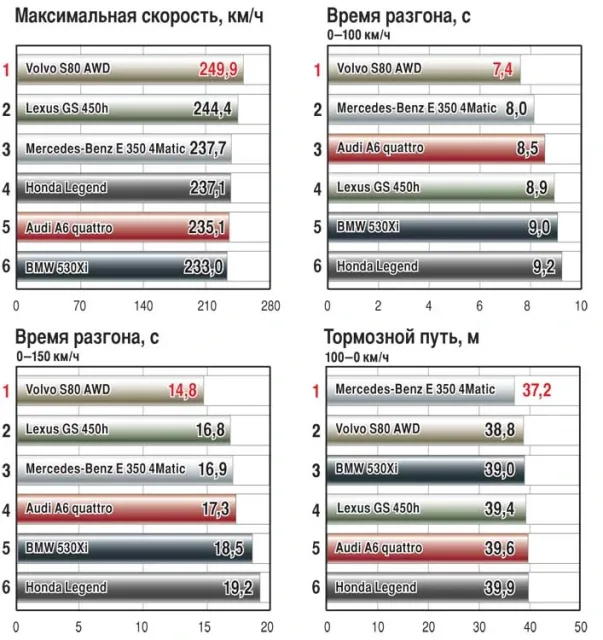
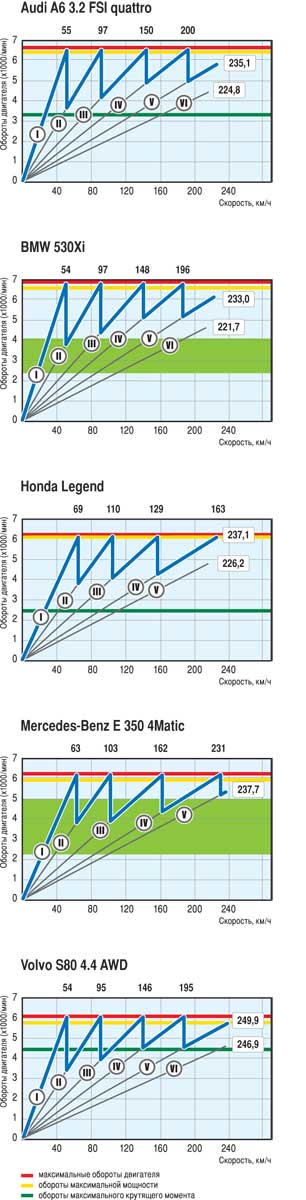
Measurements at the test site revealed an interesting picture. Despite the Volvo S80 having the most powerful engine in the test (4.4 liters, 315 hp), its results in acceleration to 100 km/h (7.4 seconds) and top speed (249.9 km/h) are truly impressive. But the Audi A6 with its 3.2-liter engine (255 hp) accelerates to 100 km/h in 8.5 seconds, which is noticeably more modest. The Honda Legend, despite its proprietary SH-AWD, didn't prove to be the fastest: 9.2 seconds to 100 km/h. The Lexus GS 450h, a hybrid, unexpectedly turned out to be very quick: 8.9 seconds to 100 km/h, and over 400 meters it loses only to the Volvo. Especially indicative are the elasticity measurements. On the 60-100 km/h run in "D" mode, the Volvo again was the best (4.4 seconds), while the Mercedes (4.8 seconds) and Lexus (4.9 seconds) are almost as good. But at 80-120 km/h, the Mercedes E 350 unexpectedly loses: 7.4 seconds versus 5.3 for the Volvo and 5.8 for the Lexus. This suggests that the Mercedes doesn't have the best gearbox tuning. Braking also put everyone in their place. From 100 km/h, the best result is the Mercedes — 37.2 meters, and the worst is the Honda — 39.9 meters. At 150 km/h, the picture repeats: the Mercedes stops in 86.6 meters, while the Honda takes 93.3 meters. During emergency braking from 200 km/h, the Mercedes is again ahead (155.6 meters), and the Honda brings up the rear with 173.8 meters. The Mercedes also has the highest deceleration — 10.4 m/s².Driving Impressions
Right behind the wheel of the Mercedes, you understand why it scored the most points in the expert assessment. Its suspension is a model of ride smoothness. The car swallows bumps as if they don't exist, while maintaining excellent directional stability. Handling is predictable but not the sharpest. In corners, it leans a bit, but that doesn't stop it from confidently holding the line. The V6 3.5 engine (272 hp) runs quietly and smoothly, but its character is more calm than sporty.
The Audi A6 feels almost as comfortable as the Mercedes, but its suspension is slightly firmer. On small joints and cracks, it transmits more vibrations to the body. However, the Audi's handling is more neutral and precise. The quattro all-wheel drive adds confidence in corners, but the steering isn't exceptionally communicative. Acceleration to 100 km/h in 8.5 seconds is decent, but nothing more.
The BMW 530Xi is a car for those who love to drive. It has the sharpest and most informative steering in the test. The car instantly responds to the driver's inputs, and the rear-wheel-drive base with a front axle that engages makes it driver-focused. However, you pay for this with comfort: the BMW's suspension is the stiffest in the test. On large bumps, it noticeably shakes, and on dirt roads, the car becomes overly nervous. Acceleration to 100 km/h in 9.0 seconds isn't a brilliant result for such a name, but the dynamics in motion are pleasing.
The Honda Legend is an interesting option. Its SH-AWD all-wheel-drive system truly works wonders, allowing the car to literally screw into corners. The Honda's handling is among the best in the test, if not the best. But there are downsides: the V6 3.5 engine (295 hp) runs with noticeable growling, and the cabin is a bit cramped for this class. The rear seats aren't as spacious as competitors', and the trunk is modest. As a result, the Honda scored the fewest points for interior comfort.
The Lexus GS 450h is a triumph of technology. The hybrid powertrain operates imperceptibly and very smoothly. In the city, it runs on electric power, and during hard acceleration, the gasoline V6 3.5 (296 hp) kicks in. Acceleration to 100 km/h in 8.9 seconds is decent, but nothing more. The main drawback of the Lexus is its trunk. Due to the batteries, it's tiny, which significantly reduces its practical value. In handling, the Lexus is decent, but not as precise as the BMW or Honda.
The Volvo S80 with its 4.4-liter V8 (315 hp) is a real monster in terms of dynamics. It accelerates to 100 km/h in 7.4 seconds, and its top speed is 249.9 km/h. But it feels heavy and sluggish to drive. The Volvo's suspension is one of the stiffest in the test, and the steering is not the most informative. However, inside it is very spacious, and the seats are among the most comfortable. But overall, the Volvo loses to its competitors due to a compromise chassis setup that provides neither outstanding comfort nor sharp handling.
Interior and ergonomics
The interiors of all six cars are top-notch, but there are nuances. The Audi A6's interior is a benchmark of design and build quality, earning it a maximum of 90 points. The Mercedes E 350 is also excellent, but a bit conservative. The BMW 530Xi's interior is functional but lacks flair. The Honda Legend and Lexus GS 450h offer modern multimedia systems, but they are not always intuitive. The Volvo S80, on the other hand, is modest and laconic, though still high-quality.
In terms of ergonomics, Audi leads (160 points). Mercedes (155) and BMW (155) are also convenient, but there are minor complaints about button placement. Honda (155) and Volvo (150) are slightly behind. Lexus (150) scored the lowest due to the inconvenient placement of some controls.
Rear seats are an important criterion for this class. BMW (75 points) and Mercedes (75 points) have the best results. Audi (70) and Volvo (70) are slightly more modest. Honda (60) and Lexus (65) are frankly cramped for rear passengers. Trunks are roughly the same for all except the Lexus (30 points), which has about 50-55 points, but the Lexus's trunk is frankly small due to the hybrid system.
Expert verdict
In the end, by total points, the Mercedes-Benz E 350 4Matic wins with a score of 900 out of 1000. It showed the best balance between comfort, dynamics, and practicality. The Audi A6 (875 points) is an excellent car, but it falls slightly short of the Mercedes in terms of ride comfort. The BMW 530Xi (865 points) is the best for the driver, but its stiff suspension and modest comfort are not for everyone. The Volvo S80 (855 points) is dynamic but too compromise. The Honda Legend (845 points) is technically advanced but cramped and noisy. The Lexus GS 450h (835 points) is technological, but its trunk and rear seats are a serious drawback.
As for the readers' forecast, they preferred the BMW (28.19%), followed by the Lexus (21.72%) and Honda (17.99%). Audi (15.97%), Mercedes (9.00%), and Volvo (7.12%) received fewer votes. But, as the test showed, readers' opinions do not always coincide with expert assessments. The Mercedes, which readers placed second to last, turned out to be the best based on measurements.