Mazda MX-5: prices and specifications
3 generations Country of origin: Japan

Mazda MX-5: history of a legendary roadster
The Mazda MX-5 is a lightweight and compact roadster from the Japanese manufacturer. It appeared in the Mazda lineup at a time when most competitors had already left the market, ensuring high sales for the first generation. The car is also known as the Miata, and the abbreviation MX-5 stands for Mazda Experiment number 5.
The idea for this convertible came from British automotive journalist Bob Hall. He proposed to the company's head, Kenichi Yamamoto, to develop an inexpensive roadster in the spirit of British models from the 1970s. It took eight years from this proposal to the release of the finished car.
First generation (NA, 1989)
The debut of the first generation Mazda MX-5 (NA) took place in 1989 at the Chicago Auto Show. The car was offered with two types of roofs — fabric and all-metal. A distinctive feature of the exterior was the pop-up headlights. To reduce weight, the hood was made entirely of aluminum. In 1994, the model underwent a facelift and received a new, more powerful engine.
Second generation (NB, 1998)
The second generation roadster (NB) was officially introduced in 1998. It was based on the same platform, but dimensions were slightly reduced. Pop-up headlights gave way to fixed ones, and exterior features were borrowed from the third-generation RX-7 sports car. In 2001, the model received a facelift, and in 2004, a turbocharged version, the Mazdaspeed MX-5, appeared.
Third generation (NC, 2005)
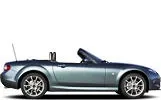
The third and currently last generation of the Mazda MX-5 (NC) saw the light in 2005. The car is built on a new platform and has increased body dimensions compared to the second generation. The model's style also changed, and after a facelift in 2008, it acquired more aggressive features. Another update to the exterior and technical content took place in 2012.
In Ukraine, the updated Mazda MX-5 (NC) has been available since autumn 2012. The model is sold only by unofficial dealers of the brand. The car is equipped with a 2.0-liter gasoline engine, which works in conjunction with a six-speed manual or automatic transmission. Drive — rear.