
Volvo V70. Air
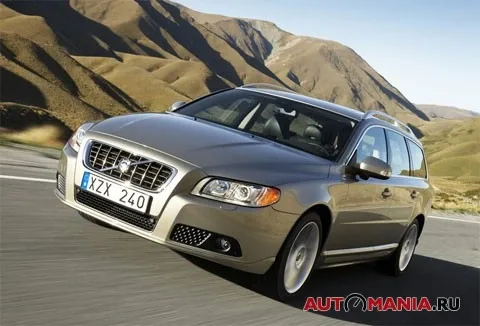
The Swedes are increasingly loudly declaring their claims to a place in the premium segment. Volvo's management already openly calls its cars representatives of the luxury class and periodically reports victories over such recognized giants as Audi, BMW and Mercedes-Benz. And all this is happening against the backdrop of persistent talk about the possible sale of the company to the Indian concern Tata. True, so far these rumors remain just rumors. But the fact remains: the "subsidiary" brand of Ford has learned to create truly high-quality cars. So high-quality that buyers increasingly think about whether it is worth overpaying for well-known brands. If I were faced with the choice of a full-size station wagon, I would certainly weigh all the pros and cons. And why? Because the new V70, on the one hand, costs noticeably less than the Audi A6 Avant or BMW fifth series in the Touring body, and on the other hand, is in no way inferior to them either in build quality or driving characteristics.
We have a cool attitude towards station wagons: they are perceived exclusively as a means of transporting crops from the dacha. However, global automakers have long reoriented such cars to completely different tasks - to driving pleasure and comfort. In short, when we say "active recreation", we mean "station wagon", and vice versa.
Opponents, of course, may object: what does Volvo have to do with it? And the point is that it is this company that today produces cars that, in my opinion, offer an ideal balance between price and quality, as well as between price and size. If you look at this segment impartially, it becomes clear: there are few truly strong players left on the market. Segment D, although it looks saturated, in reality is not. Take the Germans, for example - of them, perhaps only Opel is represented here. Undoubtedly, the Vectra Caravan is a worthy car, but already morally outdated. The French? Peugeot and Citroen are currently busy changing their model range, and we are unlikely to see the latter's products on our market. A similar fate, apparently, awaits the Renault Laguna station wagon. What remains? The pretentious and expensive Chrysler 300C or the 9-5 "barn" from Saab, which is barely breathing? Perhaps the only ones who can give the V70 real competition are the related Ford Mondeo and Mazda 6. By the way, judging by the noticeably increased dimensions, these cars are built on a modified Volvo S60 platform. True, manufacturers do not advertise such details and do not comment on rumors.
If these cars were similar in appearance, there would be no questions. But, probably, we are dealing with a well-thought-out marketing strategy. After all, despite close family ties, brands today are separated into different "rings", giving each maximum freedom of maneuver. Actually, the appearance of the new V70 indirectly confirms this. Stylistically, the car resembles its predecessor - this speaks of the brand's traditional continuity of generations. An elegant body, similar to an elongated drop, with a high "shoulder" line and a large glazing area. At the same time, as the manufacturer claims, the station wagon is now based not on the S60 platform, but on the chassis of the flagship S80 sedan. As a result, the car has grown in all directions, and along with the dimensions, the interior space has also increased. The cozy cabin, without any reservations, accommodates five. The range of adjustments for the front seats is still wide, and rear passengers have plenty of space at any position of the front row.
The Swedes worked hard on the design. In particular, they brought the design of the center console to a "corporate standard": from a familiar cockpit detail, it turned into a floating interior element, as on the related C30 or S40. In general, the architecture of the front panel is borrowed more from the S80 - at least, it cannot be denied solidity and strictness. This is confirmed by the instrument panel: two glowing dials, around which the other displays are grouped. At first glance, this original detail seems impractical, but the impression is deceptive. All key indicators are read easily and quickly. True, I honestly admit: it is still tedious to look for secondary information. Although, perhaps, it's a matter of habit.
By the way, drivers switching to the V70 from previous Volvos will have to unlearn some things. Firstly, the small naturally aspirated engines that were installed on cars of previous generations are no longer installed on the new model. Apparently, the designers decided to finally register the V70 in the business class. The minimum power unit available for this car is a five-cylinder, and it produces far from "childish" 200 horsepower. The next is a new 3.2-liter "six" with a capacity of 238 hp. (it can also be seen under the hood of the updated XC70). The gasoline line is completed by the good old inline turbo engine with the T6 index: with a volume of 3 liters, it produces an impressive 285 "horses". By the way, V70 buyers also have the opportunity to order a turbodiesel. But we will focus on the top version - it was this one that your correspondent tested.
To be honest, this engine did not bring anything new to our long-term acquaintance with Volvo. Excellent traction, excellent dynamics and smooth acceleration at medium speeds... The main thing is to get used to the turbo settings: at first it thinks a little, and then the car starts so that passengers are literally pressed into their seats. There are minimal complaints about the six-speed automatic transmission: only the pause on kickdown is alarming (the Bavarians got rid of this "disease" long ago)...
This version of the V70, by the way, is also interesting because it is equipped by default with the proprietary all-wheel drive system and can be equipped with the adaptive Four-C suspension inherited from the "older brother". The essence of the constant chassis control system is that the electronics itself monitors the quality of the surface and reconfigures the stiffness of the shock absorbers. In addition, the driver can choose one of three preset modes: Comfort, Sport and Advanced. Thanks to this, he is free to make the station wagon either tenacious and sporty, or imposing and maximally comfortable.
Otherwise, the new V70 is a complete copy of its predecessor: fast, convenient, spacious and reliable. Just the way fans and potential buyers want to see it. As for prestige, this concept is ephemeral here. Moreover, more eminent competitors bring their luxury analogues to us with great reluctance. The exception is perhaps Audi, but the prices for its cars are completely different.
Technical characteristics:
| Dimensions: | Volvo V70 |
| Length (mm) | 4823 |
| Width (mm) | 1861 |
| Height (mm) | 1547 |
| Wheelbase (mm) | 2816 |
| Ground clearance (mm) | 143 |
| Weight (kg) | 1632 |
| Trunk volume (l) | 575/1600 |
| Engine displacement (cm3) | 2521 |
| Max power (hp) | 200 at 4800 rpm |
| Max torque (Nm) | 300 at 1500—4500 rpm |
| Max speed | 230 |
| Acceleration 0-100 km/h (s) | 8.1 |
| Average fuel consumption (l) | 9.3 |
| Price (rub.) | From 1,154,600 |
Magazine "Autogid" February 15, 2008 No. 53
Source – AUTOMANIA.RU