
Volvo V50. Polsta
A few years ago, a station wagon driver in our country was perceived almost as an outcast — such a car was considered less driver-oriented than a hatchback and less prestigious than a sedan, and in the minds of most it was firmly associated with the image of a "six" stuffed with bags of potatoes and boards. However, over time, many car enthusiasts, having tasted the delights of such cars, radically changed their opinion. And automakers are not standing still: modern station wagons have long ceased to be just workhorses, having acquired a stylish appearance and a lively character. Even in the premium segment, their own heroes have appeared — take at least the Audi A6 Avant or the exotic Chrysler 300C Touring.
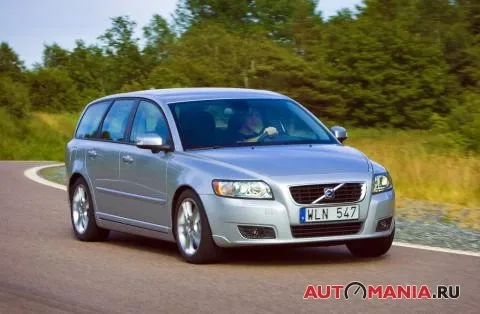
But there are also more affordable options — for example, the Volvo V50 station wagon, which occupies far from the last place in the Swedish lineup. The Scandinavians from the very beginning divide their models into sedans and station wagons: the former bear the letter "S", the latter — the proud "V", and also have an "extra" ten in the digital index. So the V50 is essentially the cargo brother of the S40 sedan and the recently appeared C30 hatchback. The new model differs from its relatives mainly in body shape. "Family" notes in the exterior are guessed immediately: expressive relief lines with a clearly defined "shoulder", a massive radiator grille with a branded badge, and a muscular front part with elegant headlights. The rear, however, refers not so much to the older "seventieth" series as to the flagship XC90 crossover, from which the V50 got brutal vertical lights. Some may not like this design, but one cannot deny: the car looks more solid than its classmates like the Opel Astra Caravan, VW Golf Variant, Saab 9-3, and the related Ford Focus II. At the same time, the "fifty" is not lost against the background of more expensive competitors from Audi, Mercedes-Benz, and BMW. By and large, Volvo occupies a niche between mass-market and premium, attracting buyers from both camps.
It is curious what the reaction of brand fans would be if this "floating" center console appeared in the Volvo interior in the mid-nineties. Conservatives would hardly appreciate it, but a decade later even they came to terms with the trends of fashion. Today, the interior of this station wagon is one of the most unusual in the class: ultra-modern Hi-Tech and solid solidity are successfully combined here. The pleasant-to-touch coarse-grained plastic of the front panel, a minimum of colorful "metal" trim — its lack is more than compensated by the same center console.
The ergonomics of the interior, as befits the heir to the legendary brand, are thought out impeccably. The front and rear seats are comfortable, with enough adjustments. The seats with an almost ideal anatomical profile are a separate topic: these "semi-buckets" instead of the usual headrests are equipped with the proprietary WHIPS system, which protects the neck and spine in a rear impact. In short, as in the company's more expensive models, V50 passengers travel both in comfort and under reliable protection. The only thing that can upset is the lack of space in the shoulders and elbows. But for a body of this size, this is inevitable.
Speaking of shortcomings, one cannot fail to mention the buttons on the center console — or rather, their number and size. The location of the keys can be remembered after a few days of use, but hitting the right one the first time is not an easy task: their concentration per unit area is too high. This is especially true of the climate control unit (the audio system buttons, fortunately, are duplicated on the steering wheel).
The trunk deserves a separate discussion. The cargo compartment for a station wagon of this size turned out to be very decent — both in volume and in ease of use. In the five-seat configuration, more than 400 liters of cargo easily fits in the compartment, and the wide opening and high fifth door allow loading bulky items. Another plus is the perfectly flat floor, which remains so even after folding the seats. The transformation is simple and logical: tip the cushion, lay the backrest into the niche — and the "chest" is ready. The volume grows to 1307 liters. If desired, the trunk can be supplemented with optional nets and fasteners, which significantly facilitate transportation.
Loading for this car is an important factor, because it is with it that the V50 reveals those qualities that we are used to expecting from "Volvo" cars. An empty station wagon, oddly enough, rides stiffly and nervously. It cannot be said that it "bucks" — the energy-intensive suspension dutifully swallows potholes and bumps, the steering is sharp and precise. But you expect more smoothness from the Swedes. Minimal rolls, obedience in maneuvers... The author of these lines even reminded the car of the C30 hatchback with its sporty habits. Apparently, the efforts of engineers to attract young people affected the entire family.
The settings of the engine and the standard 5-speed manual only confirm this guess. The 2-liter 145-horsepower "four" familiar from the Ford Focus pleases with its tractability in a wide range of revolutions. In short, there is no talk of "Volvo" leisureliness here. Fast, clear accelerations, excellent gearbox operation, good stability at speed — however, with an increase in pace, both acoustic and dynamic comfort decrease. And this despite the fact that the V50 essentially remained an ordinary "civilian" station wagon, created for transporting a family from point "A" to point "B". In the end, it is worth talking about the price. The base for the V50 is the well-known Ford 1.6-liter engine with a 5-speed gearbox. For an empty car, dealers ask almost 700 thousand rubles — about 26,000 dollars. The version with a 1.8-liter engine will cost 755 thousand. The car presented in this material costs at least 807 thousand rubles. At the same time, automatic transmission is not offered for these versions. "Automatic" and all-wheel drive are available only with 2.4 and 2.5-liter engines, but the prices there become noticeable for a family with an average income. As a result, the cost of the V50 can easily be brought to $40,000 and even $50,000, and, as practice shows, even such versions find their buyers.
Technical characteristics:
| Dimensions: | Volvo V50 |
| Length (mm) | 4514 |
| Width (mm) | 1770 |
| Height (mm) | 1452 |
| Wheelbase (mm) | 2640 |
| Weight (kg) | 1369 |
| Trunk volume (l) | 417/1307 |
| Engine displacement (cm3) | 1998 |
| Max power (hp) | 145 at 6000 rpm |
| Max torque (Nm) | 185 at 4500 rpm |
| Max speed (km/h) | 210 |
| Acceleration 0—100 km/h (s) | 9.6 |
| Average consumption (l) | 7.4 |
| Price ($) | 26,000—42,000 |
Source – AUTOMANIA.RU