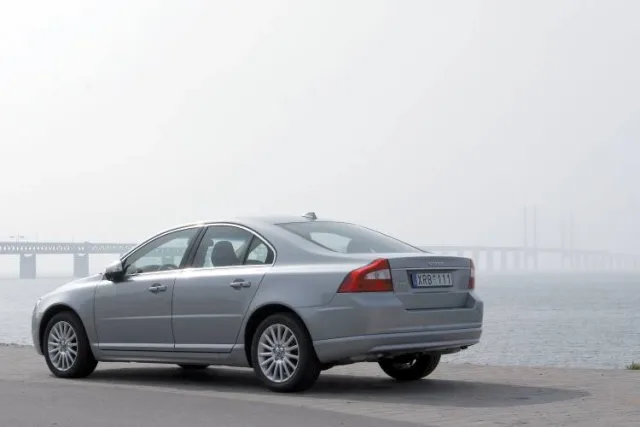
“Volvo-driver” is a curse for the Swedish brand. How many years have they been struggling in Gothenburg to shake off the label of manufacturers of safe but boring cars... And lately, they have been getting better and better at it!
Another proof is the new Volvo S80 sedan, which I drove on the roads of Sweden. And you know, it's really comfortable behind the wheel! It turned out that the second-generation S80 is not just “safety in double volume,” but also attractive design, fresh engines, different chassis settings...
True, I did provoke an accident in the S80.
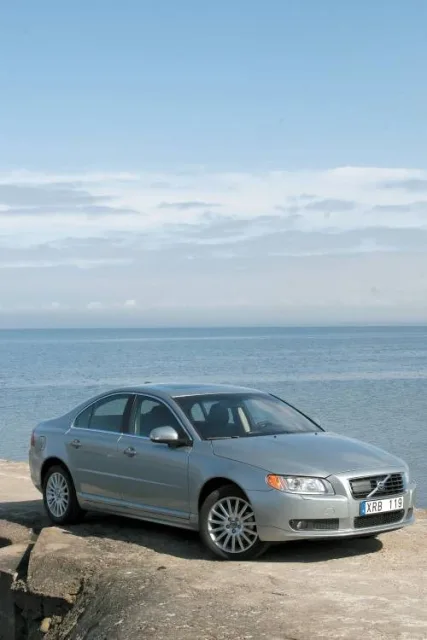
 The Swedes talk about the S80's design willingly and at length. Scandinavian style, purity of lines, imitation of nature...
The new “eighty” has indeed become more attractive and cohesive. At the same time, the car's length remained the same (only height increased by 34 mm and width by 27 mm), but the Swedes “cut off” the body corners — the headlights and rear lights now have a bevel of almost 45°. This is a well-known technique in automotive design — remember the Mitsubishi Galant of the nineties. But on the Volvo S80 it looks very natural.
Inside, there is also beauty and an impeccable combination of colors and materials. The “extra” scales have disappeared from the instrument panel — only the speedometer and tachometer remain. Each of them is made in the form of a ring around a liquid crystal display. Fuel level, on-board computer data, active cruise control settings — everything is displayed on these two screens. Beautiful and practical. But I've seen this somewhere before... Of course, in the Mercedes E-Class! Not surprising: the new chief designer of Volvo, Steve Mattin, previously worked at DaimlerChrysler.
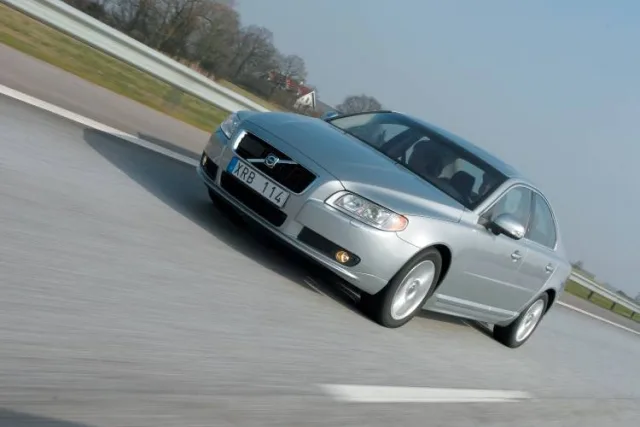
However, the Volvo interior has plenty of its own, “homegrown” ideas. Take, for example, the center console, which seems to float in the air — it first appeared on the Volvo S40. It looks great! But the buttons on it are too small — it's inconvenient to switch menu items of the on-board computer or fiddle with the stereo while driving.
It was because of these buttons that I crashed into a car.
Here's how it happened.
I'm driving the Volvo S80 on the test track. A Swedish instructor sits on the right, and another car is driving ahead of us.
— Do you want to see how the on-board computer menu works? — asks the Swede. — Say, we need to change the audio system settings...
And he points to the small buttons on the “floating” console.
 |  |
| On the center console — many small buttons | Optional — audio system with Dynaudio acoustics |
 | |
| Under the right spoke of the steering wheel, a joystick for controlling the “music” is hidden | Scandinavian design: light forms and clean lines |
I look down. And suddenly something howls in the cabin, red flashes in the instrument panel. I raise my eyes to the road — and the car ahead brakes sharply! I also press the pedal to the floor. But it's too late — about a meter was missing. And I crash into...
...a bag stuffed with foam rubber, shaped like a car!
This is how the Swedes demonstrate the operation of the Collision Warning (CW) system, which is installed on the new Volvo S80 for an additional cost. The principle is the same as in many Mercedes, Honda, or Toyota models: a radar under the false radiator grille monitors the distance to the car ahead and, when approaching dangerously, gives sound and light signals. Honda, for example, can brake on its own in such a situation, but Volvo decided not to give the electronics such authority — it only warns the driver. In a sense, this is protection against computer failures. Imagine if it suddenly gives a false alarm — and the car unexpectedly brakes sharply on the highway?
So all that the CW system does, “watching” with the radar for approaching danger, is to howl with a siren, flash a light, and slightly increase the pressure in the brake system to select the gap between the pads and discs.
Another interesting system, first used on the Volvo XC90 crossover, is the BLIS (Blind Spot Information System) cameras built into the rearview mirrors. They see objects in the “blind spots” and signal the driver with red LEDs near the mirrors. A useful thing — I was convinced of this already on ordinary Swedish roads.
 | | |
| Front seats are a bit soft. Rear headrests fold down by pressing a button on the center console | On the left of the steering wheel — keys for controlling active cruise control | Inside the scales — displays (on the left, the modes of radar cruise control are shown) |
The “skeleton” of the body is assembled from four grades of steel — in an accident, this ensures the best absorption of impact energy and maximum preservation of living space in the cabin. For minor impacts, deformable boxes made of “soft” steel, on which the front cross member of the body is attached, help reduce repair costs. The boxes crumple, while the side members (longitudinal power elements of the body) remain intact.
To mitigate the consequences of a rear impact, the WHIPS (Whiplash Protection System) system is used — the seat back at the attachment point is slightly pliable and shifts backward together with the headrest and the person's body, reducing peak acceleration. The side airbags on the S80 are now two-chamber: in the upper chamber, which protects the more “fragile” chest, the pressure is five times lower than in the lower one, which protects the hips
And the capabilities of the new engines under the hood of the S80 could only be partially assessed — large fines and local residents ready to report a neighbor at the first opportunity got in the way. As a result, I drove at the permitted 110 km/h — and sincerely sympathized with the Volvo engine builders. They, poor things, didn't sleep at night — they struggled with how to stuff an inline “six” (3.2 L, 238 hp) and a V-shaped “eight” from Yamaha (4.4 L, 315 hp) transversely into the engine compartment. In the end, they came up with it. And it turns out that all this is not needed by anyone! At least in Sweden, where even the old five-cylinder T5 engine with 210 hp is more than enough.
 | |
| Active cruise control maintains the distance to the car ahead: receiving a signal from the radar under the radiator grille, the electronics themselves control acceleration and braking. If the followed car disappears from the “radar screen,” the cruise control returns to the speed set by the driver | |
| BLIS system: cameras under the mirrors see objects in the “blind spot” and warn the driver of danger by flashing red LEDs | |
| Demonstration of the Collision Warning system: when dangerously approaching an object, a red light lights up in front of the driver's eyes and a loud signal sounds. The electronics only warn the driver of danger — he must press the brake pedal himself. A little late — and the Volvo S80 catches up with the dummy car. Good thing it's not real | |
And they had to rack their brains. If the V8 fit under the hood, albeit with difficulty, then the “six,” built on the basis of a block that was used 10 years ago on rear-wheel-drive Volvo 960, had to be thoroughly “shaken up.” The auxiliary equipment was moved to the flywheel and placed above the gearbox. The generator was hidden under the intake manifold. It is clear that with such a scheme, ordinary pulleys and a belt were not enough — they had to create a complex drive with a shaft inside a shaft. And to make the engine more economical and meet modern environmental standards, the engine builders installed a variable valve timing system and two-stage variable valve lift on the intake, like on Honda VTEC engines. At low speeds, low camshaft lobes work; at high speeds, when maximum output is needed, high lobes come into play. Surely this system was also made by Japanese engine builders — Yamaha recently became Volvo's partner in this area...
Getting behind the wheel of the Volvo S80 with the inline “six,” I, of course, did not limit myself to only low lobes — a couple of times I pressed the second gear to the cutoff, on which the car easily reaches a hundred. The dynamics are pleasing, the six-speed “automatic” from Japanese Aisin is also at its best — shifts to higher gears are smooth and prompt. With a sharp press on the gas, the gearbox thinks a little, but this is not a hindrance for confident overtaking.
| All the attachments of the inline six-cylinder engine have moved to the flywheel: the power steering pump and air conditioning compressor hang on the gearbox, while the alternator is hidden under the intake manifold. Because of this, the engine is only 3 mm longer than Volvo's five-cylinder units. |
But the S80 with the eight-cylinder engine (the same one used in the Volvo XC90 V8) is a completely different story. Official data: 0-100 km/h in 6.5 seconds, top speed — 250 km/h. Any press of the accelerator is perceived as a command to attack — the car surges forward quickly and assertively. With this engine, the Volvo flagship is no longer shy about competing with its main rivals — the Audi A6 and BMW 5 Series. Especially since the V8 comes standard with all-wheel drive, with a Haldex coupling at the rear.
The chassis has also been brought up to "German" standards. The suspension architecture is the same (McPherson in front, multi-link in the rear), but the new S80 has become noticeably more composed. Largely thanks to the active Four-C suspension: the control unit adjusts the damping of Monroe Ohlins shock absorbers depending on speed and loads. In normal modes, the suspension is as soft and comfortable as possible. But as soon as you start driving faster, the shock absorbers "tighten up," reducing body roll in corners and nose dive under braking. The driver can select a mode in advance — Comfort, Sport, or Advanced. The third, most "advanced" mode, is designed for enthusiasts: not only are the shock absorbers stiffer, but their travel is also reduced. I tried it — yes, in Advanced the car holds its line excellently!
But this mode is unlikely to catch on on our roads — it's harsh! If in Comfort the Volvo S80 seems to glide over the asphalt and softly absorbs minor imperfections, then in the other two modes the same road turns into a washboard.
Another plus for the driver is the steering. On the old S80, I was annoyed by the "empty steering wheel." Now it remains that way only in Low mode. After all, the Volvo S80, like the Ford Focus, now has three power steering modes! For those who like to turn the wheel with one finger, there's Low mode. But I prefer Medium and High, where the steering wheel fills with informative heaviness.
In short, I liked the Volvo S80. Beautiful, comfortable… Even the base audio system is decent. And if you pay an extra $1200 when buying the S80 4.4 or $1800 when ordering other versions, you get Dolby ProLogic II Surround sound — an Alpine digital amplifier and twelve Dynaudio speakers. And the front seats can be ordered not only with heating but also with ventilation.
True, the seats themselves are not particularly expressive — they're fine for relaxed driving, but for Advanced mode you'd want more serious side support. However, the statistics speak for themselves: of the 1,197 Volvo S80 sedans sold in Russia last year, about 80% went to legal entities — that is, officials and businessmen who don't need side support at all. They're more interested in comfort on the rear sofa.
 |  |  |
Admittedly, Volvo hasn't provided any particular luxuries for rear passengers. The seat is designed for two, there's enough space, a folding armrest, heating, and an optional audio system control unit. But there's no separate climate control, no window shades… And another unpleasant detail for rear passengers — the tall front headrests significantly restrict the view. Anyone who often rides in the back will understand. In other cars, you can lower the front headrest and see the road. But here — alas, it doesn't lower.
Whether the share of private buyers among Russian customers of the new Volvo S80 will increase will become clear in the fall — orders will start being accepted in June, and the first production cars will appear in September. The lineup starts with the front-wheel-drive version with the 200-horsepower T5 engine — with a manual or automatic transmission. With the 3.2-liter engine, the Volvo S80 comes standard with an automatic, and for an extra charge — all-wheel drive. The top version S80 4.4 comes immediately with all-wheel drive and an automatic transmission. The five-cylinder diesels (163 and 185 hp) won't be coming to us yet. But soon there will be an S80 with a longer wheelbase — the decision to produce it has already been made, but details are not yet disclosed. Nor are Russian prices. It's only known that the Volvo S80 will be cheaper than its main rivals from the "big German three," and the top version S80 4.4 AWD will cost $75,000 — while the Audi A6 4.2 quattro starts at $90,207, the BMW 540iA from $99,334, and the Mercedes E500 4Matic from $97,993.
Sales markets
Volvo's main market is still North America: in 2005, more than 120,000 cars out of the total volume of 444,000 were sold in the USA. In second place is Sweden (52,696 cars), in third — Great Britain (38,307). Russia, with a result of 5,713 cars, ranks fifteenth in this rating.
And Volvo's bestseller is the XC90 crossover (86,000 cars were sold last year). The Volvo S80's results are noticeably more modest — only 27,568 sedans, of which about 10,000 were sold in the USA. The second-largest sales market for the S80 is China (2,436 cars). And Sweden, with a result of 1,906 cars, takes third place.
| Volvo S80 (manufacturer data) | |||||
| Modification | 2.4 D | D5 | 2.5 LT | 3.2 I6 | 4.4 V8 |
| Body type | 4-door sedan | ||||
| Number of seats | 5 | ||||
| Dimensions, mm | |||||
| length | 4851 | ||||
| width | 1860 | ||||
| height | 1490 | ||||
| wheelbase | 2835 | ||||
| track front/rear | 1588/1585 | ||||
| ground clearance | 141—149 | ||||
| Trunk volume, l | 480 | ||||
| Curb weight, kg | 1540—1742 | ||||
| Engine | diesel, turbocharged | diesel, turbocharged | petrol, with multi-point fuel injection and turbocharging | petrol, with multi-point fuel injection | petrol, with multi-point fuel injection |
| Location | front, transverse | ||||
| Number and arrangement of cylinders | 5, in-line | 5, in-line | 5, in-line | 6, in-line | 8, V-shaped |
| Displacement, cm³ | 2400 | 2400 | 2521 | 3192 | 4414 |
| Compression ratio | 17.3 | 17.3 | 9.0 | 10.8 | 10.4 |
| Number of valves | 20 | 20 | 20 | 24 | 32 |
| Maximum power, | |||||
| hp/kW/rpm | 163/120/4000 | 185/136/4000 | 200/147/4800 | 238/175/6200 | 315/232/5950 |
| Maximum torque, Nm/rpm | 340/1750—2750 | 400/2000—2750 | 300/1500—4500 | 320/3200 | 440/3950 |
| Gearbox* | M6 (A6) | M6 (A6) | M6 (A6) | A6 | A6 |
| Drive | front-wheel drive or (for versions 3.2 I6 and 4.4 V8) all-wheel drive, with Haldex coupling in the rear axle drive | ||||
| Front suspension | independent, coil spring, McPherson | ||||
| Rear suspension | independent, coil spring, multi-link | ||||
| Front brakes | disc, ventilated | ||||
| Rear brakes | disc, ventilated | ||||
| Tires | 215/55R16 | 215/55R16 | 215/55R16 | 225/50R17 | 225/50R17 |
| Coefficient of | |||||
| aerodynamic drag | 0.29 | 0.29 | 0.29 | 0.29 | 0.29 |
| Maximum speed, km/h | 210 (210) | 230 (225) | 235 (230) | 240 | 250 |
| Acceleration time 0—100 km/h, s | 9.5 (10.0) | 8.5 (9.0) | 7.7 (8.0) | 8.0 | 6.5 |
| Fuel consumption, l/100 km | 6.3 (7.2) | 6.4 (7.3) | 9.2 (9.9) | 9.8 | 11.9 |
| Fuel tank capacity, l | 70 | 70 | 70 | 70 | 70 |
| Fuel | diesel | diesel | petrol AI-91—98 | petrol AI-91—98 | petrol AI-91—98 |
| * M6 — manual 6-speed, A6 — automatic 6-speed | |||||