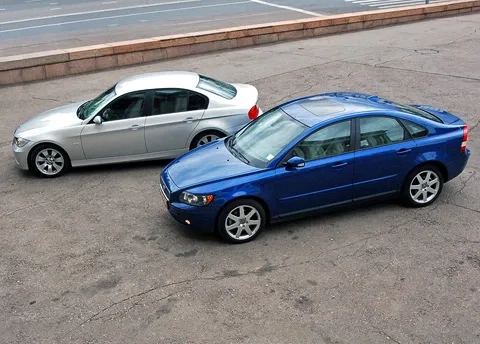
Why did we compare the BMW 320 and Volvo S40, even though according to the documents they belong to different segments? It's simple — these cars differ in length by only three centimeters. What matters more is that they have similar prices, engines, and how manufacturers position their models. Both are solid but compact sedans with a claim to "sportiness." You might say BMW has a higher status? Perhaps from the outside it looks that way, but on the road both are given way equally willingly. So let's figure out if there's any point in paying more for the German when there's a Swede nearby that seems to be in no way inferior. Moreover, in terms of characteristics and equipment, the S40 even looks preferable. Judge for yourself: the two-liter engine in the BMW produces 150 hp and 200 Nm, while the Volvo's 2.4-liter engine develops 170 hp and 230 Nm. It would seem the difference is small, but, looking ahead, I'll note: the extra 400 "cubes" and one extra cylinder in the Swede make themselves felt quite noticeably. The Volvo's equipment is also more generous. Both cars have dual-zone climate control, xenon, and parking sensors. But the S40, in addition to what the BMW has, offers a built-in phone, leather interior with electric seat adjustments, power-folding mirrors, an audio system with excellent sound, a CD changer, and a whole list of other pleasant little things. And with all this, the S40 is cheaper than its competitor. So it turns out that the more spirited and better-equipped Swede will simply crush the gray "Beemer"? Let's not rush to conclusions and compare based on paper specs — better to get inside and take a drive. The Volvo's interior leaves a pleasant impression. The interior somewhat resembles IKEA furniture — everything is simple, nice, neat, and without excessive pomp. There are also interesting details. The main one is the "floating" center console. True, in person this unusual element doesn't catch the eye. Overall, it's light and calm. The only thing to nitpick is that the texture of the plastic and leather in the Volvo is traditionally rough, making the materials seem cheaper than they actually are. Touch it — and you realize everything isn't so bad. The neutral green instrument lighting also cheapens the interior visually. Although there's a nice bonus: the Volvo communicates with the driver in Russian! But where's the promised sportiness? It's not felt in the S40's interior. The seats can't be called flat, but they're more comfortable than sporty. The steering wheel is a bit large, and the seating position is quite civilian. It's good that the "Eski" has large adjustment ranges, especially for the steering column. At first you settle in seemingly comfortably, then you notice your right leg pressing against the sharp edge of that very "designer" center console. You adjust the steering wheel — and everything returns to normal. Another downside of beautiful things is that they aren't always convenient. On this certainly attractive console, the buttons are small and placed too close together. It takes time to get used to. In the back of the Volvo, you can sit, but only if you're not tall. Otherwise, it'll be cramped — and this applies not only to tall people but also to quite average passengers. But kids have plenty of room there, and for older children, the rear seat has fold-out "boosters." This suggests that Volvo sees the main buyers of the S40 as young families with children up to ten years old — the car's dimensions suit them just right: not cramped in the back, and the trunk is quite good. The BMW's interior is a completely different story. It's dark and even a bit gloomy. No Scandinavian lightness — only a stern German character. After the Volvo, you sit in seats with tenacious lateral support, look at the reddish instrument lighting and black plastic — and feel a bit uneasy. But that's just a matter of contrast. In fact, the BMW's interior is no less thoughtful and high-quality than its competitor's. It may not look welcoming, but once you sit down, you don't want to leave. An excellent three-spoke steering wheel, seats with electric adjustments and lateral support (which even in the "weakest" position holds better than the Volvo's), a low and proper seating position — all this sets a driver-oriented mood. Ergonomics are also top-notch. A nice touch for our polluted cities is the recirculation button right on the steering wheel. However, the Volvo does even better here — it turns on automatically. And, oddly enough, the BMW has more space in the back — noticeably more room, for which passengers will forgive it both the dark trim and the lack of leather. You can see where the "Three" spent its extra centimeters of length. The trunks are about the same, though. True, the BMW only has a ski hatch (and that's for an extra charge), while the Volvo allows full transformation of the rear part of the cabin. The Bavarian's equipment is, of course, more modest. The seats, besides lateral support, lack electric adjustments, and the audio system is simple. Of course, all this can be ordered for extra money, but then the price becomes even higher. Let's start the engines. The BMW is all modern: insert the key without a "blade" into the slot, press the start button — and off we go. The Volvo is more conservative: the key is also "electronic," but you have to turn it like in regular cars. The sound of the engines is good in its own way. The BMW's is loud, aggressive, and thoroughbred, even though the engine is a four-cylinder. The Volvo's voice is quieter, but the five-cylinder notes make it unusual and, admittedly, pleasant. Enough foreplay — let's get down to business! From the start, the Volvo takes off first. The difference in displacement and cylinder count makes itself felt: the Swede is noticeably more dynamic. There's always enough thrust, and during intense acceleration, the short and juicy "kick" at the top, just before the rev limiter, is especially pleasing. It's a curious feeling: right before shifting up, the car seems to come alive and lunge forward. The "Three" is slower, although by the sound of the engine it seems like it's about to go into space, but in reality — it's looming in the S40's rearview mirror. But in everyday life, you don't just start from traffic lights; you also move in traffic. And here the BMW is more convenient — primarily thanks to the "automatic." In normal mode, it sometimes hesitates, but in sport mode, it shifts quickly and on time. The gearbox in the S40 is worse, though you can't call it a turtle either. It's just that better is the enemy of good. The Volvo compensates with engine power, but controlling acceleration is still more pleasant in the BMW. Handling is where these two cars diverge radically. When you switch from the Volvo to the BMW, you think it has no power steering at all — the steering is so heavy! However, the effort on the wheel is large in itself, even without comparing to the Swede's light steering. But there's plenty of feedback. You feel the road literally with your fingertips. That's why corners are taken "with a bang." But it's not just about the steering. In the BMW 320, the engine is entirely within the wheelbase, and the weight distribution is almost ideal with neutral handling. Combined with rear-wheel drive and a stiff suspension, this makes the "Three" not push wide at corner entry but willingly dive into it. And the heaviness of the steering is compensated by the fact that you need to turn it less — it's more "direct." The Volvo is a completely different car. Its handling was tuned not on the Nürburgring Nordschleife but in dense city traffic. Weaving through lanes in the S40 is a pleasure. And in high-speed corners, you don't feel deprived either. But still, something is missing… The car does everything right, albeit with more body roll than the BMW. But there's a lack of feedback. You can rely on the Volvo, and we're sure it won't let you down. But you want more unity with the car. However, Volvo itself doesn't call the S40 sporty — just dynamic, so it all makes sense.
But in terms of comfort, the S40 noticeably surpasses the BMW. Although the Volvo's suspension can't be called truly soft, against the competitor it seems almost velvety — the "Three" shakes noticeably on the same bumps. True, the Continental tires with reinforced sidewalls, which aren't afraid of punctures, likely contribute to this. I suspect that with regular tires, the BMW would be a bit more accommodating. But the 320's suspension boasts enviable elasticity and composure, more confidently swallowing joints and potholes — which is sometimes lacking in the Volvo, though its suspension can't be called weak either. But there's a downside: in a long corner, if a pothole gets under the wheels, the BMW's rear axle can noticeably step out. The feeling, I'll tell you, is something else!
Both cars have brakes in perfect order — deceleration is confident and predictable. But the pedal settings differ radically. The Volvo is all civilian: press harder — you brake faster, no surprises. The BMW's approach is more interesting: the pedal travel is minimal, and the force on it is dosed literally in microns. Very convenient, you get used to it quickly.

test-drive-7.jpg
BMW and Volvo have traditionally embodied two different approaches: the Bavarians focused on driving pleasure, the Swedes on comfort and safety. But times change, and the current S40 is already quite capable of surprising with precise handling and sharp responses to driver inputs.
Oddly enough, summing up this comparison turned out to be quite easy. Both cars are good in their own way, but they are absolutely different! The Volvo is a beautiful and quite dynamic sedan that remains comfortable and very easy to drive. It's almost impossible to nitpick it, it's well-equipped, and the price looks attractive. The only thing that somewhat limits the circle of potential buyers of the "Forty" is the cramped rear seats. In everything else, it can be confidently recommended to almost anyone.
But not for those who have already "fallen ill" with BMW. Because the Bavarian sedan also has something to hook a buyer: handling refined to the smallest detail, exemplary ergonomics, excellent sports seats... And those who choose BMW perfectly understand that they are not overpaying just for the name — it's just that their priorities are set differently. After all, Volvo, at a nearly comparable price ($48,170 for the top version versus €37,200, i.e., about $47.5 thousand for BMW), offers much richer equipment. But BMW fans would most likely be dissatisfied with Volvo's handling, ergonomics, and seating position — those very little things that an ordinary person wouldn't even notice. The only thing the BMW 320 itself lacks is a more powerful engine. And then the buyer faces a different dilemma in the price "fork" from $40 to $50 thousand: give up some options and take the base BMW 325 with a 218-horsepower unit. True, in this case, another player enters the scene — the Volvo S40 T5 with a turbo engine, all-wheel drive, and 220 "horses." But that's a completely different story.
Technical specifications
SpecificationsBMW 320Volvo S40
Engine
Typepetrol, with distributed fuel injection
Number and arrangement of cylinders4, in-line5, in-line
Rated power110 kW/150 hp
6200 rpm
125 kW/170 hp
6000 rpm
Displacement1995 cm32432 cm3
Compression ratio10.510.3
Number of valves1620
Maximum torque/Engine speed200/3600 Nm/rpm230/4400 Nm/rpm
Transmission
Driverearfront
Gearbox6-speed automatic5-speed automatic
Fuel consumption
Urban cycle10.7 l/100 km13.2 l/100 km
Extra-urban cycle5.6 l/100 km6.7 l/100 km
Combined cycle7.4 l/100 km9.1 l/100 km
CO2 emissions178 g/100 km217 g/100 km
Fuelpetrol AI-91-98
Fuel tank capacity63 l62 l
Dynamic characteristics
Acceleration to 100 km/h9.8 s8.9 s
Maximum speed215 km/h215 km/h
Vehicle mass
Curb weight1435 kg1369 kg
Maximum permissible weight1880 kg1960 kg
Body
Length4520 mm4468 mm
Width1817 mm1770 mm
Height1421 mm1452 mm
Wheelbase2760 mm2640 mm
Front track1500 mm1535 mm
Rear track1513 mm1531 mm
Ground clearance115 mm147 mm
Trunk volume460 l404 l
Wheels
Tires225/45 R17 Continental SportContact 2 SSR205/50 R17 Pirelli P7
Steering
SteeringPinion/rackPinion/rack
Minimum turning diameter10.6 m
Equipment of the tested vehicle
EquipmentBMW 320Volvo S40
Remote-controlled security alarm++
Central locking++
Airbags for driver and front passenger++
Front side airbags++
Inflatable safety curtains++
Tires with run-flat capability+
Adjustable steering column for reach and tilt++
Power-adjustable and heated rearview mirrors++
Power-folding rearview mirrors +
Front and rear power windows++
Heated front seats++
Fog lights++
On-board computer++
Metallic paint++
Leather multifunction steering wheel++
Split-folding rear seat back++
Parking sensors++
Headlight washers++
Rain sensor++
Light sensor++
Xenon low-beam headlights++
Xenon high-beam headlights +
Dual-zone climate control++
Cruise control++
Interior volume and motion sensor +
Power steering++
Leather interior trim +
Power front seats with memory function +
Audio system with 12 speakers and CD changer +
Audio system with 6 speakers and CD player+
Side windows with water-repellent coating +
Built-in GSM 900/1800 phone +
Engine and interior heater with timer +
Built-in child seats +
Automatic activation of interior air recirculation +
Compass in rearview mirror +
Russian language on instrument panel +
Auto-dimming interior rearview mirror +

Cars for the test were provided by
official representatives BMW Trading Russland and Volvo Car Russia.
Behind the scenes
test-drive-8.jpg