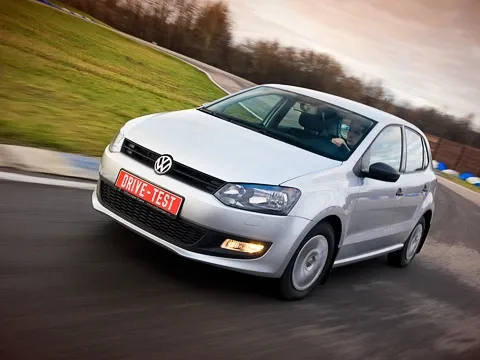
"How did you park them — one on top of the other?" Not the best joke, although our guys really did bring two new "halves" for a test — one with a 1.2 engine (70 hp), the other with a 1.4 (85 hp). I head to the fresh Volkswagens for a first impression. In the parking lot, I hoped to find the coveted pair by the unusual glow that, in my mind, should emanate from the car of the year. In my imagination, such a car must catch the eye, stop you, and rivet you. So that everything around looks like old junk. But no shine — not the slightest sign of life. I put my palm to my eyes like a visor. Bad binoculars.
Just a month ago, the Polo stood out. Back then, it teased, hiding in showrooms under a colorful cover and baring its teeth predatorily from billboards. Where is all that now? Here it is! Uh-uh, no, that's a Golf. Aha! So, also a Golf. Try to tell them apart now. My attempt to spot the Polo from afar by its "ancestral gaze" failed. Only walking along the cars gave results. I smirked: the sought-after hatchbacks — one behind the other — look like two completely different, nondescript little cars. Ugh.
Up close, the Polo's halogen headlights, which in pictures seemed to ask, "What have you done?!" — don't express even a fraction of the anger written on the Scirocco's face. No envy, no aggression. And only when the Polo stands strictly face-on does its gaze, emphasized by the sharp lines of the front end, become uncompromising. In rearview mirrors, it looks like the most displeased car in its class.
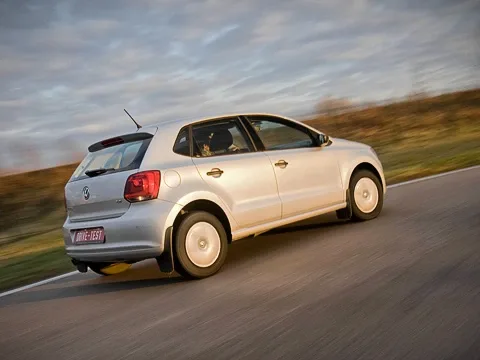
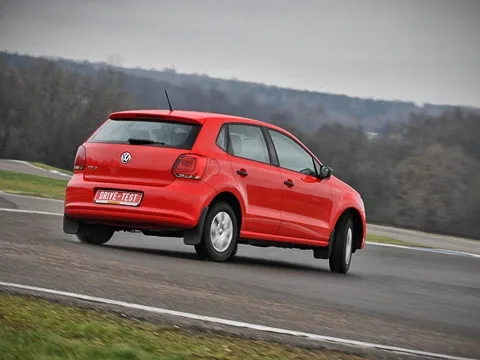
The most important, the most vital one — the silver 85-hp with the DSG "robot." Neither more nor less, an éminence grise, a gray cardinal. These are exactly what most will buy: literally, in the modest Trendline trim, with black unpainted door handles and mirror housings. But everything around is so gray that your feet carry you to the bright red car. No wonder propaganda uses this color as the most impactful. Although the blue Volkswagen one is also interesting, and the yellow is stunning, but no argument: red — yes.
And what if the "little scarlet flower" has a weaker engine... Well, at least it has an honest five-speed manual. The radio in the Polo 1.2 is simpler, instead of climate control — air conditioning, no parking sensors, steering wheel without leather, four speakers instead of six — in short, the most affordable option. But it's the one that pocketed my initial set of sympathies. I used the folding key of the red Polo first.
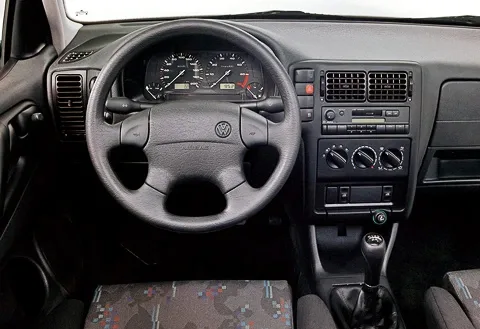
The interior is serious, if not boring. The plastic looks soft, and there's no need to touch it. The speedometer and tachometer now have no bluish tint in the backlight. The more expensive version has a leather-rimmed steering wheel with a shiny insert à la Golf. But the spokes are made of hard plastic, whereas the all-plastic steering wheel on the Polo 1.2 has soft rubberized spokes. Cost optimization.
Inside, there's plenty of room to spread out. Pockets on all doors swallow a 1.5-liter bottle. There's a capacious cooled glovebox with a USB port and a hidden compartment in the armrest. The cupholder in the center console isn't great: when removing a cola, it hits the plastic. Das Auto? Natürlich.
I, who don't fit in a Getz, I, whose forehead the Fiesta's sun visor rubs against, settle calmly behind the wheel in the firm seat and immediately turn on its heating — don't look for it in any base trim. I grope with my feet for the pedals. There's no clutch on the left! There's an empty stadium where footballer Ilya Tsymbalar, known for his superb left-foot play, hones his skills. And the long-travel pedal has run off almost to the center. And it's positioned high: you move your foot from the rest platform — as if jumping over a fence. The accelerator and brake are pressed to the limit to the right and also at different heights. The football training continues: we practice a one-touch pass with the right. Polo, of course, is also a ball game. But with sticks and on horses...
You can put both feet on the platform to the left. The explanation for this layout should be sought in passive safety requirements. Remember, in spring in Geneva, the Germans promised that the Polo would be 50% better at withstanding a frontal Euro NCAP impact? By compressing the pedal assembly, Volkswagen engineers protected the driver's lower limbs from wheel arch deformation. And we should say thank you, but the words of gratitude stick in the throat.
However, at least the "manual" Polo has proper throttle response. But in the "automated" one, it's so damped that it feels like I'm stomping on a pile of swept plaster in the corner. Or trying to squash a mouse stuck in a wall gap. At half travel, no reaction! And this contrasts with the provocatively sensitive brakes. You, like a treacherous billiard ball, want to stop softly at the edge of the pocket — and you get hit on the forehead with the cue. This is especially burdensome in traffic jams. You press, gradually increasing force, slow down, and suddenly — bang, you stop dead, as if the car stalled. Braking from high speeds is easy, but from low speeds, there's an inevitable jolt-nudge. This could be called Podlo.
I'm in a barely crawling dark rainy "jam." A woman from a small car dragging alongside wants something from me. She can't get through to me through two layers of glass. She asks with gestures to open the window. I'm not towing a gas pump on a hose. As soon as I reached for the window switch panel, the lady was swept away by the traffic flow forever. Probably, the young lady wanted me to tell her about the new Polo.
"This is not a women's car!" I would have shouted, looking at her with a hint of sympathy. "The Germans don't tie the Polo to a gender; the orientation is broader: toward the young, active, and, excuse me, positive. Freedom, fun, and all that." While replaying this unlikely conversation in my head, I look to the right — no, there's no fuel nozzle sticking out of the tank. With a manly face, the Polo in profile is unarmed.
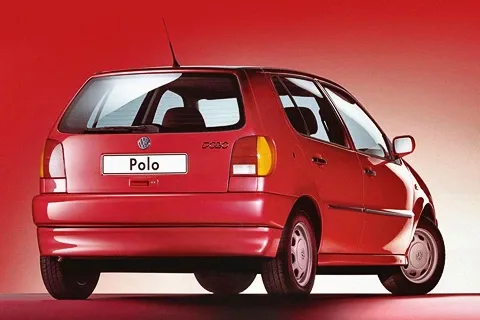
And from the rear, it's simple — only the "designer" taillight diffusers save it. The difference between the two test cars, apart from color, is also that the Polo 1.4 shows off its exhaust pipe, while the 1.2 version modestly hides it under the bumper. Who will spank whose naive rear? In a parallel sprint to 80 km/h, the cars go side by side! The first two gears of the "manual" Polo are short. It rolls with a malicious grumble reminiscent of a diesel. It howls expressively, in its own juicy way, oh! A thoroughbred voice is a sign of the male gender, and many appreciated it. Someone compared the 1.2 engine to a little puppy pretending to growl like its bulldog dad. In short, not an engine, but a son of a bitch.
True, the three cylinders stop pulling a bit before the tachometer needle touches the red zone — you need to shift without waiting for the limiter. The manual lever moves easily and precisely. The throws are a bit long, though. Just over 40 — click, second. However, on the next shift, the 70-hp engine (listed as 69 hp in the tech specs) drops in revs, and the DSG car briskly pulls away. But — with a dull, everyday hum.
The lagging red one rides on a long third gear almost up to 140 km/h. For the city, it's economical. On the highway, it's for acceleration. Because of it, the Polo 1.2 loses more than two seconds to its rival in the sprint to a hundred. Fifth gear is generally vestigial: in principle, the Polo would suffice with a four-speed manual. And fourth would only be needed if someone suddenly wanted to push the little one to its claimed top speed (165 km/h). What about the "robot": in seven gears, it's even easier to get lost. Its economy program, combined with the dull accelerator, negates the objective advantage. Subjectively, the Polo 1.4 doesn't feel more dynamic. Although the short gear ratios allow the silver car to accelerate more lively from medium speeds.
The DSG selector, unified with those installed on larger Volkswagens, seems like an overgrown mushroom inside the Polo. The manual lever pleased with precise operation, but out of six gears, we most often used four — three forward and reverse.
And also to be more economical: the average fuel consumption over half a thousand kilometers for the Polo 1.4 was 8.2 l/100 km, while the red Polo recorded a minimum of 9.2 l. There's your puppy. Rascal! The upper "city" limit of the claimed consumption — 7.3–7.7 l — we exceeded with a vengeance: it went up to 13.2 l/100 km. And none of us could reproduce the "highway" laboratory figures of 4.5–4.7 l/100 km in reality. Cold comfort: we destroyed quality 95-octane gasoline in the most civilized way — both engines meet Euro-5 standards.
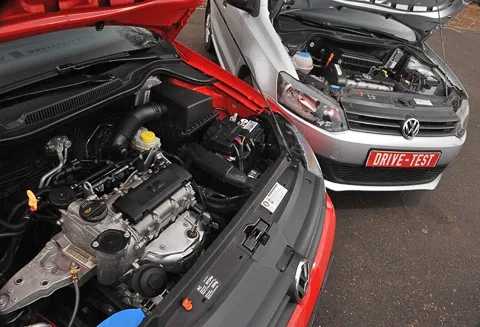
I wonder what duo the 1.4 engine would make with the same five-speed manual? This Polo variant — the last of the three available — remained unexplored for me.
The highway with three-digit speeds is an environment hostile to both "halves" of the Polo. They react too sharply to ruts, shudder at any unevenness, and in corners tend to leave their arc, yielding to the whims of the road's cross slope. The steering is informative, but at speed it's almost as light as when parking. In the silver hatch at high speed, the "zero" feels a bit more distinct — due to stiffer springs — but the wheel still turns alarmingly easily. It seems even a light breeze could move it. And the Polo on the highway is just sensitive to gusts of wind: if warm air blows from the left vent — the car is already drifting right.
The only thing that pleases is the relative quiet in the cabin. Absolute silence is absent only because of the engines running. I'm driving and clearly hear the passenger behind turning the page of the third volume of the Polo manual. Noise insulation can confidently be rated five on a six-point scale. Of course, on a highway strewn with "chess pieces" of road surface, you'll hear the "pawns" knocking on the wheel arches. But fortunately, there are few such roads. And in the city, the thermal seam of the overpass thuds under the wheels: the Polo 1.2 swallows it softly and roundly, while the silver one briefly and sharply pokes the occupants in the rear.
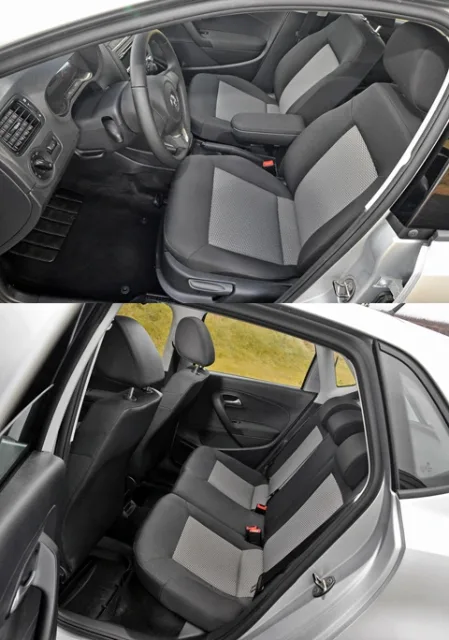
The front seats of the Polo hold well, adjust in all necessary directions, and can be heated for an extra charge. On the right, my 187 cm of height did not prevent me from brazenly stretching my legs. There's also enough air above my head. For a full fit, you'll have to turn the handles and jack up the seat.
I turn off the highway to where the electro-hydraulic power steering should show its best side. I look at the angry headlights and mentally promise to torture the car. The Polo frowns — I feel it will endure. Trying not to look at the car from other, less combat-ready angles, I throw the keys to the executioner. The soft high-profile winter tires squealed, and the eager killer got to work. Ten circles of hell on the track — and the tormented Polo returns to me smoking. The rear brakes are burning.
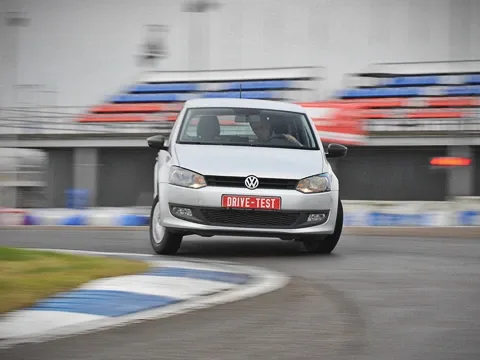
The dynamic stabilization system for the Polo can be ordered for an extra charge, but we found no urgent need for it. On pliable winter tires, the car breaks into a deep skid only after provocation with the handbrake.
The executioner, as expected, is taciturn. He says the car handles blandly but safely. At the limit, it doesn't scare with uncontrolled understeer or oversteer — it softly slides outward of the turn with all four wheels. The engine braking torque is small, so the ability to correct the trajectory with throttle is limited. Reliable and predictable behavior is very useful, especially since there's no stability control here. The electric power steering doesn't give up even with very fast steering wheel rotations. But overall — no zest. The punisher slams the door, spits, pulls off his glove. I gratefully shake his hand, but my thoughts are already elsewhere.
How pleasant is the sound of the door closing! The Polo has a low, noble "glock," not the clang of a drainpipe like some classmates. The click when opening is also unusually tasty. The tailgate smacks just as melodiously. Another feature is the lock handle in the form of a movable VW logo, like on older Volkswagens. After a highway trip, a dirty branded stamp will remain on your hand — at the factory gate in Wolfsburg, they should respectfully let you through.
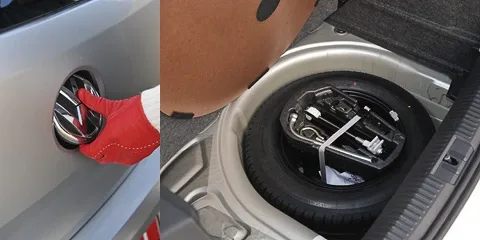

Compared to the previous generation, the volume of the not-too-spacious trunk has grown by 10 liters — to 280 (952 liters with the seats folded). For this compartment, I came up with a tongue twister: in the Polo, under the floor there's a floor, and under the second floor — a full-size spare tire.
Again a "glock" — now from the rear doors. There are no complaints about the ease of getting in and out: even Jabba the Hutt could climb out of the wide-open "gates." But being inside would be a bit heavy for him. For the three of us in warm jackets, it's tolerable. A feeling of elbow contact, of course, arises. The middle passenger complains about the central tunnel, while the side ones successfully tuck their legs under the front seats. The outer ones also have to slightly tilt their heads because of the side roof slopes. However, contact with the ceiling handles is excluded. The main thing is you can ride, but the comfort rating for three in the back equals the number of passengers.
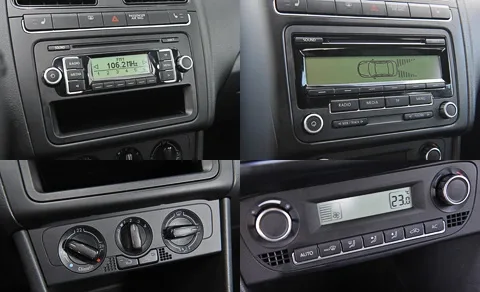
The old Volkswagen blueness remains on the displays of the more expensive radio (top right) and climate control (bottom right). In the dark, they loom in peripheral vision as harsh bright spots, dissonating with the restrained "lunar" backlighting of the instruments.
Three, four, five. The bunny went out... To list the cute little things in the Polo to my five-year-old daughter, I abandoned dry numbers and used animal images. "Look, the ceiling handles have a microlift so they don't rattle — made by Igel, the hedgehog. He for some reason decided that the driver also needs such a handle, but he could have attached a glasses case instead. The hare Hase built lighting for the mirrors in the visors. This is perhaps the only purely feminine thing in the Polo. Well, the central locking button with backlighting, like in a very expensive car, is the work of Kaetzchen, the kitten. See the convenient pull-out drawers under the front seats? Der Hund, the doggy, tried. In the trunk, there's a 12-volt outlet for a refrigerator — thanks to the boa, Riesenschlange. Imagine, even the tow hook is equipped with a plastic cap..." Turning to the child, I saw that my daughter had long been asleep. The final compliment to the suspension.

Pleasant little things. The steering column adjusts both by tilt angle and reach. True, the high seating position still dictates a pose with bent knees.
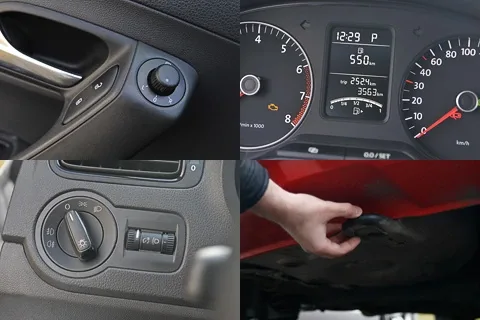
- To the person (if it is a person) who came up with placing the joystick for electric mirror adjustment in the horizontal plane, I propose erecting a monument. Instead of a head, the figure will have a leg, instead of an arm — a head, and so on. All parts seem present, but it's impossible to use.
- The central locking button has backlighting!
- The smaller round gauges showing coolant temperature and fuel level have disappeared from the instrument panel. The latter is now very sensibly displayed on the screen as a melting white strip.
- The "stove burner" light switch to the left of the steering wheel, unified with the Golf's, has slightly modernized and moved higher.
- They don't skimp on little things. The tow hook is covered with a plastic cap. Why?
The engine revs furiously, the hum turns into a roar. The sweater in the porthole becomes a round green spot. I've settled in front of the washing machine like by a fireplace, thinking that my Ford Fusion on winter tires screams like a gutted beluga just the same. And in the Polo — silence. Still, this Volkswagen is a great car. Not a step — a kangaroo jump compared to the "fourth" Polo. Fast, nimble, packed, thoughtful, safe. Sonorous. Comfortable. New! Again, German order. Das Auto. And freedom and fun? Maybe... well... I'll get used to these strange pedals?
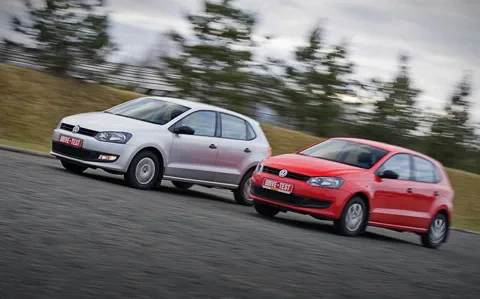
The powertrain of the Polo 1.4 is slightly heavier. To compensate for the almost 40-kilogram increase in mass, apparently, stiffer springs were used. On cobblestones at 30 km/h, the hatchback with the "robot" has sharper peaks of vertical acceleration. And the red Polo rounds them off, as if leveling the micro-profile of "Red Square."
Technically, the car is top-notch. But something else is primary. If the Germans had deviated for a second from their "praktisch" — and when creating the new Polo, who knows, maybe the confluence of my beloved rivers Nadydeya and Nadydeya would have happened. This little car could have been born in the mental interfluve they formed, in the creative hearth of civilization that ignites individuality. Without this, the dreary title of "European Car of the Year" is its whole meaning. And the colorful sticker on the rear window, which is stuck on all winners, is all the emotional baggage. Now the interfluve is wrong: in front I'm the Tigris, but behind the Euphrates. In front, I'm kind of angry! Oh, how angry I am! And on my back, I have a smiley display: sorry, I was joking. In profile, I'm invisible like a flounder, inside — quiet hour in a German village. The sexless Polo with signs of both sexes tries to please everyone indiscriminately. "To the beloved waterfowl from a very modestly equipped under-Golf." Thanks, of course, but in our case, it's 640 and 730 thousand. You do as you like, but I don't want it that way.
Technical specifications
| Model | Volkswagen Polo 1.2 | Volkswagen Polo 1.4 DSG |
| Body |
| Body type | hatchback | hatchback |
| Number of doors/seats | 5/5 | 5/5 |
| Length, mm | 3970 | 3970 |
| Width, mm | 1682 | 1682 |
| Height, mm | 1462 | 1462 |
| Wheelbase, mm | 2470 | 2470 |
| Track front/rear, mm | 1463/1456 | 1463/1456 |
| Curb weight, kg | 1067 | 1104 |
| Gross weight, kg | 1550 | 1580 |
| Trunk volume, l | 280–952 | 280–952 |
| Engine |
| Type | petrol | petrol |
| Location | front, transverse | front, transverse |
| Number and arrangement of cylinders | 3, in-line | 4, in-line |
| Number of valves | 12 | 16 |
| Displacement, cm3 | 1198 | 1390 |
| Max. power, hp/rpm | 70/5400 | 85/5000 |
| Max. torque, N•m/rpm | 112/3000 | 132/3800 |
| Transmission |
| Gearbox | manual, five-speed | automated manual, seven-speed |
| Drive | front | front |
| Chassis |
| Front suspension | independent, coil spring, McPherson | independent, coil spring, McPherson |
| Rear suspension | semi-independent, with torsion beam | semi-independent, with torsion beam |
| Front brakes | disc, ventilated | disc, ventilated |
| Rear brakes | disc | disc |
| Performance characteristics |
| Maximum speed, km/h | 165 | 177 |
| Acceleration time from 0 to 100 km/h, s | 14.1 | 11.9 |
| Fuel consumption, l/100 km |
| — urban cycle | 7.3 | 7.7 |
| — suburban cycle | 4.5 | 4.7 |
| — combined cycle | 5.5 | 5.8 |
| Emission standard | Euro-5 | Euro-5 |
| Fuel tank capacity, l | 45 | 45 |
| Fuel | AI-95 | AI-95 |
Trim levels
| Base trim | VW Polo 1.2 | VW Polo 1.4 DSG |
| ABS | + | + |
| Airbags for driver and front passenger | + | + |
| Three-point seat belts on all seats, front with height adjustment and pretensioners | + | + |
| Crash-optimised front head restraints | + | + |
| Electro-hydraulic power steering | + | + |
| Steering column with height and reach adjustment | + | + |
| Front electric windows | + | + |
| Suspension for poor roads | + | + |
| Disc brakes front and rear | + | + |
| Central locking | + | + |
| Immobiliser | + | + |
| Steel wheels with full-size wheel covers | + | + |
| Three-spoke steering wheel | + | + |
| Three rear head restraints | + | + |
| Isofix mounts for two child seats on the rear seat | + | + |
| Driver's seat with height adjustment | + | + |
| Rear seat three-seater, with one-piece cushion and backrest, folding | + | + |
| Bumpers painted in body colour | + | + |
| 12 V socket in the trunk | + | + |
| Exterior mirrors with manual adjustment from inside, driver's side — convex | + | + |
| Full-size steel spare wheel | + | + |
| Additional equipment of the test car |
| Air conditioning | + | o |
| Climate control | o | + |
| Audio system with MP3 support | + | + |
| Rear electric windows | + | + |
| Comfort electric package | + | + |
| Winter package | + | + |
| Rear parking sensors | o | + |
| Anti-theft system | + | + |
| Front centre armrest with storage compartment and two cup holders for rear passengers | + | + |
| Tyre pressure sensors | + | + |
| Asymmetrically split rear seat | + | + |
| Double floor in the trunk | + | + |
| Multi-function display | + | + |
| Steering wheel with "matt chrome" decor | o | + |
| Multimedia connector | o | + |
| Fog lights with static cornering light | o | + |
| Daytime running lights | o | + |
| Base trim price | 475 291 | 554 808 |
| Price of the tested car | 638 000 | 731 000 |
Legend:
+ — included in base trim;
- — not available;
o — option installed on the tested car.
Technology
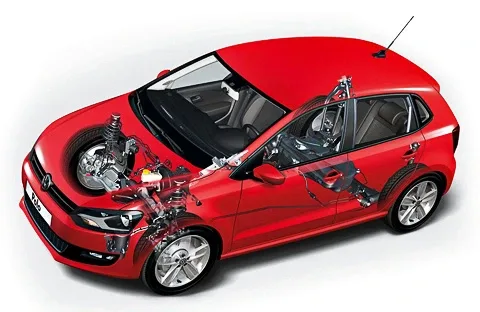
The new hatchback is based on the PQ25 platform — essentially a refined "cart" from its predecessor. The wheelbase was increased by only four millimetres, but the track was widened more noticeably — by 30 mm. The suspension, which is McPherson struts at the front and a torsion beam at the rear, was retuned towards greater sportiness.
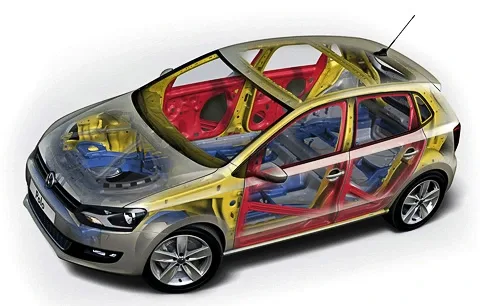
Thanks to the increased share of high-strength steels, the body became 7.5% lighter, and its torsional rigidity increased to 18,000 N•m/deg.
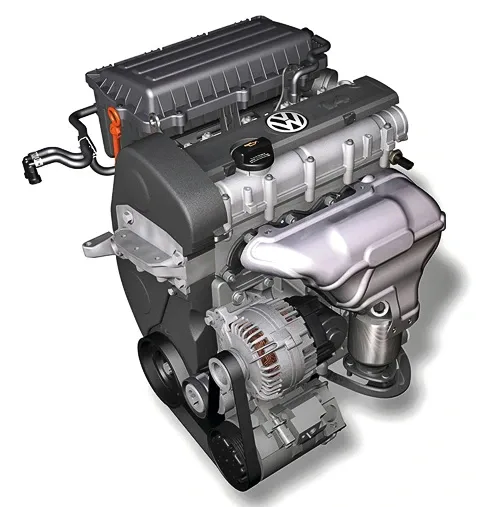
There are two petrol naturally aspirated engines for the Polo: a three-cylinder 1.2-litre (in versions with 60 and 70 hp) and a "four" 1.4 producing 85 hp. Both engines are familiar from the previous generation, but for the new generation they were refined: the aluminium units became more powerful (an increase of five to ten "horses"), received a different injection system, a fresh control programme and a modified valve timing mechanism. Together with the modernised oil pump, this made it possible to reduce noise levels. The engines comply with Euro-5 standards.
Design
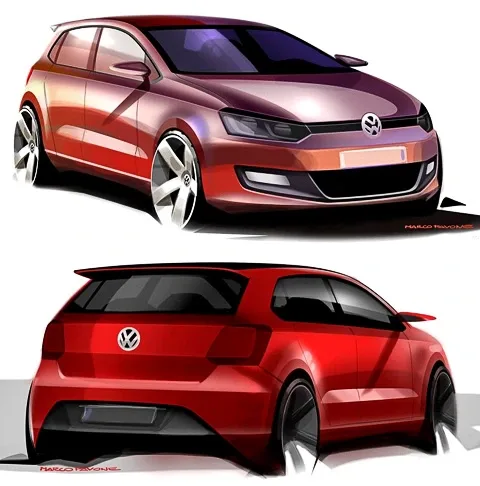
The design team led by Italian Flavio Manzoni claims that the new Polo is the first embodiment of the integrale principle, that is, "complete, integral, unified". The car's creators speak of "simplicity of design in our complex world": meticulous work on proportions, cutting off everything superfluous, restraint in "symbols of power" and rejection of excess. And perhaps it is hard to argue with that.
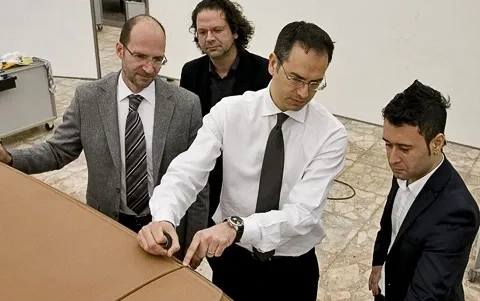
44-year-old Flavio Manzoni (second from right) is the author of the Volkswagen Up! and BlueSport concepts, as well as the "sixth" Golf and Scirocco. His track record includes interiors for Seat models and work on Lancia and FIAT projects. Unsurprisingly, Manzoni is leaving his post as Volkswagen's chief creative officer: from 1 January 2010 he will become chief designer at Ferrari.
Safety
The Polo can boast five Euro NCAP stars. Experts conducted crash tests of the Polo 1.2 at the end of last summer. Adult occupant safety was rated at 90% (32 points). True, there are nuances: the passenger should fear only the not-so-successful head restraint, while the driver should fear the rigid steering column, which could theoretically injure the hips. In a side impact, there is a risk of chest injury. Children were considered protected at 86% (42 points). The Euro NCAP report notes that the switchable front passenger airbag is a plus, as it allows a rear-facing child seat to be installed. But the driver does not always receive sufficiently clear information about whether this airbag is on. Pedestrians in the path of the Polo have a hard time — only 41% (15 points). The edges of the bumper and bonnet are to blame. Electronic assistants scored 71% (5 points).
History
The model's name can be interpreted in two ways. The first variant refers to the "polar wind" — the same logic is seen in the names Passat and Scirocco. The second, more common interpretation, links the name to a horse game with a ball and sticks — as in the case of Golf. The Volkswagen Derby modification also supports this version: derby, like polo, is a type of equestrian competition.
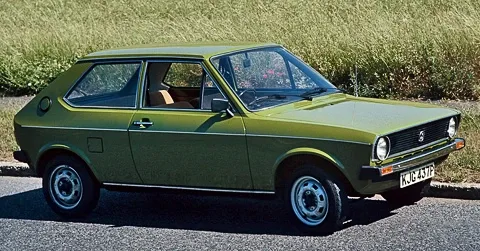
But initially, the car bore the name Audi 50. This three-door hatchback appeared in 1974 and was sold, according to rumors, without much success, and only on the European market. So Polo, which debuted in 1975 at the plant in Wolfsburg, was the result of ordinary badge engineering and took the position of the most compact Volkswagen model, which it held until 1998.
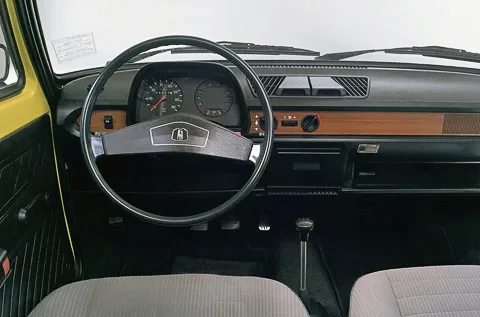
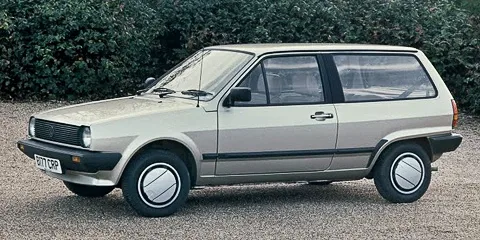
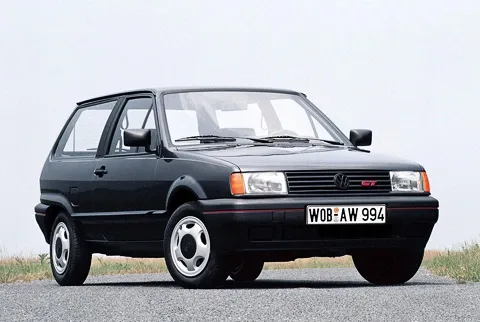
The first generation, known as Mark I (Typ 86), by the time production ended in 1979, had sold half a million units. The lineup included Polo GT and Derby sedan versions. Under the hood were inline gasoline "fours" with displacements of 895, 1093, and 1272 cubic centimeters, producing from 35 to 60 horsepower. In 1979–1981, the model underwent its first update: the bumper, radiator grille, optics, and instrument panel changed.
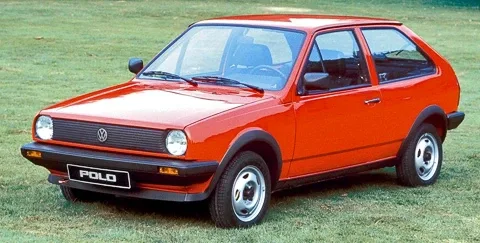
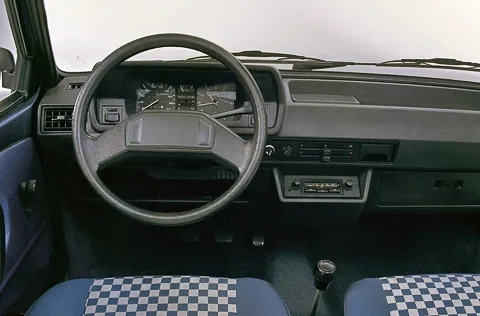
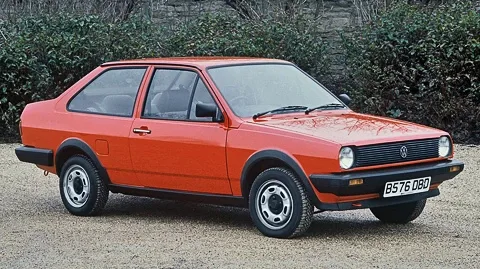
The second generation — Mark II (Typ 86C) — debuted in October 1981. The main novelty was a body variant with an almost vertical rear pillar: on some markets it was even called a station wagon, and the version with a slanted pillar was called a coupe. The third variant, the sedan, received the name Polo Classic, while Derby was happily forgotten.
During the life of the second generation (1981–1990), Polo production was established in Spain — after VW absorbed SEAT. By 1983, the millionth Polo rolled off the assembly line, and by 1986 — already the second million.
Dimensions played into Polo's hands: it was larger than almost all competitors — Ford Fiesta, Peugeot 205, Fiat Uno, Nissan Micra — and stood out from the "supermini" category. In terms of price, comfort, and equipment, it could rather be classified as a small family car like the Ford Escort or Opel Kadett.
The build quality and reliability of the Polo by the standards of that era were truly outstanding. In addition, the second Polo became a testing ground for VW engineering innovations — for example, G-Lader superchargers, which later moved to Golf, Passat, and other models of the concern. At the same time, the range of inline "fours" was supplemented with two diesel engines with displacements of 1.3 and 1.4 liters.
The restyling carried out in 1990–1994 before the release of the third generation was not limited to cosmetics. In addition to square headlights, new taillights, bumper, and interior, engineers refined the chassis, suspension, and brakes. Alongside the previous carburetor version, an engine with single-point injection and a catalyst appeared — just in time for the tightening of European emission standards. Another update included a smart option for those times: the radio could be taken with you without leaving it in the car. Owners appreciated this security measure. The concern's employees themselves were pleased not only with this but also with the flourishing of the Polo GT, which truly revealed itself at that time.
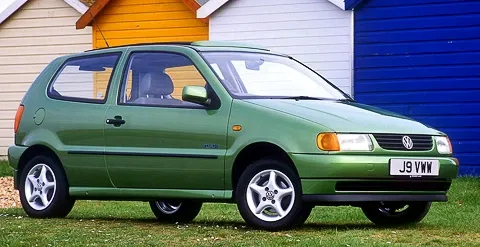
The third generation — Mark III (Typ 6N) — was built on a new chassis and shared the platform, instrument panel, engines, and much more with the second Seat Ibiza. This platform also related the Polo to the third Golf: many parts and the entire suspension were interchangeable among the three models, although they differed externally — there were no common body panels.
Since 1994, Polo hatchbacks were offered not only with three but also with five doors. The interior — a reupholstered Seat Cordoba cabin. Under the hood — gasoline "fours" 1.4 and 1.6, as well as a diesel 1.9, with power from 44 to 100 hp. The Polo GTI version was equipped with a 120-horsepower 16-valve engine. In the late nineties, the automotive press repeatedly awarded Polo the titles of Best Supermini and Best Economy Car.
The 2000 update was claimed to replace 70% of components, but externally the car changed not too noticeably. New interior, optics, bumpers. The body became fully galvanized, although in terms of shapes it did not undergo serious transformations — only some panels changed. But the standard equipment included power steering, ABS, and airbags. At the same time, a new three-cylinder diesel 1.4 TDI appeared, which experts highly praised for reliability, efficiency, and specific power.
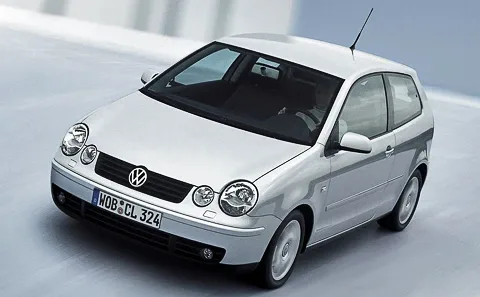
In 1996–2002, the Volkswagen Polo Playa was sold on the South African market — essentially a badge-engineered version of the second Ibiza. Playa was abandoned when the fourth Polo — Mark IV (Typ 9N), easily recognizable by its four round headlights — reached South Africa. Compared to its predecessor, everything was new in this car, including the platform — shared with the third Ibiza and the first two generations of Fabia.
The success of the fourth Polo can only be called mixed. Sales did not reach the level of early generations. Top Gear, which in 1998 recognized the previous generation as Best Supermini, this time noted a failure: in the survey-based rating, the fourth Polo noticeably lost to most rivals — Fiesta, Corsa, Clio, and Peugeot 206. In 2005, Walter de Silva updated the rear, headlights, and taillights, but the model never became a hit.
Leaving aside the CrossPolo crossover and its predecessors Polo Fun and Polo Dune, we note in conclusion: Volkswagen counts on the success of the fifth generation, among other things, thanks to the Polo BlueMotion version — the most economical five-seat car in the world, production of which is scheduled to start in February 2010.
Behind the scenes
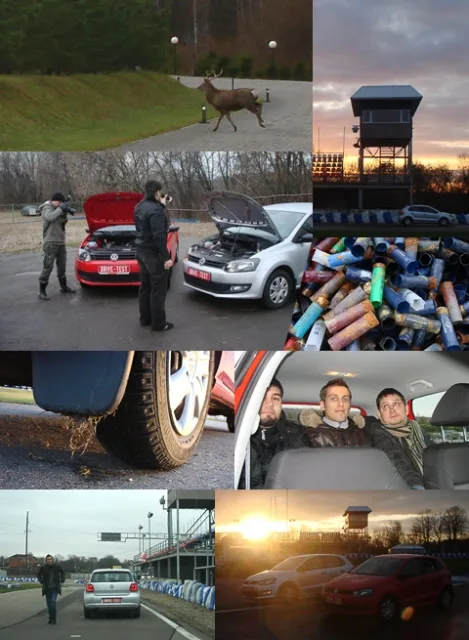
The opportunity to conduct a "moose test" with a real live deer came to us for a few seconds during filming at the picturesque sports and shooting complex "Fox Hole". It is deer, not foxes, that feel like masters there: they roam everywhere and turn lawns into "minefields". Mikhail Petrovsky momentarily lost vigilance and "hit" one of those unpleasant "landmines".
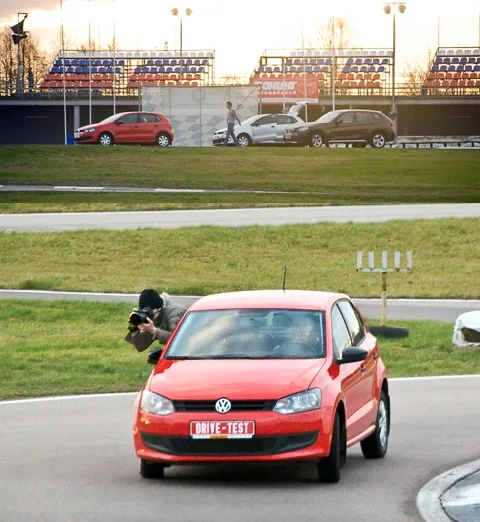
The continuation followed at the "Mayak" karting track: "I can't imagine myself in this car," our editor-in-chief cut off, jumped into a silver Polo and "burned" its brake pads. Meanwhile, a passing reader noticed us on the track and "mistakenly" took one of the Polos for a "sixth" Golf. So we became heroes of spy chronicles.