
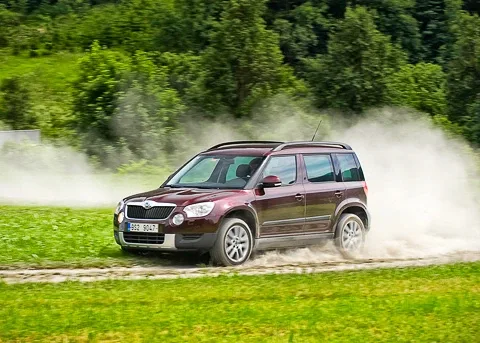
The situation with the Yeti is somewhat different. If only because it is not another passenger car, but the first Skoda crossover. Long-awaited: the Czechs showed the concept of the same name back in 2005, and the production version was released just now. By the way, the car will reach us only by the end of the year, and it is possible that immediately with Kaluga registration.
Regarding the delay, the explanation is simple. It sounds something like this: we, design engineers, when building the first Yeti concept in 2004, made it as a design experiment. Without aiming for production. And work on creating the road version began only six months after the premiere, when marketers analyzed feedback from auto show visitors and the board of directors gave the go-ahead for the development of the production version. It turns out that initially the Czechs did not even know which Volkswagen components to assemble it from! And in the end, they put it together from what was available... From the Tiguan?
The developers deny everything! Although some parts like the steering column are borrowed from the Volkswagen crossover. The main donor of organs for the Yeti, according to them, was the Octavia Scout station wagon. Moreover, the chassis, they assure, is mostly new. What is interesting in it is, first of all, the unusually widened rear track, like the Roomster compact van. Yeah, interesting...
They say the same about the interior — mostly from the Octavia, but all the panels, they say, are new here too. The garnish is, of course, the same: here is the good old gear lever with the tacky 4×4 inscription, here is the Columbus navigation system with a touch screen and a hard drive, here is the block of impeccably working climate control. I have already seen the instruments in wells with white backlighting on both the Octavia and the Superb, the steering column stalks are familiar, it seems, from birth. As a result, the only thing that seems fresh is the stupid wood trim. But, firstly, you can refuse it, and secondly, the Yeti's interior is still made much better than that of competitors, which include the Nissan Qashqai, Ford Kuga, and even the Kia Soul. And if it comes to that, it is better than the Tiguan's.
About the engines. Among the relatively new items is the base 1.2 TSI engine with 105 horsepower. We have already seen it on the Volkswagen Polo hatchback. On the Yeti, it comes paired with a seven-speed robotic DSG gearbox and front-wheel drive. The two-liter diesel engines (with 110, 140, or 170 hp), unlike the facelifted Octavia and Tiguan, are more advanced: with a common rail injection system, less noisy and less vibration-loaded.
It is only a pity that they come, like the well-known 1.8 TSI petrol engine (160 hp), only with a manual gearbox. Well, when will the Czechs finally marry the automatic and all-wheel drive, huh? Especially since the automatic gearbox suits the Yeti's character perfectly.
Because the character of the Czech crossover is very calm. The suspension turned out to be quite soft and comfortable (this applies to the petrol version; the diesel one is stiffer). The controls — steering wheel, pedals, gear lever — seem wrapped in cotton wool: lower sensitivity, but the car feels much smoother and more comfortable compared to the Tiguan. An excellent option if you want to relax! And the Octavia Scout station wagon next to the Yeti is a complete redneck: it shakes, vibrates, and makes noise all over.
But the Yeti does not urge you to drive. And not because it cannot, but because I do not want to rush. Although the engines cannot be blamed for a lack of traction, the reactions to the accelerator are incredibly slow. And the lever of the six-speed gearbox seems precise, but the throws are too long — it is inconvenient to shift quickly.
So, is it really possible that a car made from the same parts is perceived differently? While you drive like a human — yes! But as soon as hard modes begin, everything levels out. I hit a bad road, and the suspension, on the one hand, pleases with energy intensity, and on the other, loudly insists that you should slow down: “Master, what if there is a huge pothole ahead?” How familiar this is from... well, yes, from any car made on the Golf platform!
A winding and at the same time almost perfectly flat dirt road, meandering in the foothills of the Alps, is the best part of the route. Oh, if only I had an Impreza or an Evolution here! But I am in the Yeti, and it does everything exemplarily: it starts to slide neutrally on throttle lift, like a good front-wheel-drive car. Allowing you to easily control the trajectory with throttle. That is, it does everything even too well! A familiar school.
And, of course, in extreme modes, the all-Volkswagen stability control system wakes up, which has recently been made non-switchable on both regular and “hot” models. Or it does not wake up: as long as you do not make sharp movements with the steering wheel or throttle, by which the car guesses that you know how to drive, the intervention is minimal. But as soon as you get nervous — hit the brakes or sharply jerk the steering wheel — it will immediately back you up.
Great! But, alas, such “unification” seems to have spread to off-road qualities as well. To what the crossover was supposed to be built for. Here I remember the Tiguan again, which behaves on asphalt if not like a king, then like a prince, and off-road — like a beggar.
Of course, the Yeti overcame the demonstration off-road section playfully, but there was nothing serious there, a Fabia would have coped too. And what if there is something tougher? The Yeti has fairly short-travel suspensions and not the most impressive ground clearance — 180 mm, like the Octavia Scout station wagon. I suspect the Yeti will not shine.
There is, of course, an advanced hill descent assist system. The system is activated by pressing the Off-road button and works at speeds from two to 30 km/h, in the first three gears (or in neutral). This is all if the slope exceeds 10%. Working with it is as simple as pie: press the Off-road button, then adjust the speed by pressing the accelerator and brake pedals. A kind of off-road cruise control.
A convenient thing! On steep descents, you turn it on and forget about everything: you just roll down to the crackling of the brakes. What is good is that the system also works when reversing. But, of course, it is far from a full-fledged off-road cruise control, like in the Toyota Land Cruiser SUV: the Yeti can only crawl down.
But, after all, we are talking about a crossover with asphalt-tuned habits and a transmission with a banal Haldex. Yes, there is an electronic imitation of a limited-slip differential. But this is the maximum of the Yeti's distinctive features. And there is even a front-wheel-drive version. And this is not for the States, this is for Europe.
The crossover has long ceased to be a car for dacha dwellers — now it's a city resident. The main thing for it is to park on curbs and in snowdrifts, and also to have good visibility. True, in Western and Southern Europe, you can forget about snowdrifts, but practicality is held in high regard there. For buyers there, what matters more is how the interior folds, not how the suspensions work. If the Octavia has just a huge trunk with a couple of niches, the Yeti is trickier — transformation like the Roomster. You can fold the seats one by one. You can make the rear bench a two-seater by sliding the side seats toward the center. Or you can even remove all three rear seats, expanding the trunk to an indecent 1760 liters — and then the Octavia owner at the hypermarket can only envy. It's good that the Yeti is not just a "Tiguan" with a Czech accent. Nor is it an Octavia Scout on tiptoes. In character, it's a completely different car: calm and, dare I say, more noble. Even despite such trifles as ceiling handles without a microlift — they look cheap. When I returned to the editorial office, no one even asked how the trip went. Although there was plenty to tell. The ingredients are the same, after all. And the unification here is much deeper than it seems. And it will only intensify. In about five years, the concern plans to switch to just four global modular platforms, on which all brand models will be built — from city hatches and minivans to supercars and executive sedans. The matter here is, first of all, huge money: according to the concern's management, the transition to super-modular components will cut development and production costs by a third! The mass adoption of platforms is the key to competitiveness. The Volkswagen folks found this key long ago. And while half of the car companies are reaching out for help, Volkswagen is making a profit. The main thing is that the inevitable unification does not make all the concern's models twins. Well, steps in this direction are already there. Specifications Skoda Yeti | 1.2 TSI | 1.8 TSI Body Number of doors/seats | 5/5 | 5/5 Length, mm | 4223 | 4223 Width, mm | 1793 | 1793 Height, mm | 1691 | 1691 Wheelbase, mm | 2578 | 2578 Track front/rear, mm | 1541/1537 | 1541/1537 Curb weight, kg | n/a | 1520 Gross weight, kg | n/a | 2065 Trunk volume, l | 405–1760 | 405–1760 Engine Type | petrol, with direct injection and turbocharging | petrol, with direct injection and turbocharging Location | front, transverse | front, transverse Number and arrangement of cylinders | 4, in-line | 4, in-line Number of valves | 16 | 16 Displacement, cm³ | 1197 | 1798 Max power, hp/rpm | 105/5000 | 160/4500–6200 Max torque, N•m/rpm | 175/1500–3500 | 250/1500–4500 Transmission Gearbox | manual, six-speed (robotic, seven-speed) | manual, six-speed Drive | front | all-wheel Chassis Front suspension | independent, spring, McPherson | independent, spring, McPherson Rear suspension | independent, spring, multi-link | independent, spring, multi-link Front brakes | disc, ventilated | disc, ventilated Rear brakes | disc | disc Ground clearance, mm | 180 | 180 Performance characteristics Maximum speed, km/h | n/a | 200 Acceleration time from 0 to 100 km/h, s | n/a | 8.4 Fuel consumption in combined cycle, l/100 km | n/a | 8 Emission standard | Euro-5 | Euro-4 Fuel | AI-95 | AI-95 Design The Yeti had two concepts: first, the Czechs showed a classic crossover, and then its open version. Interestingly, both were built on Fabia components. But its platform does not provide for all-wheel drive. Engineering TSI engines continue to multiply! The new 1.2-liter engine will be installed only on the front-wheel-drive version of the Yeti — such a car will compete with models like the Kia Soul, Suzuki SX4, and Nissan Qashqai 1.6. Behind the scenes Slovenia is a very beautiful country, but the people there turned out to be not very friendly. Especially the farmers, onto whose territory we accidentally wandered (how were we to know what the sign Dovoljeno za lastnike zemljisc? meant). But fortunately, everyone survived safe and sound.