The success formula in the compact crossover segment has long been established: modest dimensions, the ability to choose front- or all-wheel drive, several engines to choose from, and, most importantly, a gearbox that relieves the driver of constant gear lever manipulation. This is exactly how the Nissan Qashqai appeared before us: a two-liter engine, a CVT, and 4WD transmission. It would seem nothing outstanding, but how organically this Japanese car looks in city traffic!
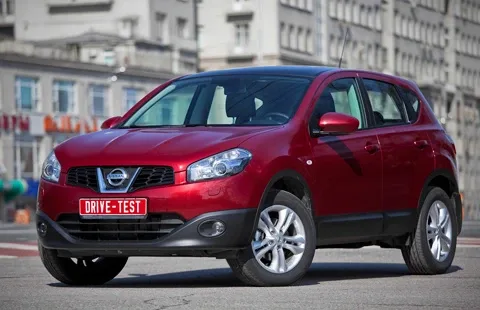
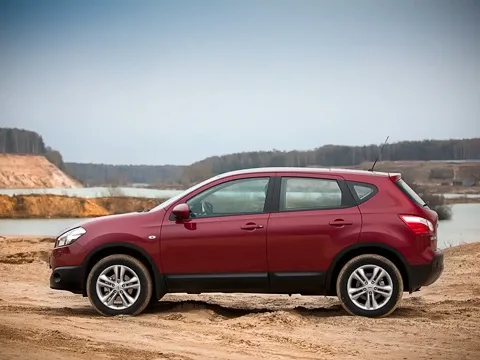
The updated Qashqai features new headlights, a faux radiator grille, hood, and front bumper.
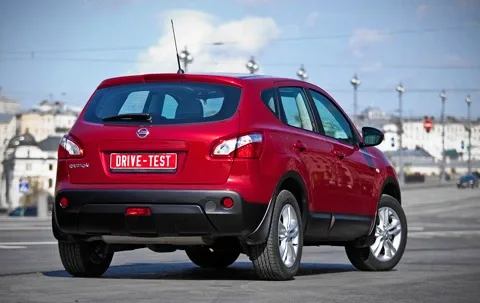
From the rear, the updated model is distinguished by white "boomerang" taillights.
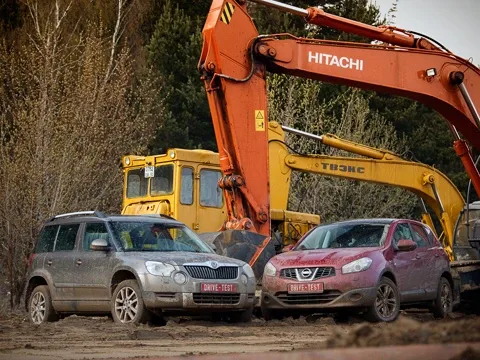
Nissan looks more massive and solid than its Czech competitor. The previous Qashqai's face resembled a mischievous teenager, but the new optics and the "grin" of the air intake did their job—the frightened expression disappeared. The facelift has definitely benefited the model. The interior is especially good. The dashboard and upper part of the door cards are trimmed with expensive, pleasant-to-the-touch plastic. Instead of the orange "eye" in the instrument cluster, a full-fledged screen has appeared, and the on-board computer menu is fully translated into Russian, including the navigation system installed in our car.
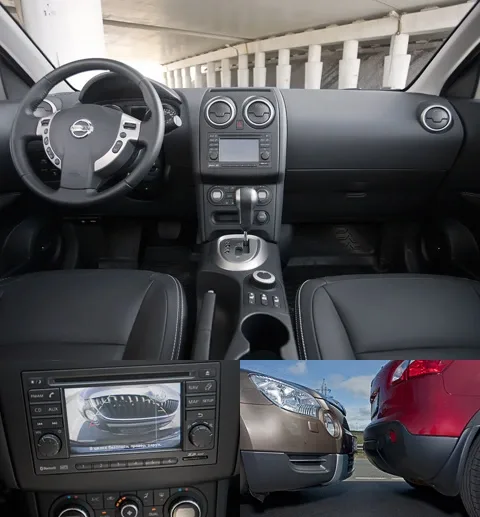
- If it ain't broke, don't fix it. The current Qashqai interior differs from the pre-facelift one only in details.
- Nissan's "parking assistant" is a rear-view camera with trajectory hints. The lens is not protected from dirt, but as long as it's clean, parking is no problem.
The driver's seat in the Qashqai is noticeably higher than in the Yeti. You sit behind the wheel and feel like a ship's captain looking down on everyone. For short drivers, this seating position is a real gift, but I am 178 centimeters tall. I constantly have to press the "jack" under the seat, trying to lower myself, because there are no more than two centimeters between my head and the panoramic roof curtain. The front seats did not please. The profile of the cushion and backrest arches your back, and you can forget about lateral support—there are simply no bolsters.
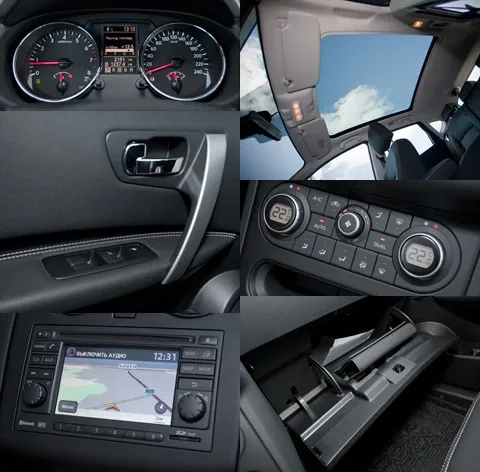
- The new instrument cluster with a rectangular trip computer screen is not only more aesthetic but also more informative than the previous one.
- The climate control unit features clear detents on the rotary knobs. However, the three-tier stack of buttons and the murky display windows are disappointing.
- Gloves and a book will probably fit in the Qashqai's glovebox. But where to store CDs?
- The navigation system is available on the Qashqai starting from the SV version for 884 thousand rubles.
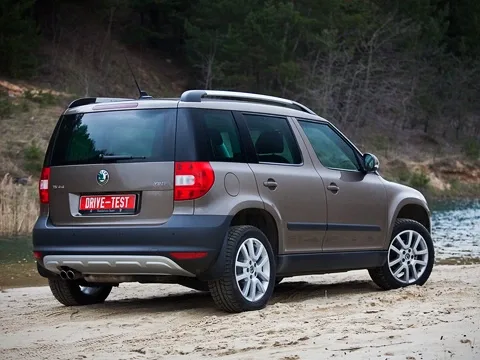
Skoda's engine and gearbox combinations are not as tight. All-wheel drive is available only with the 1.8 TSI engine and manual gearbox (as in our case). And the DSG "robot" that saves you from traffic jams comes paired with a less powerful engine and front-wheel drive. Also, the Yeti's appearance can hardly be called crossover-like. It's a bit small, this Yeti. Rather, it's a station wagon with increased ground clearance. From the rear, it looks like a van: an almost vertical door, an unpainted bumper, and a straight "windowsill" line. But from the front, it has a cute face with round "glasses" of fog lights. There's something of the snowman in it.
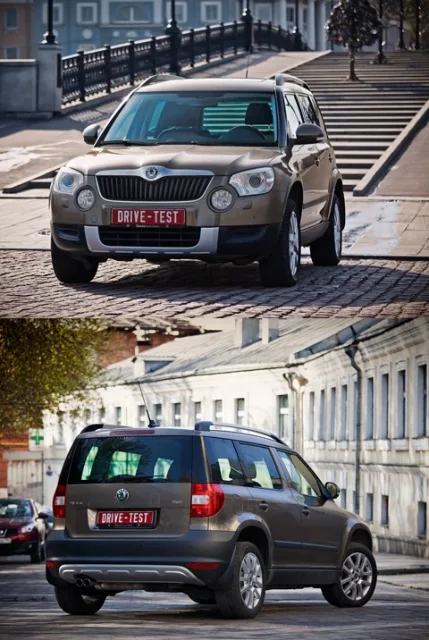
The radiator grille with vertical "teeth," the "comb" on the hood, and the aviation-style middle roof pillar, familiar from the Roomster. Working in the new genre of compact crossovers, Skoda designers tried to preserve as many family traits as possible.
The Skoda's interior greets us differently than the Nissan. When getting in, you grab the wide sill and find yourself in an almost ideal seat with moderate but sufficient lateral support. Need to sit lower? No problem! Adjustments are in the widest range, in any direction, and even at maximum height, your head doesn't touch the ceiling. Moreover, the full set of adjustments is also available for the passenger seat: it can also be raised, and even the lumbar support is adjustable.
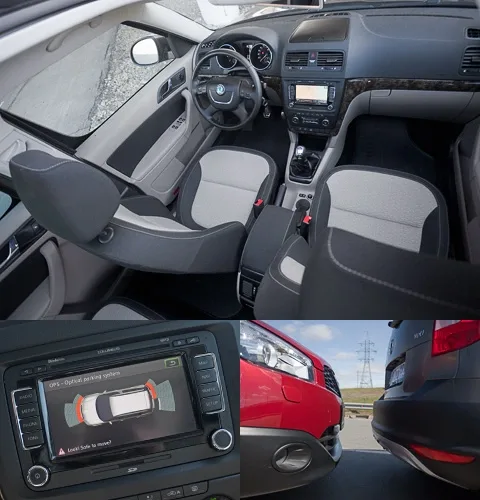
- The strict Yeti interior is diluted with chrome trinkets and an extremely unsuccessful imitation of wood veneer. Fortunately, this is an option. By default, the front panel has silver plastic inserts.
- Skoda has no parking camera; it is replaced by parking sensors. They work clearly regardless of the weather, but the alarm sounds much earlier than the rear bumper is in front of an obstacle.
Inside, everything is familiar from other Skoda models. The instrument cluster with its characteristic radial markings. The readings of the low-mounted climate control unit are only normally readable in the dark. The optional multimedia system for 12 thousand rubles stubbornly ignores the Russian language. But the interior only irritates with small things: the plastic is "oak" in places, the handles above the doors have no micro-lifts, and the sun visors have no illumination. It's clear that Volkswagen marketers are separating the Yeti from the Tiguan this way. But this somehow doesn't fit with the price of our test car—1.3 million rubles.
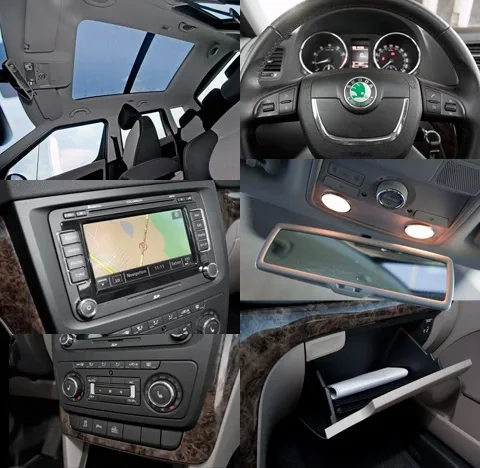
- Due to weak illumination and the low location of the climate control unit, adjusting the Skoda's temperature blindly is difficult. Moreover, the knobs easily turn two or three extra positions.
- The steering column is set too close to vertical, causing the steering wheel rim to potentially overlap the upper sectors of the dials.
- An A4 sheet of paper fits into the Skoda's glovebox only folded.
- The navigation system for 76,400 rubles is installed optionally, and only on versions not lower than Ambition (from 759 thousand rubles).
But in the back, the Skoda is noticeably more spacious, despite its smaller dimensions. Knee room is like in a business sedan, and headroom is like in a minivan. The side sections of the rear seat can be slid forward, folded, or removed entirely. The Qashqai doesn't have such freedom. The rear bench is a bit cramped, and it only transforms by folding the backrest. The Japanese saved on rear passengers!
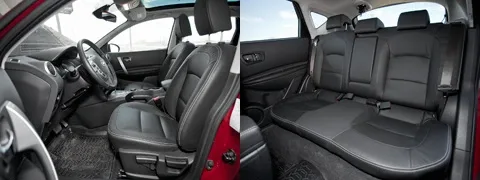
- The Qashqai's front seats have weak lateral support and a far from optimal profile. And we only noticed the accidentally pressed seat heating button after twenty minutes, when it started to get hot.
- The Qashqai surpasses the Yeti not only in body dimensions but also in wheelbase length: 2630 mm versus 2578 mm. However, the rear of the Nissan is still more cramped.
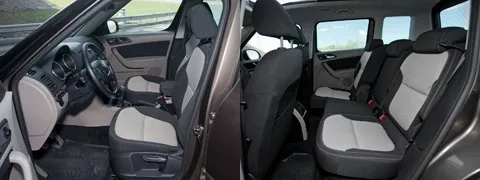
- The Yeti's front seats are comfortable for drivers of any build.
- The transformation of the rear seat adds practicality to the Czech car, but you can't fold the seats with one hand.
The main element of our subjects is the city. Let's start with that. Carefully driving off a high curb... and the Yeti's lower suspension arm catches a stone. For urban conditions, the Skoda's ground clearance is a bit small—only 180 mm. But if the "snowman" jumped off a cliff and didn't hurt itself, any winds are favorable.
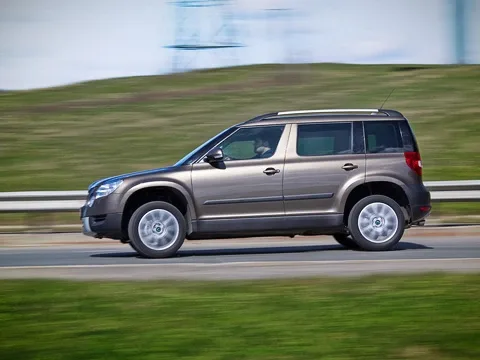
Driving the Yeti is easy and pleasant. The car is almost indifferent to ruts, and the cabin is as quiet as inside a representative Superb. The brakes are informative in a German way, and a certain excess of pedal sensitivity during smooth stops is compensated by the intensity of deceleration from high speeds.
The clutch, following old Volkswagen tradition, is "empty" and "long," but the Czechs cheated by shifting the moment of disc engagement to the very beginning of the pedal travel. Starting off has become easier. However, when changing gears, this setting requires getting used to. At first, I couldn't synchronize my actions to avoid a jerk. After all, you now have to press the left pedal all the way to the floor, and on top of that, the gear lever needs to be moved over long distances. Never mind, I got used to it.
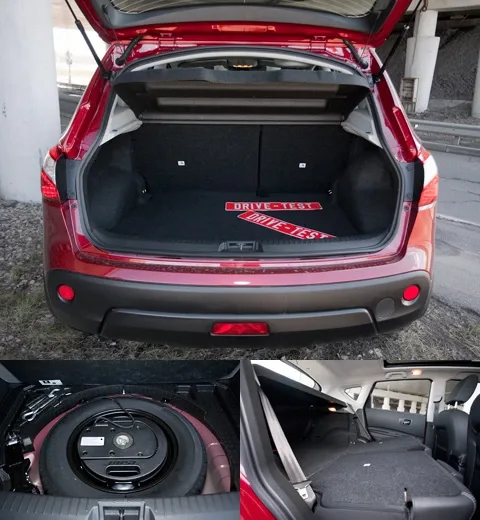
According to technical data, the Qashqai's trunk is only 350 liters (like a C-class hatchback). But visually, there's more space here than in the Yeti.
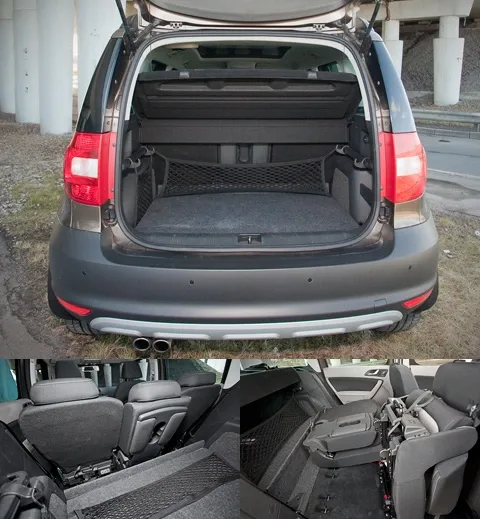
The Yeti's trunk volume is 405 liters. But the compartment is "spoiled" by a foam insert under the spare tire. If you fold the backrests (which creates a step), it becomes as much as 1760 liters.
At low revs, the 152-horsepower engine of the Czech crossover is frankly "asleep." The passport data states that 250 N•m appears from 1500 rpm, but in practice, the engine wakes up noticeably later, like a sleep-deprived student. However, as soon as the tachometer needle goes up, the Yeti literally shoots forward, and you begin to doubt the factory figures. Either the power is actually higher, or the curb weight of 1550 kg is incorrect.
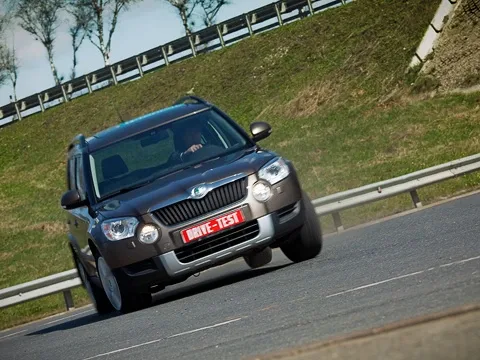
In standard modes, the Yeti pleases with moderate body roll and an informative steering wheel — handling is almost exemplary. If you overdo it with speed in a corner, the car will smoothly slide outward with the front end, and the stability system will neatly dampen both understeer and oversteer.
In essence, the Yeti is a sports car with increased off-road capability. And it's not just about acceleration to 100 km/h in 8.5 seconds — such figures would be enough for many hatchbacks to claim the title of "hot." The main thing is the feeling: you sit behind the wheel of a one-and-a-half-ton car, but you feel as if you're driving a light and nimble hot hatch. Even if the rear shock absorbers sometimes allow slight vertical pitching, the body hardly rolls in corners. The "Snowman" seems to fly over the road, and the main credit for this goes to the precise and informative steering. Just turn the wheel a couple of degrees, and the car immediately changes its trajectory.
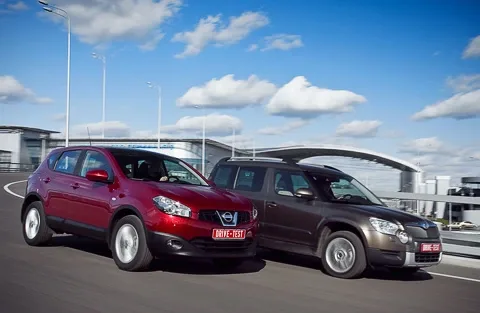
According to the documents, the Nissan yields to the Yeti almost three seconds in acceleration to 100 km/h and 19 km/h in top speed. These are cars with completely different temperaments.
The Qashqai noticeably lags behind. For example, the Japanese crossover jumped off a curb without effort and even initially rolled ahead. But its gas pedal is more damped than the Skoda's (although softer than the Renault with the same engine). The Qashqai's CVT is tuned more lively than the Koleos or Megane Coupe, but the overall impression is similar: this car is closer to measured driving rather than a spirited chase.
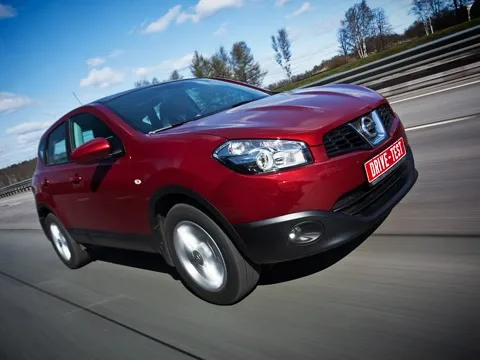
The updated Qashqai has become noticeably quieter on the move. However, the rear wheel arches are still unprotected. On dirty asphalt, the silence in the cabin is disturbed by the ringing of pebbles hitting the body.
The engine, transmission, and chassis of the "Japanese" live in one unhurried rhythm. As soon as you try to speed things up, dissonance arises. The engine lacks power, the CVT whines, piercing the enhanced sound insulation, and the steering wheel fills with unnatural effort during active driving, which only protects against gross errors. The suspension allows deep body roll. The brakes also raise questions: the first half of the pedal travel pleases with precision, but as load increases, the feeling of control is lost. Fortunately, the car continues to slow down, but the ABS engages too early and unexpectedly for the driver.
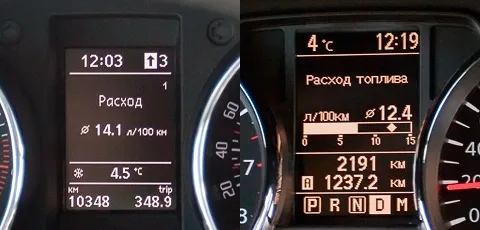
- Each car has its own way of monitoring fuel consumption. The Nissan has a graphical econometer.
- The Skoda has an arrow-hint in the upper right corner of the display, showing the optimal moment to shift gears. At the same time, the Czech crossover consumes an average of 11 liters of fuel per 100 km, while the Japanese one consumes one and a half liters more.
The "Japanese" responds to steering commands with a noticeable delay. Retuned silent blocks and more energy-intensive shock absorbers do not save the Qashqai from a feeling of looseness against the backdrop of the composed Yeti. But as soon as the Nissan stops chasing the "Snowman," everything falls into place. The suspension pleases with comfort, the engine again works in unison with the transmission, and even the "lazy" steering wheel stops being annoying. All the joy of driving the Nissan is at low speeds.
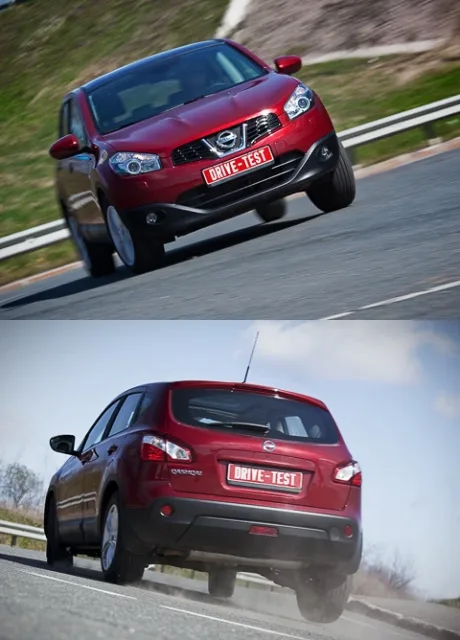
The higher the speed in a corner, the thinner the connection with the car. Under strong lateral load, the Qashqai often lifts the inner wheels, despite the impressive shock absorber travel.
Such melancholy is alien to the Yeti driver. He, of course, can also drive slowly — it was in this rhythm that we managed to achieve a consumption of 10 liters per hundred, which is not bad for a car of this class. But the suspension, which at speed indiscriminately swallows all bumps, suddenly starts letting impacts through at low speeds. And as soon as we drove onto a dirt road, shaking was added to the impacts. The Qashqai is noticeably more comfortable on gravel and, as a result, faster. It has more suspension travel and sufficient energy capacity. Where the Skoda driver has to slow down to avoid unpleasant sensations, the Nissan can continue without stopping.
What about off-road capability? Trying not to take risks, we gradually, step by step, searched for the limits of both cars in one of the Moscow region quarries. And here is the result. The Yeti, despite its off-road name, is not great off-road. But it couldn't be otherwise. The rear wheels engage automatically, and the only thing the driver can control is the accelerator algorithm. The button on the front panel sharpens throttle response, allowing wheelspin. But to avoid getting stuck, we, on the contrary, need smoothness in torque distribution.
So whether you press the pedal or not, the car is too sensitive to fuel delivery. And this is the main "anchor" off-road. Starting without wheelspin on loose sand is a whole problem, driving in a taut manner on a washed-out dirt road is another. But if there are few potholes and the dirt road is full of turns, you can fly through with a breeze. When you release the gas, the Yeti actively tucks into the corner. If you "spur" the car, you can spectacularly go through the entire turn in a controlled drift. If you don't want to play around, you can easily counter the slide with the steering wheel, and the car stabilizes without unnecessary oscillations.
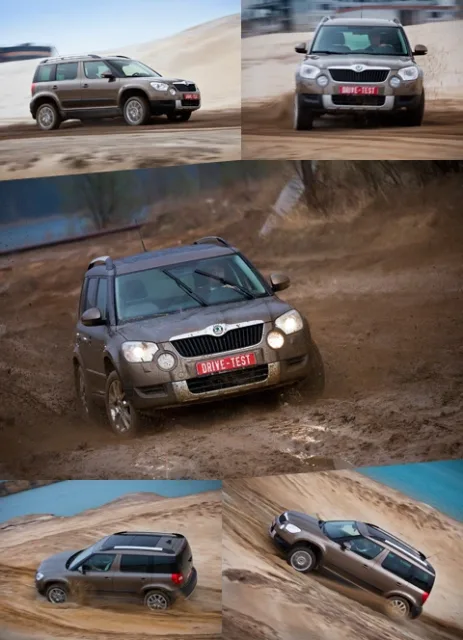
The Yeti driver is helped by electronics on steep descents. If you stop on a slope, the brakes will remain locked for a few more seconds, making it easier to start. The stability system on the Yeti cannot be switched off, but this is not a hindrance, but rather insurance for those who don't feel the limit.
The Qashqai's all-wheel drive is the same as that of the Nissan X-trail crossover: the electromagnetic clutch in the rear wheel drive can be forcibly locked. Combined with the smooth operation of the CVT transmission, this allows bolder off-road driving. True, even with the partially locked clutch, the Qashqai sends most of the torque to the front axle, which digs into loose soil.
The "Japanese" electronics play it safe, switching the transmission to Auto mode as soon as speed reaches 30 km/h. The stability system, unlike the one installed on the Yeti, can be completely switched off. But it's advisable to do this only when tackling slopes, where such a procedure provides real benefit. But the Qashqai does not approve of "driving on the ears." Slides develop unexpectedly, and it's difficult to control them with the low-information steering wheel. Moreover, slides here have an unpleasant tendency to develop both when lifting off the gas and under power. If you delay correction, you'll have to catch the car, actively working the wheel. If it weren't for this trait in the Qashqai's character, the results of our off-road competitions could be called expected. The one who is better on asphalt yields on rough terrain. However, both the Yeti and, not to mention the Qashqai, handle the simple task of getting to a beach or a country house. The main thing is not to overdo it.
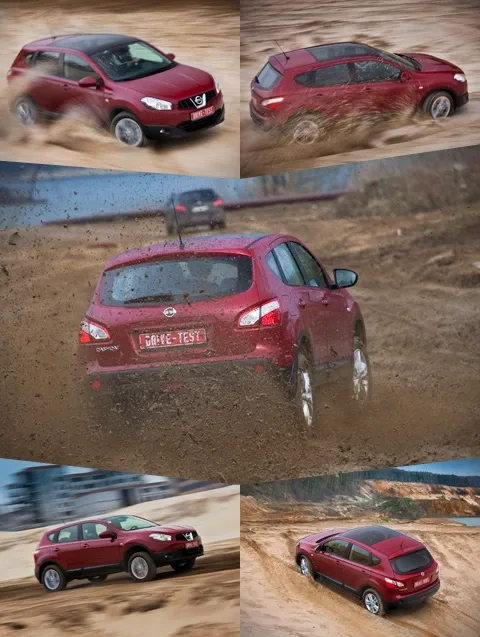
The Qashqai's clutch is forcibly locked if speed does not exceed 30 km/h. Although not completely: the system allows "insurance" slipping of the friction discs. But combined with the fully switchable stability system and large suspension travel, this still ensures the Japanese crossover's superiority over the Yeti off-road.
Ask which car was a surprise for us? The Nissan. Before the test, we were sure that the Qashqai, to put it mildly, was no match for the Yeti. Probably, if we were giving expert ratings, by points it would have turned out that way. The "Japanese" has no trumps against the "Yeti's" engine power and precisely tuned chassis. But no points can express the stress resistance that this car provides to its occupants. Nor can one measure the calm it bestows. Despite completely different characters, we cannot say that one car is worse than the other. The balance of driving qualities in both duelists is chosen correctly — with different consumers in mind.
- For the simplest crossover from the Czech Republic with front-wheel drive and a 1.2 TSI engine, you need to pay 699 thousand rubles. And for a car with all-wheel drive and a 152-horsepower engine, you'll have to pay another 200 thousand. Such a Yeti has only two airbags, steel wheels, and lacks a "music" system.
Here is the revised test drive text:
The Qashqai with a 1.6 engine is priced at a minimum of 753 thousand rubles. The initial version includes six airbags and a radio, but there is no stability system here — it's only available on cars with a two-liter engine, whose starting price is 854 thousand. For the CVT, you need to pay an extra 40 thousand, and for all-wheel drive — 99 thousand. The top modification, Nissan Qashqai LE+ with navigation, leather interior, and panoramic roof, will cost 1,163,000 rubles. A similarly equipped Yeti will be 49 thousand more expensive.
The Qashqai doesn't cause stress and will be a good helper for women. It's a bit clumsy, but reliable, and most importantly—balanced. In such company, it's harder to lose your head than next to the mischievous Yeti. The latter, although it looks like a mail van, can not only captivate the driver but also satisfy his sporting ambitions. True, due to its modest off-road capabilities, the Czech feels better in the city and on the highway. But we wouldn't recommend going off even a bad road: it's not worth it. Especially since it's not cheap anyway.
Technical Specifications
| Model | Skoda Yeti 1.8 TSI 4×4 | Nissan Qashqai 2.0 4WD |
| Body |
| Body type | wagon | wagon |
| Number of doors/seats | 5/5 | 5/5 |
| Length, mm | 4223 | 4330 |
| Width, mm | 1793 | 1780 |
| Height, mm | 1691 | 1615 |
| Wheelbase, mm | 2578 | 2630 |
| Track front/rear, mm | 1541/1537 | 1540/1550 |
| Curb weight, kg | 1550 | 1535 |
| Gross weight, kg | 2050 | 1960 |
| Trunk volume, l | 405–1760 | 352–1513 |
| Engine |
| Type | petrol, with direct injection and turbocharging | petrol |
| Location | front, transverse | front, transverse |
| Number and arrangement of cylinders | 4, in-line | 4, in-line |
| Number of valves | 16 | 16 |
| Displacement, cm3 | 1798 | 1997 |
| Max power, hp/rpm | 152/4500–6200 | 141/6000 |
| Max torque, N•m/rpm | 250/1500-4500 | 196/4800 |
| Transmission |
| Gearbox | manual six-speed | CVT |
| Drive | plug-in all-wheel drive | plug-in all-wheel drive |
| Chassis |
| Front suspension | independent, coil spring, McPherson | independent, coil spring, McPherson |
| Rear suspension | independent, coil spring, multi-link | independent, coil spring, multi-link |
| Front brakes | ventilated disc | ventilated disc |
| Rear brakes | disc | disc |
| Tires | 225/66 R17 | 215/60 R17 |
| Ground clearance, mm | 180 | n/a |
| Performance Characteristics |
| Maximum speed, km/h | 200 | 181 |
| Acceleration time 0-100 km/h, s | 8.4 | 11.3 |
| Fuel consumption, l/100 km |
| — urban cycle | 10.1 | 10.6 |
| — suburban cycle | 6.9 | 6.5 |
| — combined cycle | 8.0 | 8.0 |
| Emission standard | Euro-5 | Euro-4 |
| Fuel tank capacity, l | 60 | 65 |
| Fuel | AI-95 | AI-95 |
Trim Levels
| Base trim | Skoda Yeti 1.8 TSI 4×4 (Experience) | Nissan Qashqai 2.0 4WD (LE+) |
| Front airbags | + | + |
| Side airbags | + | + |
| Inflatable curtains | - | + |
| Isofix child seat anchors | + | + |
| ABS | + | + |
| Electronic stability control | + | + |
| Power steering | + | + |
| Automatic transmission | - | + |
| Adaptive headlights | + | - |
| Fog lights | + | + |
| Rain sensor | + | + |
| Rear wiper | + | + |
| Light sensor | + | - |
| Immobilizer | + | + |
| Rearview camera | - | + |
| On-board computer | + | + |
| Cruise control | + | + |
| Dual-zone climate control | + | + |
| Keyless entry | - | + |
| Multifunction steering wheel | - | + |
| Tilt and telescopic steering column | + | + |
| Heated and power-adjustable exterior mirrors | + | + |
| Front seat height adjustment | + | - |
| Driver seat height adjustment | - | + |
| Split second-row seats | + | + |
| Heated front seats | + | + |
| CD player with MP3 support | + | + |
| Navigation system | - | + |
| Panoramic roof | - | + |
| Alloy wheels | + | + |
| Leather upholstery | - | + |
| Base trim price | 1,019,000 | 1,163,000 |
| Additional equipment of the test car |
| Metallic paint | + | + |
| Sunroof | + | - |
| Driver's knee airbag | + | - |
| Wood trim inserts | + | - |
| Front and rear parking sensors | + | - |
| Rear side airbags | + | - |
| Curtain airbags | + | - |
| Power panoramic roof | + | - |
| Bi-xenon headlights | + | - |
| Columbus navigation system | + | - |
| Multifunction steering wheel with audio and phone controls | + | - |
| Price of the tested car | 1,300,000 | 1,173,000 |
Nissan Qashqai Technology
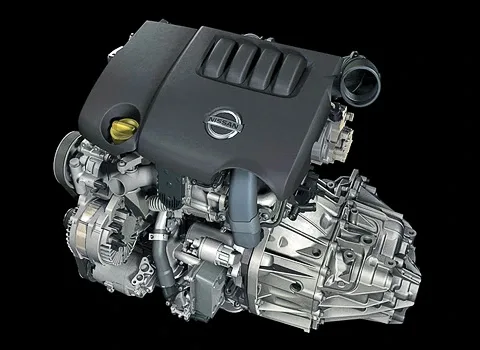
Under the hood of the Qashqai, there can be two petrol engines. The younger one—1.6 (115 hp)—works exclusively with a five-speed manual and front-wheel drive. Versions with the two-liter engine are also available with a CVT and the intelligent all-wheel drive system All-Mode 4×4i.
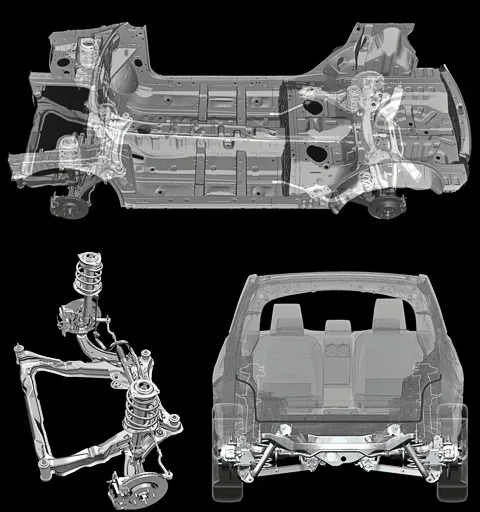
The Qashqai replaced the Almera. This "nomad" is based on the same corporate C platform as the X-trail, the American Rogue, and the "twins" Renault Koleos and Samsung QM5. It appeared on the market in early 2007. The Qashqai has McPherson struts at the front and a multi-link suspension at the rear. During modernization, engineers used less rigid silent blocks and changed the shock absorber supplier.
Skoda Yeti Technology
In Russia, only two turbocharged petrol engines of the TSI series are available for the Yeti. The turbocharged 1.2-liter engine produces 105 hp and can work with either a six-speed manual or a DSG robotic gearbox. But such a car is only front-wheel drive. In the all-wheel drive version with the 1.8 TSI engine, the power in the Russian specification is reduced by eight horsepower—to 152.
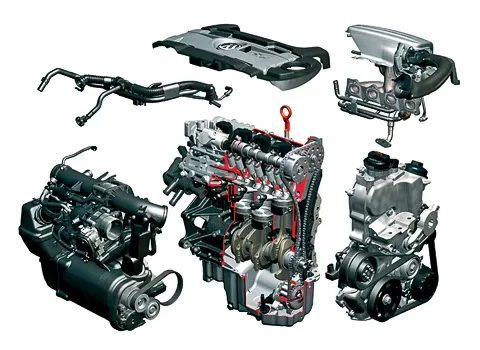
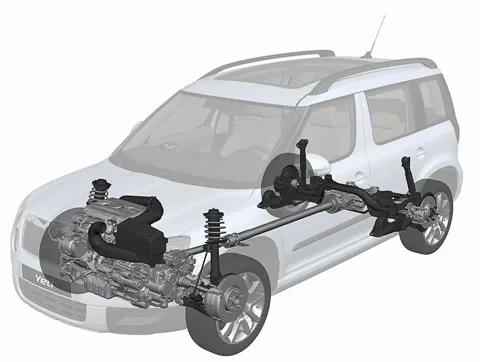
The Yeti's aggregate base was the larger Skoda Octavia: from it, the crossover got the platform with McPherson at the front and multi-link at the rear, the 152-horsepower engine, and the all-wheel drive transmission with the fourth-generation Haldex coupling.
Design
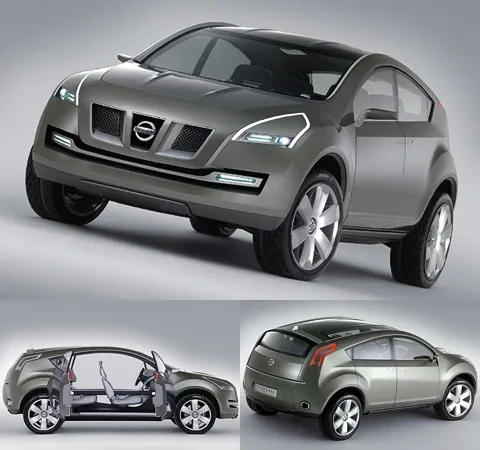
In the production crossover, it's hard to recognize the Qashqai concept shown six years ago. The prototype was larger, and its high-tech features like self-dimming headlights and rear doors that open against the direction of travel did not go into production. But the name Qashqai, contrary to expectations, was not forgotten...
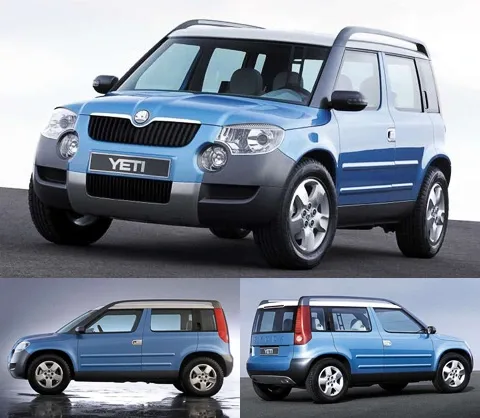
Before the premiere of the production version of the Czech crossover, the public was warmed up with a pair of concept cars. Both prototypes were based on the front-wheel drive platform of the Skoda Fabia. The blue show car was first shown in Geneva back in 2005, and it demonstrated in advance what the production car would become. True, during preparation for the assembly line, the Yeti lost some of its originality: the folding tailgate disappeared, the door handles stopped hiding in the rear pillars, and the vertical lights were replaced with ordinary ones.
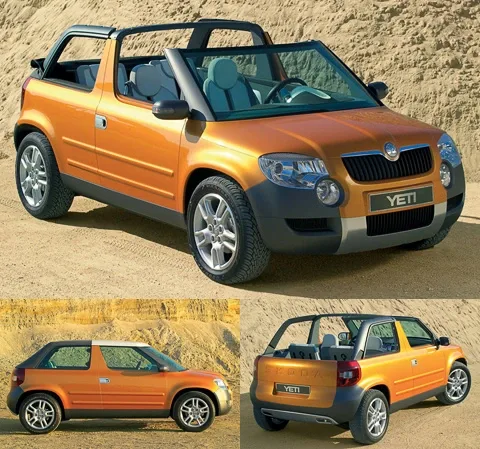
The second concept — the orange Skoda Yeti Pickup — clearly hinted at outdoor activities. This is not a utilitarian truck at all. The highlight of the open Yeti is the combined roof: a rigid removable top covered only the front seats, while the cargo area was protected from rain by a canvas awning.
Behind the scenes
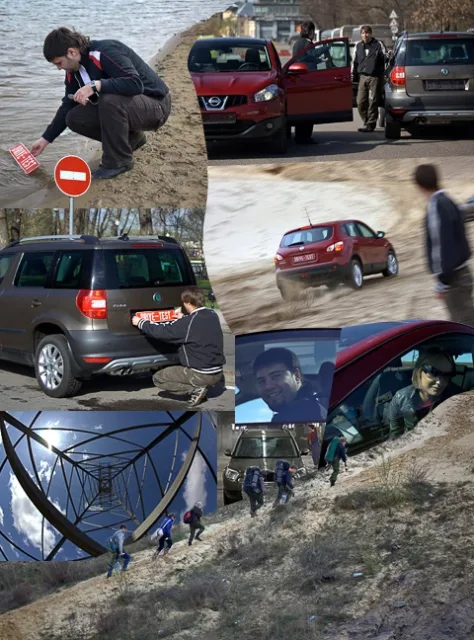
During those days we were frankly lucky. There were no queues at car washes, and traffic cops let us into pedestrian zones for shooting without any questions. And when we urgently needed mud, the sky burst into the first spring downpour, turning the surrounding dirt roads into a mess. Perfect! The only disappointment — due to lack of time, we never managed to shoot a video during this run.