
Mazda3
SPORTY
Engine — 2 L
Max. power — 150 hp
Max. torque — 187 Nm/4000 rpm
Max. speed (km/h) — 203
Acceleration 0–100 km/h — 9.1 sec
Fuel consumption:
combined — 7.4
city — 10.2
highway — 5.7
Activematic, 5-speed
Curb weight — 1260 kg
Length — 4580
Width — 1755
Height — 1470
Tires — 205/55 R16
Equipment:
Dual-zone climate control, multi-function display, 4 power windows, bi-xenon with adaptive lighting, auto-dimming rearview mirror, heated windshield, rain and light sensors, cruise control, power steering, CD MP3 audio system, central locking, alarm, parking sensors, power-folding side mirrors, ABS, EBD, DSC, front and side airbags + side curtain airbags.
Service interval:
15,000 km
Service 1 — $183 (1,458 UAH)
Service 2 — $308 (2,457 UAH)
Service 3 — $217 (1,728 UAH)
Service 4 — $308 (2,457 UAH)
Service 5 — $396 (3,162 UAH)
Service 6 — $434 (3,470 UAH)
Service 7 — $183 (1,458 UAH)
Warranty — 3 years or 100,000 km
Price — 962,000
Base — $21,499 (171,990 UAH)
Main competitors: Mitsubishi Lancer, Ford Focus, Honda Civic, Opel Astra, VW Golf 5.
Marat Makhmutov,
Kazan School of
Advanced Driving
Skills
Mazda fans have surely been eagerly awaiting this news: the brand's most popular car, the "three," has finally undergone a major update this year. But what exactly is the difference between the previous version and the 2010 model? Is there reason to praise the newcomer or, on the contrary, to criticize it? That's exactly what we wanted to find out during the test. Judging by the technical data, the newcomer uses the same platform as its predecessor, which in turn got it from the "Ford Focus 2." If so, then we can speak confidently about handling: the second "Focus" received much praise for its driving qualities, and the old "three" was loved by many for combining striking looks with a driver-oriented character. But if the technology, with rare exceptions, remained the same, was there any point in changing anything? I'm convinced there was, and I'll explain why. I'll start, as usual, with the exterior. A C-class sedan painted in dazzling white — that's what the test car was — from a distance, for someone not too knowledgeable about cars, could easily pass for a "six" from the same manufacturer, which is already D-class. Surely the future owner will be flattered if their car is mistaken for a higher-category vehicle.
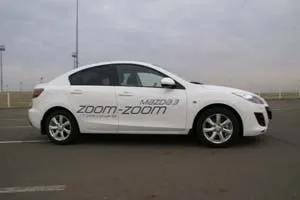
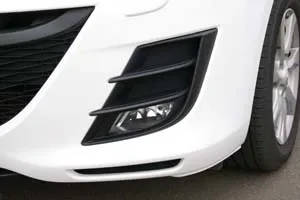
The silhouette is sporty, swift, and the sculpted ribs along the body sides and the rising beltline toward the rear add special charm. The lighting — front xenon with a swivel mechanism that reacts to the steering angle — has become more expressive both front and rear. In place of the familiar radiator grille, there's now a solid panel in body color with an emblem resembling a bird's open wings, while the grille itself has moved lower. Its shape is such that from a certain angle, the car seems to smile broadly. Some may not like it, others may appreciate it, but the fact that the new look has become friendlier is undeniable. So there you have it: a "smiling Mazda," no less. The rear looks quite "adult," and the resemblance to the "Mazda-6" is obvious. For a more solid and formidable appearance, only a second exhaust pipe is missing, but as far as I know, it's available in more expensive versions. The most noticeable changes are inside. The interior trim materials have mostly become significantly better than before. The upper part of the dashboard could serve as a benchmark for some "premium" brands — the texture is so good that it's pleasant to both look at and touch.
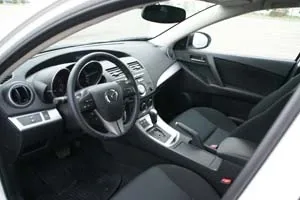
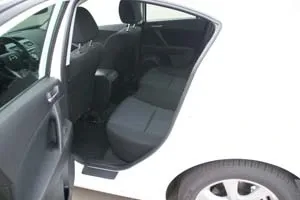
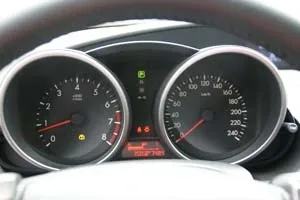
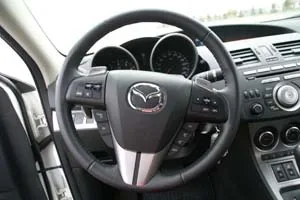
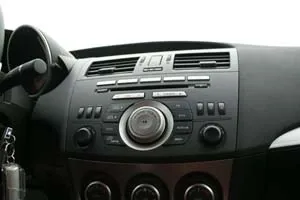
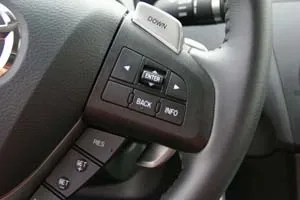
The instruments, as before with this brand, are round and recessed into wells, but now instead of three dials, there are two. A monochrome display has been added, which shows all necessary information in Russian: onboard computer data, dual-zone climate temperature, radio settings, and more. The very comfortable three-spoke leather-wrapped steering wheel not only looks stylish thanks to the aluminum insert at the bottom but also feels pleasant in the hands. It has many buttons for controlling the audio system and cruise control, and beneath it hide "paddles" for manual upshifts. To shift down, there are large buttons on the upper part of the left and right halves of the wheel. An ergonomic and well-thought-out solution, I must say! The standard audio system pleased us all with very decent sound, although checking sound quality isn't part of our mandatory test set — let audiophiles handle that. Overall, we got the car in a rich trim: dual-zone climate control, xenon headlights as I mentioned, and pleasant touches like an auto-dimming mirror, rain and light sensors, parking sensors, and much more. Getting into the comfortable front seats is easy, and the driver's position strongly resembles that of a well-known German manufacturer with aviation heritage. In the back, however, due to the narrow door opening, you have to carefully position your foot when exiting to avoid hitting the sill or pillar. Still, there's enough room for four people. A fifth can also be seated, but two in the back will be more comfortable — especially with the fold-down armrest in the seatback with cupholders. The trunk is of proper shape, but the floor isn't perfectly flat: there are raised areas closer to the bumper, and a "donut" spare hides in a niche. I really liked the noble, "soft" sound of the trunk lid closing, and for opening it, there's a discreet but convenient small button on the lid itself.
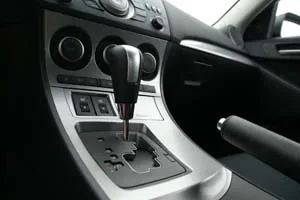
The white sedan got a two-liter engine producing 150 horsepower, paired with an automatic transmission. We insert the key into the start button — and off we go. From the very first meters, you're surprised at how briskly the car responds to the gas: the response is instantaneous, and acceleration is corresponding. The first thing that comes to mind is "sporty." The "automatic" shifts gears so smoothly and imperceptibly that the "Mazda-3" gains speed rapidly. The claimed 10.6 seconds to 100 km/h seems like some kind of error — the sensations are much faster.
To test handling, we didn't set up cones but used an existing thirty-meter slalom course set up for teaching beginners. And we were wrong not to change it! With such a spacing of cones, the car was frankly bored: its dynamics and razor-sharp steering responses deserved far more serious trials. We didn't even try hard, and the speed through the exercise was 110 km/h. Of course, for good measure, we briskly accelerated the "three," dove into narrow gates, and threw it into drifts — but all that was child's play for its capabilities. Nevertheless, even in this format, we managed to fully appreciate a car that delivered exclusively positive driving emotions, even on a training ground.
Special mention deserves the ride comfort. On broken roads, the new model has completely shed the excessive stiffness that the predecessor had: potholes, cracks, and ruts are passed elastically and quite softly. Directional stability remains excellent — the car confidently holds a straight line regardless of what's under the wheels.
The final impression was formed on the M-7 highway: without much effort, accelerating to 190 km/h (by speedometer), the "Mazda" continued to accelerate even uphill, as if it hadn't noticed it. Bravo! Among the drawbacks, I'd note the need to correct the steering at high speeds — the car requires attention to maintain a straight course. Noise insulation has become noticeably better than the previous model, but it still doesn't quite reach perfection.
However, for a "sporty" car, that's even good: the driver feels a sharper connection with the car and gets more pleasure. The car has surpassed its predecessor in both comfort and quality. Plus — reduced weight thanks to high-strength steels in the construction and improved fuel efficiency. There's also a fly in the ointment — the price. Almost a million rubles for a golf-class car? Well, you have to pay for pleasure…

Vadim Sadykov, "Autoclub-Kazan"
Every car has its own stereotype. The Mazda3, for example, is known for weak sound insulation, an ideal price-to-quality ratio (especially for women) with the 1.6 engine and automatic transmission, and hordes of aggressive drivers in 2.0 versions. When updating a model, the manufacturer can either reinforce the stereotype or destroy it. So what kind of beast are you, new three?
The catalog doesn't mention it, but under the hood we found a variable valve lift system. Before driving, it's worth studying the numbers (and I generally recommend starting your acquaintance with any car with its specifications). So, the 2.0 engine now produces 150 hp, but at high revs — 6500 rpm. This is a direct consequence of the variable valve lift: more air — more power. Previously, the two-liter unit developed 147 hp at 6000 rpm. The maximum torque has also increased: 187 Nm at 4000 rpm instead of the previous 184. True, there's not much to brag about here: modern two-liter engines rarely have less than 195 Nm, and even the 1.8 (180 Nm at the same 4000 rpm and 147 hp at 6000) is about to catch up with this 2.0. Preliminary conclusions (which we'll verify on the road): the mid-range torque, although increased, remains modest, but at the top end the car has become significantly more spirited. Surprisingly, in real driving at mid-range revs, everything turned out to be quite decent — there was always a reserve of torque. But the forecast about the "top end" was confirmed: the character is peppy, and on the highway we limited acceleration only for safety reasons. In the city (if you don't let the revs drop), the car is a real "live wire."
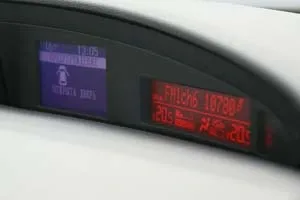
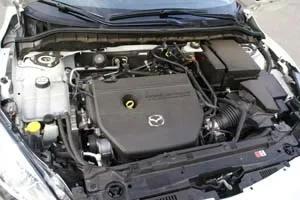
The acceleration dynamics (10.6 seconds to 100 km/h — a so-so figure for two liters) largely depend on the gearbox settings. Here, a 5-speed automatic is installed. The overall gear ratio in first gear is 13.984 (for the manual — 15.156). With such an "automatic," I wouldn't venture into deep mud or snow slush — the wheels might simply lack torque to get out. Analyzing the gear ratios gives more information. For example, when shifting from first to second, the revs drop by 1.88 times: from 3000 rpm during smooth acceleration in first to 1600 in second. It's clear that at 1600 rpm, there won't be normal dynamics. So, the engine needs to be revved. During energetic acceleration, the tachometer needle consistently hit 6000 rpm. How much fuel is consumed then — better not to ask. But on higher gears, the situation is better (from fourth to fifth — already 1.35). Theoretically, this promises good dynamics on higher gears. The road confirmed: the car drives fun, and you don't need to push the engine to the limiter.
A few words about the 5-speed automatic's operation. Let's recall a similar gearbox with a two-liter engine in the Mazda6. The 2005 facelift was remembered for quick shifts and the ability to sharply drop down several gears. The current "six" has calmed down: it engages gears solidly, calmly, going through them one by one. The Mazda3 is a car for young people, so shifts here are quicker, but the principle of sequential shifting (without jumping two or three gears) remains. While driving, there are practically no complaints about this 5-speed automatic: it works clearly and adequately. But the 2005 algorithm would have been much more appropriate here!
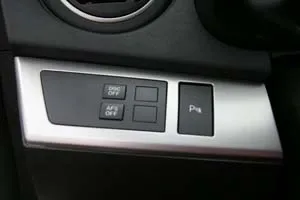
Now about the interior. Sound insulation has noticeably improved, although the engine is audible, and the rear wheels make excessive noise. The plastic of the dashboard and doors is of very decent quality. With such trim, older customers will also willingly buy the car. Another sign of "maturation" is the elastic but not stiff suspension, which swallows even serious bumps quite softly. At the same time, handling is excellent, with minimal body roll. This is important both for young people (aggressive driving, sharp turns) and for people of respectable age: comfort in everyday driving and the ability to maneuver sharply in an emergency. Fuel consumption according to the onboard computer during the test (city, highway, city) — 11.3 l/100 km. Exactly the same we got on the Audi A4 1.8 turbo (160 hp). In everyday use, the figure will likely be higher: the "three" clearly provokes revving the engine to high revs.
The Mazda3 has become more attractive externally, the interior has become more qualitative, and prices remain acceptable: everything needed for success is in place.

Alfred Mardanov, "Autoclub-Kazan"
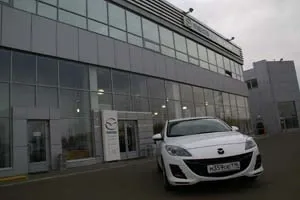
I arrived at the dealership a bit earlier than the appointed time and, approaching the window facing the street, froze by the glass. Before me stood the "three," the "six," the "five," as well as the CX-7 and CX-9. A spectacle, I tell you, impressive. Each car is attractive in its own way; they stand like planets in a parade — you can't take your eyes off them. Interestingly, the junior and senior models can be confused at first glance: the "six's" grille seems to embrace the badge, while the "three's" emblem is placed separately, on the body itself, above the grille, like on the RX-8. Well, the dimensions differ, of course, but at a distance this difference is smoothed out, and confusing the "three" with the "six" is as easy as pie. So, the new "three" strongly resembles its older sister, at least externally. The same dynamic silhouette, similar solutions around the headlights, hood, and wheel arches. Overall, the car has become not so much more interesting as more modern and stylish. And why is that, you ask? Because the previous Mazda3 with its indestructible design still looks fresh and attractive!
As soon as I took the driver's seat, I immediately noticed how dramatically the interior had transformed. I was especially pleased with the arc of information screens that stretches in a semicircle across the front panel and extends behind the instrument cluster. Honestly, I was even a bit overwhelmed — there's a lot here: cruise control, dual-zone climate, the Direct Activematic system with paddle shifters, and the trim materials are soft to the touch. The new Mazda has become noticeably richer and, in several parameters, goes beyond the usual C-class boundaries.
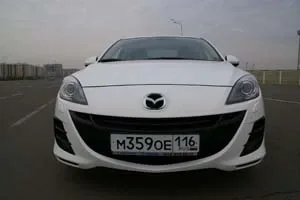
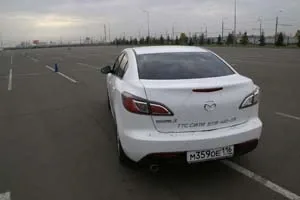
The progress in the interior is colossal — there's no trace of the old "three" here. The build quality is better, the materials are nicer, and the design is successful; the Japanese did their best. To take a couple of shots, I needed to park the car in front of the showroom. I get behind the wheel, start maneuvering in place — and then, oh my god, a terrible grinding sound comes from somewhere! Some strange noise, and precisely when turning the steering wheel in the parking lot. Brrr. It didn't happen again, but the aftertaste remained. I start the engine — and immediately feel that the sound insulation has become better than its predecessor's: the engine's operation is almost inaudible in the cabin. I don't know how the car will behave on the move, but that's the first impression.
The photo session is over, time to hit the road. As usual, the route leads to the test site, where we run the "slalom." True, today it's long — a full 34 meters, to be precise — and for this car, it's too easy, even boring! The Mazda3 dives into corners with a big margin, navigating them as if reluctantly, out of respect. If it could speak, it would surely snort: "Just like kids, honestly!" It's clear that on such a long "slalom," you can't squeeze anything out, although it's obvious: the car handles excellently and, thank God, hasn't lost its sharpness and driver-oriented character. Since the "slalom" didn't work out, I'll try using the free space to test it in a drift.
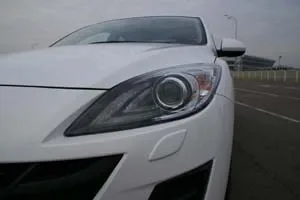
I turn off the stability control, floor the gas, sharply turn the wheel — the car reluctantly goes into a slide and, when I release the gas, quickly returns to the set trajectory. Not bad, let's try again! The result is the same: the car "catches" perfectly if provoked into oversteer. Perhaps the electronics still don't fully "let go of the reins" and imperceptibly intervene in extreme modes. It's very pleasing that, contrary to modern trends, the car hasn't turned into a safe "mush" and has retained the charge of driving excitement for which 100,000 buyers chose the previous model.
Marat is the first to leave the racetrack onto the highway — he got the longest section, while I got more "city." On the highway, we mainly check the automatic transmission's operation and acoustic comfort at speed. Alas, weak sound insulation remains the bane of Mazda — although it has become noticeably better than before, the noise from the wheel arches is still audible. It's felt that the suspension has also been worked on: it has become more comfortable but hasn't lost any handling. Even at the site, I noticed that the car barely rolls even in sharp turns. Outside the city, it's pure pleasure: the car holds its course by itself, ignoring bumps, and can be controlled with literally one finger. Ergonomics are excellent, the interior is comfortable, though the steering wheel is littered with a bunch of buttons that you can't figure out at first glance. The buttons on the steering wheel allow shifting gears even in Drive mode. Moreover, the buttons on the left and right duplicate each other. In other models, usually the right side is "up," the left is "down," but here both paddle shifters are "up," and the buttons under the thumbs are "down." A convenient solution: you can shift up or down with either hand.
The city mode also did not disappoint. With the nimble automatic transmission and sharp steering, you feel like a fish in water in traffic. I even made the whole company laugh by teaching a rude driver in the next lane a lesson. The car allows it, and that's pleasing. As I already mentioned, the car has clearly become better, richer, more fashionable, and, as a result, more expensive. But, it's worth noting, this is a general trend, and it should not spoil the driving pleasure that this car provides.