
Lexus gathered journalists in a Moscow suburb nature reserve, saturated with a poetic atmosphere, not at all to introduce us to the beautiful. The purpose of the meeting was to get acquainted with the GS 350 AWD modification, new to the Russian market. The model's life cycle is coming to an end, and as a final touch, the Japanese decided to bring us the all-wheel-drive version, which was previously sold only in the USA and a couple of Middle Eastern countries.
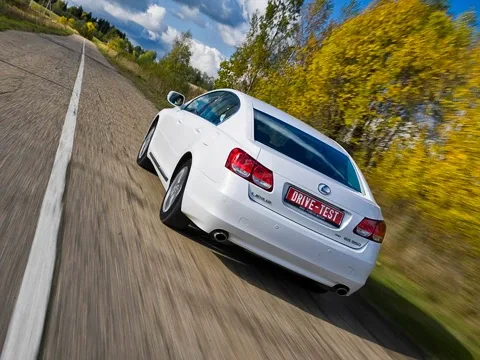
The Lexus office is in no hurry to reveal sales volume plans, but hopes that half of all GS models sold before the generation change will be all-wheel-drive versions. For reference: last year, 1,861 such sedans were sold in Russia. This year, repeating this result is unlikely — the market situation is different.
We are already well acquainted with the GS sedan. In a comparative test with the new Mercedes E-Class and the updated Audi A6, the Lexus GS 300 seemed comfortable but too sluggish and therefore boring. Those who sat behind the wheel of the GS dreamed of only one thing — moving to the rear seat and taking a nap. We also thought then: it would be nice to add all-wheel drive to this Asian cocktail. Why not? After all, if driving this cruise liner is a pleasure akin to driving in reverse, then the 4x4 formula in Russian winter conditions certainly won't hurt the Lexus. And now this addition has finally been made. What came of it?
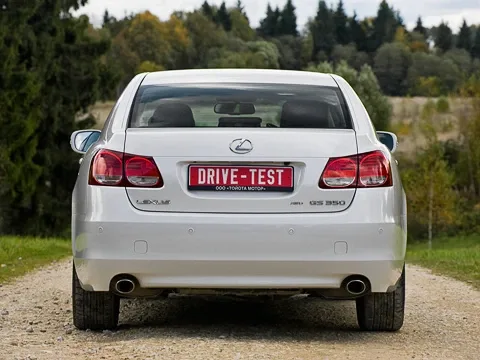
Instead of the 249-horsepower three-liter six-cylinder, a more spirited V6 3.5 with combined injection, producing 307 hp and 372 N•m, now works under the hood. This same unit, by the way, forms the basis of the hybrid powertrain of the top-end GS 450h. According to the specs, the "three-fifty" hits 100 km/h a second faster than the "three-hundred" — in 6.1 seconds, and in practice, the difference in dynamics is colossal. The launch from a standstill in the GS 350 AWD was excellent. The gearbox in both versions is a six-speed automatic with manual mode. But in the all-wheel-drive modification, all gears except the direct fifth are slightly longer, while the final drive ratio is, on the contrary, shorter.
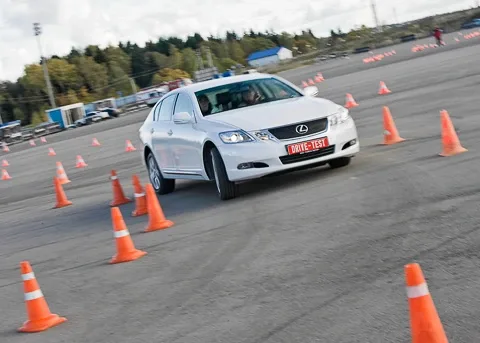
The all-wheel drive was to prove itself on long, intricately winding asphalt routes and on broken country roads. On asphalt, we didn't notice much difference, but on dirt roads, the sedan clearly enjoys sliding its rear end. Only gravel flies in a fan toward the leaning dacha fences. Thanks for this go to the locking center differential and the switchable stability control system. True, for this, you need to know the secret cheat code.
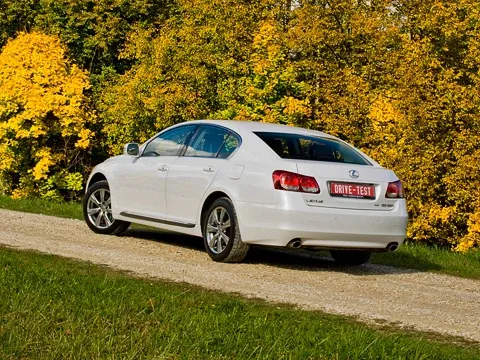
If you turn the "electronic collar" back on, it instantly suppresses any attempts by the driver to misbehave. Be that as it may, you get much more pleasure from the GS 350 AWD than when trying to rouse the sleepy engine in the "three-hundred." During the trip, we once again noted the excellent ride smoothness. The car literally floats over the asphalt and surprisingly confidently absorbs impacts on bumpy paths that seem not to have changed since Blok himself strolled along them. So we didn't stand on ceremony and, in search of our own inspiration, drove at full tilt.
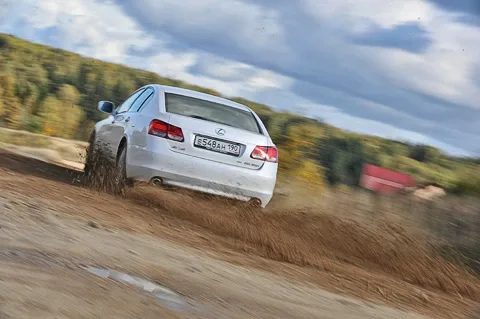
In a more spirited car, the seats, which we had criticized before, draw more attention: they are soft and completely unsuited for active driving. The "empty" and somehow heavier steering wheel also alarmed us. Although the Japanese claim that the steering has been refined and the wheel turn angle increased. Yes, at low speeds, sensitivity and informativeness are fine, but as soon as you increase speed and enter a sharper turn, the wheel "empties," feedback disappears, and you have to correct the trajectory almost blindly. At the same time, the ultimate capabilities of the all-wheel-drive model seemed to us still higher than those of the GS 300.
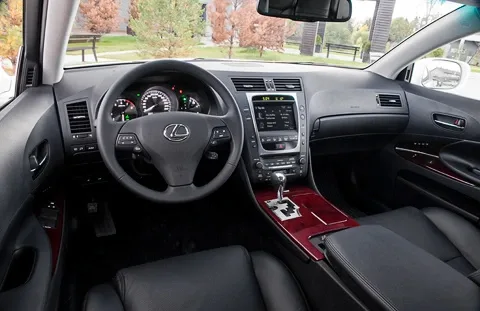
- The interior of different versions is almost the same. True, the center tunnel in the all-wheel-drive car, by subjective feelings, is wider. Its side persistently presses on the right leg. Uncomfortable.
- The vintage cassette radio will not last long in the options list — until November. Hurry to catch the moment!
Of course, with such an engine and rear-wheel drive, throwing gravel would be even more fun. But we live in Russia, where there is snow, ice, and other weather surprises. And for the most unrestrained Lexus fans, the Japanese offer the rear-wheel-drive GS 460 version for 2,806,000 rubles. But we would advise choosing the all-wheel-drive "three-fifty" from the pre-retirement GS family. This is exactly what an ideal GS should be.
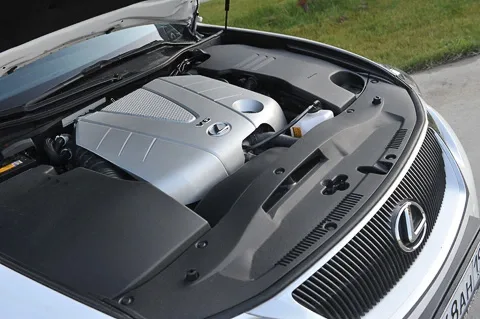
The engine is a V-shaped "six" 2GR-FSE. A 3456 cm3 engine with 307 hp (372 N•m) and the D4-S injection system, where port injection into the intake manifold is combined with direct injection. The engine is also equipped with the Dual VVT-i system with phase shifters on the intake and exhaust camshafts. The same engine, but with different settings, is used in the powertrain of the GS 450h hybrid.
And its price, it's worth noting, is not biting — from 2,184,000 to 2,440,000 rubles. Those who have such an amount can, of course, also look at competitors. But the Audi A6 3.0 TFSI in the "base" costs at least 2,192,900 rubles, and the Mercedes E 350 4MATIC — even from 2,398,000. And the equally aged but more driver-oriented Infiniti M 35x will not be cheap — from 2,385,300 rubles.
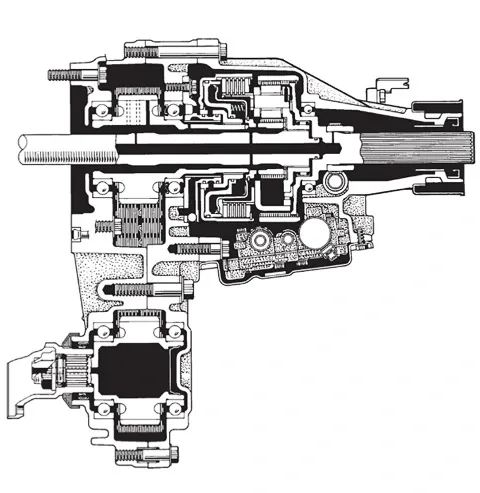
The highlight of the farewell modification is the transfer case UF1AE. The all-wheel-drive system in the GS has a center differential that is locked by an electro-hydraulic clutch. The degree of locking is determined by electronics, and torque to the front axle is transmitted via a chain.
One thing is disappointing. Next year, the current GS will give way to a new generation, so the Russian office cannot count on a rapid sales growth. Yes, a well-known model has revealed itself to us from an unexpected and interesting side, but, honestly, the all-wheel-drive GS should have been brought to Russia earlier. If Alexander Alexandrovich Blok had seen this car, he would have dedicated these lines to it: "I waited long — you came out late..."
| Model | Lexus GS 350 AWD |
|---|---|
| Body | |
| Body type | sedan |
| Number of doors/seats | 4/5 |
| Length, mm | 4850 |
| Width, mm | 1820 |
| Height, mm | 1430 |
| Wheelbase, mm | 2850 |
| Curb weight, kg | 1830–1870 |
| Gross weight, kg | 2230 |
| Trunk volume, l | 430 |
| Engine | |
| Type | petrol, with port fuel injection |
| Location | front, longitudinal |
| Number and arrangement of cylinders | 6, V-shaped |
| Number of valves | 24 |
| Displacement, cm3 | 3456 |
| Max power, hp/rpm | 307/6400 |
| Max torque, N•m/rpm | 372/4800 |
| Transmission | |
| Gearbox | automatic, six-speed |
| Drive | permanent all-wheel drive |
| Chassis | |
| Front suspension | independent, coil spring, double wishbone |
| Rear suspension | independent, coil spring, multi-link |
| Front brakes | disc, ventilated |
| Rear brakes | disc, ventilated |
| Performance characteristics | |
| Maximum speed, km/h | 190* |
| Acceleration time from 0 to 100 km/h, s | 6.1 |
| Fuel consumption, l/100 km | |
| — urban cycle | no data |
| — suburban cycle | no data |
| — combined cycle | 10.1 |
| Toxicity standard | Euro-4 |
| Fuel tank capacity, l | 71 |
| Fuel | AI-95 |
Behind the scenes 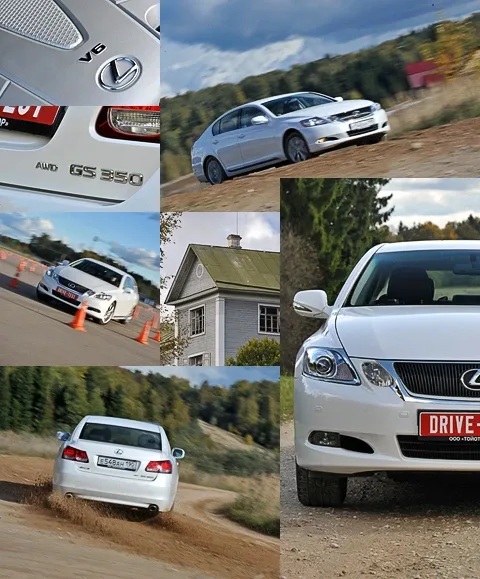
Our route ran through the Solnechnogorsk district of the Moscow region, and we did not limit ourselves to just the vicinity of the Shakhmatovo estate. We finished the trip in Sorochany, from where Lexus instructors drove us to Moscow. This moment turned out to be the most pleasant of the entire test: I finally got some sleep, spending an hour and a half in the back seat of the all-wheel-drive GS.