
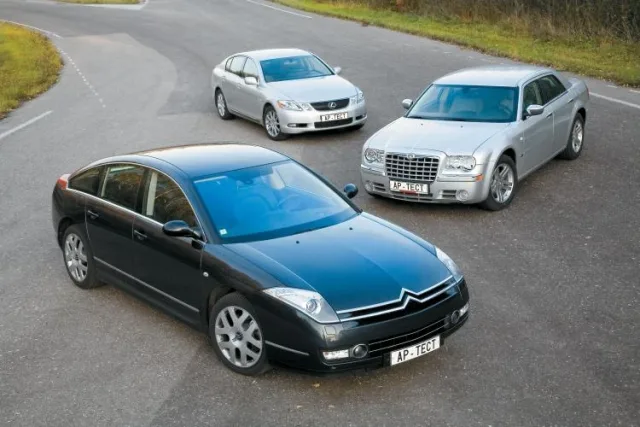
The most challenging in this comparison turned out to be the Citroen C6. And it's not just about character — on the scales, it showed 1871 kg, which is a hundredweight heavier than the Chrysler and almost two hundred kilograms more than the Lexus. At the same time, the 215-horsepower French engine is inferior to the competitors' engines by 35 horsepower...
 | |
 |  |
 | |
| The Citroen's mirrors (top) are the most unsuccessful: they are small, and the panoramic section "eats" almost a third of the area. The Lexus mirrors (center) are noticeably more convenient, although it would not hurt for them to be larger — like the Chrysler's (bottom), where the mirrors are large and without distortion. When arming the alarm, the Lexus and Citroen mirrors fold automatically | In the Citroen (top), all power windows operate in automatic mode, and the control buttons for the front seats are placed on the door, like in a Mercedes. The Lexus (center) also has full auto mode, plus both front seats have memory. But the Chrysler (bottom) is more modest: memory — only for the driver's seat, and "auto" — only for the front windows |
The Citroen's acceleration is sluggish. The six-speed automatic transmission shifts smoothly, but to wake up the engine, you need to press the pedal to the floor — in dense city traffic, this is annoying. The adaptive algorithms of the "automatic" save the day: after a sharp press on the gas, it holds a lower gear for a long time. There is also a sport mode, where shifts occur at higher revs. But even manual gear selection does not make the Citroen noticeably livelier. A funny detail: during acceleration, you can feel the seat slightly tilting back, taking up slack in the rails...
 | |
| Lexus GS: beautiful and high-quality | Under the sliding armrest — a button to disable the traction control system and a key to control additional transmission modes. Front seats — with heating and ventilation |
The Chrysler is more dynamic both in feel and measurements: the engine sounds more cheerful, and the pauses of the "automatic" are shorter. True, the five-speed gearbox does not adapt to the driving style, but in "manual" mode you can force it to hold the desired gear. As a result, the American sedan reaches the first hundred a second earlier than the Citroen, and by 200 km/h it already wins a quarter of a minute. However, the maximum speed is almost the same — 213 versus 210 km/h. The "brick-like" aerodynamics take their toll. But the "wing-like" Citroen C6 — the only business-class sedan with an active spoiler — has its main feature in the tail: a metal strip rises above the trunk lid after 65 km/h, and from 125 km/h it stands at an angle of 45°, reducing lift.
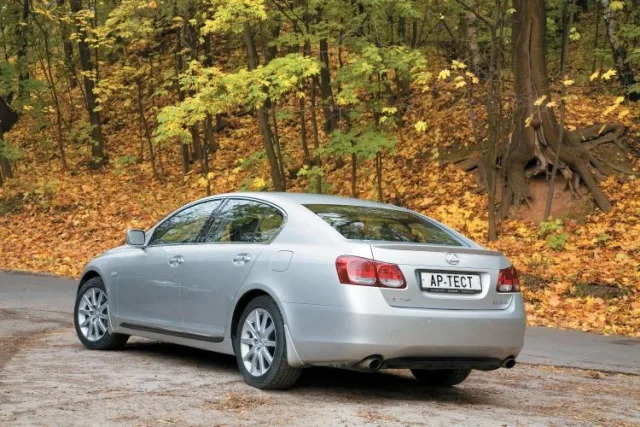
On the dynamometric road, the Lexus is beyond competition.
Firstly, it accelerates faster than all in any speed range. This is largely due to the quick "automatic" Aisin AW, which has a sport mode (lever to the left, like in a BMW) and manual. Moreover, in manual, the gearbox strictly holds the selected gear and does not shift up, although kick-down works as usual: press the pedal — and it will shift down. The Lexus reaches 200 km/h half a minute earlier than the Citroen!
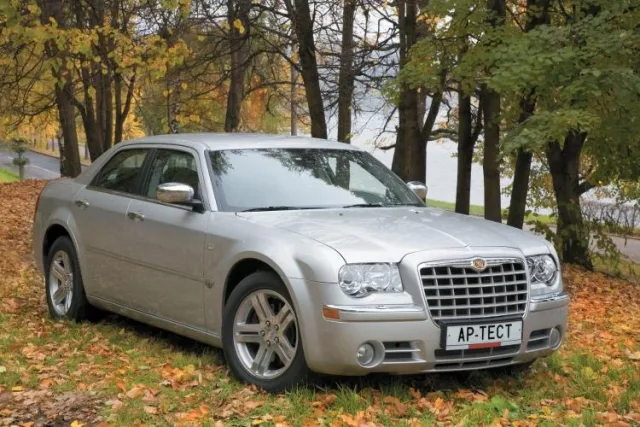
Secondly, the Lexus brakes best of all — 38.5 m from 100 km/h. Moreover, deceleration is easiest to control: the drive is precise and informative! The Chrysler's braking distance is only slightly worse, but dosing deceleration in normal modes is more difficult. But the Citroen's brakes did not please, despite a decent 39.4 m when stopping from 100 km/h. The force on the pedal grows faster than the deceleration — it feels as if the discs are oiled. Unpleasant.
| The Chrysler's instruments are beautiful, but the speedometer is uninformative | The interior light fixtures are integrated into the base of the folding handles | The elbow fits right into the bottle recess… |
 |  |  |
| The Chrysler 300C's interior is attractive, but it falls short of its rivals in terms of "perceived quality" | The climate control unit, modeled after Mercedes' "thermatic" with rotating knobs, is very convenient | Chrysler's seats are amorphous |
Ride comfort? That's where the Citroen C6 should surely make up ground! The latest Hydractive hydropneumatic suspension with seven spheres (versus six on the C5), quick switching between "soft" and "firm" modes... Plus the ability to adjust ride height over a huge range, even greater than the Audi Allroad: from 80 to 191 mm!
 |  |  |
| With the Lounge package, which includes electric rear seat adjustment, the Citroen (left) is unrivaled in passenger comfort. The Lexus (center) is cozy, but there's not enough room for your feet. The Chrysler (right) is spacious, but the flat and slippery bench is uncomfortable | ||
| All cars have dual-zone climate control, with simple air vents in the rear. Only the Citroen (left) has a rear control panel for adjusting airflow direction (face or feet) and fan speed. The Lexus (center) only has an ashtray, and the Chrysler (right) doesn't even have that | ||
On a good road, the Citroen is indeed comfortable—it just gently rocks on large undulations. But as soon as the good road turns into an ordinary one, the "C-six" starts to shudder in a "lambda"—rolling from side to side, diagonally, and shifting left and right. The sport mode of the hydropneumatic suspension is not a panacea: the rocking decreases slightly, but even on small bumps the car shakes noticeably. The suspension itself works noisily, with thuds. Tires also make noise, and mirrors whistle... However, in other respects, the cabin's acoustic insulation is good—thanks to the triplex side windows (this, by the way, is an option—600 euros).
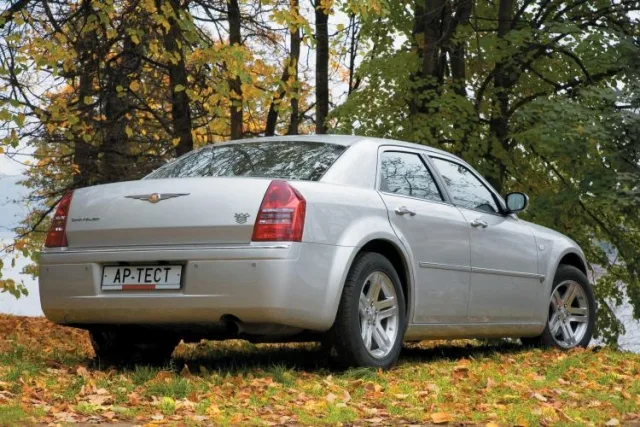
But the Chrysler 300C shows even stronger dissatisfaction with our roads—the level of vertical acceleration is clearly higher. On harsh bumps, vibrations from unsprung masses are felt, often accompanied by knocking sounds. However, there's none of the Citroen's "wobbling" here. And the Chrysler is noisier—both tires and engine, and sand hitting the wheel arches.
The Lexus doesn't notice road "trifles" at all, rounds off impacts from medium bumps, and only responds with hard jolts to the largest potholes. And all this—without complex hydropneumatics. Of course, the Lexus isn't flawless: on transverse waves, the suspension sometimes allows a secondary "half-sigh" from the dampers, causing the car to roll from side to side. But that won't stop us from calling the Lexus the most comfortable and the quietest.
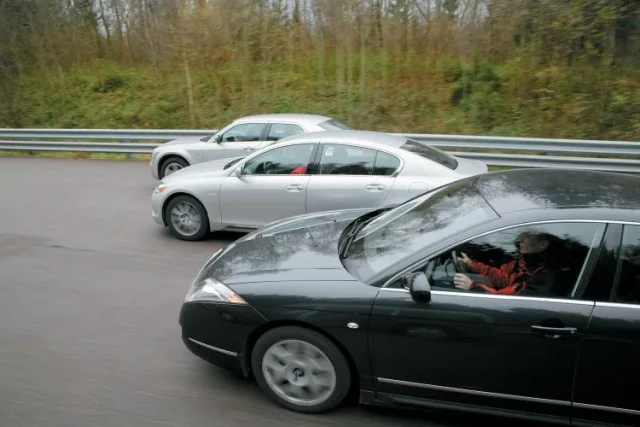
The Lexus also left a pleasant impression with its handling. In corners, there's a logical build-up of steering effort, no trajectory deviations, and complete mutual understanding. But if you want to have some fun—it won't happen: the stability control system will resist.
The Chrysler, on the other hand, gives free rein to emotions: lift off the throttle in a corner and the car eagerly dives into the arc; add power and it smoothly straightens the trajectory. No hints of understeer or oversteer: the stability control is excellently calibrated. But there's a fly in the ointment—on uneven surfaces, the 300 "jumps" off course, and the steering wheel receives not just vibrations but real impacts. You have to grip the wheel with a death grip, although the steering's feedback leaves much to be desired. Even on straights, the sedan wanders, slightly shaking the wheel.
 |  | |
| In the Citroen (left), the glove box is single-section, with pockets in the lid and RCA ("tulip") connectors for connecting external audio equipment. In the Lexus (center), it has a T-shaped divider, and in the Chrysler (right), a shelf divided into sections | ||
 |  | |
| The most original (and most inconvenient) pockets are in the Citroen's doors (left): a micro-lift-equipped, wood-trimmed lid slides along rails. The Lexus's door pockets (center) are expanding, while the Chrysler's (right) are simple but the most convenient | ||
 |  |  |
| Loading items is easier into the modest trunk of the Citroen (420 L): it has the most "open" aperture and the lowest loading height (left). The Lexus (center) has a slightly larger trunk (430 L) and a power-closing lid, but the aperture is narrower. The Chrysler (right) has the largest and most functional cargo area with folding seatbacks (rivals only have ski hatches). But the Chrysler has the highest loading height and very sparse trim | ||
And what about the Citroen? A true antipode, damn it! The chassis feels well-tuned. In sharp corners, it leans noticeably more than its rivals, but it holds the line very precisely: on entry, it tends to push the nose outward, but the rear axle immediately plays along, keeping the car on the desired path. The whole picture is spoiled by the "weightless" steering—the driver doesn't feel the car either on straights or in corners. And although the wheel gains weight with speed, the near-zero zone remains "empty"—this doesn't add confidence. But here's an interesting nuance: the car's reactions directly depend on what you expect from it. Turn the wheel smoothly—the sedan reluctantly moves aside; a sharp jerk—and the C6 instantly follows the wheel. This was clearly demonstrated in the "moose test." In standard mode (65 km/h), three out of five drivers "had an accident." But when a test driver got behind the wheel to determine the maneuver's maximum speed, the Citroen drove flawlessly! In the "lane change," the C6 was the fastest: 79 km/h versus 73 km/h for the Lexus, which took second place. At one point, even the stability control system "lagged behind" the test driver—a malfunction message appeared on the central display. A "reboot" by turning the ignition off and on saved the day.
Could the Hydractive suspension really be tuned for "spirited" driving? But then why such a "empty" steering wheel? Alas, the Citroen's score for handling reliability is 70 points, on par with a "four."
 |  |  |
| Chrysler 300C: 3.5 L, 249 hp, 340 Nm | Citroen C6: 3.0 L, 215 hp, 290 Nm | Lexus GS 300: 3.0 L, 249 hp, 310 Nm |
In the overall standings, it scored 815 points — more than the Chrysler, but noticeably less than the Lexus. If you choose with your head... Then first of all, you should remember the prices: the base Chrysler 300C 3.5 costs $58,420, the Citroen C6 — $63,370, and the Lexus GS 300 — $63,200. True, the base Citroen won't have a CD changer, triplex side windows, leather-and-wood trim, or — most importantly! — reclining seats. You'll have to pay extra for all that. Moreover, the version with electrically powered rear seats will cost at least $74,300 — more expensive than the most expensive Lexus 'three hundred' in Premium trim ($65,900)! But such a C6 will get a massager. That's how the 'buzzer' built into the driver's seat is perceived, which warns about crossing lane markings. It doesn't even warn, but rather states: the system activates after the car has already half-stuck out into another lane. Jokes aside, but with such a price tag, you're within reach of the BMW 'five' and even the Mercedes E-Class, not to mention the Audi A6. And what can save the new Citroen then? That's right, beauty. There's something enchanting, unusual, and alluring about the Citroen. It's not a simple car. It's not just a car...
Moose Test
The tests simulating avoidance of a suddenly appearing obstacle are conducted in two stages. First, five drivers, having already familiarized themselves with the car in normal driving modes, try to avoid the 'moose' on the first and only attempt at a speed of 65 km/h. Then the test driver, in a series of runs, tries to determine the maximum speed for performing the maneuver. All runs are conducted with stability control systems enabled.
This time, the results turned out to be quite curious. Behind the wheel of the Citroen, three out of five drivers failed to avoid an 'accident'. This could have been assumed: driving in normal modes showed that the car responds vaguely to steering inputs, reluctantly and with large body rolls changes its trajectory. But the main thing is the lack of feedback 'through the steering wheel': in an emergency situation, drivers simply feared to briskly turn the wheel — and hit the 'moose'.
 |  | |
| In the moose test, the Citroen driver managed to show the highest speed of the maneuver (78.6 km/h). Although in normal modes, feedback is clearly lacking | In an emergency situation, the Lexus driver is confused by the intrusive intervention of the stability control system and the 'overweighted' steering wheel. Total — 73.0 km/h | The Chrysler's problem during a sharp obstacle avoidance is the drop in the already low steering sensitivity. The maximum speed is 72.6 km/h |
But in the hands of the test driver, the car transformed: it responded quickly and adequately to sharp steering turns. The stability control system effectively corrected the skid and immediately released its grip, not interfering with further maneuvering.
The result exceeded all expectations: 78.6 km/h — that's slightly faster than the moose avoidance on the BMW 530Xi (see AR No. 17, 2006). It's time to state: excellent chassis tuning! But what about the lack of feedback? According to Alexander Divakov, the point is that when performing the maneuver, the test driver acts according to a developed algorithm and sometimes doesn't need feedback — the speed of his movements is such that he simply cannot analyze visual, 'vestibular', or 'tactile' information. Increasing the speed from run to run, he plans his actions in advance and follows this plan as long as he has the strength for very fast steering wheel rotation.
The Lexus GS 300 puzzled with ambiguous reactions: when avoiding the 'moose', the car willingly followed the steering wheel, but refused to return to its lane. This confused three out of five drivers, and they had an 'accident'. The expert experienced the same difficulties along with the intrusive intervention of the stability control system — the steering wheel filled with a high 'blocking' force. The result — 73.0 km/h.

Behind the wheel of the Chrysler 300C sedan, drivers had only two 'accidents'. The reason is the sharp drop in the already low steering sensitivity during fast steering wheel rotation. Because of this, the maximum speed of the maneuver is not high — 72.6 km/h.
| Maximum speed of the moose test, km/h | |
| Car | Speed |
| Chrysler 300C | 72.6 |
| Citroen C6 | 78.6 |
| Lexus GS 300 | 73.0 |
| Moose test on the first attempt at a speed of 65 km/h* | |
| Car | Maneuver completed |
| Chrysler 300C | 3 out of 5 drivers |
| Citroen C6 | 2 out of 5 drivers |
| Lexus GS 300 | 2 out of 5 drivers |
| * 5 drivers participated in the tests | |
Under Impact
All three cars have undergone independent crash tests, but comparing them directly is incorrect. The reason is simple: the Citroen and Lexus were tested according to the EuroNCAP methodology, while the Chrysler was tested according to the protocol of the American organization NHTSA. The American frontal impact test is simpler: the car crashes into a concrete wall at a speed of 56 km/h. And the Chrysler 300C handled this brilliantly, earning the highest five stars for driver and front passenger safety. In a side impact, driver protection was rated four stars — and this is despite the fact that a version without side airbags was crashed, while cars for the Russian market have them as standard.
The European protocol is stricter: a frontal impact on the driver's side against a deformable barrier at a speed of 64 km/h. Both the Citroen C6 and the Lexus GS300 passed it without a hitch — strong bodies, belts with pretensioners and load limiters, as well as nine airbags in the Citroen and twelve in the Lexus, including knee airbags for the driver, and in the GS300 also for the passenger. Plus, the Citroen received the maximum rating for pedestrian protection — four stars, facilitated by the hood that pops up upon contact with a person.
| Citroen C6 |  |
|
| Overall rating | 34 points | |
| Frontal crash test | 14 (88%) | |
| Side crash tests | 17 (94%) | |
| SBR* | 3 | |
| Child passenger protection | 38 (78%) | |
| Pedestrian protection | 28 (78%) | |
| Curb weight | 1816 kg | |
| Lexus GS 300 |  |
|
| Overall rating | 35 points | |
| Frontal crash test | 15 (94%) | |
| Side crash tests | 18 (100%) | |
| SBR* | 2 | |
| Child passenger protection | 41 (84%) | |
| Pedestrian protection | 18 (50%) | |
| Curb weight | 1630 kg | |
| Chrysler 300C** |  |
|
| Driver protection in frontal impact | 5 stars | |
| Passenger protection in frontal impact | 5 stars | |
| Driver protection in side impact | 4 stars | |
| Rear passenger protection in side impact | 5 stars | |
| Curb weight | 1836 kg | |
| * SBR — presence of seatbelt reminder | ||
| ** Tests were conducted according to the rules of the American organization NHTSA | ||
What's the Price?
Chrysler 300C in the base version with a V6 2.7 engine (193 hp) and a four-speed automatic is sold for $50,420. Standard equipment includes six airbags, dual-zone climate control, leather interior, electrically adjustable and heated front seats, and xenon headlights. The version with the 3.5-liter 'six' (249 hp) costs from $58,420, and it already comes with a five-speed automatic with manual mode AutoStick. Additionally — a CD changer, Boston Acoustics audio with six speakers, and walnut inserts on the steering wheel and gear lever. For an extra $1,900, a package with a DVD video system and adjustable pedals is offered. Touring station wagons are about $3,800 more expensive. Next comes the 300C V8 5.7 Hemi (340 hp) for $72,770, and the top version 300C SRT8 from Street Racing Technology with a 6.1-liter engine producing 431 hp costs $88,000. Waiting for a car after ordering is about two months.
Warranty — 2 years without mileage limit. The Chrysler dealer network in Russia includes 16 showrooms in 10 cities.
Citroen C6 is available in Russia only with a petrol V6 3.0 L (215 hp) and a six-speed automatic. The starting price is $63,370, and the base already includes nine airbags, leather steering wheel, dual-zone climate control, xenon with swivel mechanism, and heated seats (front ones with electric adjustment). The Exclusive version will cost more — $72,390, but adds navigation and leather upholstery with wood inserts. There are almost no options: only an electric sunroof ($1,270) and separate rear seats with electric adjustment ($1,900). Delivery will take about three months.
Warranty — 2 years without mileage limit. Citroen sales in Russia are handled by 27 dealers in 20 cities.
Lexus GS 300 (3.0 L, 249 hp) starts at $63,200 for the Executive trim: leather, electric adjustment and heated front seats, twelve airbags, xenon, dual-zone climate control. For $2,700 you can upgrade to the Premium version, which adds a leather steering wheel with wood and a Mark Levinson audio system. The Lexus GS 430 with a 276 hp V8 in similar equipment costs $80,600. The only option is an electric sunroof for $1,300. A separate story is the GS 450h hybrid with a combined output of 345 hp, available in a single rich trim with a DVD changer for $78,500. Delivery time is up to two months, except for white and red cars: those will have to wait twice as long.
Warranty — 3 years or 100,000 km. The Lexus dealer network — 7 showrooms in 4 Russian cities.
Light output
Night photography of cars from one point allows assessing the effectiveness of headlights. All three cars have xenon low beam, and the Lexus and Citroen also have swivel headlights. The low beam performed best on the Citroen and Chrysler: a pedestrian on the roadside is clearly visible from both 65 and 80 meters. True, the Chrysler's headlights capture the roadside slightly wider. But the Lexus xenon disappointed me — it feels like the headlights shine almost under the wheels, and even from 65 meters a person in light clothing is barely visible! However, the high beam on the GS300 is excellent — it even reaches the treetops. And both the Chrysler and Citroen also have excellent high beam.
Photography was carried out only with the driver in the car, headlight levelers operated in automatic mode.
| Chrysler 300C |
Citroen C6 | Lexus GS 300 |
| Low beam. A pedestrian stands on the roadside 65 meters from the car | ||
| Low beam. A pedestrian stands on the roadside 80 meters from the car | ||
| High beam. A pedestrian stands in the center 160 meters from the car | ||
Autoreview readers' forecast
Before this test, we asked visitors of www.autoreview.ru to choose the car they would prefer among the participants of our comparison.
The votes were distributed as follows:
Lexus GS 300 - 68.69%
Citroen C6 - 18.77%
Chrysler 300C - 12.54%
4,400 people took part in the survey
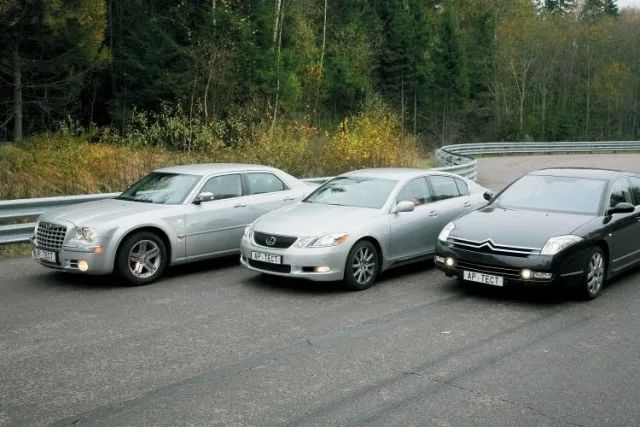
Test of large sedans: Chrysler 300C, Citroen C6 and Lexus GS 300
I decided to arrange a comparison of three large sedans that represent completely different approaches to comfort and style. The muscular American Chrysler 300C, the French aristocrat Citroen C6, and the technologically advanced Japanese Lexus GS 300 — each has its own character, and I was interested to see which of them would better handle the role of a car for long trips and business meetings.
First impression and design
When I first saw them side by side, it immediately struck me how different they are. The Chrysler looks like a real "brick" — massive, square, with a huge radiator grille. It seems to have stepped off a gangster movie screen. The Citroen C6, on the contrary, has smooth, streamlined lines that seem designed for aerodynamics. It looks very elegant and unusual. The Lexus GS 300 is perhaps the most restrained and "correct" in terms of design. It doesn't have that flashy appearance, but you can feel the thoughtfulness of every line.
Inside, the difference is felt even stronger. In the Chrysler 300C, the interior looks somewhat old-fashioned, but there is a certain charm to it — lots of chrome, wood, and soft leather. The Citroen C6 surprises with its minimalism and unusual solutions, such as the fixed central steering wheel hub. But in the Lexus GS 300, I felt most at home: everything is thought out to the smallest detail, materials are expensive, seats are very comfortable, with ventilation and memory settings. The instruments are perfectly readable, and all information is presented very clearly.
Driving impressions
I enjoyed driving the Lexus the most. Its naturally aspirated 3.0-liter V6 engine runs very smoothly and quietly, and the automatic transmission shifts imperceptibly. Acceleration is confident but not neck-snapping, which is rather a plus for this class of car. The GS 300 also handles best: it follows the steering wheel precisely, body roll in corners is minimal, and the brakes are informative and powerful. The suspension is firm but not harsh, it absorbs bumps perfectly, and sound insulation is simply exemplary. The cabin is quiet even on the highway.
The Chrysler 300C is a completely different philosophy. Its large and powerful 5.7-liter V8 engine with a cylinder deactivation system is a song. It pulls like a locomotive, and the engine sound is very pleasant. But at the same time, the car feels heavy and stately. Steering is not as sharp as in the Japanese car, and body roll in corners is noticeably stronger. The Chrysler's suspension turned out to be the most energy-intensive, but also the noisiest on small joints. Inside, this results in more vibrations and rumble than in competitors.
The Citroen C6 is, without a doubt, the most comfortable car in terms of ride smoothness. Its hydropneumatic suspension simply "swallows" the road, and I practically didn't feel any bumps. But this comfort comes at the cost of handling. In corners, the C6 rolls noticeably, the steering wheel is empty and uninformative. Its acceleration dynamics are the most modest due to the less powerful engine, and the brake mechanisms seemed less effective to me than in the others. The 3.0-liter V6 engine runs quietly, but with a sharp press on the gas pedal it starts to roar loudly, and the gearbox doesn't always respond quickly to commands.
Practicality and cost of ownership
As for practicality, there are surprises here. The Chrysler has a folding rear seat, which allows carrying long items, although its trunk itself is not the largest. The Citroen and Lexus rear seats don't fold, but there is a hatch for long items. However, the French car has adjustment of the front passenger seat from the rear seat, like in a real limousine.
Prices for the cars also differ. The base version of the Chrysler costs $58,420, the Citroen — $63,370, and the Lexus — $63,200. However, the tested Citroen with options turned out to be the most expensive — $74,300, while the Lexus was $65,900, and the Chrysler remained without extras. At the same time, the maintenance cost of the Chrysler is the highest — $4,768 for 90,000 km, the Lexus — $4,042, and the Citroen — only $1,285. True, some parts for the French sedan, such as the front bumper or suspension struts, are not cheap at all.
Verdict
This test showed that an ideal car doesn't exist. The Chrysler 300C is a car with character that loves fast and measured driving on a straight line, but it is noisy and not as comfortable as one would like. The Citroen C6 is a true "mile eater" designed for maximum comfort, but its handling disappoints. And the Lexus GS 300 is perhaps the most balanced car. It combines comfort, dynamics, and handling, although it doesn't have that zest that the American or French car has. I would choose the Lexus for its versatility and quality, but if I were looking for a car with character and weren't afraid of compromises, I'd take a closer look at the Chrysler.
As for expert assessments, we distributed points as follows. In terms of design and appearance, the Citroen was the best, but in ergonomics and driving qualities, the Lexus was ahead. In the end, by the sum of all parameters, the GS 300 scored 855 points out of 1000, ahead of the Citroen C6 (815 points) and the Chrysler 300C (805 points). The Lexus won this test, but all three cars are very worthy representatives of their class, each with its own character.
The numbers speak for themselves
When I first looked at the summary table of measurements taken by our editorial team, the first thing that caught my eye was how differently these three large sedans use their capabilities. We're talking about the Chrysler 300C, Citroen C6, and Lexus GS 300. Each has its own character, and the instrumental measurements only confirm this.
Let's start with dynamics. The fastest in the "0–100 km/h" exercise was the Lexus: it takes only 7.8 seconds. The Chrysler with its 9.0 seconds is noticeably calmer, while the Citroen shows 10.2 seconds, which for a car of this class and price seems frankly sluggish. At the same time, the maximum speed recorded by instruments is also the highest in the Lexus — 228 km/h, while the Chrysler accelerates only to 212.8 km/h, and the Citroen — to 209.8 km/h.
Interestingly, the official data promises slightly better figures than we got at the test track. So, the Chrysler according to documents should reach the first hundred in 9.2 seconds, and the Lexus — in 7.2 seconds. However, the difference between factory figures and real measurements is a common thing.
Elasticity and brakes
However, not only standing-start dynamics matter. On the highway, elasticity is much more useful — the ability to confidently accelerate from a rolling start. And here the picture is no less telling. When accelerating from 80 to 120 km/h in "drive" mode, the fastest again is the Lexus — it needs only 6.0 seconds. The Chrysler loses by just under a second, while the Citroen again brings up the rear with a time of 7.5 seconds.
The braking situation is curious. During emergency deceleration from 100 km/h, all three cars show almost identical results: the distance ranges from 38.5 to 39.4 meters, and deceleration is 9.8–10.0 m/s². However, when braking from 150 km/h, the Lexus pulls ahead: 87.1 meters versus 92.1 meters for the Chrysler and 94.0 meters for the Citroen. Moreover, the Lexus's deceleration remains stable at 10.0 m/s², while for its rivals it drops to 9.2–9.4 m/s².
Speedometer accuracy
It is also worth mentioning the accuracy of the instruments. The Lexus's speedometer embellishes reality the most: when the gauge shows 200 km/h, the actual speed is only 192 km/h. The Chrysler has a minimal discrepancy — 199 km/h at a reading of 200. The Citroen takes an intermediate position with 198 km/h.
Character and compromises
Behind these figures lies a difference in philosophy. The Chrysler 300C with its 3.5-liter V6 (249 hp) is a classic American sedan with rear-wheel drive and a torquey engine that does not like fuss but pulls confidently from low revs. It is almost 125 kilograms heavier than the Lexus, which, however, does not prevent it from being the most "long-range": its coasting distance from 160 km/h is 1533 meters.
The Citroen C6 is the only one here with front-wheel drive and hydropneumatic suspension. Its 3.0-liter V6 produces 215 hp — the most modest of all. It is also the heaviest: the curb weight reaches 1816 kilograms. And although this Frenchman's suspension is rightly considered a benchmark of smoothness, in dynamics it clearly yields to both rivals.
The Lexus GS 300 is the athlete in this company. The 3.0-liter V6 (249 hp) and six-speed automatic make it the fastest, the lightest (1620 kg), and the most economical. The claimed fuel consumption in the combined cycle is 9.8 l/100 km versus 11.1 l for the Chrysler and 11.2 l for the Citroen. True, it also needs more expensive fuel — AI-95 or even 98, while the Chrysler is content with AI-92.
Each of these cars is an answer to different questions. The Chrysler is about style and imperturbability, the Citroen is about comfort and Gallic originality, the Lexus is about precision and passion. And although the Japanese car wins in numbers, the choice here is clearly not mathematical but emotional.