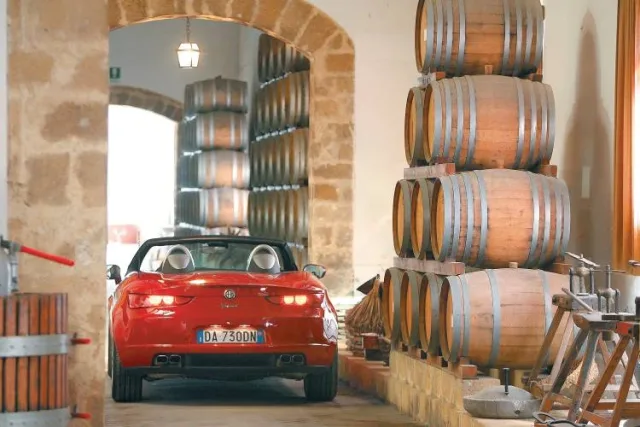
Right, now I remember: at the Geneva Motor Show, the Alfa Romeo Spider was named the best convertible of the year. I recall journalists crowding around the Alfa stand and the awards ceremony... But I missed one detail: what does the Alfa Spider actually look like? I walked around it, examined it... I remember the stunning three-door Alfa Brera, I remember the angular Alfa 159 sedan. But why didn't the image of the open-top Alfa stick in my visual memory? Apparently, my memory is selective.
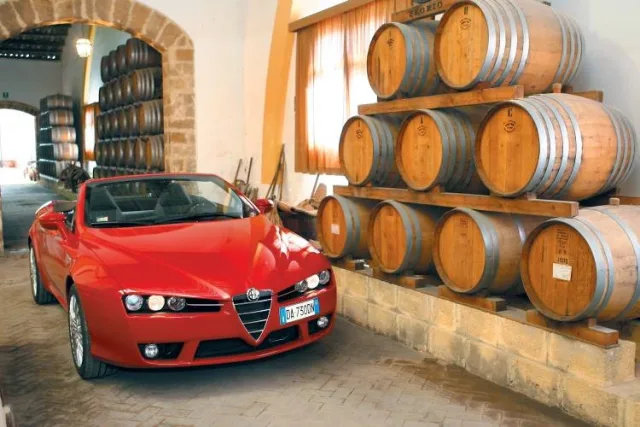
Later, I found myself in Sicily, where I spent a lot of time driving the open-top Alfa. And luck smiled on me: I took the beautiful Cristina Siletto as my companion — the very lady responsible for developing the "large" cars of the FIAT concern, including the Fiat Croma, Alfa 159, Alfa Brera, and, of course, the Alfa Spider convertible built on the same platform. I remember our conversation "about life" in every detail: how Cristina learned to talk to men as equals, how she stays at work until midnight, how she never has enough time and energy to notice the new colors of life rushing by... I remember Cristina, I remember the fishermen on the coast. But the Alfa... The Alfa just drove and drove. Now I'm flipping through photos, trying to fill this gap...
 |
| Cristina Siletto — it was she who enlivened the "driving" presentation of the new Alfa in Sicily. This lady is responsible for all Fiat cars on the "large" platform |
Formally, the famous Pininfarina studio was responsible for the convertible's styling. And the Alfa Spider is assembled at Pininfarina's plant in Turin. But if the design of the Alfa 159 and the stunning Brera was created at Giugiaro's studio, Pininfarina's stylists got a simpler task: not to create an open-top car "from scratch," as was done before, but to make a convertible based on the "foreign" coupe Alfa Brera. Naturally, with maximum unification to fit a modest budget. "Don't you have the same one, just without a roof?"
And here's the result: there's unification, but no spark. At least they kept the traditional fabric top for convertibles, rather than developing a hard folding roof, which would almost certainly have led to an absurd lengthening of the rear, as already happened with the French Peugeot and Renault with the CC index, meaning "coupe-cabriolet." Why is that needed? After all, a convertible (like a coupe) is bought primarily because it's a beautiful car, not because of "two in one." Moreover, such cars are most often bought by people who can afford not one, but two cars, but so that each is not "two in one," but rather "one in one." And so that each pleases the eye. So that, after closing the door, after five steps, you feel an irresistible urge to turn around. I closed the Spider and didn't turn around. Because the convertible is secondary — it's "reworked" from the Brera and the Alfa 159.
You'll say such "reworkings" are common in the industry and cite a dozen examples? Yes, they are common. But remember the predecessor cars: for example, the predatory Spider of the previous generation with its angry round headlights that appeared in 1994. What did it look like? Only like the Alfa GTV coupe! But both the GTV coupe and the Spider convertible were developed from start to finish by Pininfarina's stylists and had nothing in common with the "passenger" models of those years, whether it was the Alfa 156, Alfa 146, or the big Alfa 166! Unless, of course, you count the Alfa "shield" and the round emblem. And it turned out wonderfully.
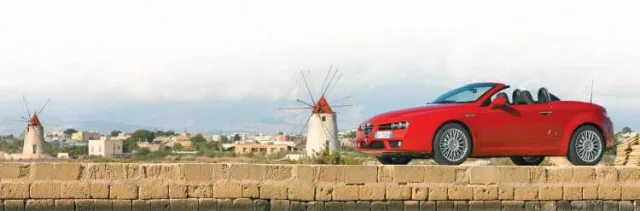
Together with Avtoreview's art editor Natalya Yakunina, we're examining the photos for this article. She, as always, has already read the draft. "But this is a very beautiful car. And you didn't like it?" Natashenka! I completely trust your taste. But because Alfa's sales managers so ineptly missed the Russian market, you never saw the Alfa Brera in the flesh! Consider that the Alfa Brera blew my mind, hence the bout of amnesia...
 |  |
 | |
| The roof folds and unfolds fully automatically, but you can't do it while driving: you need to stop and engage the "handbrake" | |
There are two engines, both petrol, and each is already familiar from the 159 and Brera models: a four-cylinder (2.2 JTS, 185 hp) and a V-shaped "six" (3.2 L, 260 hp), which arrived by sea from Australia. There are no diesels, nor automatic gearboxes: only a six-speed manual. Although an "automatic" would have suited this Alfa perfectly — the Alfa has become bourgeois. Yes, the sound of the "six" still delights with its rich, deep "low end," but its melancholic, correct character would suit a Mercedes more than an Alfa: whether you want to shift from second to third at 2000 rpm or at six thousand... The engine just pulls and pulls: 90% of the torque is available from 1800 to 6200 rpm. You can't say a bad word about it. Nor can you say one about the gearbox. It would seem great: since all manipulations are performed almost on a subconscious level, without requiring concentration, it means the engineers and ergonomists did a great job. Yes, a great job! But on one condition: if they had worked for Koreans, Chinese, or Americans. Bravo, guys! You made a car in which nothing irritates! But from an Alfa, damn it, I still expect something different. So that every shift is an event, every turn a victory, every glance love! Alas. Neither love, nor events, nor victories. To the right is a lovely lady, to the left are mountains, above is the sun, and it doesn't even cross my mind to rev out second gear to the redline, take a turn in a light slide, and surge out... And yet, the convertibles with the "six" have all-wheel drive, with most of the torque sent to the rear. But there's no thrill, no matter what!
 |  |
 |  |
| The front part of the cabin is almost the same as in the Alfa Romeo Brera coupe. In the trunk and behind the seat backs, there's still room for luggage, but even a small suitcase that you're allowed to carry into an airplane cabin will be hard to fit | |
As if sensing what I was keeping quiet about, Cristina suggested swapping the Alfa with the six-cylinder engine for the one with the "four": "I think it's livelier, you'll find it more interesting..."
More interesting. At least on a mountain road. With the loss of two cylinders, the Torsen differential, and with them the 160 kilograms of extra weight, the open-top Alfa began to show something resembling temperament. Unlike the well-fed grumbling of the "six," the engine's sound now had a hint of fury, and with its sharp nose, the Alfa began to sniff out corners not like a pampered cat, but like a mature predator, with precise and measured movements. And the fact that along with the weight, 75 "horses" also disappeared, almost two seconds in the sprint to 100 km/h, and the drive to the rear wheels — that's not a problem. "It's not about money or the number of women..." It's about sensations. And they finally appeared.
I'm already noticing that compared to the previous "Spider," there are fewer "convertible" creaks, that the body almost stopped "breathing" on bumps, that reactions have become more precise, that in corners you can drive much more boldly without fearing that the rear axle will suddenly slide into oversteer. I notice that all panels are fitted meticulously, and the texture and quality of trim materials are on par with the best German cars... And I tell Cristina about this. She's pleased: "You know, we planned to hold this presentation a couple of months earlier, even sent out invitations, and then canceled. We decided we'd had enough of apologizing for cars from the first, pre-production batches, saying we'd refine them later. We decided to do everything right from the start."
They really did do everything right: the Alfa Spider is perceived as a solid, well-equipped car that's well worth its 45 or, for expensive versions, even 55 thousand euros. And it will probably break down less often than its Alfa predecessors. But...
I'm already flipping through the hefty booklet attached to the press release for the tenth time. Several pages detail the intricacies of Bluetooth operation and list the audio file formats — mp3, WMA, WAP — that can be played on the standard Bose sound system, whether via phone or USB drive. But my thoughts are somewhere far away. It occurs to me that anti-globalists should create their own "automotive" wing. There would be no fewer willing and sympathetic people than in the ranks of our Automobilists' Party. I know one such supporter for sure. And who knows, maybe there would be fewer memory lapses, and Alfa would remain that same Italian Alfa.
I understand this is naive, but it's always nice to dream.
P.S. It seems the ice has finally broken. Just before the issue went to press, it became known that Major-Auto has received the status of official importer of Alfa Romeo in Russia. Three dealerships are planned to launch soon: two in Moscow and one in St. Petersburg. The showrooms promise to display both the Alfa Brera and the Alfa Spider.
| Alfa Romeo Spider (manufacturer's data) | ||
| Modification | 2.2 JTS | 3.2 V6 Q4 |
| Body type | convertible | convertible |
| Number of seats | 2 | 2 |
| Length, mm | 4393 | 4393 |
| Width, mm | 1830 | 1830 |
| Height, mm | 1318 | 1318 |
| Wheelbase, mm | 2528 | 2528 |
| Track front/rear, mm | 1579/1559 | 1579/1559 |
| Trunk volume, l | 235 | 235 |
| Curb weight, kg | 1530 | 1690 |
| Engine | petrol, with direct injection | petrol, with direct injection |
| Location | front, transverse | front, transverse |
| Number and arrangement of cylinders | 4, in-line | 6, V-shaped |
| Displacement, cm³ | 2198 | 3195 |
| Cylinder bore/piston stroke, mm | 86.0/94.6 | 89.0/85.6 |
| Compression ratio | 11.3 | 11.25 |
| Number of valves | 16 | 24 |
| Max power, hp/kW/rpm | 185/136/6500 | 260/191/6200 |
| Max torque, Nm/rpm | 230/4500 | 322/4500 |
| Gearbox | manual, 6-speed | manual, 6-speed |
| Gear ratios | ||
| I | 3.82 | 3.92 |
| II | 2.35 | 2.04 |
| III | 1.57 | 1.37 |
| IV | 1.15 | 1.05 |
| V | 0.94 | 0.85 |
| VI | 0.86 | 0.75 |
| Reverse | 3.55 | 3.77 |
| Final drive | 4.18 | 3.9 |
| Drive | front | all-wheel |
| Front suspension | independent, double wishbone | independent, double wishbone |
| Rear suspension | independent, multi-link | independent, multi-link |
| Front brakes | disc, ventilated | disc, ventilated |
| Rear brakes | disc | disc, ventilated |
| Tires | 215/55 R16 | 225/50 R17 |
| Maximum speed, km/h | 217 | 235 |
| Acceleration time 0-100 km/h, s | 8.8 | 7 |
| Fuel consumption, l/100 km | ||
| urban cycle | 13 | 16.9 |
| extra-urban cycle | 7.3 | 8.4 |
| combined cycle | 9.4 | 11.5 |
| Fuel tank capacity, l | 70 | 70 |
| Fuel | petrol AI-95 | petrol AI-95 |