
Recently, Alfa Romeo and Saab have finally started to see an improvement in their fortunes. But not in Russia. On our soil, where they revere AvtoVAZ and are full of stereotypes, including automotive ones, there are brands that everyone respects without exception. And there are those that try to win over the masses but only get a handful of fans that can be counted on one hand — dozens, at best hundreds, but certainly not thousands.
Everyone seems to know the reasons for the fear, and even grandmothers on the porch gossip about the unreliability of Alfas and Saabs. But on the other hand, who among us as children, when foreign cars were only seen in pictures and the words "service network" and "liquidity" were empty sounds, didn't dream of such a car? Exactly! So why not let these cars awaken that very forgotten "I want!!!"?
So, our test features two cars — Alfa Romeo 159 TI and Saab 9–3 Aero. We won't pit them head-to-head — they are completely different. A passionate "southerner" and a reserved "northerner." However, besides their rarity, they have much in common. Even die-hard fans of German and Japanese brands, who sleep with a calculator, will turn their heads at this pair racing side by side. This is the freshest that Alfa Romeo and Saab can offer today. And who else but them to prove that they are worth buying? And also — that you can fall in love with them. Deeply and forever.
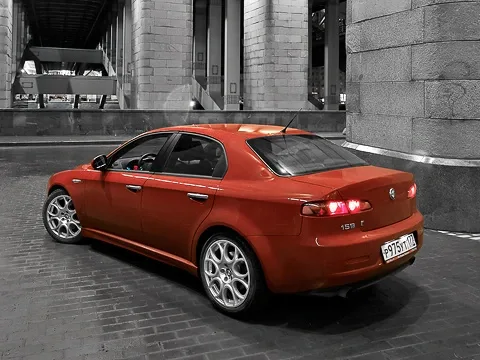
She is so beautiful that you want to walk up and give her a big hug.
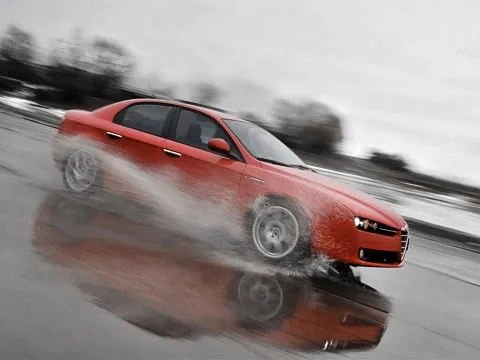
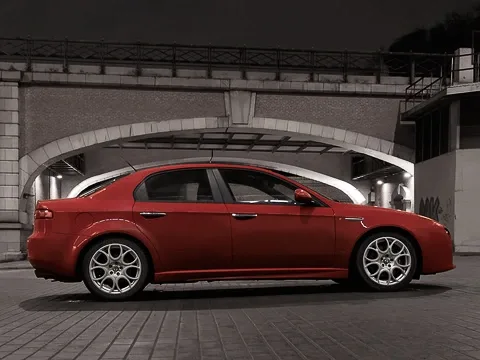
The Alfa 159 TI is the top version of the model. Under the hood is a powerful 3.2-liter V6, all-wheel drive, and a six-speed manual transmission. But the main thing here is the factory sport package Turismo Internazionale, which costs 3,500 euros ($5,450) and includes a solid list of upgrades. On the outside, these are side skirts, lightweight R19 wheels (though the test car had standard 18-inch winter wheels), and large red Brembo calipers. Under the beautiful body is a stiffer and lowered by 20 mm suspension, sharp steering (just over two turns lock-to-lock). And the body color — Alfa Rosso!
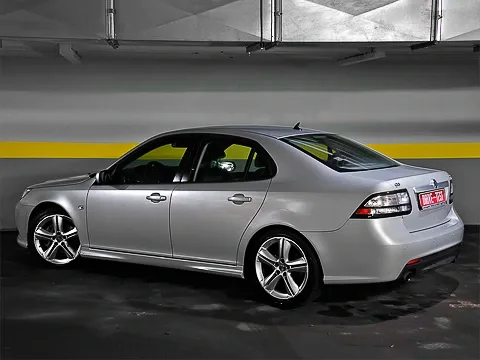
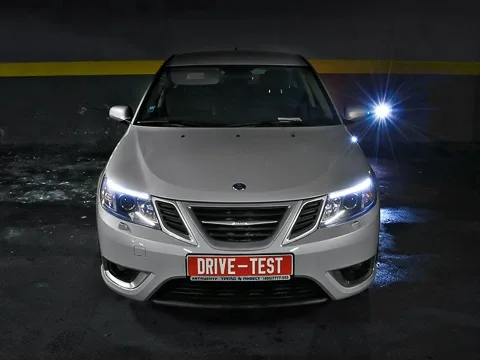
Against the backdrop of the gracefully crouched Alfa, even the updated Saab 9–3 Aero with its striking LED daytime running lights gets a bit lost. Although arguing with the "Italian" in design is a difficult and even foolish task. But there is also a certain charm in the "Swede's" minimalism. 18-inch wheels, a swift front end in the style of the Aero X concept. Beautiful! And in brighter colors, it will be even better. And some will surely prefer the restrained Swedish style over the outright passion of the "southerner."
To fall in love, many just need looks. But there's also the interior. From my observations, every second driver has to be almost forcibly pulled out of the 159 Alfa. Gorgeous dashboard architecture, metal trim, and excellent leather. Every detail is imbued with the spirit of Alfa; there are no ultra-modern gadgets here, only a modern take on classics. But the feeling inside is almost supercar-like! It's in everything: from the driver-oriented center console with round air vents and gauges to the deliberately simple buttons on the audio system. The engine starts via a button, but you don't just press it once; you hold it until the engine wakes up. Starting must remain a ritual.
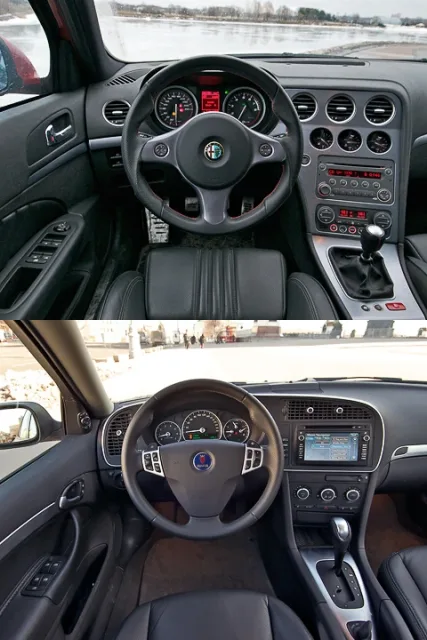
If comparing interiors, it must be admitted that Alfa beats Saab, if not by a landslide, then by a clear advantage. The only thing the "Italian" lacks is a color display. But even without it, she looks much more interesting.
The TI interior has additional accents. Darkened metal inserts, new seats with pronounced lateral support, a delightful steering wheel, red stitching... To die for! When the red instrument lighting comes on and the tuned (for TI) exhaust system starts to grumble bassily, the blood boils in your veins, and your heart races...
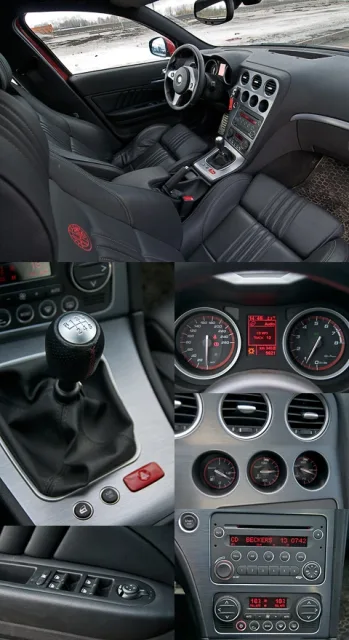
In terms of tactile sensations, Alfa Romeo leads. Its steering wheel is simply ideal, and the short-throw gearshift lever is so flawless that you want to click through gears even with the engine off.
The driver in the 9–3 Aero also experiences a full range of feelings. Although, unfortunately, Saab engineers, in pursuit of ergonomics, removed a million buttons from the center console, replacing them with a touchscreen display (which during the facelift received new attractive graphics, the same as on Cadillac cars) and three climate control knobs. It became, of course, more convenient, but the aviation spirit was diluted with a simulator one. However, the signature ignition lock between the front seats and the clever air vents are still there, as is the Night Panel button that turns off all instruments except the speedometer. It's a pity one thing — the age of the interior cannot be hidden by any facelifts.
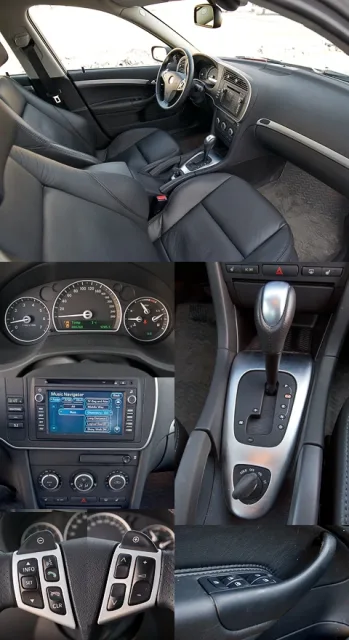
Saab has another trump card, not even available to the Alfa with an "automatic," — the most convenient paddle shifters on the steering wheel.
Minimalism fans are pleased again: predominantly black color, laconic metal-look inserts, and quality assembly. The Saab Aero seats differ from standard ones with a pronounced profile, but the steering wheel here, unlike the Alfa, is like on regular 9–3s. In the more compact "Swede," it feels even a bit more spacious. The seating position is slightly lower and visibility is better. True, Alfa interiors have never been known for space... And we're not interested in that right now.
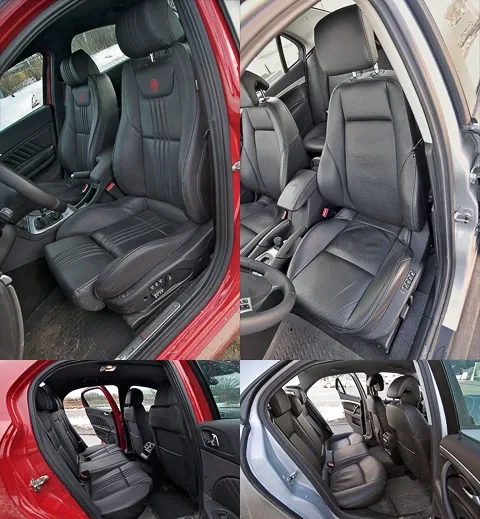
The front seats of both cars are good. Moderate lateral support coexists with decent comfort. Except in the 159, you want to sit a bit lower, but the adjustment range is already exhausted. In the back, it's cozier in the Alfa, and there's a bit more space in the Saab.
There's no time to study the technical specifications — after all, together they have more than five hundred "horses." Let's get behind the wheel quickly! But I still managed to glance at them. So, the 159 TI has a six-speed manual transmission (with a well-tuned short-throw shift mechanism), permanent all-wheel drive, and a powerful 260-horsepower engine.
Working the tight and very "short" steering wheel, we pull the Alfa out of the parking spot. She, rumbling from the exhaust, rolls up to the pole position at the traffic light. As soon as the light turns green, the tachometer needle, which a second ago was resting somewhere at idle, shoots up. Short movements of the gas and clutch pedals — and the 159 takes off with a slight wheel spin. The engine rages under the hood, after a couple of seconds you engage second gear and... What's this? Where's the kick in the back? Where are the 3.2 liters of displacement, where are the 260 horsepower?
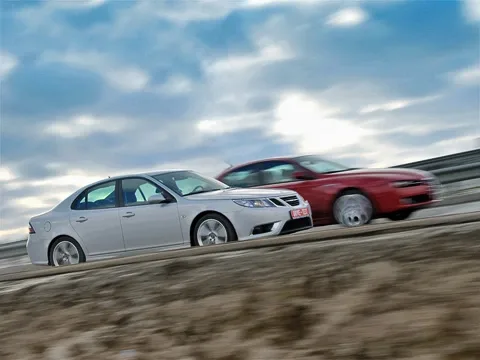
The 9–3 Aero accelerates rapidly, but the 159 TI at that moment flies past... This is only possible when starting from a standstill up to 100 km/h. Further, the light and powerful Aero takes over. And it does so very confidently!
They are in place. The car accelerates quite well from there. But why are there not so many vivid emotions as the simple front-wheel-drive 159 with the 2.2-liter engine once evoked? Maybe we just expected more from the Alfa? Yes, perhaps. But that's not the only thing. First, the car is quite heavy — 1,740 kg. More than 200 kg heavier than the Saab! And second, the TI has an incredibly long "autobahn" gearbox: in second gear it accelerates to about 115 km/h, and in third — to almost 170.
Given the torquey nature of the non-native engine, which performs well in the mid-range but fades at the top, this looks doubly strange. As a result, for active driving, the most used gears are not third and fourth, as on other similar cars, but second and third! And this looks completely incomprehensible against the backdrop of the same base 159, where keeping below three thousand rpm was barely possible even during calm driving. The 159 3.2 TI is, of course, faster, but acceleration in it is, oddly enough, just acceleration. Confident but not daring, without aggression. You don't expect that from an Alfa Romeo.
The 9–3 Aero is front-wheel-drive (all-wheel-drive versions will appear at the end of May), equipped with an "automatic" and is five "horses" weaker. But the 2.8-liter V6 is turbocharged, which, among other things, means 350 newton-meters of torque. Unlike the Alfa, you don't expect jerks during acceleration from it, and the automatic transmission suits its character perfectly. The engine here quietly purrs at idle, and the steering wheel after the 159 seems even too light and "long" (about 2.7 turns lock-to-lock).
But just lightly touch the gas pedal — and you immediately feel that the front wheels are trying to tear up the already fragile asphalt. You press harder — and the power presses your body into the seat, and instead of the roar of the engine, you watch the speedometer needle, which runs off to the right too quickly. Even though the Saab yields to the Alfa up to a hundred (due to front-wheel drive), after that mark it leaves its rival behind without any chance.
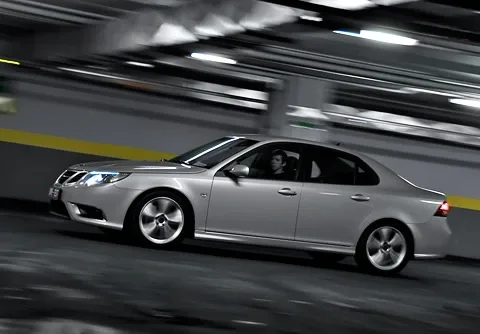
Saab is especially impressive with its persistence in accelerating to a hundred. Honestly, it feels like there's a huge V8 hiding under the hood! The engine delivers all 350 newton-meters already from 1800 rpm. Moreover, it reaches its peak without turbo lag — smoothly and elastically. And when the tachometer goes over 3000, the Aero surges forward, turning all fellow travelers into motionless scenery. The automatic transmission shifts with a slight hesitation, but you don't even notice it: with such torque, such trifles don't matter. As a bonus to the automatic, there are convenient paddle shifters hidden in the upper part of the steering wheel hub. With your thumbs, without taking your hands off the wheel, you can easily flip through gears even in a corner.
Having conceded in dynamics, Alfa tries to make up for it with its signature dish — handling. The trump card of the Italian is filigree steering! The car obeys the steering wheel as if alive; it is agile and maneuverable. Despite the short rack, the 159 confidently holds a high-speed straight, not making the driver strain unnecessarily. All-wheel drive with a bias towards the rear axle relieved the front wheels of excess torque — the feedback is clean and transparent.
But Saab can't boast of this… There are no limited-slip differentials in the front drive; the powerful torque flow even on dry pavement makes the car wander. During intense acceleration, you have to firmly hold the light steering wheel and correct the trajectory. And on a broken or slippery road, the steering wheel literally jumps in your hands. In short, for overtaking you don't need to turn the steering wheel — just press the gas harder! If you turn off ESP, the Swede will easily polish the asphalt even in third gear. Therefore, a properly tuned traction control system, which imperceptibly cuts torque and helps the car go smoother, is simply necessary here.
In a limit corner, Saab behaves classically for front-wheel drive. At the entry, it slightly understeers if you don't calculate the speed; when lifting off the gas, it first slightly steers with the rear axle (the rear multi-link ReAxs is responsible for this), and then goes into a predictable drift, which with such traction on the drive wheels can be controlled at almost any stage — it all depends on the driver's skill and the width of the road. The feedback, which seems insufficient in normal modes, becomes exhaustive at the limit — you feel the car perfectly! The suspension also impressed. Decent comfort is combined with moderate body roll, and on a broken arc, the car doesn't scare you with deviations from the trajectory. Although in a rut, it still kicks…
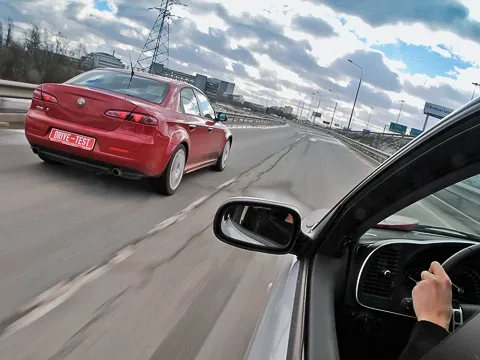
It's a bit harder to make friends with the Alfa. But only if you want to get everything from it — to enjoy controlled drifts. If you don't push it into slides, then, like the Saab, the Italian sedan is adequate and easy to drive. There's even a bit more comfort here than in the Saab. Body roll and delays are minimal. Now let's try entering a corner faster! First, the 159, like its rival, slides outward with its front end. Then the driver has two options. Either just lift off the gas and return the car to the trajectory, or "break" it (although it's better to do this before entering the corner). A short pause in fuel supply, the front wheels grip the asphalt, and all that remains is to sharply press the gas again! The torque goes to the rear axle, and it tucks the sedan into the corner. A little patience to catch the 159 in a slide, and then, working with the steering wheel and gas, you can drive the Alfa sideways even in a straight line!
And yet, the behavior of the Italian could be better… Perhaps this is just an attempt to find spots on the sun, but if these spots weigh 200 kg, can you not notice them? The difference in weight is felt not only during acceleration. Even on the slalom, you feel that the 159 TI is more inert and heavier than the 9-3 Aero. And the unsprung masses also make themselves known. It's no wonder that during the last modernization, all 45 kg that the car lost were precisely in the suspension.
The Swede has no problems with excess weight, and the chassis design is maximally lightened (the hub mounts, calipers, lower front suspension arms, and rear arms are made of aluminum). Therefore, on the move, the light blue sedan feels like a lighter, almost airy car. In a word, an airplane.
But although it's not a heavy airliner, you can't call the 9-3 Aero truly sporty. Despite excellent handling and a powerful engine, there's no hint of pure sport here. Let the seconds to a hundred interest street racers; the 9-3's kick is in acceleration after that mark. And at the same time, the Saab remains quite comfortable and quiet. The main thing here is the emotions it gives the driver. There are many faster cars than the 9-3 Aero. But few can give such sensations. And the price tag of about $47,000 for the base Aero version looks quite humane. At least for those who have already managed to fall in love.
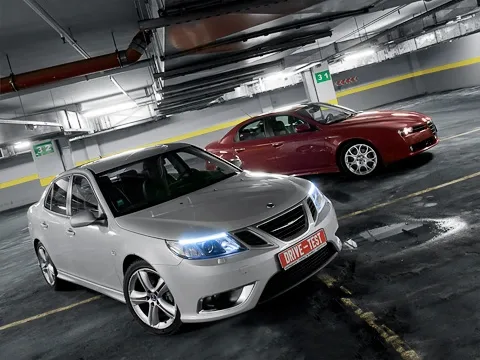
It's a pity that the determining factor when choosing one of these cars will most likely be the cost. We're talking about Alfa Romeo. Judge for yourself: if the test 9-3 Aero is estimated at about $61,000, then for the TI 3.2 they ask almost twenty thousand more!
Alfa Romeo is completely different. And although the engine and gearbox "saved" it from overheating with emotions, it still remained itself — sensual, sharp, and unrealistically beautiful. If you still care about banal technical characteristics, then you shouldn't even look at the Alfa: the pleasure of communicating with this car is not expressed in "horses" and seconds. The effort on the somewhat heavy steering wheel in a sharp turn, the rich roar of the engine, the amazingly precise and short-throw gear lever… And the appearance again. The owner of the 159 is no stranger to catching envious glances from owners of even those cars that cost twice as much. And the Alfa is not cheap at all (our TI costs over $80,000), but at such moments you feel like a million.
In any case, both cars are a worthy alternative to the existing and well-known premium representatives of the D-class. They have everything — decent equipment, respectable dynamics, proper comfort, and a level of safety. But the desire to stand out from the crowd is not enough. You need to erase stereotypes from memory and overcome greed. To do this, you at least need to fall in love. And there is something to fall in love with.
I was driving an Alfa Romeo 159 with a three-liter engine and a manual gearbox, while next to me at a traffic light stood a Saab 9-3 Aero with a turbocharged six-cylinder and an automatic. Two completely different views on what a sports sedan should be. One is a temperamental Italian with all-wheel drive, the other is a pragmatic Swede with front-wheel drive and turbocharging. And although both claim the title of "hot" sedans, their approaches are radically different.
The Alfa 159 in TI trim is not just a body kit, but a full-fledged claim to driving pleasure. Under the hood is a naturally aspirated 3.2-liter V6 producing 260 horsepower. It loves high revs and requires confident handling of the six-speed manual. Acceleration to 100 km/h takes 6.8 seconds — a figure that still doesn't let you get bored today. The engine is flexible, but truly wakes up after 4500 rpm, when the signature Italian exhaust note begins to sound. The Q4 all-wheel drive adds confidence when exiting corners, although it increases weight — the curb weight of 1740 kilograms makes itself felt.
The Saab 9-3 Aero, in turn, bets on a turbo engine. Its 2.8-liter six-cylinder with a twin-scroll turbo develops 255 horsepower, but thanks to 350 Nm of torque, it pulls powerfully and smoothly from as low as 1800 rpm. The automatic gearbox shifts quickly and smoothly, and acceleration to 100 km/h takes 7.5 seconds. Not a record, but subjectively the Swedish sedan feels lighter and more responsive — due to its lower weight (from 1440 kilograms) and front-wheel drive.
On the road, their characters fully reveal themselves. The Alfa 159 TI is a stiff, composed car that demands the driver's engagement and concentration. The suspension with double wishbones at the front and MacPherson struts at the rear is tuned for sportiness: body roll is minimal, the steering is heavy and informative. But this comes at the cost of comfort — on uneven surfaces the car shakes, and minor road ripples are transmitted to the steering wheel and seats. However, on a winding road, the 159 can deliver true pleasure: it grips corners tenaciously, and all-wheel drive allows you to start accelerating earlier than you would on a front-wheel-drive car.
The Saab 9-3 Aero is a different approach. It is softer, more comfortable, and forgives more mistakes. The multi-link rear suspension with a self-steering effect makes the car surprisingly stable on straights and obedient in corners. The steering is lighter than the Alfa's, but feedback is excellent. The automatic, though not a robot, works very well in conjunction with the turbo engine, allowing you to keep the tachometer needle in the zone of maximum torque. However, during spirited driving, front-wheel drive makes itself known: if you overdo the throttle on corner exit, the electronics begin to delicately hold back the wheels.
Inside, both cars are interesting in their own ways. The Alfa 159 TI features signature Italian aesthetics: a stylish instrument panel with distinctive dials, sports seats with good lateral support, and a leather steering wheel with a pleasant grip. There's also a Start/Stop button and parking sensors (in the test version — as an option). The trunk, however, is modest — 405 liters, although with the rear seatbacks folded (60/40), it grows to 1235 liters. The Saab offers a more restrained but no less high-quality interior: the brand's characteristic "aviation-style" climate control unit, a touchscreen display, and comfortable seats (sports seats are an option). The trunk is slightly larger — 450 liters.
In the end, the choice between these cars is a choice between temperament and pragmatism. The Alfa 159 3.2 TI is for those who are willing to endure stiffness for the sake of driving pleasure, who love working with their hands and feet on a manual gearbox, and who appreciate all-wheel drive. The Saab 9-3 Aero is for those who want maximum driving excitement without compromising comfort, who prefer an automatic and are not ready to put up with excessive stiffness. The price difference is significant: the Alfa starts from 1,739,000 rubles ($74,000), while the Saab starts from 1,103,769 rubles ($46,900). But in the test versions, the gap narrows: 1,900,000 (80,800) versus 1,450,000 (61,700) rubles, respectively.
Both cars are already history. They are not sold as new, but they still evoke emotions and find their buyers on the secondary market. And perhaps that is their main value: they remain cars with character, not just a means of transportation.
Saab is a brand with not the richest biography, but the history of the 9-3 model holds many interesting facts. The ancestor of the current family was the famous "nine hundred," based on a modified platform of another Swedish legend — the 99 model. This veteran, whose production began back in 1978, still appears on the roads today — a true object of fan love! The car turned out to be so successful that, with various updates, it survived on the assembly line until 1994! Over the years, many versions appeared, but special attention is certainly deserved by the turbocharged modifications with four-cylinder engines producing from 143 to 174 horsepower.
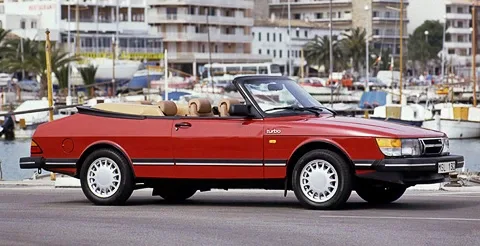
The second generation of the 900 series was nicknamed by the people with an unflattering but fair name "Opel." This happened because the model was based on the Opel Vectra platform — by that time, GM already owned a controlling stake in Saab. The last 900 lived on the assembly line for only four years. Under the hood, you could even find an Opel V-shaped six-cylinder with a volume of 2.5 liters and 170 horsepower, but the discerning public, of course, primarily looked at the turbo version with 185 "horses."
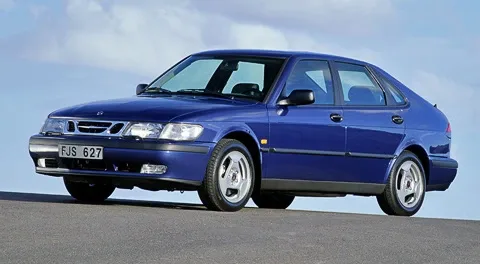
In 1998, the 900 went down in history, and the restyled version received the new name 9-3. The Opel engine no longer "stained" the Saab engine bay… The first generation of the 9-3 is remembered for two versions: the limited series Viggen (turbo engine 2.3 liters, 225–230 hp) and the more common Aero with a two-liter unit producing 205 hp.
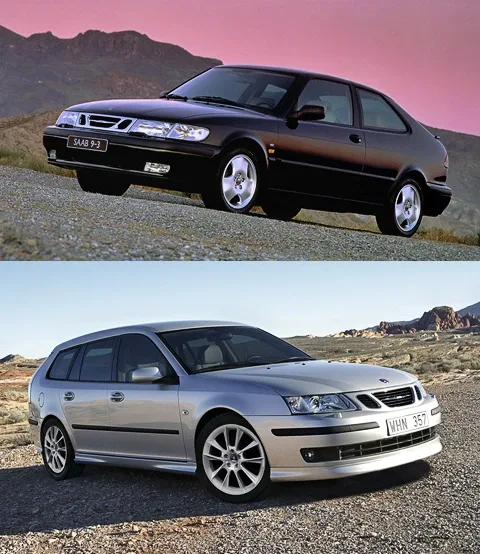
Well, the current chapter of the 9-3's history started in 2003. The car was again built on the common Epsilon platform with Opel. Last year, the model underwent a serious restyling.
Behind the scenes
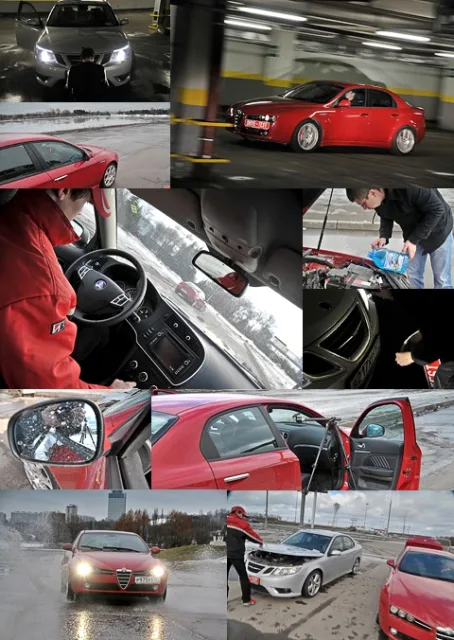
Alas, for almost the entire trip, the weather was not kind — it was mostly cloudy and damp. And the tires were clearly not for such conditions: winter tires, without studs, but with an overly soft tread and a speed index of only 160 km/h! The only consolation is that both cars had equally mediocre tires. However, even such slippery rubber could not spoil our enjoyment of driving these cars.