

Volvo XC90 D5. Price: 1,574,100 RUB. On sale: since October 2007.
Volvo begins sales in Russia of diesel modifications of the XC90 SUV, as well as the XC70 and V70 station wagons. We tested the strengths and weaknesses of the XC90 D5 during a road trip from Arkhangelsk to Moscow, timed to coincide with the arrival of diesels on our market.

2008 Volvo XC90 D5
© Photo: Volvo
Like both Swedish station wagons, the diesel XC90 received Volvo's inline five-cylinder D5 engine with a displacement of 2.4 liters. Thanks to new electronics and an improved turbocharger with variable geometry, the aluminum unit develops 185 hp. The XC90's engine control unit is tuned to deliver maximum power at minimum fuel consumption: the maximum revs are artificially reduced from 6000 (as on front-wheel-drive station wagons) to 5000 rpm, and the red zone starts already at 4500 rpm. The extra range is cut off, so the engine mainly operates in the range from 1500 to 2700 rpm, where peak torque of 400 Nm is achieved.
2008 Volvo XC90 D5
© Photo: Volvo
In terms of environmental friendliness, the Swedish diesel can outperform many rivals. Even in the base configuration for Russia, the engine is equipped with a maintenance-free particulate filter with a catalytic coating of precious metals, which allows all diesel D5s supplied to us to meet strict Euro 4 standards. In addition, almost all diesel Volvos, starting with the base Optima version, will receive a pre-heater with a timer — on a frosty morning, this option will significantly simplify the driver's life. In general, the Swedes paid special attention to the operation of the diesel engine in cold weather. The calculation of the fuel line cross-section practically eliminated the crystallization of paraffin. Combined with multi-stage heating of filters and the fuel line, this allows the engine to start even at –37°C.
2008 Volvo XC90 D5
© Photo: Volvo
Volvo prepared for the Russian debut of diesels for almost a year and a half. All this time, D5 engines were run in on domestic roads, checking fuel quality. From time to time, the "Russified Swedes" were sent to the factory in Gothenburg for a "check-up" and adaptation to our conditions. As a result, the quality of Russian fuel was deemed satisfactory, but the engineers made an unexpected verdict: it is better to refuel away from Moscow and the region. It turned out that the closer to the capital, the worse the local diesel fuel becomes.
The "From Arkhangelsk to Arkhangelskoye" road trip was supposed to show how unpretentious Volvo engines are to Russian fuel. For the purity of the experiment, on the way to Moscow we deliberately refueled at stations of three different oil companies. And no complaints about the fuel arose. The Swedish engine happily consumes Russian diesel, but without a voracious appetite. With calmer driving, the 1300 km to Moscow could have been covered on just two 65-liter tanks: the Volvo's certified fuel consumption in the combined cycle is 9 liters per 100 km, but we drove most of the way at speeds above 120 km/h, so our XC90 with a six-speed automatic averaged 11.4 liters per 100 km. For comparison, the petrol XC90 2.5T, which was taken on the trip specifically for comparison, turned out to be one and a half times more voracious — more than 17 l/100 km.
The Kholmogory highway is an ideal place for testing cars. You get the feeling that you are on a multi-kilometer proving ground with a wide variety of surface types. Occasionally there are sections of smooth, glass-like fresh asphalt. But mostly the Arkhangelsk tract is hastily patched, bumpy roads that shake your soul, interspersed with shallow potholes that are almost safe for tires. On such a surface, the Volvo's suspension seems slightly stiff, and despite the wide track, the short XC90 has to be constantly corrected. Although, to be fair, at speeds over 150 km/h on such a road, no one drives except during tests.
Lomonosov's Route

2008 Volvo XC90 D5
© Photo: Volvo
Nine cars started in Arkhangelsk. In addition to seven diesel vehicles, two petrol Volvos were taken on the trip: an XC90 2.5T and an XC70 3.2. The next day, having covered more than 1300 km, all nine cars successfully finished at the Arkhangelskoye estate near Moscow. The average fuel consumption for the diesels was 11 liters per 100 km, for the petrol ones — 17.
It is curious that the route of the run through Kholmogory, Velsk, Vologda and Yaroslavl almost exactly repeated the path that Mikhailo Lomonosov took to Moscow in 1730. And it is doubly symbolic that on the eve of the 300th anniversary of the great Russian scientist, this path was traveled precisely behind the wheel of Swedish cars! After all, it was the Swedish Royal Academy that in 1760 was the first in Europe to award Lomonosov the degree of academician. So two and a half centuries ago, the Swedes were the first to recognize the talent of the Russian scientist. And 250 years later, his native Kholmogory became the starting point for the recognition of Swedish diesel cars in Russia.
Driving
The steering wheel, like on most SUVs, is somewhat empty, but there are no complaints about the operation of the automatic transmission. No unnecessary shifts or jerks — everything is clear and logical.
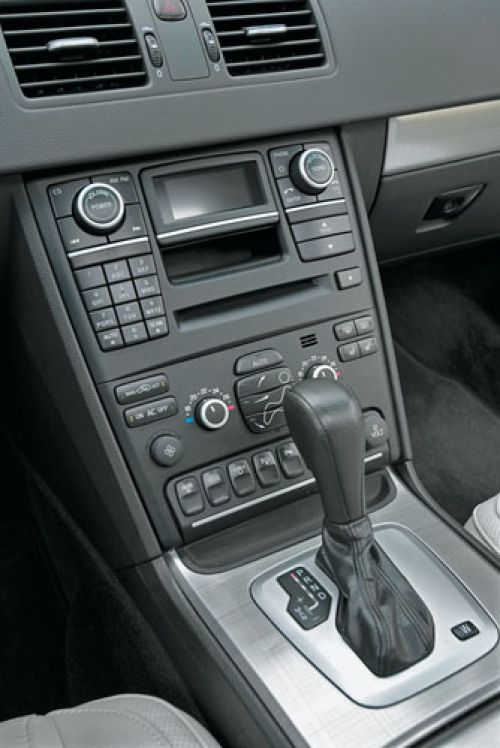
Interior
The design is somewhat outdated, but remains practical, and in January 2008 it will be supplemented with a retractable navigation monitor in the upper part of the center console.
Comfort
Light vibrations on the steering wheel and pedals, typical of diesels, are of course felt, but overall the engine runs smoothly and quite quietly.
Safety
The car is far from new, but passive safety remains at a traditionally high level for Volvo.
Price
The diesel XC90 on average (from 1,444,800 RUB) is $1,500 cheaper than the petrol one in a similar configuration, not to mention significant savings on fuel.
| Dimensions, mm | 34807/1898/1784 |
| Engine | diesel, 2401 cm3, 185 hp/4000 rpm |
| Transmission | automatic, 6-speed |
| Dynamics 0-100 km/h, s | 11.5 |
| Maximum speed, km/h | 190 |
| Competitors | BMW X5, Volkswagen Touareg TDI |
Advantages and disadvantages
+ Low fuel consumption, high environmental friendliness and a wide range of revs with maximum torque.
- The accelerator pedal has noticeable free play.
Our opinion
Solid appearance and low fuel consumption, combined with good performance characteristics, make the diesel Volvo XC90 a real find for the Russian market, especially in the regions. The car certainly justifies its price.
© 5 Koleso