
Volvo XC 70. Expensive, family-oriented, valuable
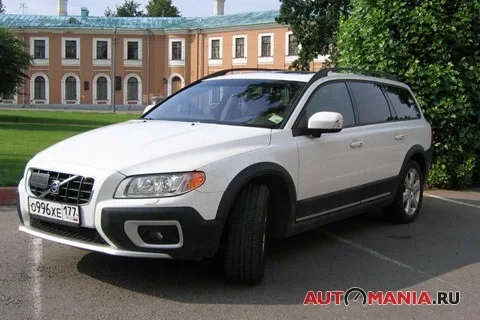
The creators of the new Volvo XC 70, first presented to the public at the Geneva Motor Show in 2007, took another step in the development of the automotive industry. The 7-year history of the previous version of the XC 70, which had the Cross Country prefix, ended, and it was replaced by a completely new car that, despite its station wagon body, is ready to compete with many crossovers.
The development of all-terrain station wagons among different brands follows different paths. If the new Audi Allroad, based on the Audi A6 Avant and appearing a year earlier than the Volvo XC 70, became more "asphalt-oriented," then the XC 70, based on the V70 station wagon, on the contrary, became more adapted to off-road conditions than its predecessors.
Are there rivals?
Today, the XC 70 has only one rival in its class — the aforementioned Allroad, but even they are hard to call rivals; these are too different cars (recently the Skoda Octavia Scout also appeared, but it is too early for it to compete with the aforementioned giants). Yes, and the Audi's price is much higher, although it does not have much of what the XC 70 has. The only thing the Volvo lacks, if we compare the two cars, is a ground clearance adjustment mode. However, with a clearance of 210 mm, this is not so important. In terms of clearance, the XC 70 is only 8 mm behind the quite serious SUV XC 90. Yes, and the 4×4 transmission, based on the Haldex coupling, capable of redistributing traction between the front and rear wheels in different proportions, will also play a significant role when you find yourself off normal asphalt roads in your XC 70. The quality of the XC 70 fully justifies the advertising slogan created for this model: "As long as the quality of roads lags behind the quality of Volvo, this car will constantly help you out in any situation."
If you try to characterize the XC 70 briefly, it should be said that it is a true family car created as a result of crossing the luxury sedan S80 and the crossover XC 90. True, for a family with above-average income.
Interior of a luxury sedan
The interior of the cabin and its finishing, including hand-polished walnut wood inserts on the panel, console, and steering wheel, have completely moved here from the S80 in the Executive version. From there also came the audio system with a power of 650 W, created using Dolby Pro Logic II technology with 12 Dynaudio speakers. For the driver's convenience, there is an integrated built-in phone headset with Bluetooth function. As soon as you get into the car, it automatically finds your phone, and no problems with traffic police. The seats are more reminiscent of their relatives from the XC 90, but softer, capable of not only heating but also cooling. Inside, of course, there is the proprietary optional BLIS system, which alerts with red lights about the presence of cars (and even motorcycles) in the blind spot. Also, the CWBS system, which uses radar to warn of a possible collision (except frontal) and forces the brake to activate in support of the driver's actions (read more about its operation in the Volvo S80 EXE test). For rear passengers, the BMW system with 2 monitors and wireless headphones is also optionally offered. But you won't be able to watch two different films, as well as TV.
By the way, when getting behind the wheel of the Volvo XC 70, you will only need to learn these three words in English. All car settings and all information from the on-board computer are provided in Russian. Future buyers do not need to learn English or carry a dictionary with them to understand the instructions or the inscriptions appearing on the display.
It is very convenient that the low beam turns on automatically when the ignition is turned on (this function is especially relevant for Scandinavian countries), and the brightness of the instruments also automatically changes depending on street lighting.
Almost like a pickup
The total load capacity of the all-terrain station wagon is far from small — almost 700 kg. Many crossover SUVs and even pickups cannot boast of such "weight data." And even more so the volume of the luggage compartment. A whole 575 liters with the rear row of seats folded and an impressive 1600 liters — with them folded.
As in the sedan, there are three suspension levels: Comfort, Sport, and Advanced.
With the help of three buttons that activate the mentioned suspension modes, the driver can change the settings on the go, adjusting the stiffness of the shock absorbers, adapting to the quality of the road surface. For example, the Comfort mode is recommended for use in rain. In this case, the softest damping. The Sport mode (recommended as permanent in the city) reduces lateral rolls, provides a faster response of the steering wheel, and stiffer suspension damping. On highways, you should use the Advanced mode. It provides the lowest rolls when cornering.
Truly family-oriented
If you have children older than 5–6 years, then in the XC 70 you don't need to buy an additional child seat. The seats in the rear row are designed so that part of the seat can move up and back, thus providing the optimal height for using the seat belt. With a light press of the handle, you get a child seat, and the main seat becomes a convenient footrest.
The fact that the XC 70 was created as a family car is also indicated by the rigid (as well as soft mesh) partition separating the luggage compartment from the passenger compartment. This will save you from problems with transporting animals and subsequent cleaning of the cabin, as well as from things falling on the heads of rear passengers when the trunk is fully loaded. If you are a fan of winter sports and plan to go skiing, a ski hatch is provided for placing your equipment. You can also fold the rear seats in a 40/20/40 ratio. Well, if you are going to the mountains, the typical SUV Hill Descent Control system, which prevents the car from sliding on steep descents, will definitely not hurt you.
Scandinavian weather conditions are somewhat similar to Russian ones. We have mud on the roads for at least 9 months a year. Apparently, this problem is also familiar to the Swedes, so they made sure that dirt, if it gets on the car, remains only outside. You won't have to open and close the splashed rear door, getting your hands dirty. It opens with the key fob or by pressing a button in the cabin, and closes with a button located on the door itself, but on the inside. Touch it, and the door will close and seal. A similar mechanism is used on Audi, BMW, Mercedes. By the way, when the door is open upward, the rear taillights automatically turn on. For dark times of the day, this is a useful thing in terms of passive safety. If an obstacle appears in the path of the door, it will not strive to close, pressing everything in its path, but will crawl back up. In the side windows, you are not at risk of pinching your hand. At any foreign object in the path of the glass, they sharply lower down.
Let's look under the hood
It should also be told what is under the hood of the Volvo XC 70. If the previous version had a turbocharged TS engine with 210 hp, now buyers are offered a choice of two power units. Either a 2.4-liter diesel, as on the XC 90, with 185 hp. Or, as on the car we tested, an inline "six" with an output of 238 hp. Although the engine seems powerful enough, it must be said that it accelerates the XC 70 leisurely. True, the lack of dynamics on asphalt is fully compensated by confident driving off-road. But we decided to postpone this "experiment" for later — when we take the diesel version of the station wagon.
Well, of course, we cannot ignore such an important indicator in our time as fuel consumption. We will get to the diesel later, but we have already gotten acquainted with the 3.2-liter engine firsthand. The minimum consumption we managed to achieve was 12.8 liters per 100 km, the maximum in traffic jams — 15.6 liters. A very good result, especially considering that the car allows you to occasionally use 92-octane gasoline in emergency circumstances. Although, on the other hand, you can't boast of achievements here if on the S80 with 315 hp and 8 cylinders we managed to achieve results of 12.6 liters per "hundred" (with a maximum of 18.7).
It should be noted that Russians liked the new off-road station wagon, and according to the results of the first quarter of 2008, they purchased 691 cars. The XC 70 yielded only to the XC 90 (1410 cars) and the small S40 (713 units).
Dmitry Shavyrin
Technical specifications
| Dimensions (mm) | 4838 x 1861 x 1604 |
| Wheelbase (mm) | 2815 |
| Gross weight (kg) | 1794 |
| Trunk volume (l) | 575–1600 |
| Ground clearance (mm) | 210 |
| Engine displacement (cm3) | 3192 |
| Max. power (hp) | 238 at 6200 rpm |
| Max. torque (Nm/rpm) | 320 at 3200 rpm |
| Max. speed (km/h) | 215 |
| Acceleration 0-100 km/h (s) | 8.6 |
| Fuel consumption (avg. l/100 km) | 11.4 – 16.4 |
| Price (RUB) | From 1,431,800 |
We thank the Volvo Cars Russia representative office for providing the car for the test.
Longitudinal roof rails
Standard side window trim
Leather gear shift knob
Textile floor mats in the cabin
Leather-wrapped steering wheel
Radio and climate control knobs with chrome trim
Chrome trim on ventilation diffusers
Storage compartment in the rear part of the front armrest for rear passengers
Interior trim XC 'Crossed aluminium'
Anti-lock braking system ABS
Side airbags SIPS
Emergency stop sign
Inflatable curtain airbags, IC
Seat belts with pretensioners (front, rear)
Whiplash protection system WHIPS, front seats
Emergency brake assist system, EBA
Side airbags SIPS, front seats
ISOFIX child seat attachment
Two-stage driver and passenger airbag
Additional brake light
Intelligent Driver Information System (IDIS)
Brake light flashing function during emergency braking
Luggage compartment protective net for two-section rear seat
Luggage compartment cover
Security system
Illumination in side rearview mirrors
Alarm and central locking remote control integrated into the key
Exterior lighting
Anti-theft system volume sensor
Anti-theft system vehicle tilt sensor
VOLVO anti-theft system
Dead Lock system
Follow-me-home lighting
Side windows tempered, without water-repellent coating
Two-stage heated front seats
Power driver seat with memory
Manually folding rear headrests
Manual passenger seat adjustment
Memory for driver and passenger seat positions
Dynamic Stability and Traction Control system, DSTC
Electronic parking brake
Hill descent control system
Additional brake light
Rear fog light with auto-off
Fog lights in front bumper spoiler
Separate low and high beam headlights
Standard front headlight angle
Cabin filter
Dual-zone electronic climate control
Standard windshield
Transmission
6-speed automatic transmission AWD
Clock
Intelligent Driver Information System (IDIS)
Trip computer
Russian language for computer and radio
Tachometer
Outside temperature thermometer
Electronic speed limiter 250 km/h
Performance audio system (4 speakers, amplifier – 4×20 W)
Single-disc CD player without MP3
Other equipment
Vanity mirrors for driver and passenger, with illumination
12V socket in luggage compartment
Headlight washers
Lockable glove box
Storage compartment for small items behind the center console
Storage compartments for small items in front doors
Front armrest
Owner's manual and service book in Russian
Electrically folding rearview mirrors
Cigarette lighter
Rearview mirror tilt function when reversing
List of additional equipment installed on the test car
| Power tailgate | 20700 |
| Wood interior trim | 16800 |
| Sport steering wheel with wood | 7800 |
| Rear armrest with cup holders | 2600 |
| Leather gear shift knob with wood insert | 5200 |
| Natural wood interior trim | 16800 |
| Passenger airbag deactivation | 1300 |
| Bag holder in luggage compartment | 2600 |
| Adaptive cruise control | 64600 |
| Collision warning system | 64600 |
| Vertical steel cargo area protective net | 5200 |
| Integrated child seat in rear (outboard positions) | 11600 |
| Power child lock for rear doors | 2600 |
| Keyless ignition technology | 25800 |
| Heartbeat sensor in vehicle | 25800 |
| Laminated side windows with water-repellent coating | 25800 |
| Power passenger seat | 18100 |
| Heated rear seats | 12900 |
| Power steering with variable assist | 10300 |
| "FOUR-C" system | 64600 |
| Nivomat system, automatic self-leveling | 5500 |
| BI-XENON headlights | 38800 |
| Humidity sensor | 5200 |
| Fine air filtration system | 5200 |
| Parking heater with timer, fuel-operated | 25800 |
| Heated windshield washer nozzles | 2600 |
| "Clean air" system, CZIP | 7800 |
| Heat-reflecting windshield | 12900 |
| Electric air heater (quick cabin warm-up) | 10300 |
| Tinted glass for rear doors and cargo area | 10300 |
| PREMIUM SOUND audio - 12 speakers, amp 4x70W, DolbyProl2 | 46500 |
| Steering wheel audio controls | 2600 |
| Headphone jack for rear passengers | 7800 |
| Rear seat entertainment system (DVD) | 77300 |
| Bluetooth - mobile phone synchronization with audio system | 25800 |
| Subwoofer | 20700 |
| Rain sensor | 3900 |
| BLIS – blind spot information system | 38800 |
| Auto-dimming rearview mirror | 5200 |
| Water-repellent coating for front door windows | 7800 |
| Compass in interior rearview mirror | 7800 |
| Eyeglass holder | 800 |
| Parking radar, front and rear | 20700 |
| Total: | 795 800 rubles |
Total vehicle cost with additional equipment 2 227 600 rubles.
Source – AUTOMANIA.RU