
Alexander DIVAKOV, Pavel KARIN | Photo by Stepan SHUMAKHER
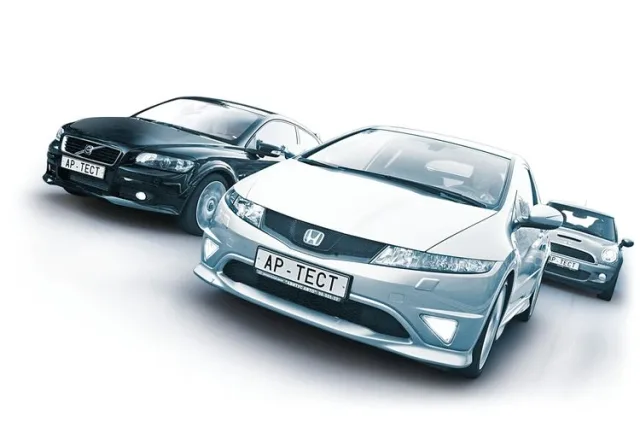
Take a closer look at the traffic in the city. Gloomy! Almost all cars evoke no interest in us, like boring sandwiches. The bread seems fresh, and the sausage looks appetizing, but... Only a few models stand out in this gray mass like exquisite snacks — true designer canapés. Among them are the Honda Civic Type R, Mini Cooper S, and Volvo C30 T5. But which of them can not just ignite, but truly satisfy our hunger?
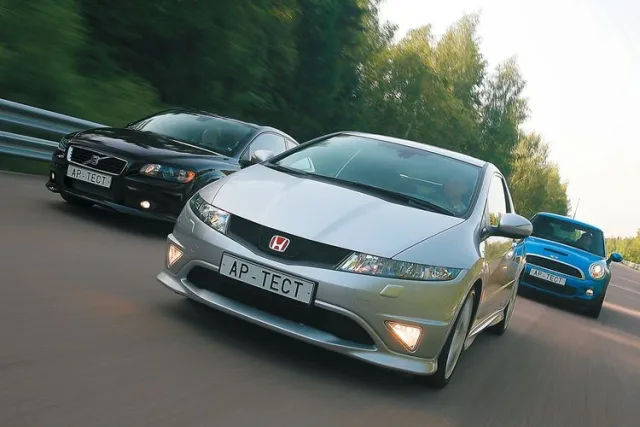
Comparing cars from different segments in one article is a thankless task, wouldn't you agree? However, the fresh Honda Civic Type R at $37,800 has clearly outgrown its golf-class siblings, which we've already studied inside and out. Where does the Civic with its two hundred "horses" stand against, say, the 260-horsepower Mazda 3 MPS? Especially since the latter is also $6,000 more affordable...
That's why we decided to pit the new Type R head-to-head against a pair of powerful hatches that win with design — the Mini Cooper S (175 hp) in its second generation and the Volvo C30 T5 (220 hp), whose starting prices are from $38,400.
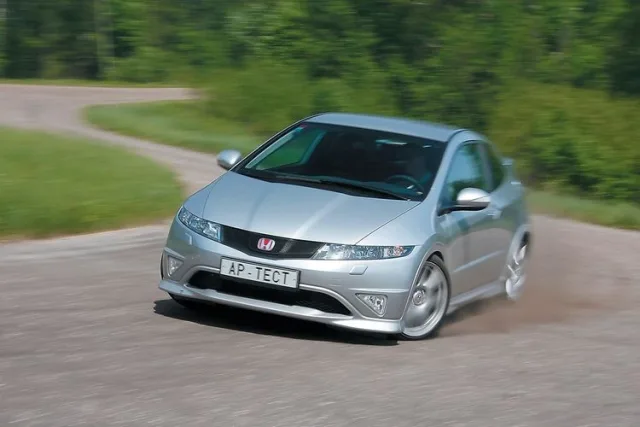
Honda Civic Type R: razor-sharp reactions and minimal body roll coexist with outright understeer — the car stubbornly slides its front axle outward on corners
The updated Mini, a modern reincarnation of Alec Issigonis's legendary creation, hasn't changed its principles in the new generation. The hood line has risen, the "lips" of the fake radiator grille have stretched slightly, the "turn signals" have moved into the headlights, and chrome inserts have appeared in place of the grilles in the front fenders. However, the "nostril" on the hood of the Cooper S remains — but now it's purely decorative.
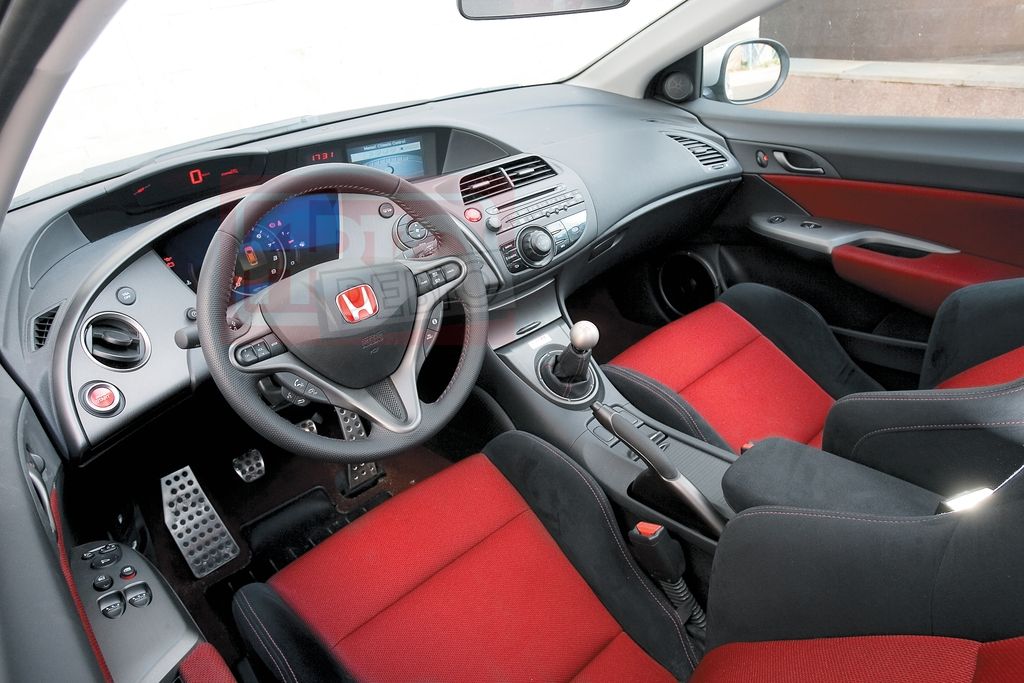 | 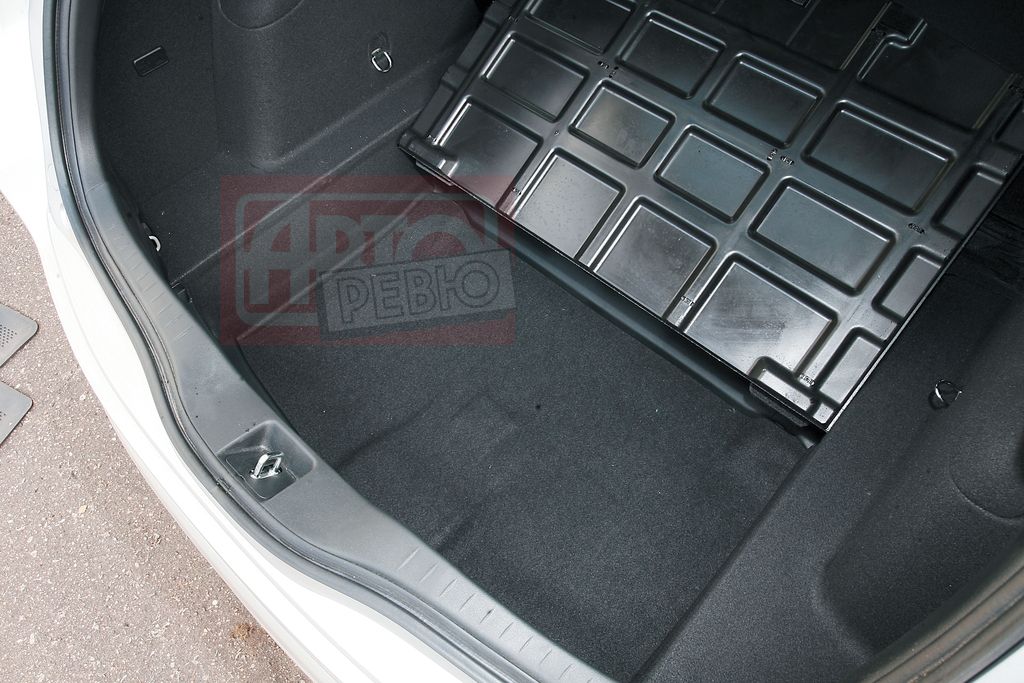 |
| The futuristic interior of the Civic is complemented by bright details — the instrument backlighting, the brand emblem, and the stitching of the leather-Alcantara trim have become red | The Honda's trunk has a "subfloor," but instead of a "spare tire," there's only a repair kit with a can of sealant |
Getting inside the Cooper S is like putting on a branded baseball cap: the roof hangs like a visor over the forward-set windshield pillars. Those who've already dealt with the first new Mini view the familiar interior as if through a magnifying glass: the "plate" of the speedometer has grown from a dessert plate to a soup plate! True, in our case with the navigation screen built into the speedometer, the scale readings are still impossible to see: the needle wanders somewhere along the rim of the decorative instrument. But there are plenty of toggle switches here not only on the center console but even on the ceiling! There are so many stylish and stylized details that you get the feeling the Cooper S is tugging at your sleeve: "Come on, I'm cool, right? Say it, huh?"
Cool, cool...
| Honda Civic Type R | Mini Cooper S | Volvo C30 T5 |
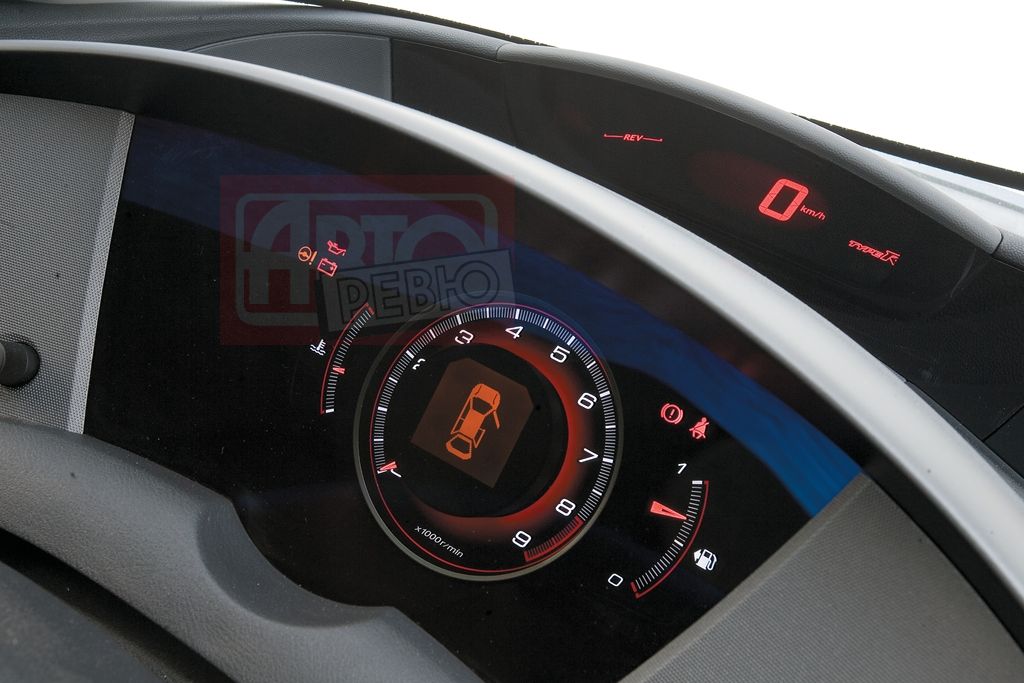 | 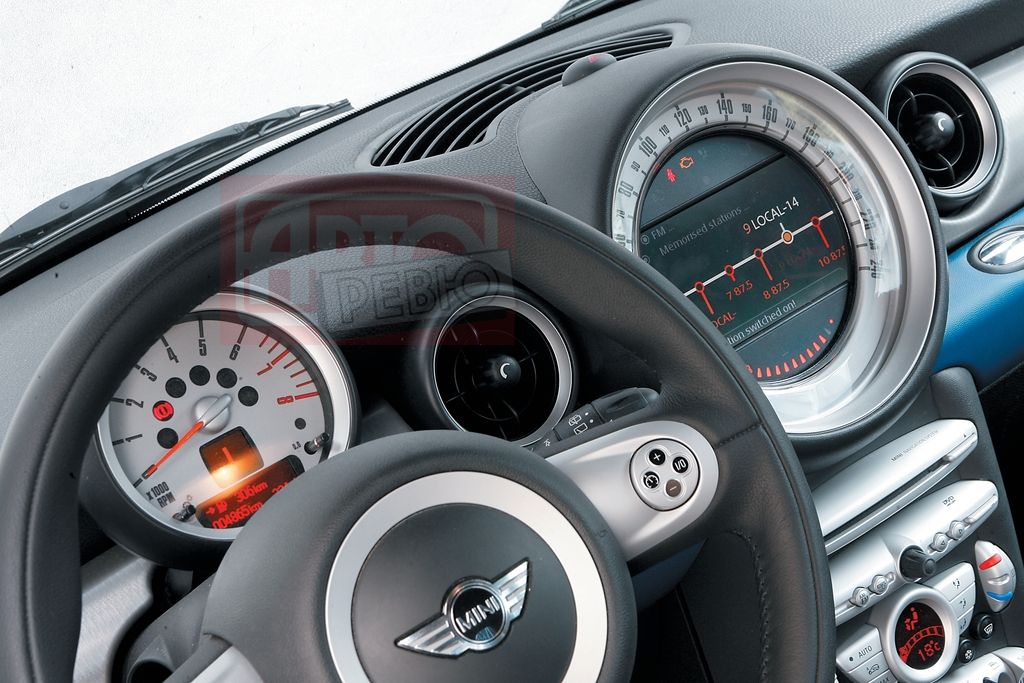 | 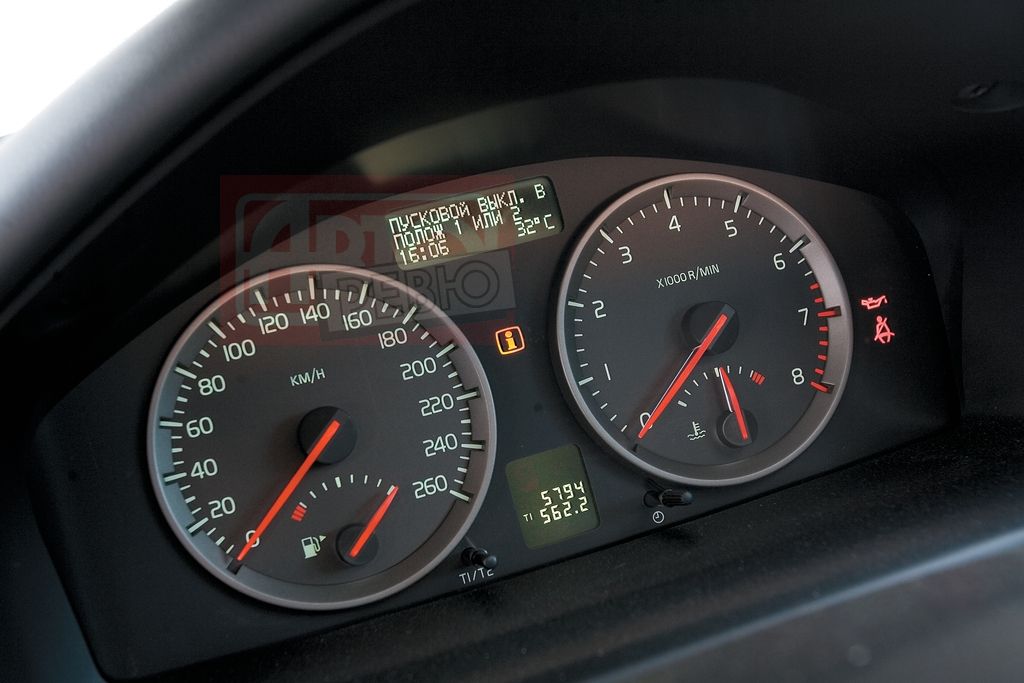 |
| The most interesting instruments are in the Honda: beautiful and informative. In the Mini's "decorations," you still need to figure things out: the driver can't see the readings of the huge speedometer, but the speed can be displayed in "digital" form on the tachometer's screen. The Volvo's instruments are more modest and read perfectly | ||
Plus ergonomic order: excellent seats with wide adjustment ranges, a pleasant steering wheel. You press the stiff long-travel clutch, shove the huge — orange-sized! — gear knob into first gear and...
No, no, first let's look at the Honda and Volvo.
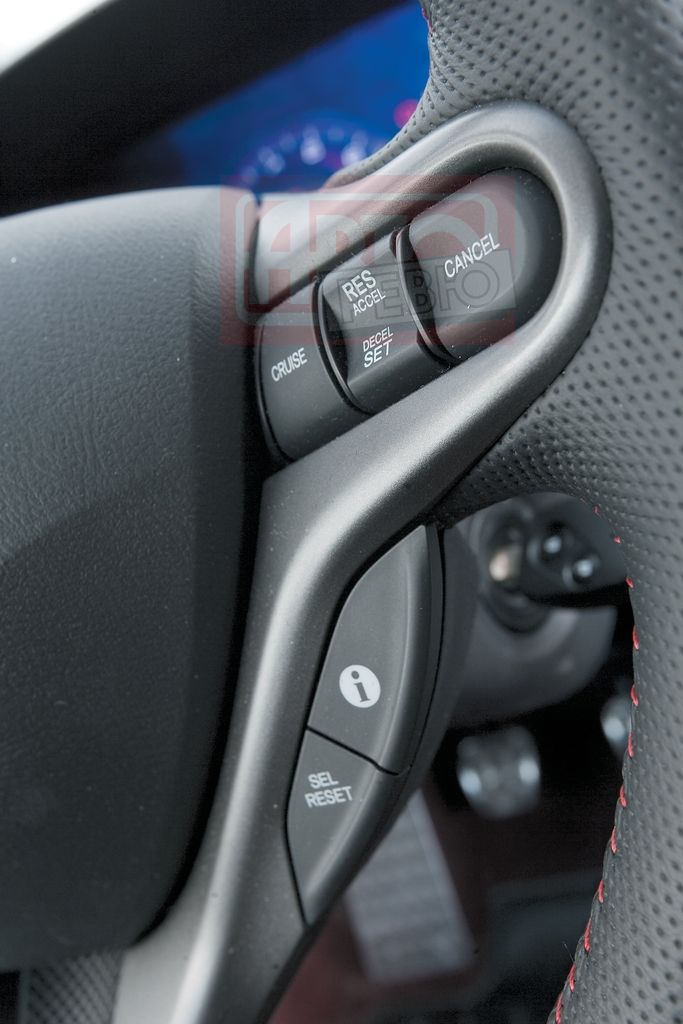 | 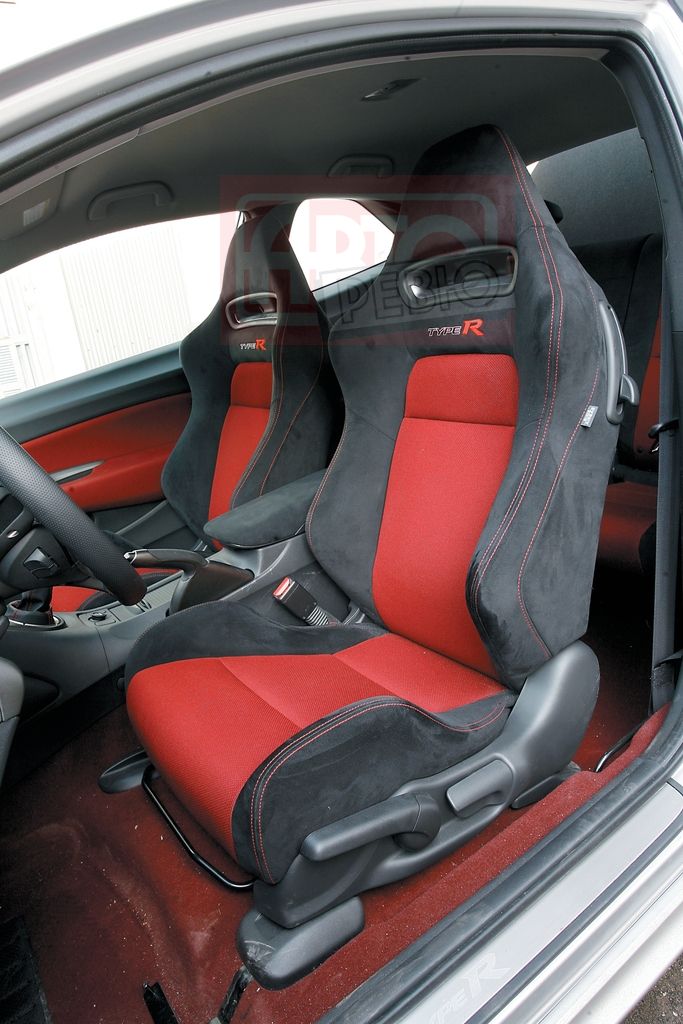 |
| The Honda's steering wheel is literally covered with buttons, but there's no problem with convenience | The Honda's "bucket" seats, adjustable in height and tilt angle, are the best. Airbags are hidden in the outer side bolsters of the seats |
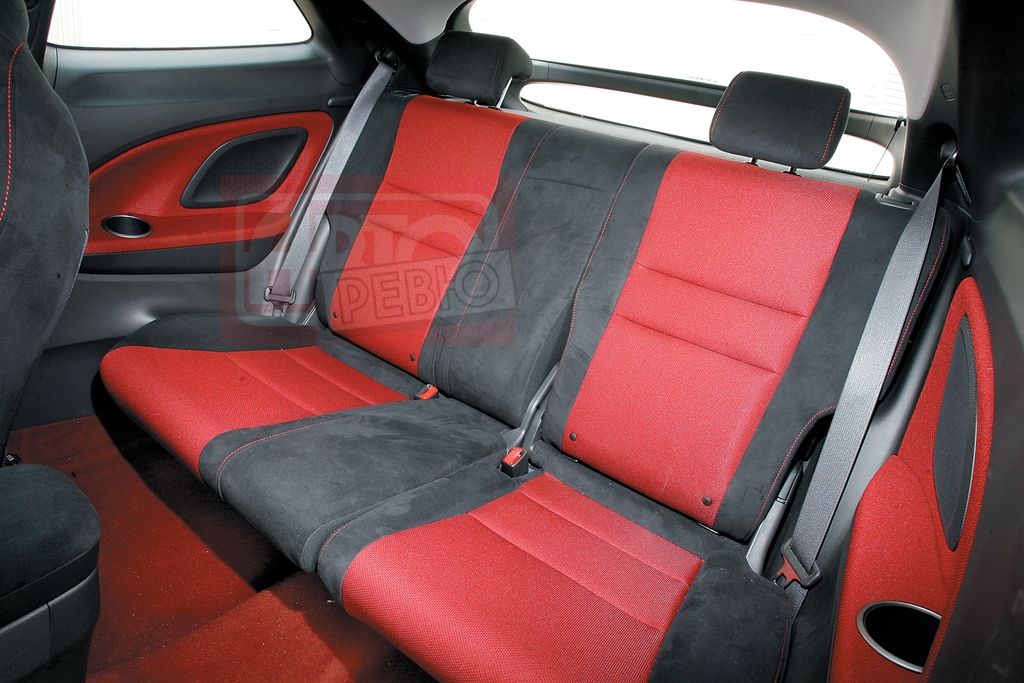 | 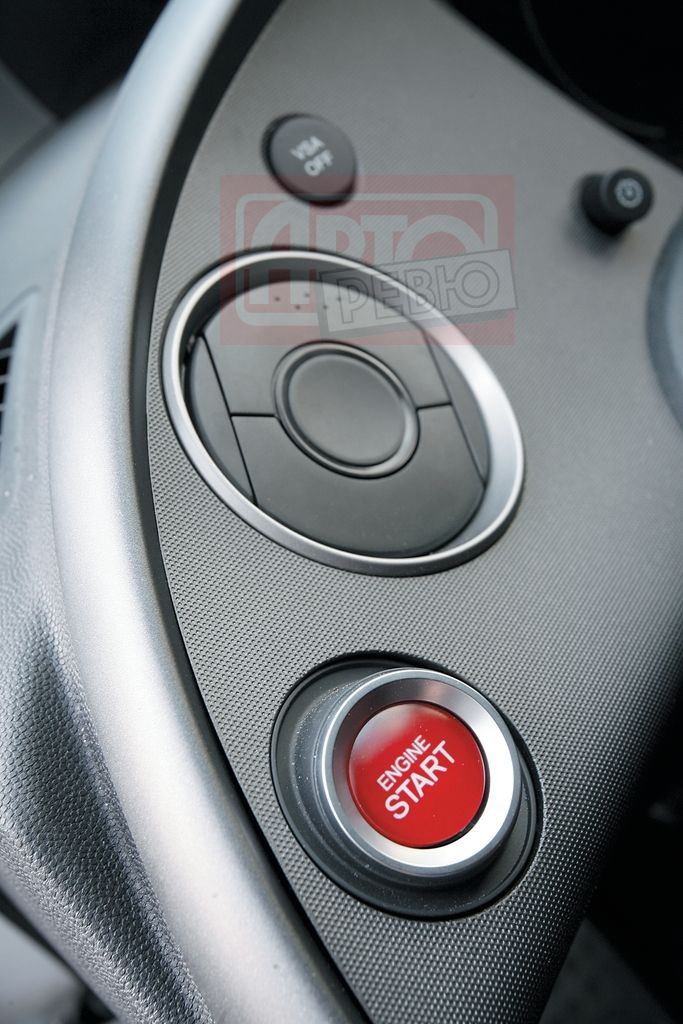 |
| The Civic is spacious and comfortable in the back even in the three-door version | To start the Honda's engine, you first need to turn the key to the right of the steering wheel, then press the red button with your left hand — like in the S2000 roadster |
The Honda Civic Type R is a real breakthrough compared to its predecessor! The new Type R bares its teeth with a wide air intake in the front bumper, bristles with a spoiler on the "tailgate" door, and the brand emblems are filled with the blood of the R group... And instead of the striking "chandelier" between the headlights of regular Civic hatches, the Type R version has a familiar fake radiator grille so the powerful engine can "breathe" easier.
Inside — out of this world. Beautiful "two-story" instruments with fiery red backlighting, an aerospace cockpit that embraces the driver. Plus a magnificent racing "bucket" sport seat and a ball crowning the gear lever. Style, mood, ergonomics — everything is superb! True, the arrow-shaped front end visually makes the seating position feel higher.
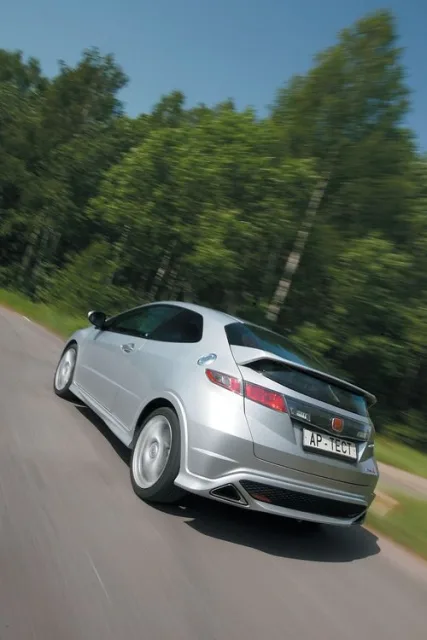
Beautiful but impractical: the rear spoiler worsens "in-cabin" visibility, and the "curved" glass collects road grime. And there's no "wiper" either
The newest three-door Volvo C30 looks like a copy of the Volvo S40 sedan from the front. But from the rear — a sharply cut-off glass tailgate. Beautiful! Inside, Swedish maxi-minimalism reigns: the laconic interior is complemented by luxurious light-cream seats. Sitting is comfortable, but where's the sportiness? The instrument scales are the most ordinary, and the aluminum "floating" console is adorned with frivolous designer swirls. A women's car? But then why is there a manual gearbox and a 220-horsepower five-cylinder turbo engine here? Moreover, the Volvo C30 T5 in our trio leads not only in power but also in power-to-weight ratio, that is, the ratio of horsepower to curb weight.
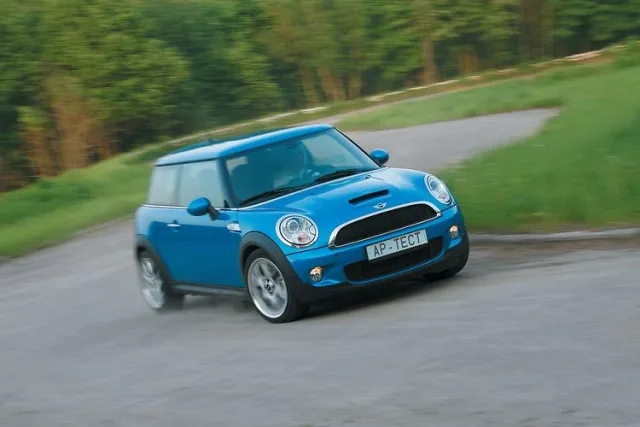
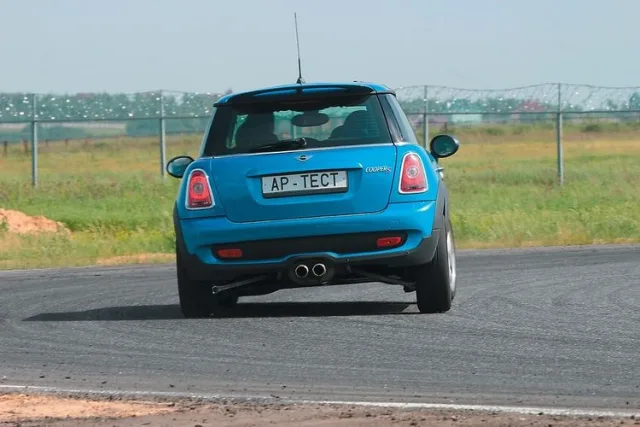
On a smooth road, the Mini is devilishly pleasant to drive, but Russian realities make it nervous
And who's actually faster?
Mini!
It would seem, where does a little car with a 1.6-liter turbo engine stand against the supercharged "five" of the Volvo with a whopping 2.5 liters? But go figure...
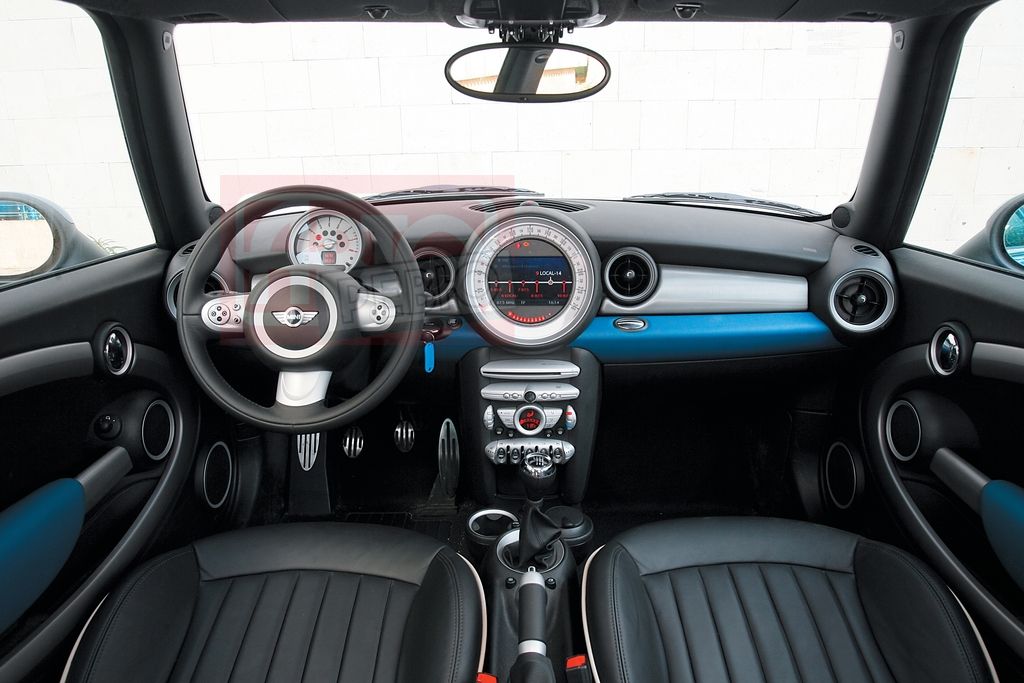 | 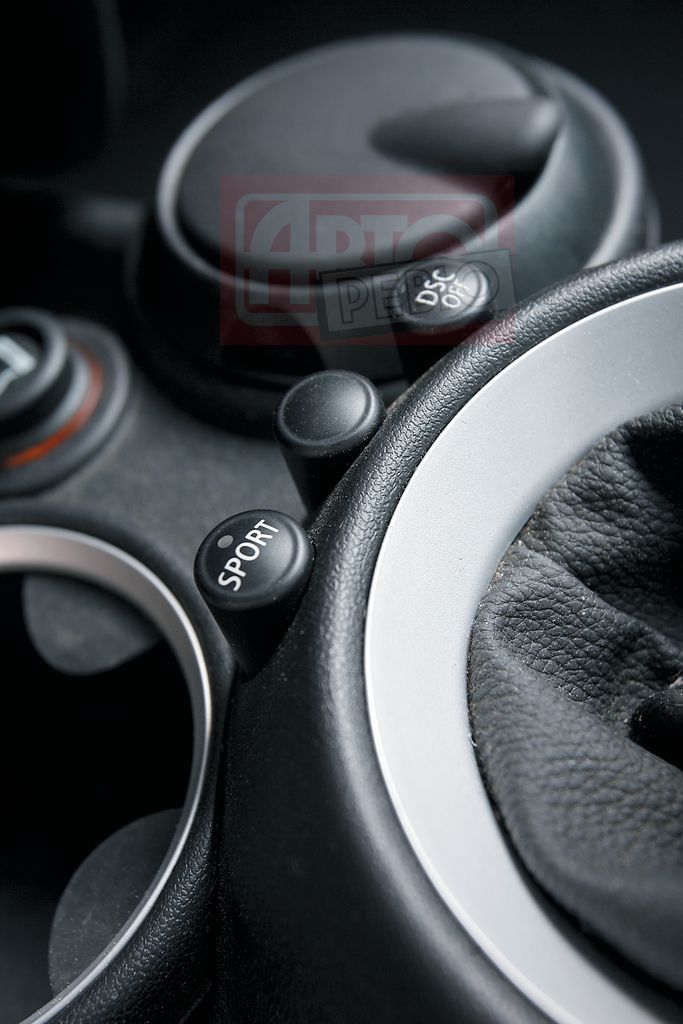 |
| The Mini's interior is well-made, but the design is sometimes "overdone" | The Sport button "sharpens" the accelerator response and "weights" the steering — a gimmick |
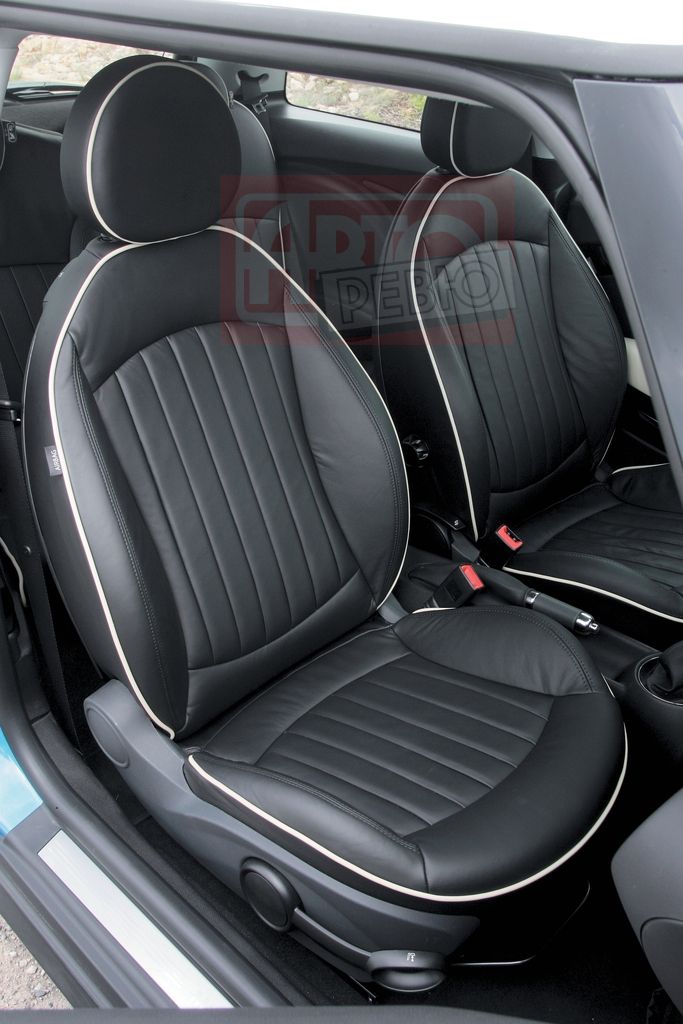 | 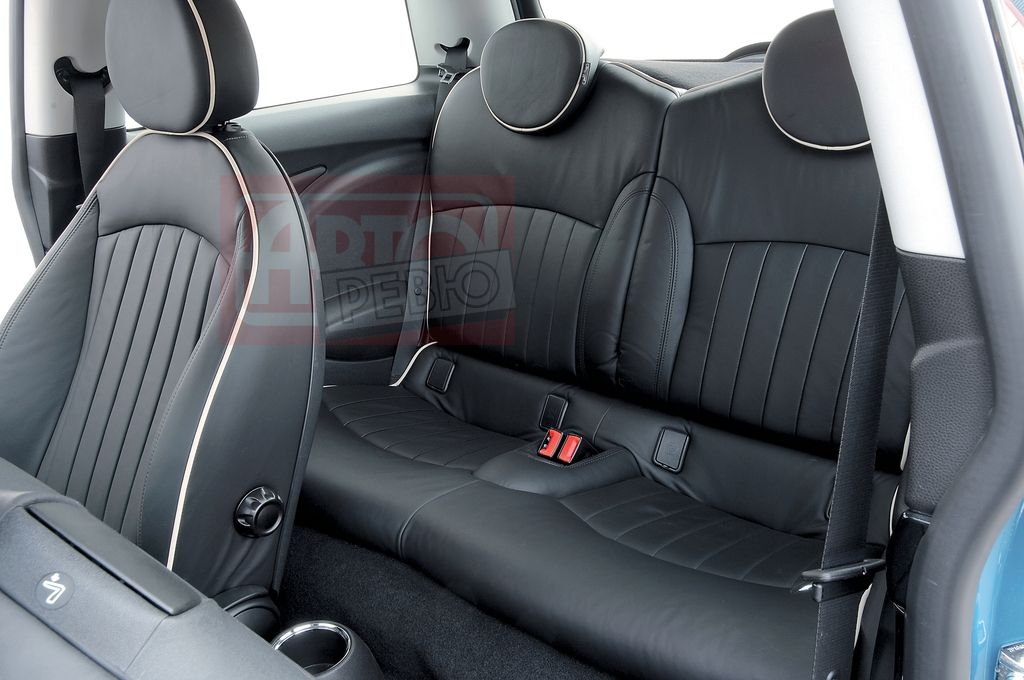 |
| The leather seats are excellently profiled | In the back, the Mini is, alas, mini |
The Mini's engine's considerable thrust is felt from the very "bottom" — the turbocharger develops maximum 0.8 atm of boost pressure already at 1600 rpm. And after 2500–3000 rpm, you get a push in the back: at full throttle, the turbo's wastegate opens a bit later, allowing a temporary increase in the torque "shelf" from 240 to 260 Nm (Overboost mode). But the engine doesn't like high revs: after 5000 rpm, the acceleration pace subsides, and you need to grab the "orange" gear knob. Fortunately, the six-speed manual works like clockwork.
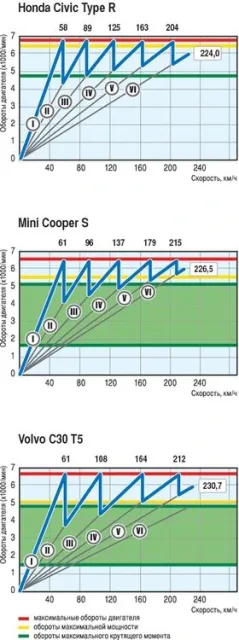
The Volvo C30 T5's engine has a smooth character: if the Mini's acceleration has excitement, the "Swedish matches" don't ignite. The "stretched" transmission also takes its toll: second gear "spins" up to 108 km/h, third — up to 165 km/h. And the six-speed gearbox shifts precisely but mundanely.
Comparing these three cars is no task for the faint-hearted. Each has its own character and temperament. The Honda is all about exhaust screaming at high revs, the Mini is a born racer, and the Volvo is a restrained but quick "Swede." And although all three have a manual gearbox and the word "hot" in their description, in reality they turned out to be so different.
Let's start with the numbers. In the sprint to 100 km/h, the Volvo and Mini showed nearly identical results — 7.7–7.8 seconds. The Cooper S was actually faster by a tenth of a second. The Honda, alas, lagged behind at 8.6 seconds. But it's not fair to blame only the engine's weakness. Last time we measured this same Civic Type R a month ago, it did the sprint in 7.3 seconds. It wasn't as hot then. Apparently, 34-degree heat is not the best friend of a naturally aspirated engine. The Volvo also got a bit tired this time, but lost only 0.4 seconds to itself, while the Honda lost almost one and a half!
Still, if you take the average figures from both sessions, all three would be roughly equal. In the hands of most drivers, the difference between them would be imperceptible. But the Mini, I repeat, is slightly faster. And it's not just about the engine.
I recall that at the presentation of the pre-production Cooper S, it seemed more "civilian," if you will. Fortunately, the Germans heeded journalists' criticism, and the production car retained its fighting spirit. Yes, the responses have become a bit calmer than the predecessor's, but on smooth asphalt, the Mini still handles like a true go-kart. Just turn the heavy steering wheel slightly, and the car instantly dives sideways with almost no body roll. At speed, this is even frightening — the reaction is too sharp. However, at the limit of its capabilities, when the car is about to break into a slide, the Cooper S is perfectly balanced. With the stability control off, you can easily guide it along the edge of understeer and oversteer. But in an emergency maneuver, you need to be on guard: first, the car slides with the front axle, then abruptly breaks into oversteer. The stability control intervenes too roughly and with a delay, which prevented me from completing the lane change faster than 79 km/h.
However, on broken roads, the Cooper S starts to get nervous — it just shakes. The stiff suspension not only reduces comfort but also worsens handling. The steering wheel tugs out of your hands, and precision disappears. You constantly have to correct to counter body oscillations. In corners, the Mini dances off the line, and hitting a large pothole can even make it jump sideways. Therefore, in the "Handling" category, the Mini gets the lowest score.
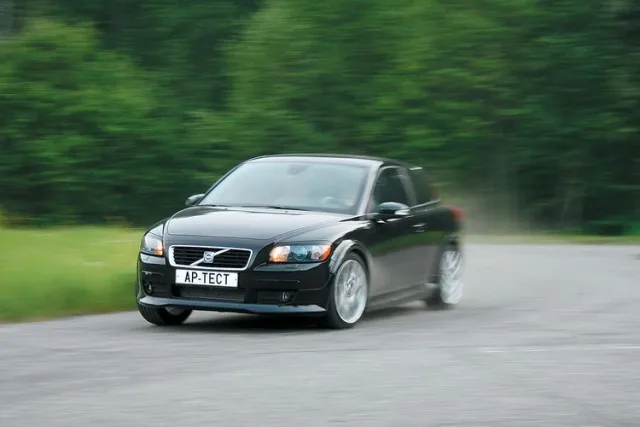
The Volvo C30 T5 is a fast car, but not a lively one. As the Swede Carlson taught: "Calm, only calm"!
The Volvo C30 handles simply excellently for a "civilian" car. It confidently holds a straight line, responds smoothly and precisely to the steering. The suspension swallows waves in the road without excessive pitching, and harsh bumps are felt in the cabin much softer than in the Mini. There's none of the nervousness characteristic of the "hot" Ford Focus ST, with which the Volvo shares a platform. On uneven surfaces, the steering wheel only sways slightly, and in corners, the car reliably "bites" into the line.
But as soon as you pick up speed, the C30's non-sporty nature comes to the fore. Pronounced body roll appears, along with diagonal pitching, and responses to steering inputs become drawn out in time. In a limit corner, the Volvo understeers. When avoiding an unexpected obstacle, the "Swede" is treacherous: a prolonged understeer is followed by a sharp and deep oversteer, to which the stability control reacts with a significant delay. The result — knocked-over cones and the lowest maximum maneuver speed in the test at 77.6 km/h.
The fastest "moose test" was achieved in the Honda at 82.8 km/h. But overall, we expected more from the handling of the "hot" Civic.
On one hand, the car has enviable steering feedback, race-sharp responses, and minimal body roll. On the other, there's excessive understeer: just slightly exceed the speed at the corner entry, and the Civic helplessly slides its nose toward the barrier. The stability control only protects the Honda from oversteer, but that almost never happens. The Civic Type R shakes considerably: the body transmits the road's "oscillogram" in detail to the cabin, periodically punishing occupants with noticeable jolts. Only the smallest bumps are absorbed softly by the Honda.
But maybe the Civic will redeem itself on the track? After all, Type R comes from the word racing... So we took all three cars to the ADM circuit in Myachkovo, inviting renowned circuit racer Oleg Keselman as an independent expert.
However, on the Moscow-region track full of tight corners, the Mini Cooper S once again beat everyone!
It accelerates faster than its rivals — only the lack of a limited-slip differential hinders it, causing the unloaded inner wheel to spin actively on corner exits. But the "self-lock" for the Cooper S costs just 209 euros.
Braking points can be confidently chosen 15–20 meters later than in the other two cars. Moreover, even after five or six laps in "combat" mode, the brakes don't fade.
Finally, near-neutral handling allows easy corner entry and trouble-free line holding. Mistakes are easily corrected — the Mini responds adequately to both additional steering and changes in throttle. Delight!
The easiest to use are the buttons and knobs on the Volvo's center console, while the Mini's are the hardest. Each console has its own decoration: the Honda has a plaque with the car's "personal" number (our example is No. 006!), the Mini has a "microclimate" block styled after the brand emblem, and the Volvo's "floating" console is adorned with intricate patterns. Only the Mini Cooper S has navigation that works in Russia.
The toggle switches are framed with "toy-like" plastic and are duplicated on the ceiling. One of the ceiling toggles changes the color of the interior lighting.
The joystick for controlling the "TV."
The most pleasant to hold in hand is the Honda's metal ball, but the Mini's "orange" gives the most precise gear shifts. The Volvo's lever is ordinary.
Volvo C30: dark top, light bottom, and luxurious white leather on the doors and seats.
Getting into the back of the Volvo C30 is inconvenient. The electric drive takes a long time to move the front seat forward, and the driver's seatbelt needs to be removed from the bracket on the seat.
The BLIS (Blind Spot Information System): miniature tracking cameras are built into the side mirror housings; if a follower appears in the "blind" zone, the lamps flash red.
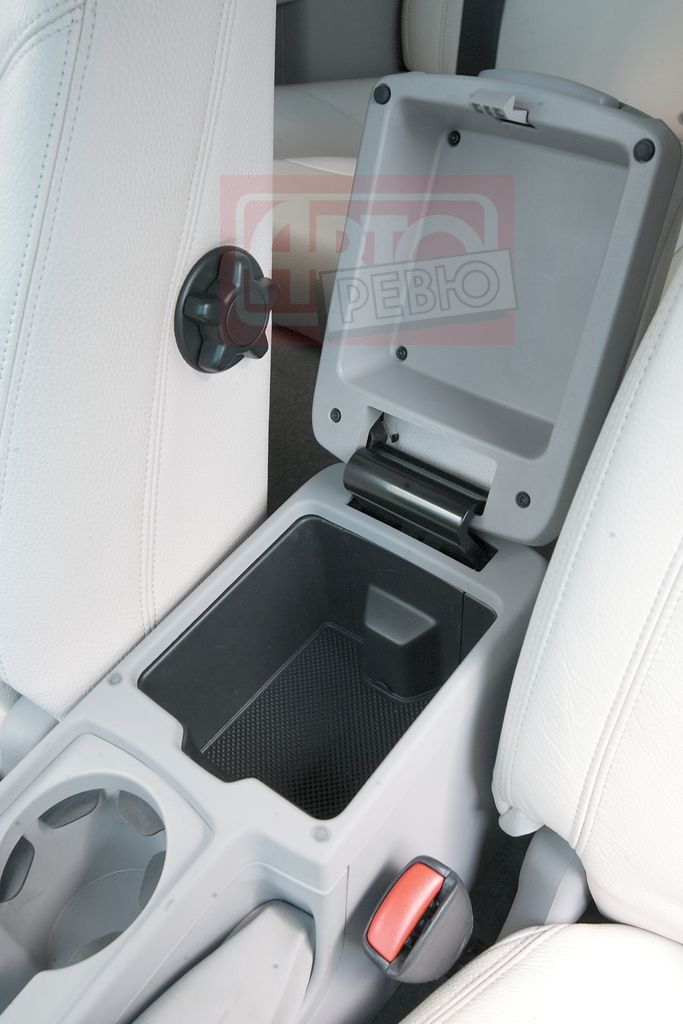 | 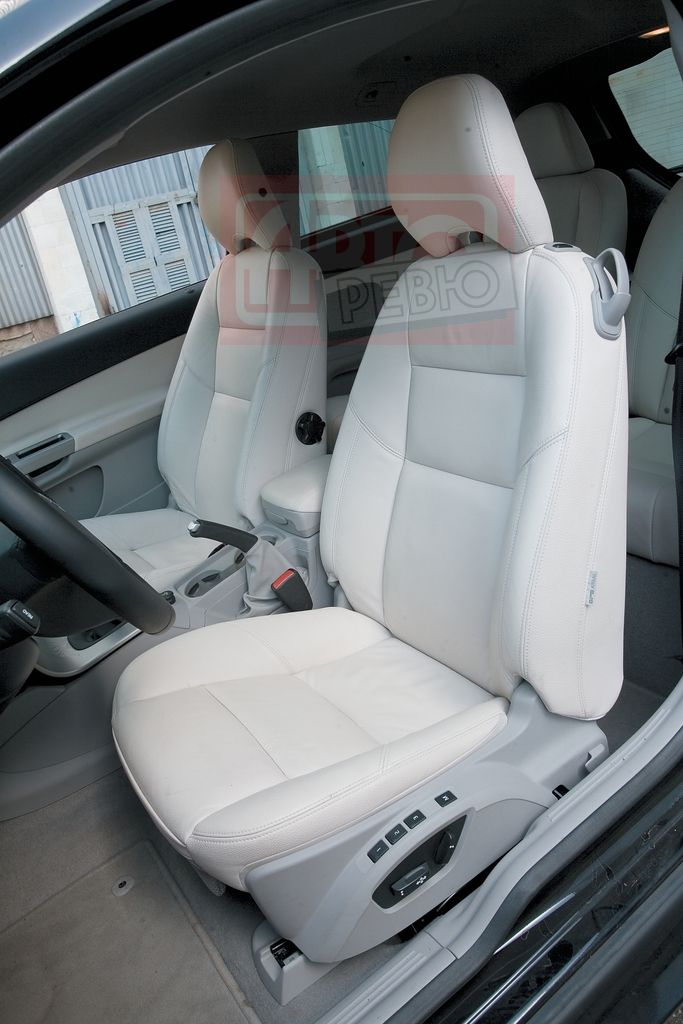 | 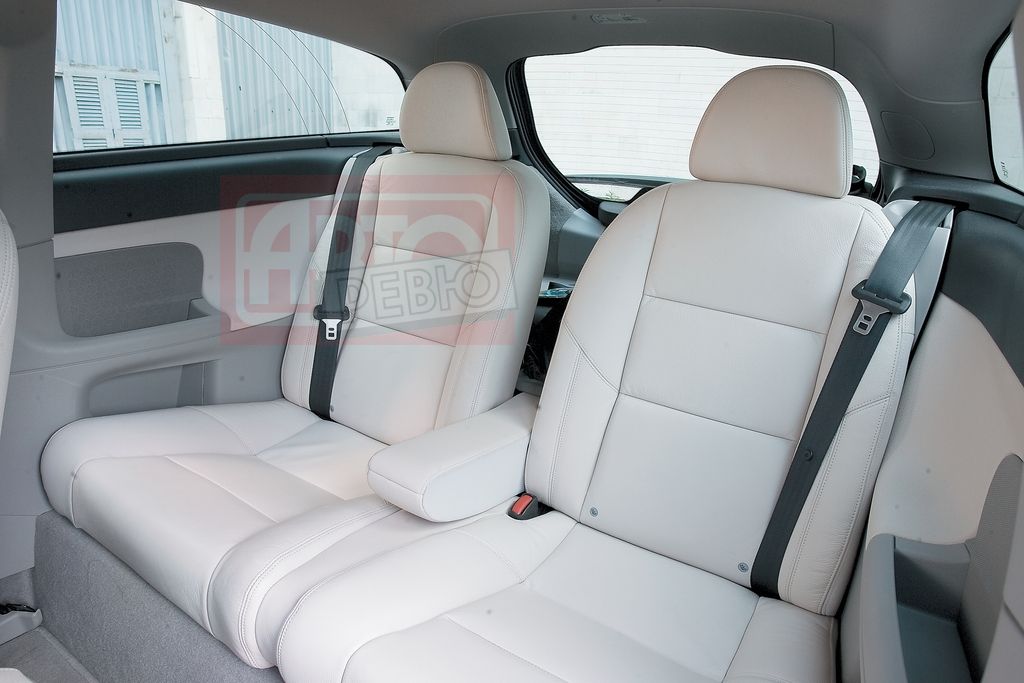 |
| Between the Volvo's front seats is a box with a cap-like lid | Comfortable seats — for a "road" car | Two people fit most comfortably on the C30's rear bench, but entry and exit are complicated by the "three-door" design and very high sills |
We expected the Volvo C30 with its calm, purely "civilian" nature to frankly struggle on the track, but it turned out otherwise. This soft and slow-reacting three-door unexpectedly pleased with its simplicity and confidence in handling. It all comes down to the ability to modulate the throttle. Slightly overdo it at the corner entry, and the car starts to push its nose wide. And if you first lift off the throttle, then abruptly apply it, you can fall into a turbo lag: the turbocharger needs a pause to spool up to the required revs.
The Volvo's brakes work less tenaciously than the Mini's, and the pedal has too long a travel. No excitement, but also no cause for concern.
But the Honda on the track... Frankly, it disappointed.
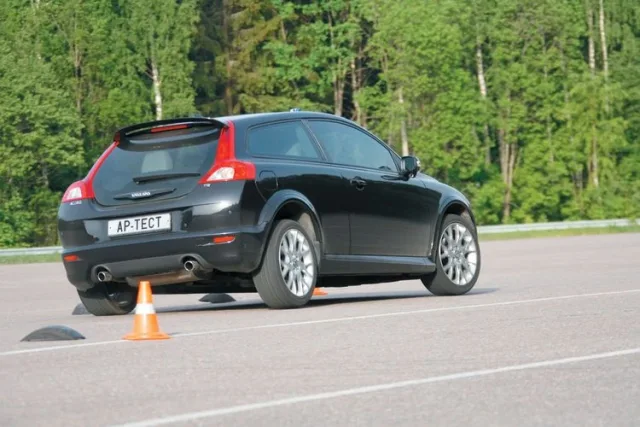
Soft responses, noticeable body roll... But the Volvo C30 handles reliably
The high-revving engine has to be constantly kept on the boil — in the 5500–8000 rpm zone, which means shifting very often, sometimes right in the middle of a corner. In places where I would start braking in the Volvo (let alone the Mini!), I would miss the corner in the Honda. The pedal hits the floor, but deceleration doesn't happen. It only gets worse with each lap: the brakes heat up and start to fade. As for handling, it's clear that the chassis is perfectly tuned for smooth, fast arcs — a couple of such sweeping bends where you can fly at over a hundred, the Civic Type R sails through with no effort at all. But on tight "hairpins," problems begin. On the exit, it seems the car has hooked onto the line and is ready to launch in the right direction. You open the throttle — and the Civic smoothly drifts wide, straight onto the tire barrier. In the end, the Honda even lost to the Volvo in lap time!
But for now, track days are just a dream for us, and "racing" shortcomings aren't that important. For example, in single emergency braking in everyday life, the Honda is impeccable: the stopping distance from 100 km/h for the Type R was 41.2 meters, while the Mini's was 42.1 meters, and the Volvo's 42.6 meters. However, the Cooper S, when braking hard on uneven surfaces, starts to wander and decelerates in jerks.
So, what do we get in the end? What are we being asked to pay almost 40 thousand dollars for?
| Honda Civic Type R | Mini Cooper S | Volvo C30 T5 |
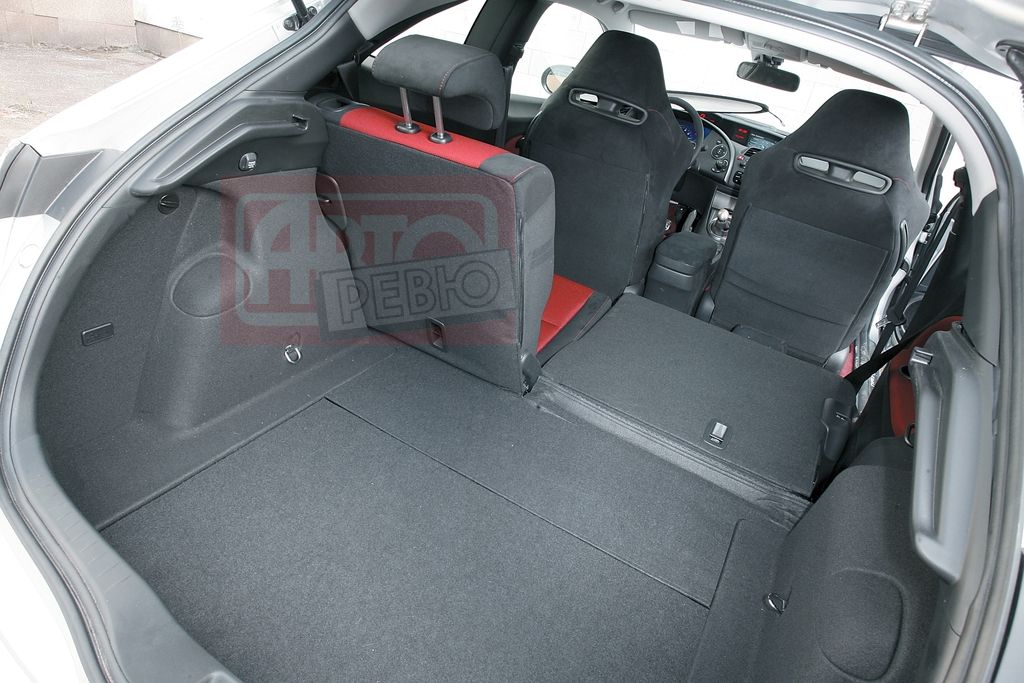 | 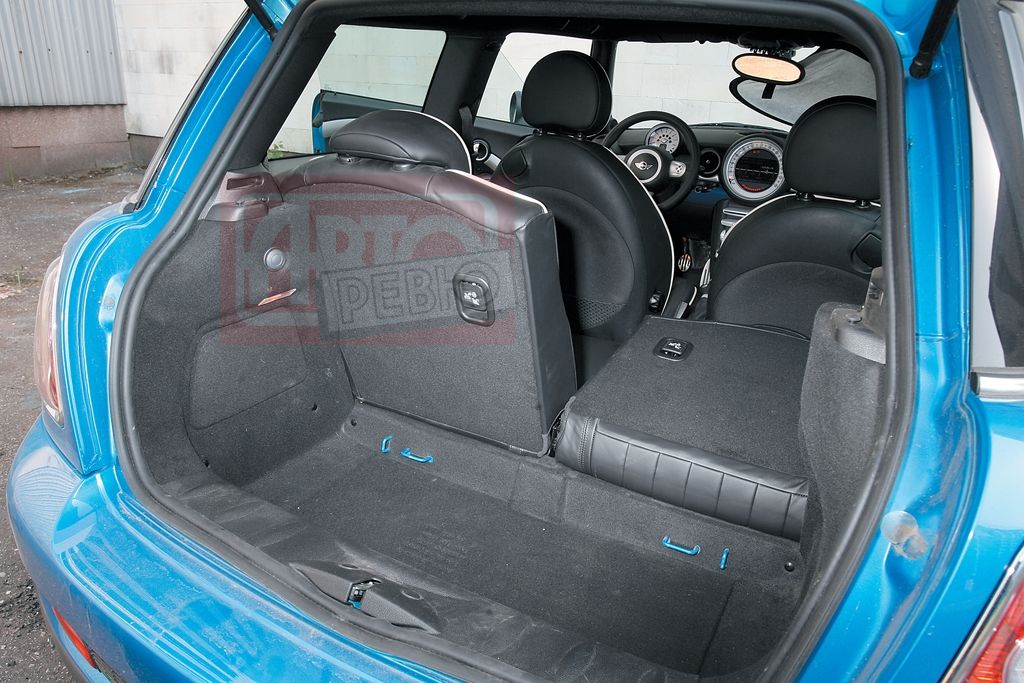 | 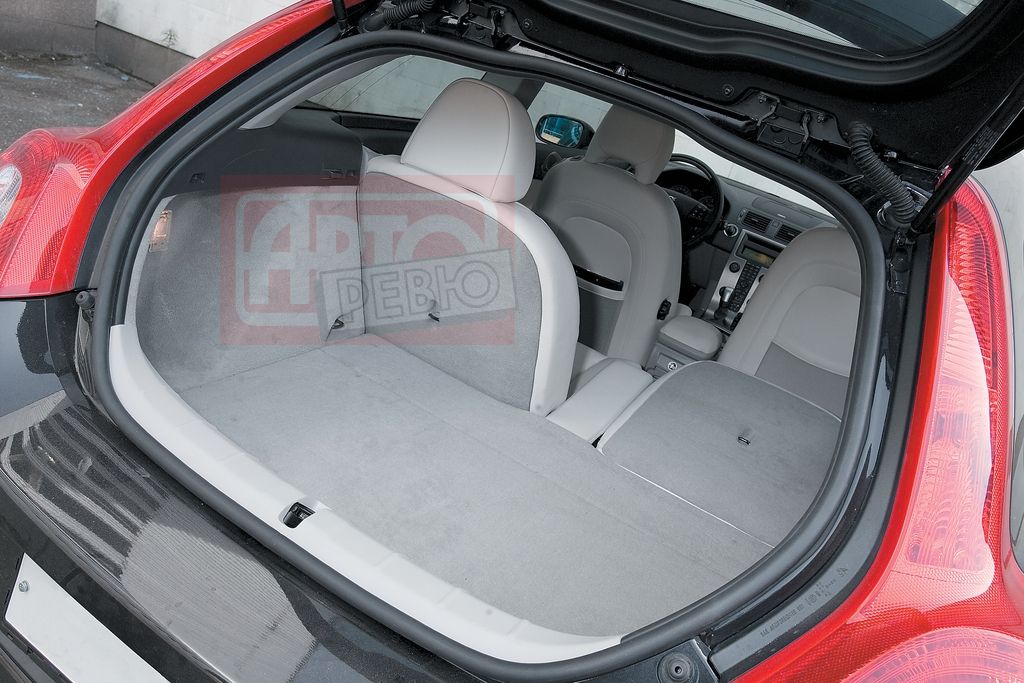 |
| The Honda's trunk and transformation possibilities are beyond competition. In the Mini, the cargo area is simply small, and in the Volvo it is also hard to reach: to load things into the "glass" hatch, they need to be lifted too high | ||
The new Civic Type R has a smoother engine character, brakes suitable for the city, and "straight-line" handling. But in our trio, the Honda is the most practical. No, we are not talking about the rear window without a wiper — that is indeed a problem. But the Civic is more spacious not only than the "little" Mini, but also than the C30. Three people can even sit in the back, and the trunk can easily fit not just one or two large bags. And if you need to transport a bicycle, the Honda's interior is the easiest to transform: the rear seat folds in parts, or you can just lift half of the cushion. This was precisely the formal reason for the Civic's victory on points.
Second place goes to the Volvo. It is also not a sports car. But it does not pretend to be a "racer." Its purpose is to evoke pride in its design, and while driving, you listen not to the engine but to a powerful audio system with Dynaudio speakers and a 650-watt Alpine digital amplifier. Although practicality is out of the question. The rear is comfortable, but only for two. And the trunk is just a name: a narrow opening, a huge loading height, and an inconvenient soft cover on straps instead of a rigid shelf.
In the Mini, the rear is cramped even for two, and the small trunk is only suitable for ladies' shopping in boutiques. Therefore, on points, the Cooper S lost to all rivals. But it left the brightest impressions! It may be bumpy and behave poorly on uneven roads, but in a single corner with smooth asphalt, the Mini will give so much pleasure that it will last for a whole day.
So all three can whet your appetite. But only one of them can satisfy it — the Mini Cooper S.
| Expert ratings from Autoreview | ||||
| Evaluated parameters | Max. score | Cars | ||
| Honda Civic Type R | Mini Cooper S | Volvo C30 T5 | ||
| Design | 180 | 170 | 165 | 160 |
| Exterior | 90 | 85 | 85 | 80 |
| Interior | 90 | 85 | 80 | 80 |
| Ergonomics | 190 | 175 | 160 | 155 |
| Driver's workplace | 100 | 95 | 85 | 85 |
| Visibility | 90 | 80 | 75 | 70 |
| Dynamics | 300 | 250 | 255 | 250 |
| Acceleration dynamics | 100 | 85 | 90 | 85 |
| Braking dynamics | 100 | 85 | 90 | 85 |
| Handling | 100 | 80 | 75 | 80 |
| Ride comfort | 200 | 150 | 130 | 165 |
| Ride smoothness, vibration protection | 70 | 45 | 40 | 55 |
| Acoustic comfort | 70 | 55 | 45 | 55 |
| Climate control | 60 | 50 | 45 | 55 |
| Interior comfort | 130 | 110 | 75 | 90 |
| Passenger seats | 50 | 40 | 30 | 40 |
| Trunk | 50 | 45 | 25 | 30 |
| Interior transformation | 30 | 25 | 20 | 20 |
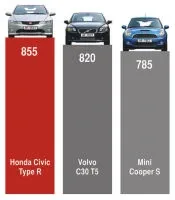
| Total score | 1000 | 855 | 785 | 820 |
Autoreview readers' forecast
Before the test began, we asked visitors on www.autoreview.ru which of the three cars they would choose.
The votes were distributed as follows:
Honda Civic Type R 53.72%
Mini Cooper S 26.05%
Volvo C30 T5 20.23%
A total of 5551 people voted
Final Autoreview ratings
The racer's word
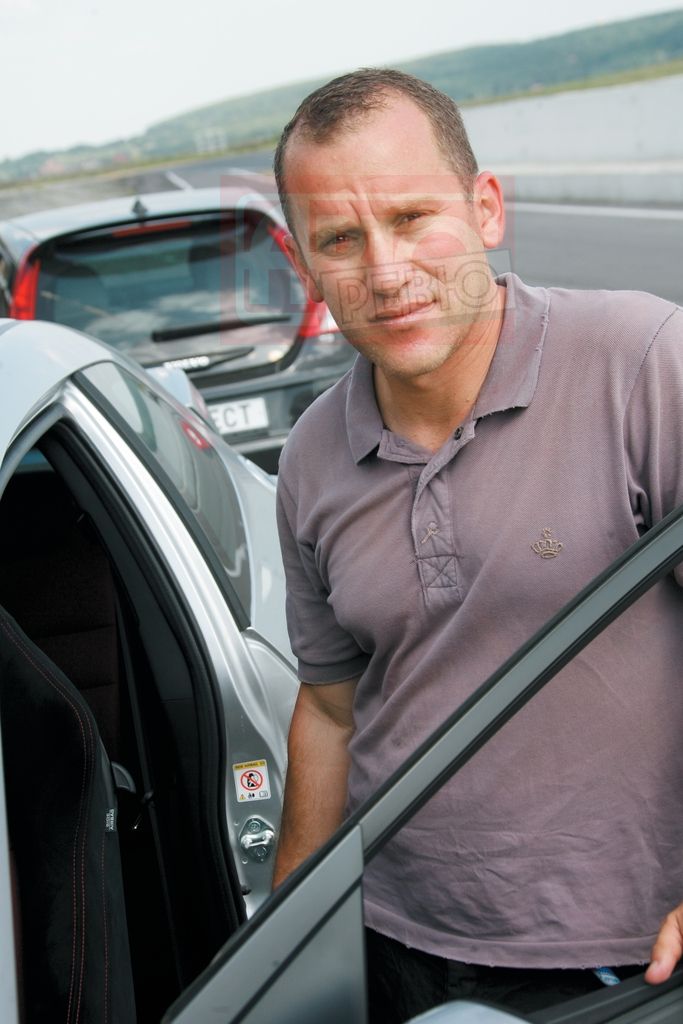 |
| Oleg Keselman driver of the Dreamcar Racing team in the Porsche Cup |
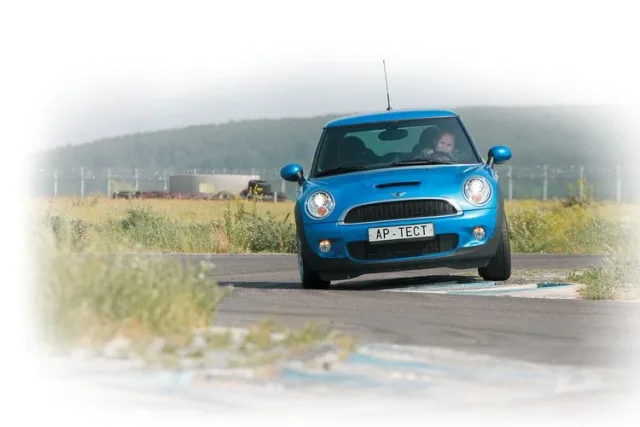
My favorite is the Mini Cooper S. In character, it is very similar to its predecessor, although it has gained a bit of weight. First of all, the Cooper S won me over with its brakes — they could easily be installed on a much more sporty car. The engine is also excellent — it feels like a two-liter, not a 1600-cc one. In corners, the short wheelbase and perfectly tuned rear multi-link suspension help. And the atmosphere is like sitting in a retro sports car! The only thing missing is a front differential lock: on corner exits, the Mini squeals with its inner wheel.
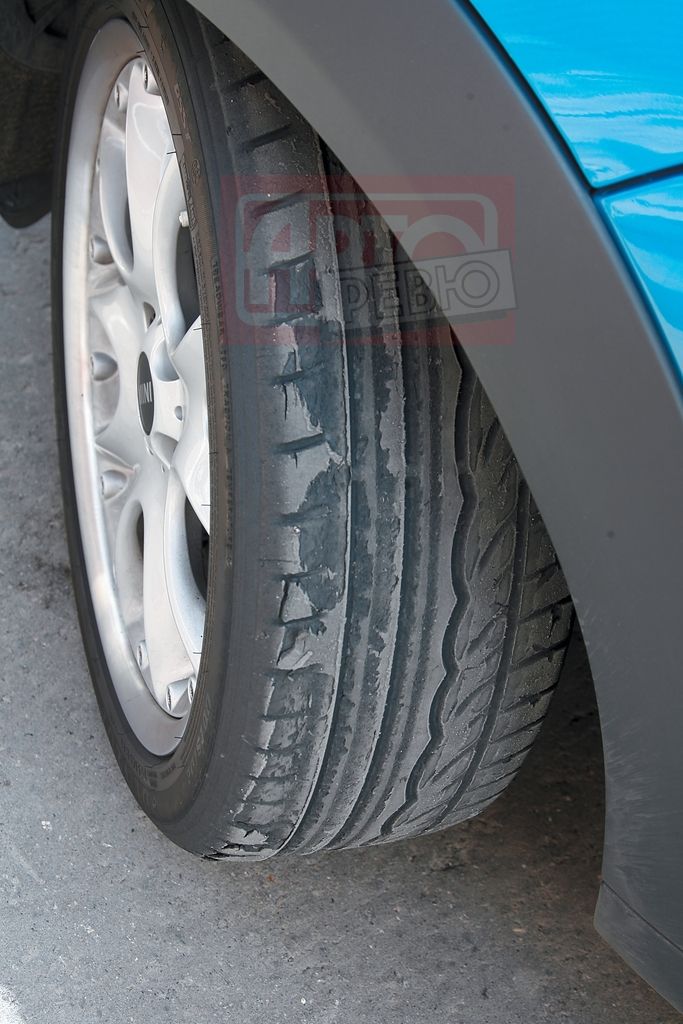 |
| The "civilian" Dunlop tires (Mini) are not suitable for driving on a race track — in 34-degree heat, the tread began to lose rubber in chunks |
The Volvo C30 T5 left exclusively positive emotions — perhaps it is the most understandable and "humane" car in this trio. No sporty aggression, but the chassis is superbly tuned: the car drives very composed and balanced. The only thing that slightly disappointed was the engine: despite the larger displacement and power, subjectively it does not give the increase you expect, and the difference with the less powerful Mini is almost unnoticeable. The brakes also raised questions — the Mini slows down noticeably more effectively. And one more unpleasant moment: it seems the brake assist system on the Volvo played a trick on me and stole a couple of seconds on the lap. I had already released the pedal, but the electronics, being cautious, continued to hold the wheels!
The Civic Type R, on the contrary, greatly disappointed. The main complaint is the seating position: it has become even higher, and the car increasingly resembles a "racing minivan." In motion, the Honda feels much heavier than before — the curb weight has increased by a hundredweight to 1301 kg, and 200 horsepower seems to have dissolved. You get the impression that you are driving a two-liter Mazda 3. If the old Civic picked up from 6000 rpm, the new one only comes alive in the range from seven to eight thousand — and that is a very narrow band! In addition, the rear multi-link suspension is missing: on corner entry, the car stubbornly pushes outward with the front axle, and to make it follow the arc with all four wheels, you need to work hard. The brakes are a separate problem: their reserve is only enough for a couple of fast laps, and you have to start braking twenty to thirty meters earlier than in other cars. As they heat up, the pedal effort doubles — an unprepared driver will simply get confused and fly past the corner!
| Best lap time on the ADM track | |||
| Car | Drivers | ||
| Oleg Keselman | Oleg Rastegaev | Yaroslav Tsyplenkov | |
| Honda Civic Type R | 2.07.29 | 2.09.42 | 2.10.03 |
| Mini Cooper S | 2.04.51 | 2.07.05 | 2.09.03 |
| Volvo C30 T5 | 2.06.82 | 2.08.50 | 2.10.09 |
| "Telemetry" by Oleg Rastegaev | |||
| Parameters | Cars | ||
| Honda Civic Type R | Mini Cooper S | Volvo C30 T5 | |
| Max. speed on lap, km/h | 145.7 | 151.0 | 154.5 |
| Max. lateral g-force, g | 1.22 | 1.09 | 1.06 |
| Max. deceleration, g | 0.91 | 1.11 | 0.91 |
Avoiding an obstacle
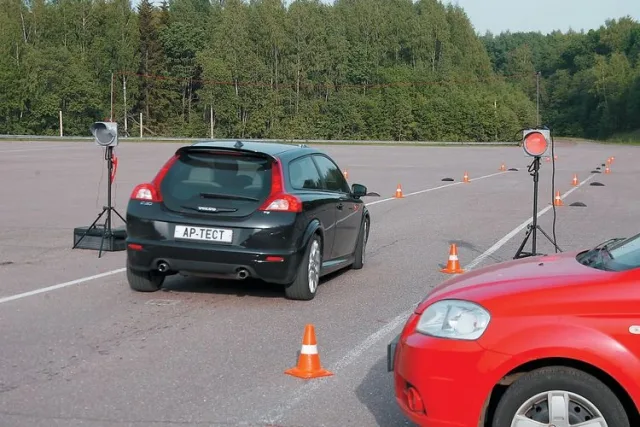
It would seem that each of these cars should easily pass the "moose test." But reality turned out to be more complicated.
Let me remind you of the methodology: first, five drivers get acquainted with the cars in normal mode and at a speed of 65 km/h try to avoid a sudden obstacle and return to their lane on the first attempt. Then the tester, through a series of runs, determines the maximum speed of the maneuver. This time we made the task more difficult by adding an element of surprise — traffic lights (details on page 38).
The best result was shown by the Honda — 82.8 km/h. It was helped by very sharp and informative steering, but hindered by pronounced understeer. Only three of the five volunteers managed it — the rest cited the suddenness of the maneuver.
The Mini Cooper S performed flawlessly — all five drivers completed the task. True, everyone noted that the car reacts too sharply to the steering wheel and strongly "darts," but due to instant reactions, everyone managed to correct the trajectory. But the tester had a hard time: at the entry, the front wheels slid, and in the second corridor, the Mini kept trying to turn sideways — requiring steering correction in a split second. Additionally, the rough and too-long operation of the stability control system interfered. The result — 79.0 km/h.

But the most stubborn in the "moose test" was the Volvo C30. Only two drivers completed the maneuver cleanly: the rest complained about deceptive dimensions, insufficient steering sensitivity, and a step in effort during sharp steering wheel rotation. These same factors also let the tester down. After understeer, the Volvo, like the Mini, tends to go into a deep skid — you just have to keep turning the wheel. Faster than 77.6 km/h is simply not possible.
| Maximum speed of completing the "moose test," km/h | |
| Cars | Speed |
| Honda Civic Type R | 82.8 |
| Mini Cooper S | 79.0 |
| Volvo C30 T5 | 77.6 |
| "Moose test" on the first attempt at a speed of 65 km/h | |
| Cars | Maneuver completed |
| Honda Civic Type R | 3 drivers out of 5 |
| Mini Cooper S | 5 drivers out of 5 |
| Volvo C30 T5 | 2 drivers out of 5 |
Some measurement results from Autoreview

| Specifications | |||
| Parameters | Cars | ||
| Honda Civic Type R | Mini Cooper S | Volvo C30 T5 | |
| Body type | 3-door hatchback | 3-door hatchback | 3-door hatchback |
| Number of seats | 5 | 4 | 4 |
| Trunk volume, L | 485—1352* | 160—680* | 364—1010* |
| Curb weight, kg | 1301 | 1130 | 1347 |
| Gross weight, kg | 1750 | 1580 | 1860 |
| Engine | gasoline, with distributed injection | gasoline, with direct injection and turbocharging | gasoline, with distributed injection and turbocharging |
| Location | front, transverse | front, transverse | front, transverse |
| Number and arrangement of cylinders | 4, in-line | 4, in-line | 5, in-line |
| Displacement, cm³ | 1998 | 1598 | 2521 |
| Cylinder bore/piston stroke, mm | 86.0/86.0 | 77.0/85.8 | 83.0/93.2 |
| Compression ratio | 11.0:1 | 10.5:1 | 9.0:1 |
| Number of valves | 16 | 16 | 20 |
| Max power, hp/kW/rpm | 201/148/7800 | 175/128/5500 | 220/162/5000 |
| Max torque, Nm/rpm | 193/5600 | 240/1600—5000 (260/1700—4500)** | 320/1500—4800 |
| Gearbox | manual, 6-speed | manual, 6-speed | manual, 6-speed |
| Gear ratios | |||
| I | 3.27 | 3.31 | 3.39 |
| II | 2.13 | 2.13 | 1.91 |
| III | 1.52 | 1.48 | 1.27 |
| IV | 1.15 | 1.14 | 0.95 |
| V | 0.92 | 0.95 | 0.78 |
| VI | 0.74 | 0.84 | 0.65 |
| reverse | 3.58 | 3.23 | 3.20 |
| final drive | 5.06 | 3.65 | 3.77 |
| Drive | front | front | front |
| Front suspension | independent, spring, McPherson | independent, spring, McPherson | independent, spring, McPherson |
| Rear suspension | semi-independent, spring | independent, spring, multi-link | independent, spring, multi-link |
| Front brakes | disc, ventilated | disc, ventilated | disc, ventilated |
| Disc diameter, mm | 300 | 294 | 300 |
| Rear brakes | disc | disc | disc, ventilated |
| Disc diameter, mm | 260 | 259 | 280 |
| Tires | 225/40 R18 | 195/55 R16 | 205/55 R16 |
| Maximum speed, km/h | 235 | 225 | 240 |
| Acceleration time 0—100 km/h, s | 6.6 | 7.1 | 6.7 |
| Fuel consumption, L/100 km | |||
| urban cycle | 12.7 | 8.9 | 12.5 |
| extra-urban cycle | 7.0 | 5.7 | 6.5 |
| combined cycle | 9.1 | 6.9 | 8.7 |
| Fuel tank capacity, L | 50 | 50 | 62 |
| Fuel | gasoline AI-95 | gasoline AI-91—95 | gasoline AI-91—98 |
| * With rear seats folded | |||
| ** Data in parentheses — in Overboost mode | |||
| Speedometer reading accuracy | ||||||||||
| Cars | Speedometer readings, km/h | |||||||||
| 40 | 60 | 80 | 100 | 120 | 140 | 160 | 180 | 200 | 220 | |
| True speed, km/h | ||||||||||
| Honda Civic Type R | 37 | 56 | 75 | 95 | 114 | 133 | 152 | 172 | 192 | 211 |
| Mini Cooper S | 38 | 56 | 76 | 96 | 116 | 136 | 155 | 174 | 193 | 212 |
| Volvo C30 T5 | 42 | 64 | 84 | 106 | 125 | 145 | 165 | 188 | 208 | 228 |
| Some measurement results from Autoreview | ||||
| Parameters | Cars | |||
| Honda Civic Type R | Mini Cooper S | Volvo C30 T5 | ||
| Maximum speed, km/h | 224.0 | 226.5 | 230.7 | |
| Acceleration time, s | 0—50 km/h | 2.9/3.7 | 2.9/2.9 | 2.7/3.0 |
| 0—100 km/h | 8.6/9.7 | 7.7/7.8 | 7.8/8.2 | |
| 0—150 km/h | 17.5/18.6 | 16.8/17.3 | 16.5/16.9 | |
| 0—200 km/h | 36.8/37.3 | 35.8/36.3 | 35.1/35.3 | |
| over 400 m | 16.1/16.9 | 15.7/15.7 | 15.7/16.0 | |
| over 1000 m | 29.0/30.0 | 28.5/28.7 | 28.5/28.9 | |
| 60—100 km/h (III) | 5.3 | 4.6 | 5.2 | |
| 60—100 km/h (IV) | 6.8 | 6.0 | 7.2 | |
| 80—120 km/h (V) | 9.5 | 7.8 | 9.5 | |
| 80—120 km/h (VI) | 13.2 | 9.1 | 12.2 | |
| Coast-down, m | from 50 km/h | 673 | 679 | 760 |
| 130—80 km/h | 1091 | 979 | 1125 | |
| 160—80 km/h | 1641 | 1469 | 1686 | |
| Braking from 100 km/h | distance, m | 41.2 | 42.1 | 42.6 |
| deceleration, m/s² | 9.4 | 9.2 | 9.1 | |
| Braking from 150 km/h | distance, m | 91.9 | 92.7 | 95.4 |
| deceleration, m/s² | 9.4 | 9.4 | 9.1 | |
| * ESP off/ESP on | ||||
| Equipment of the cars tested | |||
| Equipment | Cars | ||
| Honda Civic Type R | Mini Cooper S | Volvo C30 T5 | |
| Base version price, $ | 37800 | 38340 | 38400 |
| Front airbags | + | + | + |
| Front side airbags | + | + | + |
| Inflatable "curtains" | + | + | + |
| ABS | + | + | + |
| Traction control system | + | + | + |
| Dynamic stability control system | + | + | + |
| Power steering | + | + | + |
| Multifunction steering wheel | + | + | O |
| Adjustable steering column for height and reach | + | + | + |
| Leather-wrapped steering wheel | + | + | O |
| Heated windshield | – | + | – |
| Power-adjustable front seats | – | – | O |
| Memory for front seat adjustments | – | – | O |
| Heated front seats | – | + | O |
| Front seat adjustment from rear seats | – | – | O |
| Auto-dimming interior rearview mirror | – | + | O |
| Built-in phone | – | – | + |
| Central locking (remote) | + | + | + |
| Keyless entry system | – | O | O |
| Anti-theft alarm | – | + | O |
| Single-zone climate control | – | + | – |
| Dual-zone climate control | + | – | O |
| Power-adjustable and heated exterior mirrors | + | + | + |
| Power-folding exterior mirrors | + | – | O |
| BLIS (blind spot information system) | – | – | O |
| Power windows | + | + | + |
| Split-folding rear seat backs | + | + | + |
| Rear seat armrest | – | – | + |
| CD audio system | + | + | + |
| CD changer | – | O | O |
| DVD | – | O | – |
| Navigation system | + | O | – |
| Engine start button | + | + | – |
| Light sensor | + | + | – |
| Rain sensor | + | + | O |
| Rear wiper | – | + | + |
| Tire pressure monitoring | – | + | – |
| Trip computer | + | + | + |
| Cruise control | + | O | O |
| Rear parking sensors | – | + | O |
| Rear head restraints | + | + | + |
| Leather upholstery | – | O | O |
| Remote fuel filler flap lock | + | – | + |
| Xenon low-beam headlights | – | + | O |
| Bi-xenon headlights | – | + | O |
| Fog lights | + | + | O |
| Headlight washers | + | + | O |
| Alloy wheels | + | + | O |
| Full-size spare wheel | –** | – | –*** |
| Metal engine underbody protection | – | – | – |
| Metallic paint | O | O | O |
| Price of tested car, $ | 38100 | 52371 | 48200 |
| * Keys on the backs of the front seats | |||
| ** Compressor, sealant | |||
| *** "Space saver" | |||
| (+) Included in base version | |||
| (–) Not available in base version | |||
| (O) Options installed on the cars tested | |||
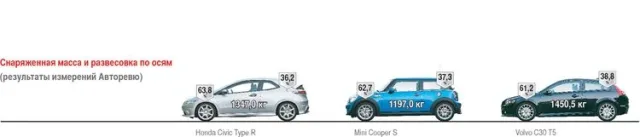
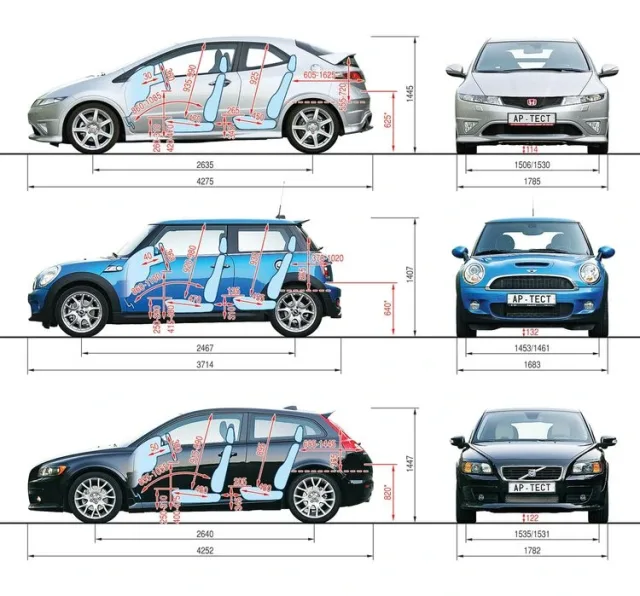
Black indicates manufacturer data, red indicates Avtoreview measurement results
* Loading height
Acceleration graphs
Visibility
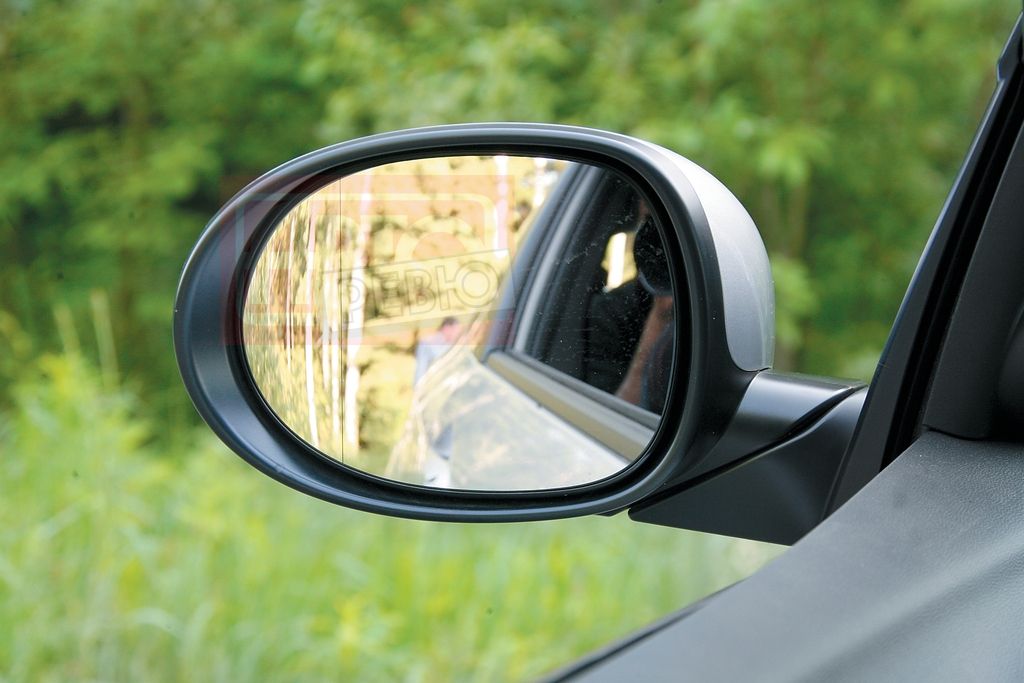
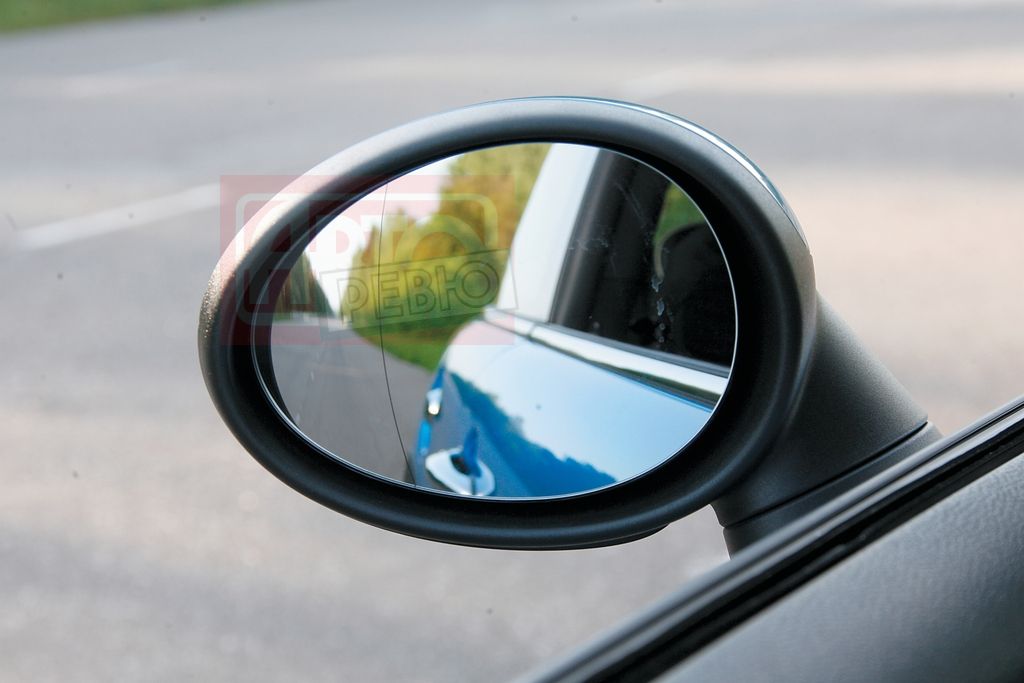
Visibility is best organized in the Honda: the pillars here are thin, and the exterior mirrors are large and informative. True, through the interior mirror you can only see the spoiler itself. The Mini takes second place — through the interior mirror almost the entire rear window is visible, and the total viewing angle reaches 281.5°, which is the highest figure. However, the Mini's side mirrors are small, have strong diopter, and are shifted back. The Volvo is saved by the BLIS system, because the right side mirror is half blocked by the "window sill," and the rear window opening is squeezed. In addition, the C30 has the most massive front pillars.
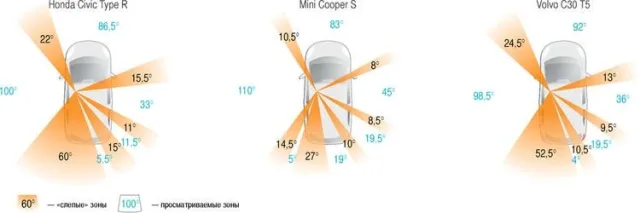
| Car | Total viewing angle, deg. | Total "blind" zone angle, deg. |
| Honda Civic Type R | 236.5 | 123.5 |
| Mini Cooper S | 281.5 | 78.5 |
| Volvo C30 T5 | 250 | 110 |
| Honda Civic Type R | Mini Cooper S | Volvo C30 T5 |
 |  |  |
Light output
Shooting cars at night from one point allows you to evaluate how well the headlights work. In our case, the Mini and Volvo have xenon low beams, while the Honda has regular halogen. The Mini illuminates the road best: from 80 meters, a person standing on the roadside is clearly visible. The Volvo's light is slightly "shorter" but wider, and the Honda, although it illuminates mainly the space in front of it, also notices a pedestrian. The high beam of the Civic and Mini is excellent, but the Volvo's is even better.
At the time of photography, the cars had only the driver, the xenon headlight adjusters worked in automatic mode, while the Honda's were set to zero position.
| Honda Civic Type R | Mini Cooper S | Volvo C30 T5 |
| Low beam. Pedestrian standing on the roadside 80 m from the car | ||
| Honda Civic Type R | Mini Cooper S | Volvo C30 T5 |
| High beam. Pedestrian standing in the middle of the road 160 m from the car | ||
How safe are they?
From a safety point of view, all three cars are in perfect order. Standard equipment includes ABS, Brake Assist, brake force distribution and stability control systems, as well as six airbags — front, side, and "curtains." Isofix anchors are only available in the base version for the Honda and Mini; for the Volvo C30 they are offered for $30.
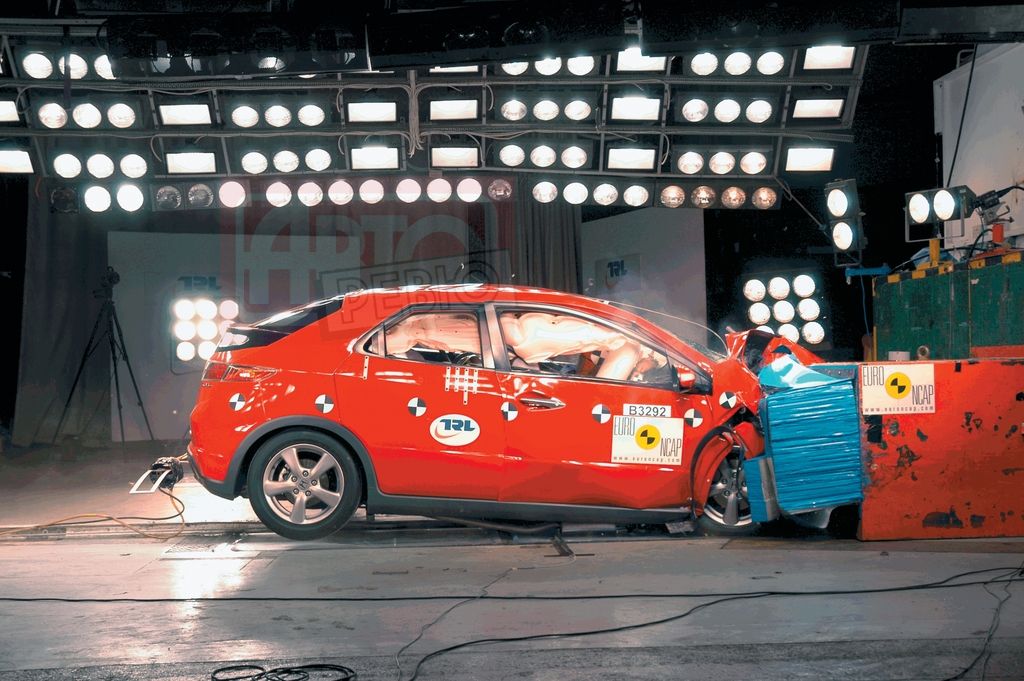 | Honda Civic | ★★★★☆ |
| Overall rating | 30 | |
| Frontal crash test | 11 (69%) | |
| Side crash tests | 16 (89%) | |
| SBR* | 3 | |
| Child occupant protection | 38 (78%) | |
| Pedestrian protection | 24 (67%) | |
| Curb weight | 1251 kg | |
| * Seat belt reminder | ||
All three cars were tested according to the EuroNCAP methodology. The five-door Civic hatchback received four stars out of five. In the frontal impact, the body performed excellently, the belts and airbags reliably held the passengers, but the final rating was lowered due to the traumatic steering column lock and the gas pedal displacement, which exceeded the norm by 4 mm. Two more points were deducted for increased loads on the upper torso of the dummy in the side impact. Protection for child passengers is good — four stars out of five. The level of "pedestrian" safety is also high — three stars out of four.
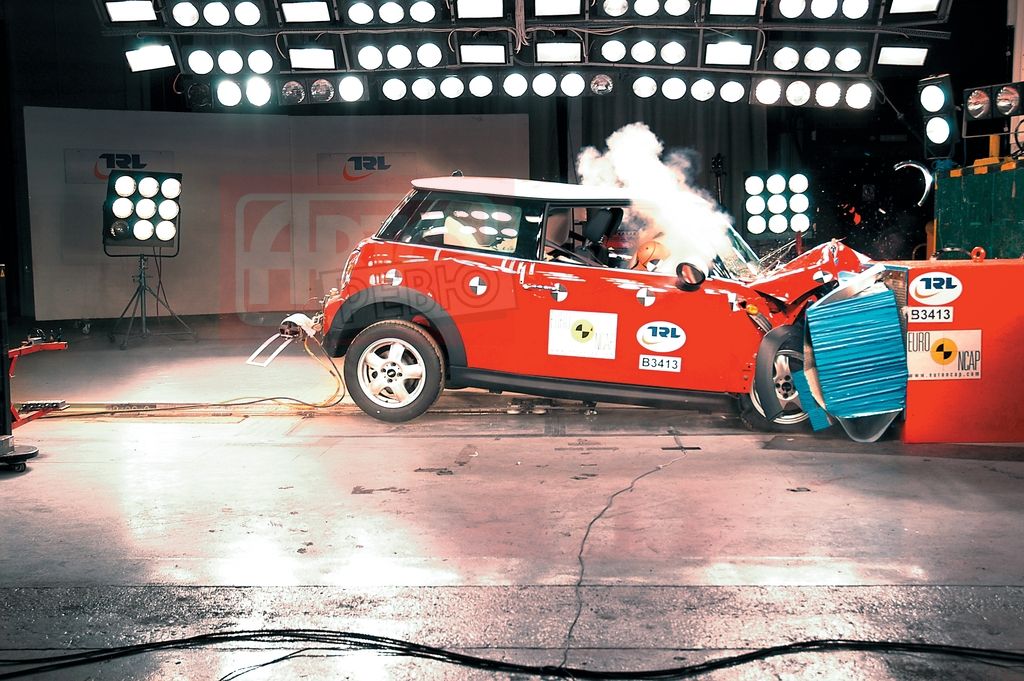 | Mini Cooper | ★★★★★ |
| Overall rating | 33 | |
| Frontal crash test | 13 (81%) | |
| Side crash tests | 16 (89%) | |
| SBR* | 3 | |
| Child passenger protection | 29 (59%) | |
| Pedestrian protection | 14 (39%) | |
| Curb weight | 1140 kg | |
| * Seatbelt reminder | ||
The Mini performed better — five stars, although EuroNCAP specialists still noted that the front panel and steering column could be traumatic, and the brake pedal moved back 92 mm, almost reaching the dangerous 100 mm threshold. Child protection was rated a "C": in the side impact, the child seats rotated toward the impact, and the 1.5-year-old "child" hit its head on the upholstery. "Pedestrian" safety is average — the bumper and hood edge are too rigid.
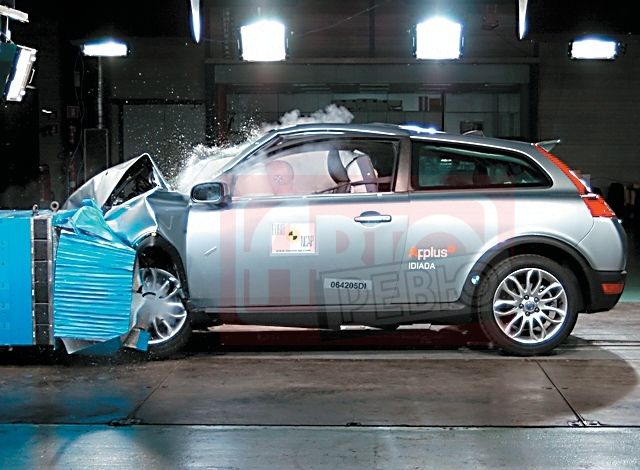 | Volvo C30 | ★★★★★ |
| Overall rating | 34 | |
| Frontal crash test | 15 (94%) | |
| Side crash tests | 17 (94%) | |
| SBR* | 2 | |
| Child passenger protection | 38 (78%) | |
| Pedestrian protection | 9 (25%) | |
| Curb weight | 1352 kg | |
| * Seatbelt reminder | ||
The Volvo C30 also earned five stars. True, in the frontal impact, one point was deducted for the potential injury risk of the front panel to the driver's knees, and in the side crash test, the child seat prevented the inflatable "curtain" from fully deploying. However, child protection was rated a "B". But the Volvo C30 does not spare pedestrians — only one star out of four.
How much does it cost?
Honda Civic Type R (2.0 L, 201 hp) is available in a single trim at a price of $37,800. Equipment includes six airbags, dual-zone climate control, CD stereo, rain sensor, heated mirrors, and VSA stability control. Additionally, you can order metallic paint for $300, a CD changer for $780, and aerodynamic bumper trim for $850. The wait for the Civic Type R will be at least six months, and the less powerful three-door Type S is not officially sold in Russia. Payment is made at the current exchange rate of the Central Bank of Russia.
Warranty — 3 years or 100,000 km. Honda cars are sold by 32 dealers in 16 Russian cities.
Mini Cooper S (1.6 L, 175 hp) in the base Drive trim costs €28,400 ($38,340*). The equipment list includes six airbags, air conditioning, heated front seats, CD stereo, stability control, rear parking sensors, and light and rain sensors. The Chili version for €30,900 ($41,720*) is better equipped — climate control, bi-xenon headlights, sport suspension, and leather interior. Instead of the manual, you can install a six-speed automatic on the Mini Cooper S — this will add €2,000 ($2,700*). A self-locking differential will cost €208 ($281). There are also less powerful versions — Mini Cooper (1.6 L, 120 hp) from €23,400 ($31,590*) and Mini One (1.4 L, 95 hp) from €19,900 ($26,870*). Dealers accept payment at the Central Bank of Russia exchange rate. You will have to wait about four months for the ordered car. By the way, dealers still have a few "old" Minis in the extreme GP version (1.6 L, 218 hp), produced in a limited run of only 2,000 units — from €39,900 ($53,870*).
Warranty — 2 years without mileage limit. Mini cars are sold by 8 dealers in 6 Russian cities.
Prices for the Volvo C30 T5 (2.5 L, 220 hp) start at $38,400. The base trim here is the most modest — six airbags, air conditioning, CD stereo, and stability control. A sunroof costs $1,000, climate control — $800, heated front seats — $250. The surcharge for the five-speed automatic is $2,000.
Volvo C30 1.6 (100 hp) is priced at $22,900, the version with the 2.0 engine (145 hp) — $26,900, and the C30 2.4i (170 hp) — $29,900. Payment — at the Central Bank of Russia exchange rate. The order is completed in two to three months.
Warranty — 2 years or 100,000 km. Volvo cars are sold by 55 dealers in 47 Russian cities.
* At an exchange rate of 1 euro = $1.35
| Cost of scheduled maintenance with consumables and parts* | ||||
| Scheduled service | Cars | |||
| Honda Civic Type R | Mini Cooper S | Volvo C30 T5 | ||
| Cost per hour | 58 | 88 | 65 | |
| Mileage, km | 10,000 | — | — | — |
| 15,000 | 288 | 270 | 354 | |
| 20,000 | — | — | — | |
| 30,000 | — | 405 | 921 | |
| 40,000 | — | — | — | |
| 45,000 | 327 | 270 | 354 | |
| 50,000 | — | — | — | |
| 60,000 | 550 | 581 | 967 | |
| 70,000 | — | — | — | |
| 75,000 | 238 | 270 | 354 | |
| 80,000 | — | — | — | |
| 90,000 | 692 | 405 | 894 | |
| Total | — | 2,201 | 3,844 | |
| * Prices are in US dollars | ||||
| Approximate prices for original parts at Moscow dealers* | |||
| Parts | Cars | ||
| Honda Civic Type R | Mini Cooper S | Volvo C30 T5 | |
| Oil filter | 13 | 174 | 29 |
| Fuel filter | 37 | 83 | 70 |
| Air filter | 30 | 35 | 52 |
| Cabin filter | 21 | 48 | 64 |
| Spark plug | 38 | 32 | 26 |
| Front brake pads | 180 | 232 | 169 |
| Rear brake pads | 136 | 174 | 149 |
| Front shock absorber | 135 | 211 | 324 |
| Rear shock absorber | 285 | 144 | 229 |
| Front headlight | 221 | 417 | 580 |
| Rear light | 212 | 174 | 342 |
| Front fender | 273 | 38** | 414 |
| Front bumper | 1005 | 339 | 979 |
| Hood | 367 | 598 | 692 |
| Windshield | 382 | 702 | 462 |
| * Prices are in US dollars | |||
| ** Wheel arch trim | |||
What else?
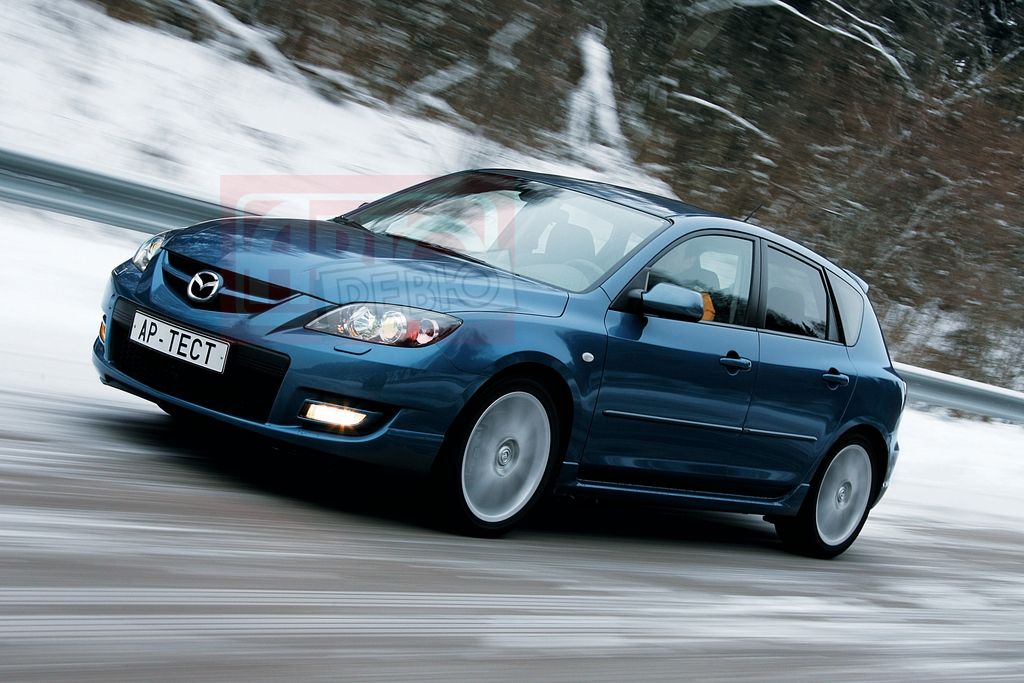
If we talk about other "hot" hatchbacks, most of them will cost less than our trio. The most cost-effective per "horse" is the five-door Mazda 3 MPS: under the hood is a turbocharged 2.3 DISI with 260 hp, and the starting price is from $31,900. Interestingly, the self-locking differential on the Mazda is already in the base trim, while for the Mini Cooper S you will have to pay extra. The chassis is also top-notch: the car confidently holds high speed and delights with precise handling. Details — in AR No. 23, 2006.
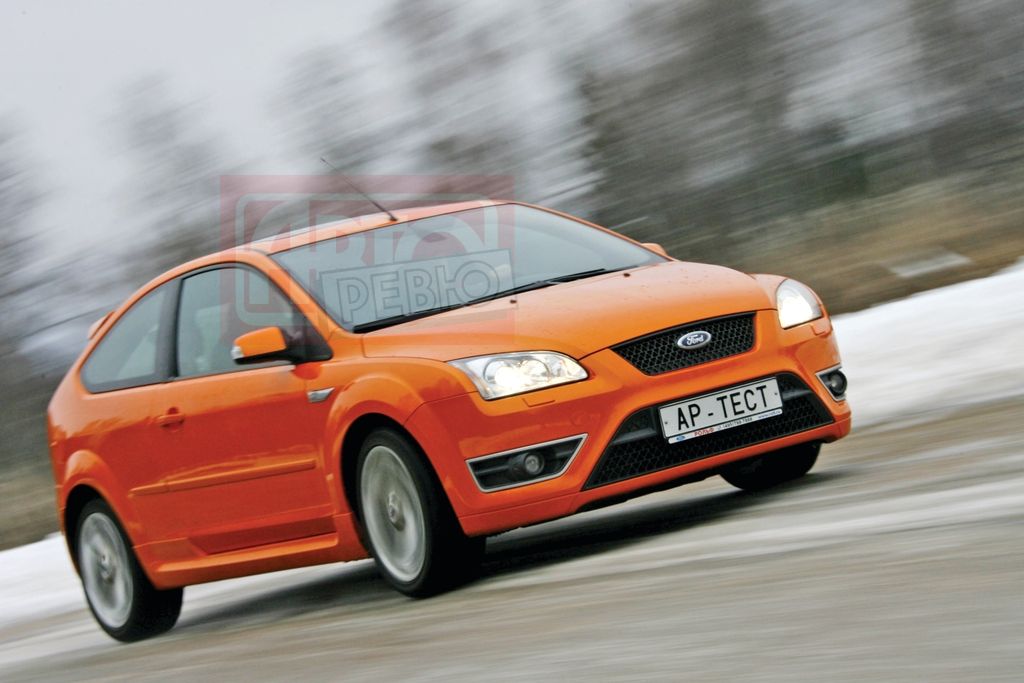
The Ford Focus ST in the three-door version costs $30,450, and for the five-door body you will have to pay $1,000 more. Under the hood is a five-cylinder turbo engine with 225 hp, the same as the Volvo C30 T5. The "hot" Focus surprises with cabin quietness and quite acceptable ride smoothness — it is essentially a "civilian" car that can also "light up". More details — in AR No. 10, 2006 and AR No. 23, 2006.
| Mazda 3 MPS | Ford Focus ST | Volkswagen Golf GTI |
 |  | 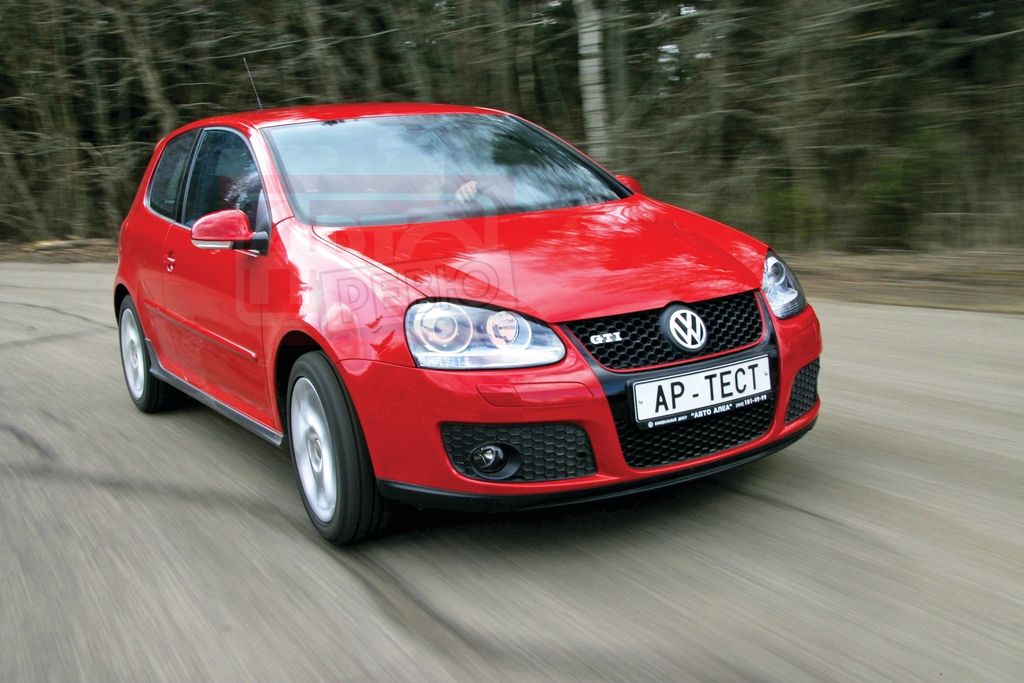 |
Volkswagen Golf GTI with a 2.0 TFSI turbo engine (200 hp) starts at $30,930. Among all of them, only it has an alternative to the six-speed manual — the DSG robotic gearbox, which costs an additional $1,700. The five-door version is another $800 extra. The progenitor of "hot" hatches accelerates well, but the overly stiff, "autobahn-style" suspension spoiled the impression. Details — in AR No. 10, 2006.
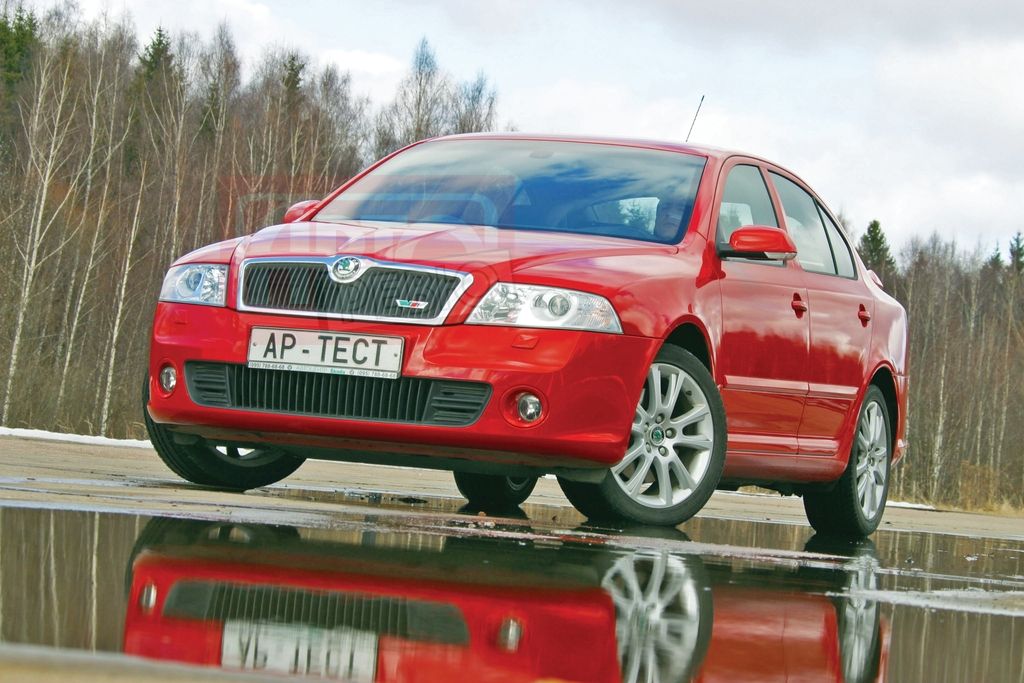
The same 200-horsepower engine is also under the hood of the five-door Skoda Octavia RS. True, unlike the Golf, the Skoda only has a manual gearbox. Price — from $33,690 for the hatchback, the wagon is $34,790. The Octavia RS successfully combines good dynamics with the comfort of a family car. More details — in AR No. 10, 2006.
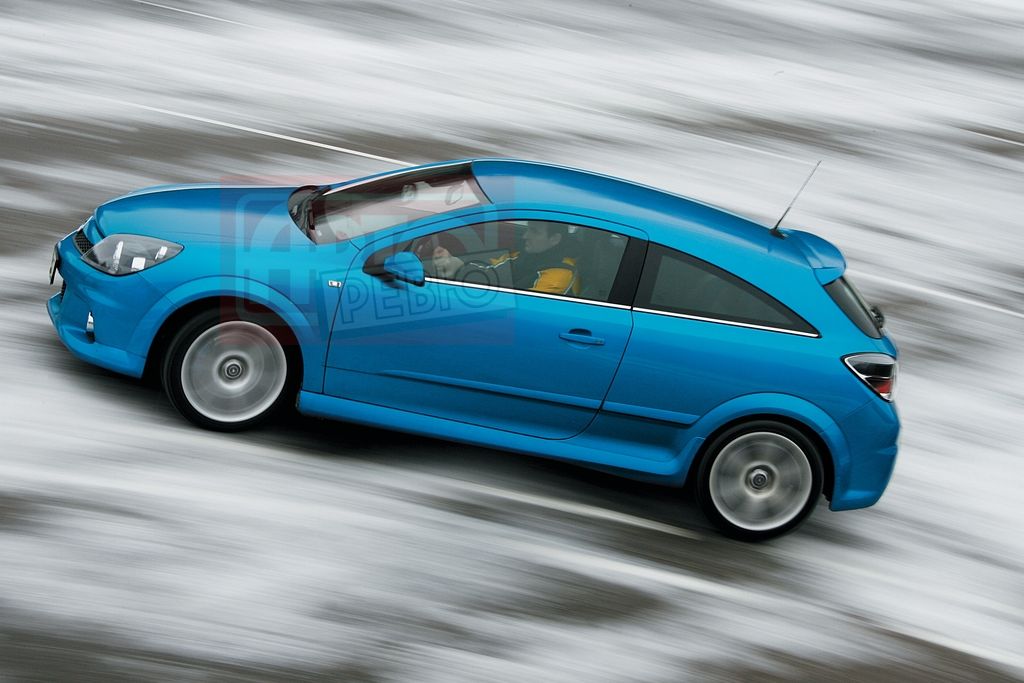
The Opel Astra OPC with a two-liter turbo engine (240 hp) is available only in a three-door body at a price from $31,490. It is the most uncompromising in its class: stiff suspension, narrow sports seats... Details — in AR No. 23, 2006.
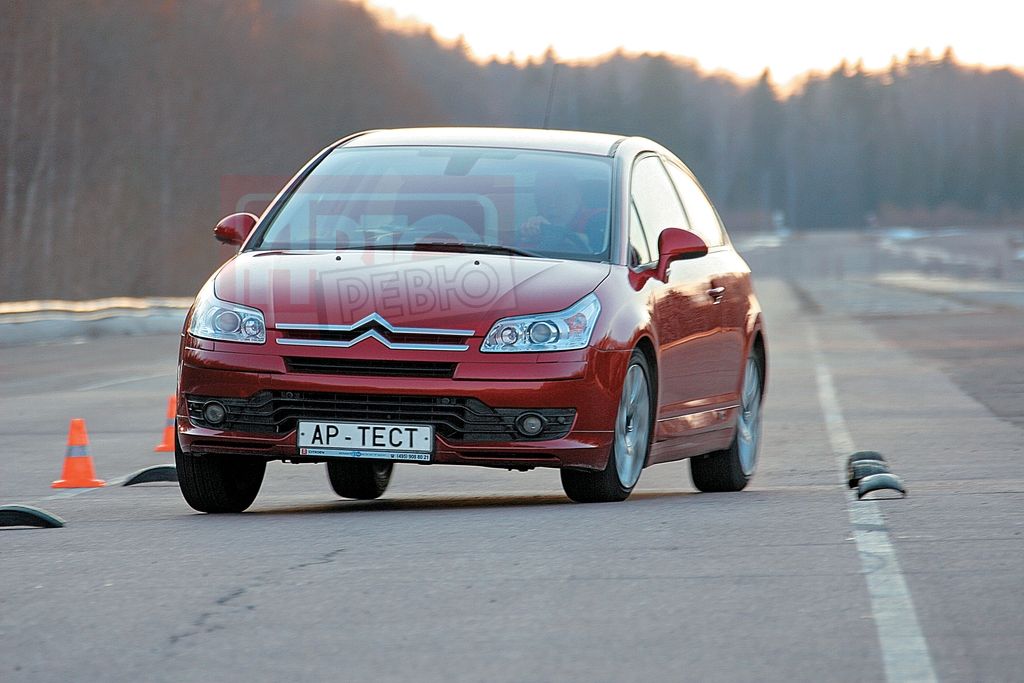
The Citroen C4 VTS hatchback has a stylish appearance and a price from €22,290 ($30,090*). But its handling is ordinary, and the two-liter engine (180 hp) is relatively weak. Details — in AR No. 10, 2006.
| Skoda Octavia RS | Opel Astra OPC |
 |  |
| Citroen C4 VTS | Audi A3 |
 | 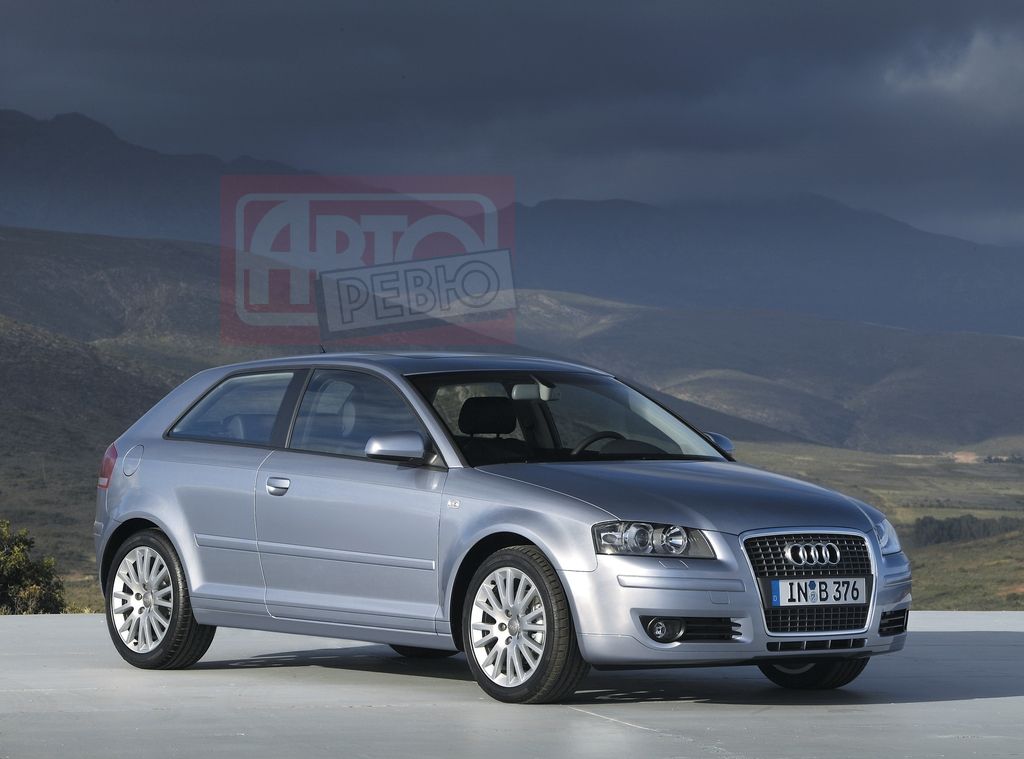 |
The premium segment, as usual, is more expensive. The Audi A3 2.0 TFSI with a 200-horsepower engine costs from $40,980, and for all-wheel drive you need to pay an additional $3,770. Details — in AR No. 15, 2005.
Or the BMW 130i (from $43,600 for the three-door and from $44,550 for the five-door version): "...pleasure from the classic sound of the inline six, the grip of the brakes, the reliable profile of the new sports seats." Details — in AR No. 17, 2005.
* At the exchange rate of 1 euro = $1.35