
A prestigious SUV from Volkswagen? Some thirty years ago, such a combination of words seemed like something out of science fiction, and not even scientific at that. But today it is already a reality!
Since 2002, over 300 thousand units of the Volkswagen Touareg — true prestigious SUVs — have been sold worldwide.
Now, to support the image and boost sales, a facelift is due: light "cosmetics" and fresh technical solutions.
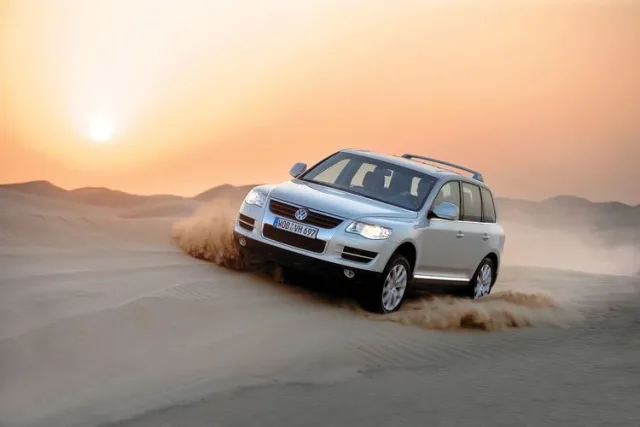
In the old days, the front of the Touareg strongly resembled the previous generation Passat. But the Passat generation has changed, and the Touareg tries to keep up with the times, trying on a new chrome mask that has become the hallmark of all Volkswagen models. Whether it adorns the strict car — everyone will decide for themselves.
From the rear, you can distinguish the fresh Touareg from the pre-facelift one only by the taillights: they have darkened and received LEDs instead of regular bulbs. The bumpers have been touched very lightly — the car's length hasn't even changed. And the extended spoiler on the fifth door and the new exhaust pipe design will be noticed only by the most attentive.
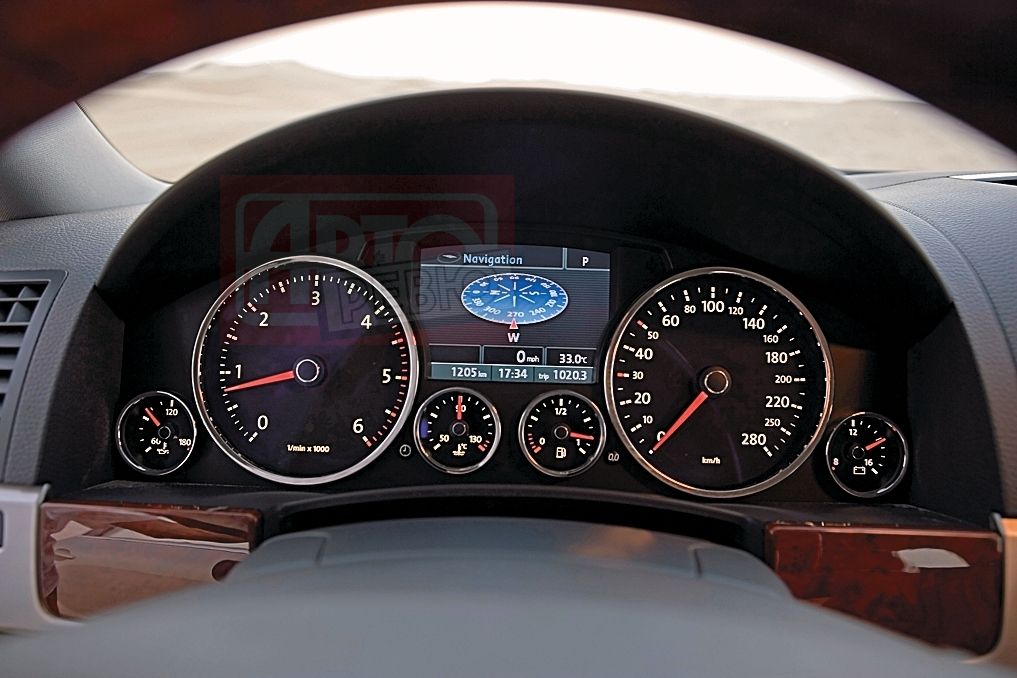 | 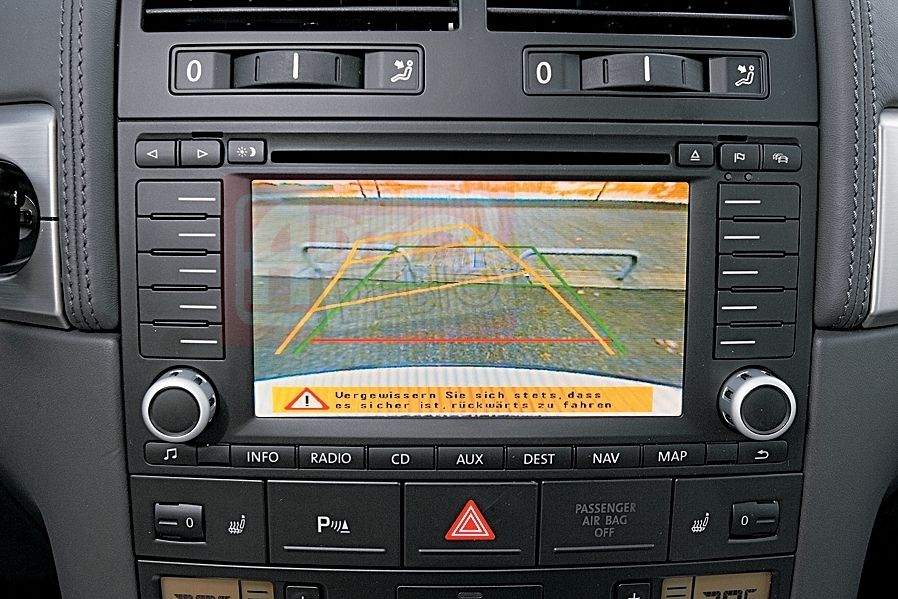 | 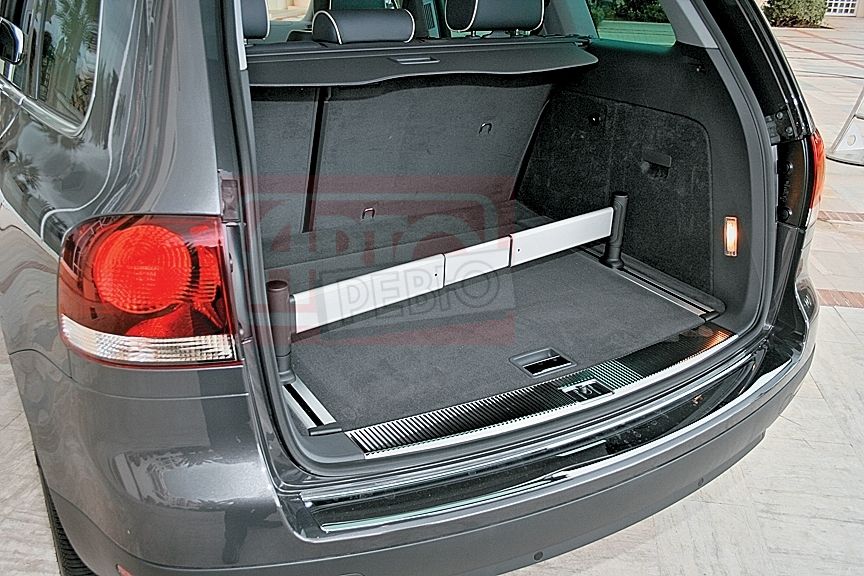 |
| The enlarged information display fits well into the instrument panel | The rear-view camera screen ($933) and navigation ($3044) will now find use in Russia as well | For the convenient cargo securing system, you will have to pay an extra $459 |
Inside, everything is still the same: only the information display in the instrument cluster has become noticeably larger. In well-equipped versions, the seats are now "comfortable," borrowed from the Phaeton sedan. Soft, but with impeccable geometry and excellent lateral support.
It's just a pity that the low-mounted steering column switches remain unchanged…
For the trunk, you can now order a cargo securing system familiar from the Audi Q7 — an aluminum crossbar sliding along rails. There is also another useful option — the "anti-cut-in" Side Scan system, which debuted on the Audi Q7 under the name Side Assist. A pair of radars at 24 GHz, hidden in the corners of the rear bumper, monitor "blind" zones extending 50 m in length and 3.6 m in width along the sides of the car — and when an obstacle is detected, they light up orange LED strips in the exterior mirrors at half brightness. Turn on the "turn signal" when about to change lanes in that direction — the LEDs will start flashing and shine three times brighter. Like, be careful — there's an obstacle to the side!
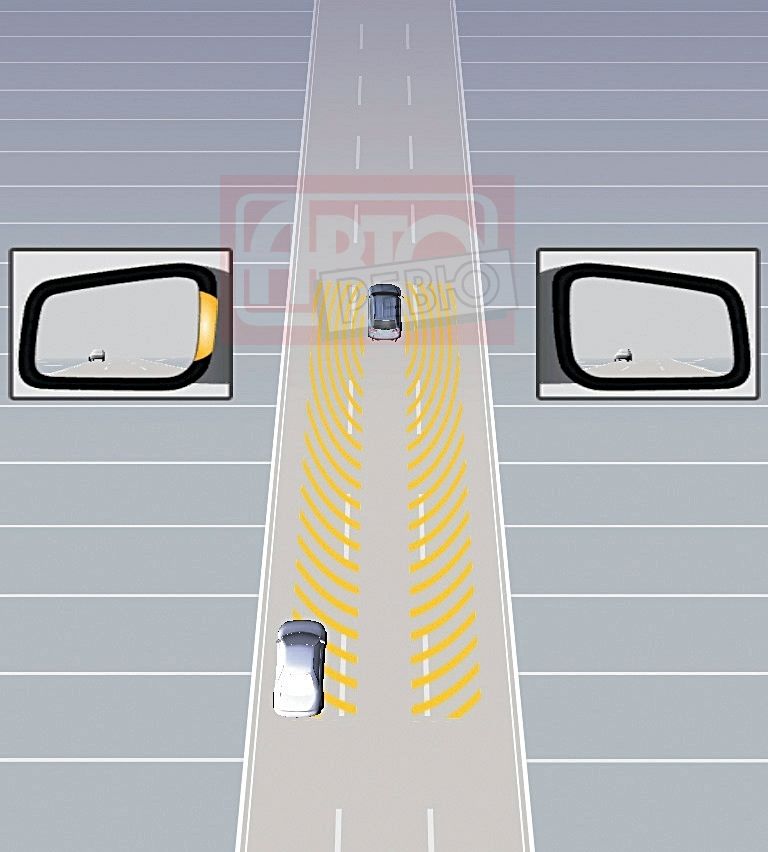 | |
| The Side Scan system monitors vehicles in the "blind" zones and warns the driver by lighting up LEDs at the bases of the exterior mirrors | The active cruise control radar, which can maintain a set distance even in traffic jams, operates at 76.5 GHz. "Range" — 200 m |
A very handy thing.
There is also the opportunity to indulge in active cruise control. You select the desired target and the distance to it (maximum 200 m), press the button — and just steer. True, the radar's viewing angle is quite narrow (12°), and the intensity of autonomous braking is limited to 0.4 g. But even when switched off, the radar cruise control works as a collision warning system: when approaching dangerously, it emits an annoying beep and raises pressure in the brake line, bringing the pads to the discs for emergency braking. True, Volkswagen hasn't yet learned to tighten seat belts and brake fully like the Honda Legend.
And the main "gift" from the Audi Q7 is the V8 4.2 FSI engine (350 hp) with direct gasoline injection. It is 40 hp more powerful than the previous all-Volkswagen "eight" of the same displacement. And although the Touareg V8 with this engine has gained 82 kg in weight, acceleration to 100 km/h has become quicker: according to the specs — by 0.6 s.
Powerful "trolleybus-like" thrust from 2000 rpm all the way to the cut-off at 7000 rpm, the responsive work of the "automatic"… You feel like the master of the road!
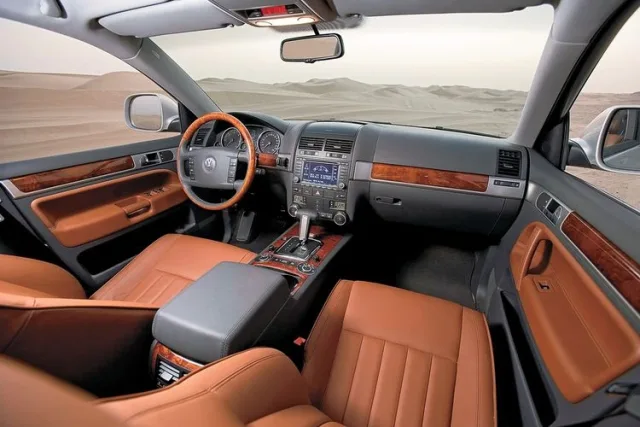
The luxurious interior has hardly changed
The gearbox doesn't even need sport and manual modes. You intuitively select gears with your foot. Driving at 80 km/h, you release the gas — sixth gear engages. You lightly press the accelerator — fourth. And if you press properly — the gearbox instantly drops two more gears. Moreover, the spirited "metallic" voice of the engine tempts you to repeat this again and again.
For comparison, I took a ride in the 3.6 FSI version — this 280 hp engine appeared under the hood of the Touareg last year. Of course, you no longer feel that huge reserve of thrust, and the gearbox has to jump through gears more often. But it's still fast enough!
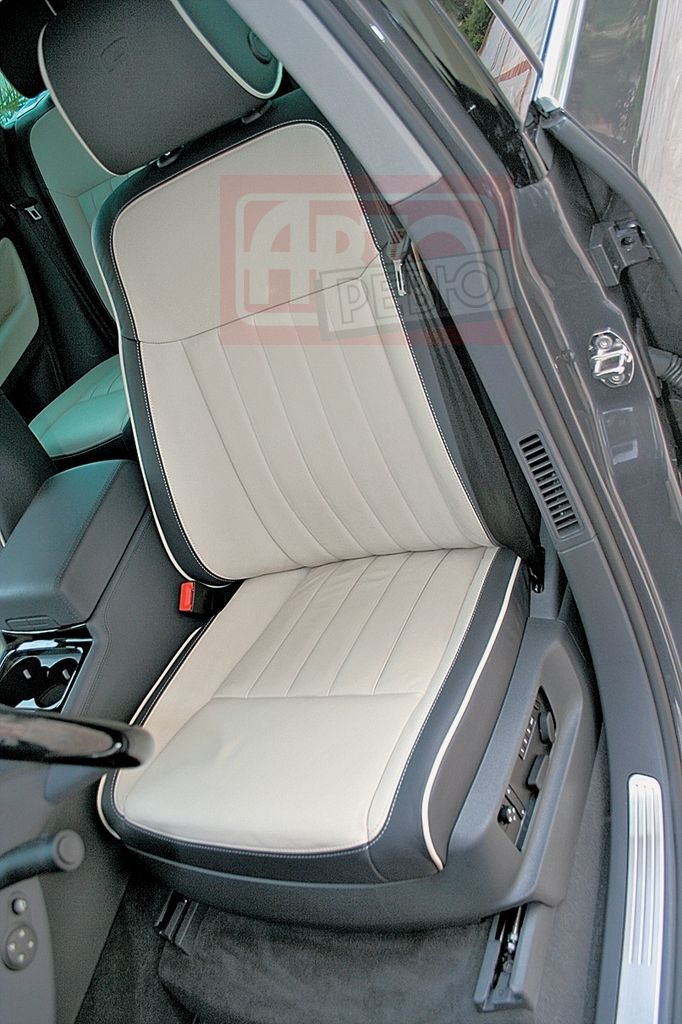 | 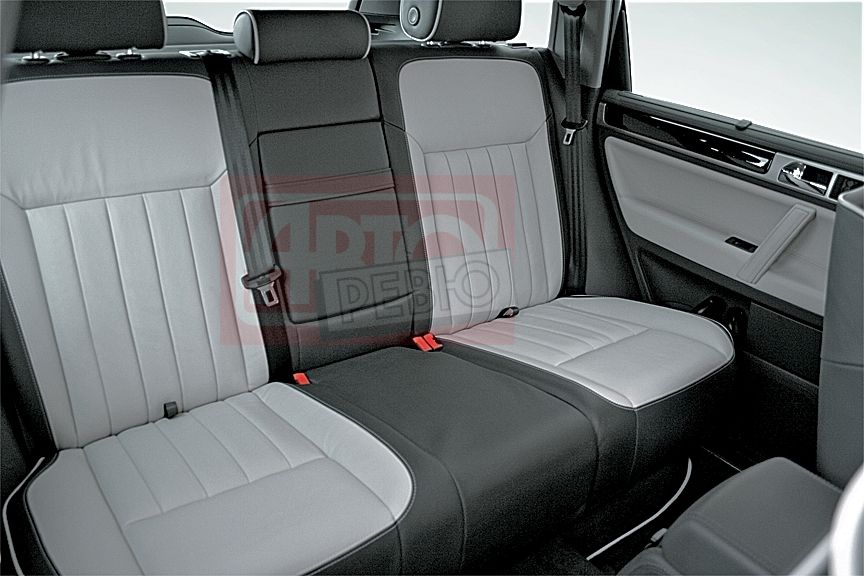 |
| Seats from the Phaeton sedan are more comfortable than the previous rigid chairs | In the back — no changes |
By the way, the old V6 3.2 engine (247 hp) will disappear from the engine lineup, and all gasoline Touaregs will be equipped exclusively with "automatics": manual transmission will remain only for diesels.
The chassis hasn't been touched — the Touareg drives excellently. Both on coil springs and on adjustable air suspension. The steering wheel has become a bit "heavier," but it hasn't lost a gram of informative "transparency."
And thanks to new algorithms of the stability control system, the Touareg has become even safer. As before, ESP monitors the onset of understeer or oversteer. But now it can also recognize dangerous body rolls — using acceleration and body angular position sensors. As soon as the roll reaches 80% of the level that the electronics consider maximum permissible, ESP begins to reduce speed by braking both outer wheels.
This doesn't hinder fast cornering at all — the car still starts to slide earlier. But the "just in case" backup doesn't hurt, especially when driving on slopes and during maneuvers like the "moose test." In my presence, colleagues from Slovenia, saving the life of a dog that suddenly ran onto the road, performed a "dog test." The rolls during the emergency avoidance were quite significant...
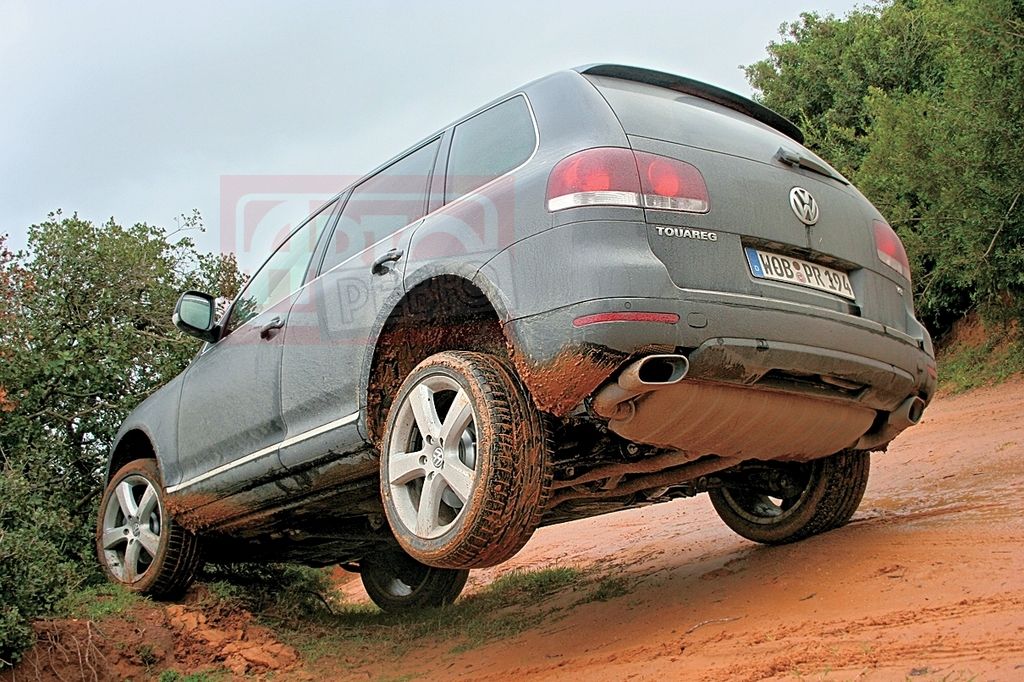 | 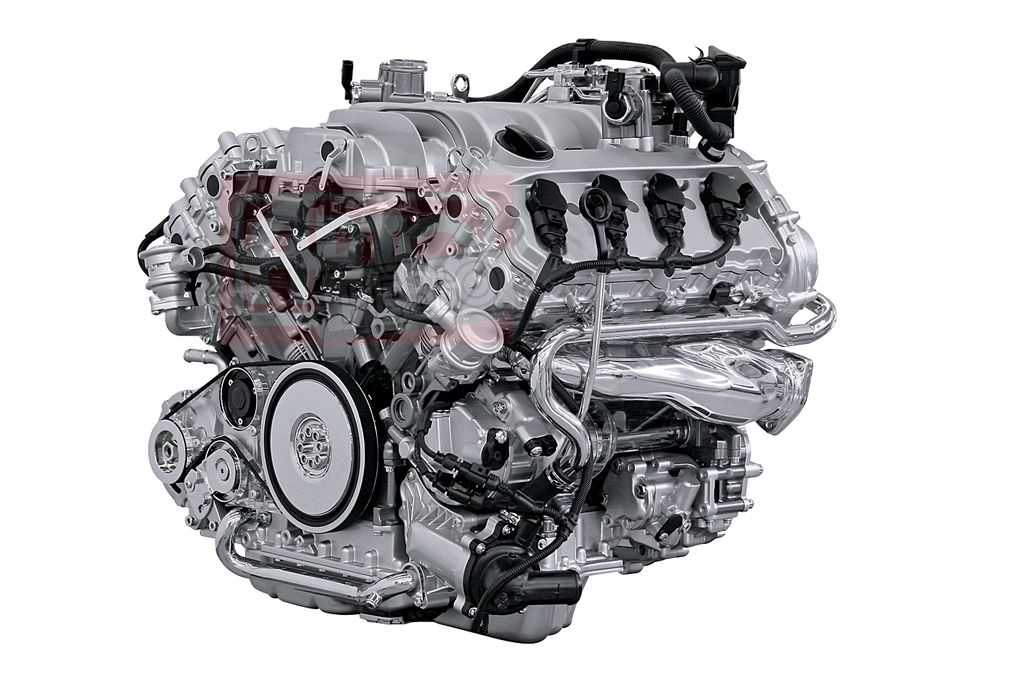 |
| The optional rear differential lock and adjustable air suspension give the Touareg considerable off-road potential | The new "heart" of the Touareg V8 4.2 FSI from the Audi Q7 — a de-tuned from 420 to 350 hp "eight" from the uncompromising Audi RS4 |
This is where active stabilizers PDCC, like those in the platform-sharing Porsche Cayenne (see AR No. 2, 2007), would come in handy! But the Touareg lacks them — according to the creators' design, the ideology of ultimate handling is not needed for it.
As for comfort, the Touareg on air suspension is beyond competition. Moreover, I would prefer to drive only in "comfort" mode — the negligible reduction in rolls and delays in Sport mode does not compensate for the increased shaking. The ride smoothness on coil springs, as before, occupies an intermediate position between the two modes of the "air suspension."
But paying an extra $3300 for air struts is worth it not for comfort, but for off-road capability. Three hundred millimeters of maximum ground clearance is something! True, in Russia, the option of expensive disconnecting anti-roll bars for $2433 is not offered. There is no demand — no one is going to use their Touareg for storming slopes that require large axle articulation angles… But the rear differential lock for $900 is still on the list. And with it, the Touareg is ready to climb dunes and sand hills no worse than the nomads of the African tribe of the same name!
| Factory tuning from Wolfsburg — R-line series: "sporty" bumpers and a suspension lowered by 20 mm |
And a new ABS algorithm is designed to help it descend from them. The fact is that on loose soils, the braking distance on fully locked wheels is much shorter — they pile up a "berm" in front of them. But at the same time, the car slides strictly straight, not obeying the steering wheel. The new ABSplus system takes both of these points into account. When decelerating from 0.4 to 0.65 g, which corresponds to braking on loose soil, sand, and possibly snow, ABSplus allows the wheels to lock for 0.1—0.2 seconds. During this time, they manage to pile up a "ridge" in front of them, and the braking distance compared to the standard algorithm is reduced by 20%.
Thanks to the fact that the locking system operates in pulse mode, the updated SUV responds perfectly to the steering wheel and maneuvers without any problems even on loose sand — I tested this on the beaches of Tunisia. At the same time, ABSplus does not in any way reduce braking efficiency on wet asphalt: deceleration remains as confident as before. The secret is that on ice or on hard surfaces, when wheel traction changes, the ABS system automatically switches to its normal operating mode.
However, the updated Touareg also has a downside — it has become more expensive. If you take versions with the previous engines, the price increase averaged 4 percent. The starting price for the diesel R5 modification is from $54,040. But the super-diesel V10 TDi will not appear on our market yet: according to Volkswagen representatives, the blame lies with the particulate filter. The most powerful petrol version, the W12, in turn, will only reach customers in a year — it is not ready yet. So for now, the new Touareg V8 FSI remains the flagship in terms of horsepower. For an additional 40 "horses" you will have to pay $6,600 extra. However, the final price tag is quite reasonable — from $85,500. That is $20,000 cheaper than the comparable Audi Q7.
But there is nothing to be done here — within the corporation, a strict hierarchy prevails…
| Specifications | |||||
| Parameters | Vehicle | ||||
| Volkswagen Touareg | |||||
| Modification | V6 3.6 FSI | V8 4.2 FSI | R5 TDI | V6 3.0 TDI | V10 5.0 TDI |
| Body type | 5-door wagon | 5-door wagon | 5-door wagon | 5-door wagon | 5-door wagon |
| Number of seats | 5 | 5 | 5 | 5 | 5 |
| Length, mm | 4754 | 4754 | 4754 | 4754 | 4754 |
| Width, mm | 1928 | 1928 | 1928 | 1928 | 1928 |
| Height, mm | 1726 | 1726 | 1726 | 1726 | 1703 |
| Wheelbase, mm | 2855 | 2855 | 2855 | 2855 | 2855 |
| Track front/rear, mm | 1652/1688 | 1652/1688 | 1652/1688 | 1652/1688 | 1652/1688 |
| Trunk volume, l | 555—1570* | 555—1570 | 555—1570 | 555—1570 | 555—1570 |
| Curb weight, kg | 2238 | 2332 | 2267 (2247)** | 2321 (2301) | 2602 |
| Gross weight, kg | 2945 | 3000 | 2850 | 2945 | 3200 |
| Engine | petrol, with direct fuel injection | turbodiesel | turbodiesel | turbodiesel | |
| Location | front, longitudinal | front, longitudinal | front, longitudinal | front, longitudinal | front, longitudinal |
| Number and arrangement of cylinders | 6, V-shaped | 8, V-shaped | 5, in-line | 6, V-shaped | 10, V-shaped |
| Cylinder bore/piston stroke, mm | 89.0/96.4 | 84.5/92.8 | 81.0/95.5 | 83.0/91.4 | 81.0/95.5 |
| Displacement, cm³ | 3597 | 4163 | 2461 | 2967 | 4921 |
| Compression ratio | 12.0:1 | 12.5:1 | 18.5:1 | 17.0:1 | 18.5:1 |
| Number of valves | 24 | 32 | 10 | 24 | 20 |
| Max. power, hp/kW/rpm | 280/206/6200 | 350/257/6800 | 174/128/3500 | 225/165/4000 | 313/230/3750 |
| Max. torque, Nm/rpm | 360/2500 | 440/3500 | 400/2000 | 500/1750 | 750/2000 |
| Gearbox | automatic, 6-speed | automatic, 6-speed (manual, 6-speed) | automatic, 6-speed | ||
| Drive | permanent all-wheel drive, with symmetrical center differential | ||||
| Front suspension | independent, spring, on transverse arms, with stabilizer (optional — air) | independent, air, on transverse arms, with stabilizer | |||
| Rear suspension | independent, spring, on transverse arms, with stabilizer (optional — air) | independent, air, on transverse arms, with stabilizer | |||
| Front brakes/disc diameter, mm | disc, ventilated/330 | disc, ventilated/330 | disc, ventilated/308 | disc, ventilated/330 | disc, ventilated/350 |
| Rear brakes/disc diameter, mm | disc/330 | disc/330 | disc/314 | disc/330 | disc/330 |
| Tires | 235/65 R17 | 255/55 R18 | 235/65 R17 | 235/65 R17 | 255/55 R18 |
| Maximum speed, km/h | 218/227*** | 234/244*** | 183/189*** (188/194***) | 202/209***(209/212***) | 231 |
| Acceleration time 0—100 km/h, s | 8.6 | 7.5 | 11.6 (11.5) | 9.2 (8.9) | 7.4 |
| Fuel consumption, l/100 km | |||||
| urban cycle | 19.2 | 19.7 | 13.6 (13.2) | 14.4 (14.1) | 17.7 |
| extra-urban cycle | 10.4 | 10.7 | 8.6 (8.3) | 8.5 (8.6) | 9.6 |
| combined cycle | 13.6 | 13.8 | 10.4 (10.1) | 10.7 (10.4) | 12.6 |
| Fuel tank capacity, l | 100 | 100 | 100 | 100 | 100 |
| Fuel | petrol AI-95—98 | petrol AI-91—95 | diesel Euro 4 | diesel Euro 4 | diesel Euro 4 |
| * With rear seats folded | |||||
| ** In parentheses — data for vehicles with manual transmission | |||||
| *** For vehicles with air suspension | |||||