
VW Tiguan
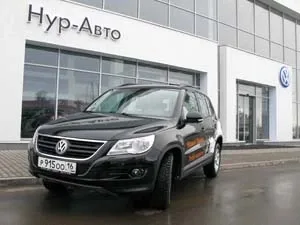
TigGUANa
Engine — 1.4 L TSI
Peak power —
150 hp/5800 rpm
Max torque — 240 Nm/1750-4000 rpm
Top speed (km/h) — 195
0-100 km/h acceleration — 9.3
Fuel appetite:
city — 9.4
highway — 6.2
combined cycle — 7.4
6-speed manual
front-wheel drive with pluggable rear axle
Curb weight — 1451 kg
Length — 4427 mm
Width — 1809 mm
Height — 1686 mm
Ground clearance — 200 mm
Tires 215/65R16
Price — $30,511 (244,081 UAH)
Equipment:
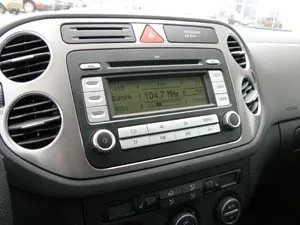
Offroad package (different bumpers, trims, hill descent assist, off-road mode for accelerator pedal and ABS), 8 airbags, dual-zone climate control, ESP (ABS, ASR, EDS, MSR), tire pressure monitoring, rear parking sensors, compass, RCD 300 audio system
Maintenance intervals:
15,000 km
Service 1 — 15,000 — $220 (1,756 UAH)
Service 2 — 30,000 — $507 (4,051 UAH)
Service 3 — 45,000 — $220 (1,756 UAH)
Service 4 — 60,000 — $743 (5,940 UAH)
Service 5 — 75,000 — $220 (1,756 UAH)
Service 6 — 90,000 — $743 (5,940 UAH)
Warranty — 2 years without mileage limit
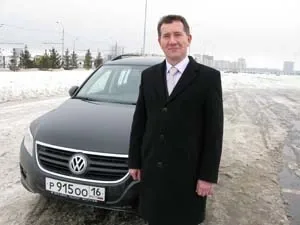
Marat Makhmutov, “Kazan School of Higher Driving Skills”
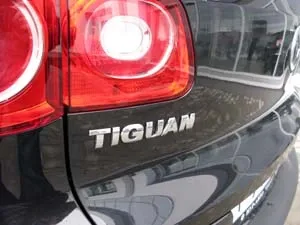
The first compact crossover from Volkswagen named Tiguan interested us primarily as a possible “younger sibling” in the Touareg family — many perceive it in that role. The concept version of this A-class SUV appeared back in 2006, a year later the car hit the European market, and reached us with a six-month delay — in 2008. However, the start of sales coincided with the launch of assembly near Kaluga, so this VW can, with some stretch, be considered Russian. Unlike Touareg, whose name instantly paints the image of a rugged desert dweller, “Tiguan” is not translated from any common or even rare language. The manufacturer chose it based on a survey of readers of the German Autobild, combining two words: Tiger and iGUANa. According to the idea, the new model should combine the beauty, grace, and strength of a feline predator with the speed, agility, and nimbleness of a reptile. How well the car lives up to its name and whether it can become a people’s car at its assembly site — that’s what we’ll check now.
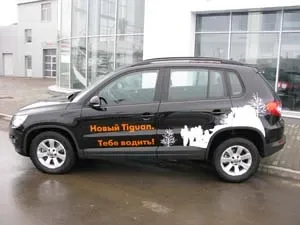
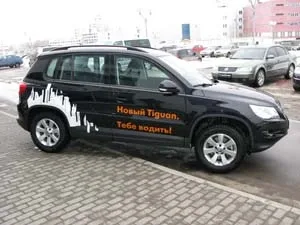
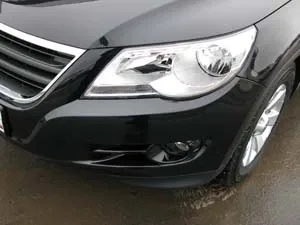
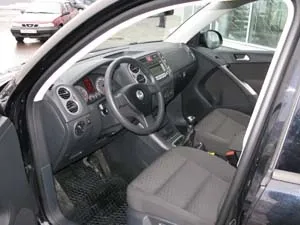
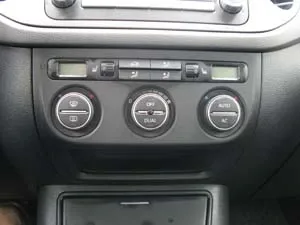
The first thing that comes to mind when looking at the black crossover on our site is “a reduced Touareg.” But upon closer inspection, differences are found beyond dimensions: the body lines here are rounder, and the rear looks lighter than that of the older brother. The front is strict and solid — you can feel that Volkswagen is no longer quite “people’s” but aiming for the premium class. This aspiration is visible in everything: in the impeccable fit of body panels, in the trim materials, and in the neat assembly of the interior. Particularly pleasing was the top of the dashboard made of soft fine-grained plastic — matte black, it feels like velvet to the touch. I had similar texture and quality in a BMW 5 Series in the E39 body, and I admit I really liked it. Overall, the interior design strongly resembles the Golf Plus, and if there are differences, they are quite insignificant. Eight vents combined with dual-zone climate control allow air flows to be distributed as efficiently as possible. The instruments — with the blue backlighting typical of the German “people’s” brand — are easy to read, and the speedometer with 5 km/h increments additionally helps maintain the desired speed.
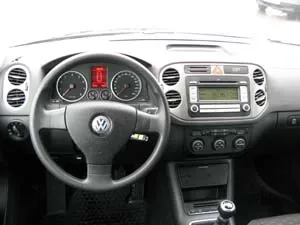
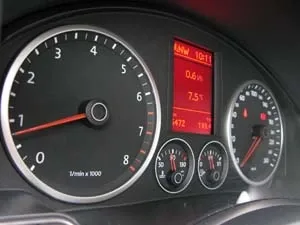
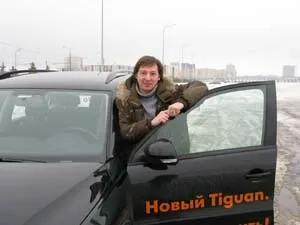
I was pleased with the abundance of various pockets and compartments for small items, as well as the glove box with adjustable airflow — depending on the regulator position, it cools or warms the contents inside. There are also fold-down tables on the backs of the front seats. It’s worth noting that the equipment of our Kaluga car was far from top-of-the-line, but this did not affect consumer qualities — except that the steering wheel looked unusually empty due to the lack of buttons. However, the Tiguan was in the Track&Field version, which means a modified front bumper: its successful shape increases the approach angle to 28 degrees versus 18 for the standard version. For leisurely driving in difficult road conditions, which are common for us in winter, there is an “off road” button on the tunnel. Pressing it simultaneously activates hill descent and hill start assist, electronic differential lock simulation, a special ABS mode, and a torque modification function. Nearby is the “auto hold” button for the handbrake, which does not disengage itself when starting off. The bottom of the doors is molded with an inward fold to protect the sills from street dirt, and this simple solution fully justifies itself: when getting in and out, there is simply nothing to dirty your trousers on.
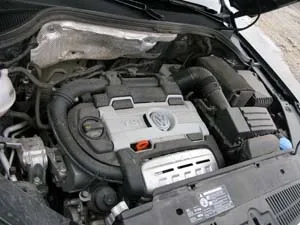
As usual, we start tests on our site, which has not yet fully cleared of ice and thawed snow. The Russian Tiguan is, of course, all-wheel drive — our mentality does not accept an SUV with a single driven axle. Under the hood is a 1.4-liter engine with 150 hp. Such output from such a modest displacement was achieved by installing both a mechanical supercharger and a turbocharger. It was unusual to see the lever of the good old manual in place of the “automatic” selector — at a time when even avid off-road enthusiasts had begun to look toward automatic transmissions. Nevertheless, it is the “stick” that allows the potential of both the car and the driver to be more fully revealed. For example, the real traction of the engine is best assessed precisely with a manual. Despite the modest 1400 cubic centimeters, the engine turned out to be lively and cheerfully accelerated a far from light car. The secret is simple — turbocharging spins it up to 150 horses. If only our road tax were based on cubic centimeters rather than horsepower! Because although there are a hundred and fifty horses, you don’t feel them at low revs. Our test subject stalled more than once in drifts of melting snow when I tried to pull away “in gear.” But at high revs — just what the doctor ordered! There is no excess of power, but no shortage is felt either. On ice, the car behaves quite adequately, as befits all-wheel drive: the stability control system works logically, but when you try to turn it off, it only lowers the activation threshold. However, it already allows the driver to control the car a bit independently.
Having dealt with the behavior of the power unit and noted the early intervention of the ABS, we move to the next stage — studying how the suspension copes with urban irregularities and how the car feels on the highway. The chassis is dense and resilient: at low speed on a broken road, the rear noticeably shakes. Vibrations are also felt at the front, but it does not reach discomfort. At higher speeds, when “more speed — fewer potholes,” the Volkswagen is perceived as a solid and composed car. What especially surprised me was that the steering wheel absolutely does not transmit vibrations from the road surface. The explanation is that the steering mechanism uses a rolling bearing instead of a standard sliding bearing. Together with the installation of a shock absorber siphon, this not only removed unpleasant vibrations from the steering wheel but also improved steering precision. Countryside dynamic tests confirmed: the engine truly comes alive at medium and high revs. At the same time, calling the Tiguan sluggish is hard; you just expect a bit more agility from it. It’s interesting how much more fun the two-liter engine paired with DSG would be, but the question is — would fuel economy suffer? With our crossover, by the way, everything is in perfect order: the declared combined consumption is only 8.4 liters per hundred with a 64-liter tank. There was also a small off-road episode. True, we went there with considerable caution: the snow had already thawed and turned into a loose and viscous mass. The “off road” button instilled, rather, psychological confidence than real belief in the car’s ability to pass such a test, which is difficult even for real SUVs. However, careful work with the accelerator pedal and electronic assistants did their job: the crossover slowly overcame the winter road and returned to the starting point with a sense of self-respect.
The return road to the city and the change of drivers are behind us. So, did the Tiguan manage to embody the engineers’ intent and justify its name? It’s hard to give an unambiguous answer, but by the finish I realized — I truly took a liking to the car. At the stated price, which looks more attractive than competitors’, combined with quality and modern technologies, it has every chance of becoming “people’s” in its segment.
Alfred Mardanov, “Autoclub-Kazan”
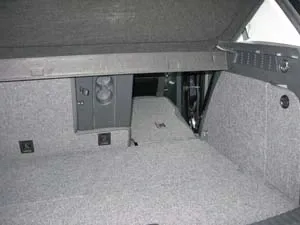
So how is that possible? It seems to be a crossover, albeit a compact one, yet under the hood there's only 1.4 liters, even if it does produce 150 horsepower. I remember a similar engine from the new Fiat Bravo. The Italians made a lively little car, but it's much lighter than the Tiguan and clearly not meant for off-road adventures. In short, the task is intriguing, and I could probably guess the approximate answer, but I won't rush and will start in order. The Tiguan made a splash even before its official debut — I still recall TV reports about a shortage of these cars due to unexpectedly high demand. That's all well and good, but global popularity isn't a rule for us: we're used to fitting a car to ourselves and our operating realities. Our test car is the Track&Field trim with a shortened front overhang — apparently, just to improve geometric off-road capability (otherwise why such flimsy plastic under the bumper over the metal?), high-profile tires, and that very off-road function. Once inside, I immediately felt déjà vu: as if I'd been here before. I hardly had to get used to the controls or the seating position. Although no, I'm lying: the wiper stalk kept confusing me with its inversion. Up to turn off, down to turn on. An unfamiliar algorithm; my hand kept trying to do the opposite. That's perhaps the only thing I can fault in terms of ergonomics and comfort. Everything else is thought out to the smallest detail — right down to the cooled glovebox. Excellent visibility, comfortable seats with purely German lateral support, steering wheel, pedals — no complaints. The rear row pleased with a folding middle section: it opens access to the trunk, allows carrying long items like skis or a snowboard, and in its normal position serves as an armrest with cup holders.
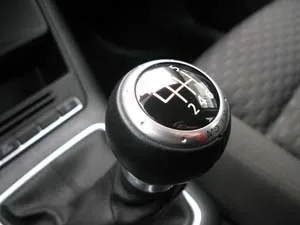
That was the first acquaintance, and now it's time for our favorite test site. I start the engine, carefully pull out of the parking lot — and off we go. All the way, a strange feeling from the engine sound in the cabin doesn't leave me. It's not deep and bassy, but rather ringing, breaking almost into falsetto. There's no low-end torque, which is expected, but above three thousand rpm — an unexpectedly cheerful and brisk pickup; the car literally leaps from a standstill. On smooth asphalt and in stop-and-go city traffic, the six-speed easily smooths out the dip at low revs, especially since the gearbox's operation here is very, very pleasing. The shifts are crisp, short, impossible to confuse. The main thing is to remember where reverse is: like in the Lada 9, it's toward you and up. At the site, I first rode as a passenger, and then we drove off the icy asphalt into snowdrifts. We stalled there, of course, more than once, but got out on our own. The site showed that ESP doesn't turn off completely; it still actively interferes with control — as soon as the wheels turn to a certain angle, the system immediately stifles any initiative and straightens the trajectory. No matter how hard I tried, I couldn't catch the car in a rhythmic drift or sideways slide. It didn't work. Here, the approach to safety is undoubtedly correct, but a thought creeps in that modern cars are gradually becoming household appliances for the average user. Like a kettle: press a button — and boiling water is ready, never mind what's inside, as long as it looks decent and is prestigious.

It's the same here: turn it on — and go. The main thing is not to skip maintenance. In highway mode, when revs climb above mid-range, the car responds briskly to throttle input, even in a higher gear. We tried pulling away in sixth from low revs — the car strained but still managed from about 50 km/h. On our off-road section, we honestly hesitated at first. Then I was sent as a scout along the route, though I'd be lying if I didn't mention Vadim — he was the first to attempt the climb. It was obvious that was impossible, but we did find out how the hill descent control works with a manual gearbox. And when I drove over natural off-road terrain, I had plenty to worry about. Dense, wet, packed snow couldn't hinder my progress, but the car didn't inspire confidence. In such conditions, there's clearly a lack of low-end torque. At the same time, credit where it's due: the activated off-road mode doesn't let you over-rev and dig in. The system clearly monitors revs and, like Ariadne's thread, guides you over bumps and hummocks. The car's philosophy is now clear. It won't win a jeep trial or a street race — it will simply take the whole family, drive to the store, cinema, or theater. In the morning, it will patiently sit in traffic jams on the way to work, and on weekends, it will easily turn off the asphalt and head into the forest, closer to nature. And what more does a city dweller need, for whom, essentially, this car was created? Expecting more from it would be, at the very least, foolish.
P.S. One of the most respected automotive experts in our city, who remained behind the scenes, stated outright: the car is good, and he'd gladly buy one for his wife.
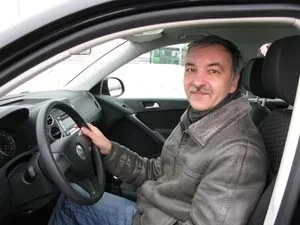
Vadim Sadykov, Avtoklub-Kazan
The choice in the crossover class is now huge. Even if you just filter by size: compact Nissan Qashqai, standard Toyota RAV4 and Honda CR-V, slightly larger Volvo XC60, Audi Q5, BMW X3, and already large Audi Q7, Honda Pilot, and others. The Tiguan fits very well into this lineup: compact dimensions, front or all-wheel drive, turbo engines 1.4, 2.0, and 2.0 diesel.
The car really did turn out successful, but I'll start with what I didn't like. The engine is too noisy, especially under hard throttle. And there's a lack of dynamics on the highway when revs are below three thousand. That's probably all. Of course, you could mention the stiff suspension, but that's already subjective perception.
Now about the strengths. I'll note right away: this car's dimensions aren't my format, so don't expect wild enthusiasm from me. But some things here are truly well done. On an icy road, the car behaves predictably; the electronics actively suppress traction — for the average driver, this is an ideal option. Acceleration dynamics are top-notch; you can even have some fun if you keep the tachometer above 3000 rpm (or even better, above 4000). On the highway, the car confidently holds a straight line and handles smooth curves flawlessly. I was especially pleased with the hill descent control: it activates even in neutral when reversing!
But still... The thought 'not my size' won't let go. Without a doubt, this car is more interesting than the Qashqai, but... However, with the turbocharged 2.0, my impressions would likely have been more vivid. Although, if you consider it as a compact little SUV for the wife — why not?