
VW Tiguan. Entertaining Zoology
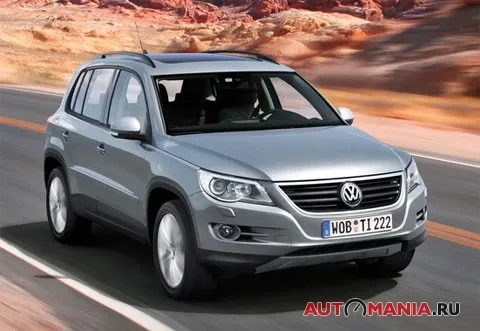
It seems that European buyers have seriously decided to swap compact hatchbacks for something taller and more capable. Automakers, sensing the demand, are flooding the market with such models — here you have the Suzuki SX4, the Nissan Qashqai, and soon the Ford Kuga will join in. But even more interesting is the new offering from Volkswagen — the Tiguan crossover, whose debut at Russian dealers is scheduled for literally a couple of months from now.
So what kind of beast is this? We have before us a subcompact SUV that burst without hesitation into the newly formed class of small SUVs, where the Qashqai and SX4 already reign, along with, to some extent, the Dodge Caliber (it can only be conditionally included here, as it has no all-wheel-drive version). Success for the newcomer is almost guaranteed: in the Old World, its direct competitors sell like hotcakes, and the number of those wishing to acquire such a car is only growing. Moreover, even before the start of sales, this Volkswagen has managed to earn the title of the most people's concept car of the most people's brand in the world.
The Germans from Volkswagen, long before the official presentation, offered everyone interested a virtual walk through the interior and a look at the exterior of the future newcomer. And it worked: the company received enviable consumer activity, which was enough to launch the model into series production. And by the autumn of last year, when the car was finally shown to the public in person, marketers already knew exactly what the buyer wanted. Therefore, this crossover can confidently be called not only the most people's concept but also the most people's Volkswagen of the last one and a half to two decades.
The design of the model — as is often the case today — is a typical compromise. There is a little bit of everything here. The front part clearly echoes the older Touareg, the rear references the more modest Golf Plus, and along the sides, signature stylistic details are generously scattered, designed to attract as many buyers as possible. The car's name itself also works towards this — a hybrid of the names of two completely dissimilar animals, the tiger and the iguana. German marketers figured that such a bizarre combination would, firstly, draw attention to the model, and secondly, emphasize its versatility and universality.
However, those who see this car merely as the German answer to the Qashqai are greatly mistaken. The Tiguan is much closer to another "Japanese" — the Suzuki SX4. The similarity lies in the fact that, like the Suzuki, the German crossover will be offered in two versions — for asphalt and for off-road. The Trend&Fun and Sport&Style versions are designed for regular roads: they have classic proportions, typical for a compact SUV — a massive hood, a heavy bumper under the front optics. The Track&Field version is a completely different matter; it is a born conqueror of rough terrain. Externally, it differs strikingly from its urban siblings. The lower part of the bumper and the underbody form a steeper angle, thanks to which the approach angle of such a Tiguan reaches 28 degrees (for the "asphalt" versions, only 18). The rear and middle part of the body are the same for all modifications: the departure angle is 25 degrees, and the ramp angle is 20. The ground clearance, which is 195 mm, also remains unchanged.
Among other things, the permanent all-wheel-drive system 4motion will be installed on all Tiguans without exception, which favorably distinguishes the German crossover from its competitors. Fans of all-wheel drive will be pleased. But do not be deceived: like other compact crossovers, this VW will in most cases drive on the front wheels. The transmission with an electro-hydraulic Haldex coupling engages the rear axle only when the front wheels slip. Theoretically, it can send up to 100% of the torque to the rear, but in practice, only about 10% goes there, with the remaining 90% staying on the front axle.
The Tiguan's arsenal also includes some off-road assistants. There is, of course, no air suspension or honest mechanical locks like on the older Touareg, but there is a hill descent and ascent assist system. By the way, this year the Germans promise to equip the newcomer with an electronically controlled suspension with "Comfort," "Normal," and "Sport" modes. But despite all the manufacturer's tricks, the Tiguan's native element is the city, or, at most, light off-road. Here, the car with proper settings will not let you down, and an inexperienced driver will be helped by electronics activated by the On road/Off road button on the center console (in the Track&Field version). The throttle response will become smoother, pseudo-locks will engage, and ABS will adapt to gravel or sand.
On asphalt, the Tiguan is also good. The suspension confidently holds the road, and the car handles well. And in a parking lot, it can even act almost independently — if, of course, you pay extra for the optional Park Assist system. However, the car's main trump card is its engine. The Tiguan is the first compact crossover in the world to be equipped exclusively with turbocharged engines. The base 1.4-liter unit has a supercharger and produces 150 horsepower. It accelerates the crossover to 100 km/h in 10 seconds and develops 240 Nm of torque already at 1750 rpm. Paired with the base six-speed manual, the car drives very decently, and fuel consumption is low — 8.4 liters per 100 km. If economy is your top priority, you should take a closer look at the new two-liter TDI turbodiesel with 140 horsepower. At the same rpm, it delivers over 300 Nm, accelerates to 100 km/h only slightly slower than the petrol version, and consumes even less diesel — about 7.2 liters. There is something to think about.
The interior holds no surprises. Ergonomics are at a height that competitors have yet to reach: the instruments are perfectly readable, the buttons press, and the knobs turn. The trim materials match the car's class. The seats are comfortable, and the adjustment ranges are wide, so sitting in the Tiguan is quite comfortable, especially in the front row. But since the model is built on the platform of the good old Golf V, it is better to ride in the back with two — three will be a bit cramped. There is also not too much legroom for second-row passengers, despite the fact that the rear seat can be slid back. However, this is more of an inconvenience for tall riders — people of average height will sit quite freely. And in extreme cases, you can simply move to the front.
But there are practically no complaints about the crossover's cargo capabilities. The rear seat backrest folds in a 60:40 ratio, and after transformation, the trunk volume grows to over 1500 liters. In the normal seating position, the car holds 470 liters of luggage with a maximum load capacity of 650 kilograms. Optionally, a double floor with a cargo securing system is offered. Additionally, on the Track&Field and Sport&Style versions, the front passenger seat also folds, allowing the transport of items up to 2.5 meters long. Although such a possibility is already perceived as something taken for granted.
Technical specifications:
| Dimensions: | VW Tiguan |
| Length (mm) | 4430 |
| Width (mm) | 1810 |
| Height (mm) | 1670 |
| Wheelbase (mm) | 2635 |
| Ground clearance (mm) | 195 |
| Weight (kg) | 1490 |
| Trunk volume (l) | 470/1510 |
| Engine displacement (cm3) | 1390 |
| Max power (hp) | 150 |
| Max torque (Nm) | 240 |
| Max speed | 192 |
| Acceleration 0-100 km/h (s) | 9.3 |
| Average fuel consumption (l) | 8.4 |
Magazine "Autogid" March 21, 2008 No. 58
Source – AUTOMANIA.RU