
 <\/a><\/td> <\/a><\/td> |  <\/a><\/td> <\/a><\/td> |  <\/a><\/td><\/tr> <\/a><\/td><\/tr> |
Kaluga wolf. Volkswagen Tiguan
Remember how a year ago Volkswagen marketers held a nationwide vote for the name of this car? Nanuk, Namib, Rockton, Samun...
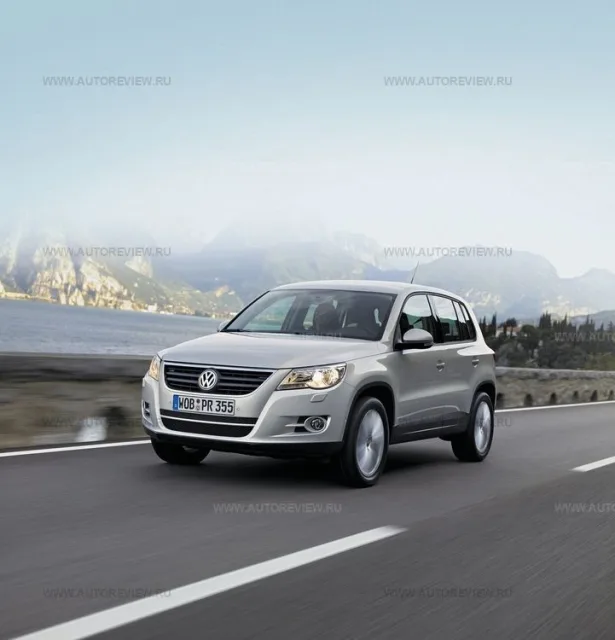
Remember how a year ago Volkswagen marketers held a nationwide vote for the name of this car? Nanuk, Namib, Rockton, Samun... Such names would have suited an Iranian or, at best, a Korean model. But the Germans almost unanimously chose: "Tiguan"! That's what the production compact crossover is now called. A tiger and an iguana in one bottle — you couldn't say it better: it's no longer just an all-wheel-drive station wagon, but not yet a full-fledged SUV. However, you just need to take a closer look at the sharp little face of the Tiguan in the off-road version... A young wolf, and nothing else. It's no wonder it comes from Wolfsburg — the "city of wolves."
On high-speed German autobahns, crossovers don't shine with advantages. So they decided to hold the "driving" presentation in Hungary. The country is agricultural (remember green peas, salted tomatoes, and Globus pickles?) — and the condition of the roads still reminds of the socialist past. And the favorite car of Hungarian farmers is our Niva, the progenitor of all current compact crossovers. Unibody construction, components from a golf-class car, large wheels, increased ground clearance plus all-wheel drive — that's how all such cars are arranged now. But thirty years ago, the Niva couldn't become a trendsetter: it was too off-road, noisy, and uncomfortable. The new standard in 1994 was set by the Japanese — the Toyota RAV4 perfectly met the demands of more discerning buyers worldwide.
And Europeans... They completely slept through the trend. And then for many years they doubted. In Wolfsburg, for example, they deliberated for a full nine years. But then, unlike the French from Peugeot-Citroen, who simply bought the new Outlander XL from Mitsubishi, Volkswagen spent four years developing its own compact crossover.
And what came of it? In dimensions — the Toyota RAV4 to within 34 mm, and the wheelbase is longer by only 44 mm. Externally — a reduced Touareg. But with more muscular sides and a dynamic beltline. However, the rear end looks a lot like the Korean Hyundai Santa Fe. And overall — a strict design that remained unchanged after Marat Gunak left. Such is the "asphalt" Tiguan — with an approach angle of 18°.
And what, besides the "wolfish" front end, distinguishes the "off-road" version? Only the front bumper beveled at 28°. Inside — the same German Ordnung, that is, order. But instead of trapezoidal deflectors — round ones, to make it more interesting. A neat steering wheel and clear instruments with poisonous blue backlighting — from the Golf, excellent seats, and even with underfloor trays — from the Touran, and the climate control unit, an entertainment-navigation center with a touch-screen display, and an automatic selector under a strong male hand — that's, consider it, all-Volkswagen. Everything is high-quality and ergonomic. Especially pleasing are the power window buttons and the electric mirror control: right at hand, on the continuation of the parabolic door handle. And also — plastic overlays with seals that extend onto the underbody: the sills will always be clean!
On the rear split sofa with a huge range of longitudinal adjustment — space and comfort. Especially if the car has a glass roof, and even with an ultra-thin sunroof that doesn't steal headroom. A thing! Koreans and Japanese don't offer this yet.
The trunk doesn't impress with volume, especially in the version with a "doughnut" spare ("in the base" — only sealant and a compressor). And the loading height is high — it's harder to toss stuff in than in the RAV4. But if there are many suitcases, the seats that fold in a second, including the front right one, will save you. Transporting an armful of cross-country skis or five furniture shelves — no problem.
And what is the "wolf cub" made of? From the Golf? Yes, the Tiguan and Golf have much more common parts than the Niva and Zhiguli, but you can't say that the crossover is based on the golf platform: it's assembled from "cubes" according to the modular principle borrowed from Audi. The front "cube" is entirely from the Golf. This is the engine with gearbox and steering mechanism with electric power steering, mounted with the McPherson front suspension on an aluminum subframe. Only the characteristics of the elastic elements and shock absorbers have been revised. The rear "cube" is from the all-wheel-drive Passat, but with a new-generation Haldex coupling in the rear-wheel drive. It's lighter than the previous one (the assembled reduction gear weighs only 44 kg), and the 10-percent "pretension" allows it to transfer torque to the rear axle faster. And both "cubes" are attached to a very rigid body: torsional rigidity — 34 thousand newton-meters per degree!
What does this give? On a straight line, the Tiguan is the embodiment of calm. Clear reactive action accompanies any steering wheel deviation. Every lane change is a pleasure. Without sleepy laziness, but also without excessive twitchiness, the "wolf cub" changes lanes as if playing checkers: one, two — and you're in kings. Confident maneuvering in Budapest's city traffic was hindered only by poor visibility: thick front pillars, "short" mirrors, and a small rear window opening blocked by a palisade of headrests. But with a sense of dimensions — no problems: the edge of the hood is visible even with the seat fully lowered. And parking is helped by the electronic Park Assist assistant, like on the Touran, which itself recognizes a free spot and turns the steering wheel.
But the German breed fully manifested itself on the Hungarian autobahn. And it was worth finding a small piece of mountain road...
A dozen training runs through a deliberately safe turn — and I'm afraid of nothing! Rain? So it's even more fun! The Tiguan with minimal rolls and the grace of Bagheera traced both gentle arcs and steep "mother-in-law's tongues." Softly and quickly diving under throttle lift into the inside, followed by precise rear-end steering. Light but perfectly transparent reactive action always informs how much grip went "into the turn" and how much — "into acceleration." And the stabilization system intervenes only in frankly dangerous moments, without depriving the feeling of unity with the car. By the way, it doesn't turn off completely.
The "automatic" is smooth and responsive<\/td> The "manual" lever is German-precise<\/td> Rear view camera — above the license plate<\/td><\/tr><\/tbody><\/table>
Source: АвтоРЕВЮ
Comments
No comments yet. Say the first word.