
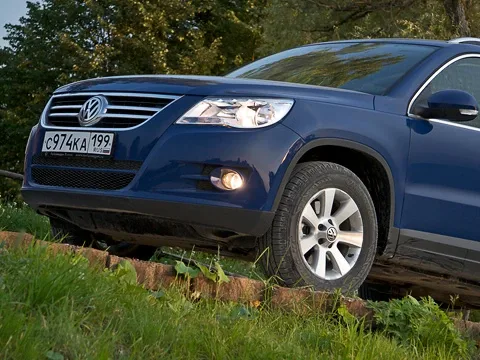
Volkswagen enthusiasts never tire of repeating that the Tiguan is a car with two faces. But in reality, this crossover has only one face — stern and slightly frowning. The difference lies only in the "jaws," that is, the bumpers: the urban Sport & Style version has one set, while the off-road Track & Field has another. The price doesn't change because of this — it depends solely on the engine. The top-of-the-line Tiguan with the two-liter TSI and six-speed automatic will cost at least 1,053,550 rubles. But my test car is fifty thousand cheaper — under its hood is a turbocharged 1.4-liter four-cylinder producing 150 horsepower, paired with a manual gearbox.

Tiguan Sport & Style: tinted windows, more chrome, sport seats, fabric upholstery with appliqué, leather-wrapped steering wheel and gear lever. The Onroad styling package reduces the front overhang angle from 28 to 18 degrees.
My car's "jaw" is jauntily tilted upward — a sure sign of the Track & Field version. Here the trim is simpler, the seats are more comfortable, there's a tire pressure indicator with a compass, and an engine underbody guard. "You go this way — off-road!" the instructor frowns no less than the Tiguan itself and points to the factory track. Ah, I see: Track & Field is just an imitation of a field, and even in greenhouse conditions. The concrete obstacles are measured to the millimeter, as if by a ruler.
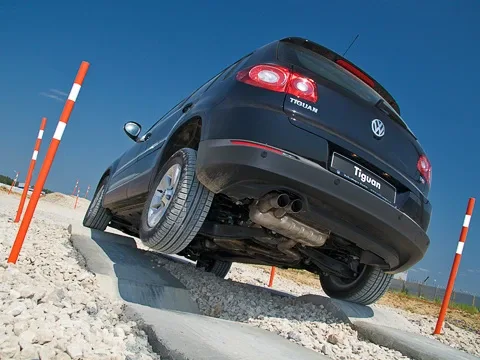
As long as the wheels don't slip, the electronic differential lock imitation helps the Tiguan move confidently. Ground clearance for all versions is 195 mm.
This is where Track & Field shows what it can do: the money saved on trim clearly went into a couple of extra buttons. Press the Off Road button, and the electronics change the settings: the accelerator pedal becomes less responsive, hill descent assist engages, ABS allows the wheels to lock briefly, and the Haldex IV coupling starts to engage faster. The sand on the concrete bumps was swept away in advance, so the wheels have something to grip, and the coupling deftly shifts torque from axle to axle. When the car hangs diagonally, you can see the suspension travel is modest, but the Tiguan, like a tightrope walker, confidently conquers the obstacle course.
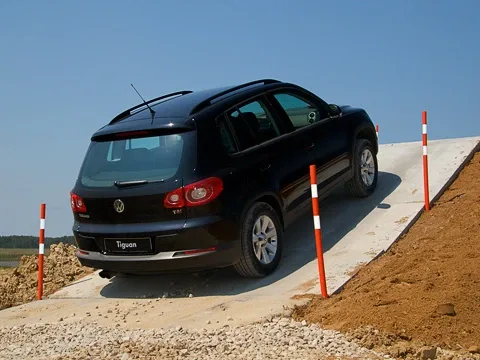
The Auto-Hold function activates if the driver's door is closed, the driver is buckled up, and ESP is on. The hill descent assist works if Off Road mode is engaged, speed is below 20 km/h, the slope angle is more than 20%, and both the accelerator and brake pedals are released. Both functions remain active while the engine is running.
Next — a steep incline. I press the Auto-Hold button, which holds the car on the slope. "Give it some gas, give it some gas!" the instructor shouts, just like the traffic cop to Detochkin. I drive up the hill and press the clutch. Whoa! The Tiguan rocked back for a moment, but then, with a surprised grunt, froze in place. However, starting off again doesn't work: the clutch pedal has a long travel, making it impossible to play it finely, and the accelerator is further dulled by the electronics. The engine stalls — and Auto-Hold washes its hands of the matter. I have no choice but to roll back in embarrassment. On the second attempt, without stopping, we crest the ridge. "Release the pedals!" I release everything I can, and the hill descent assist, with a crunching sound, carefully guides the crossover to the bottom. But in everyday life, it's better not to rely on these magic buttons — they don't turn the Tiguan into a Touareg.
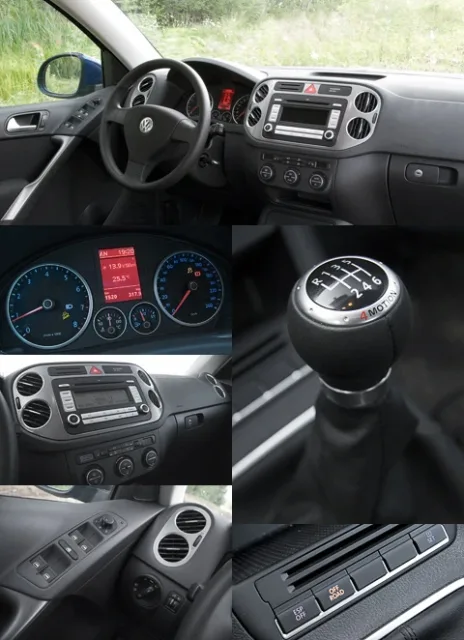
- No complaints about the controls. But a driver of average height would want to raise the seat higher for more comfort.
- The Tiguan bodies are shipped from Wolfsburg fully assembled. The task of the Kaluga workers is to "marry" them with the chassis, connect the connectors, and fill the fluids. So the cabin assembly quality is still purely German.
Essentially, this is a greatly grown-up "Golf" — at least in the cabin, which lacks individuality, everything is utterly "Golf-like." That means it's very comfortable, correct, and pleasant to the touch. No complaints about the seat adjustments and transformations either. Plenty of room. It's just boring to settle into.
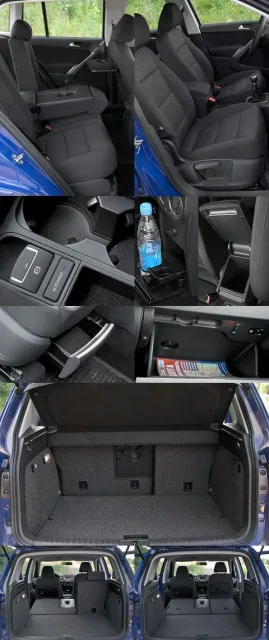
- The Track & Field version has the most comfortable front seats. The sport seats in the Sport & Style, however, can be ordered with leather upholstery for an extra charge. The adjustment ranges are wide, in true Volkswagen fashion. And under the seats, there are trays for small items.
- The rear seat is split 60:40. Both sections move independently by 160 mm, and the backrest angle is adjustable.
- The electronic "handbrake" automatically releases after pressing the accelerator pedal.
- The trunk volume is 470 liters, but with a spare wheel and a false floor, it decreases to 320. The maximum cargo capacity with the seats folded reaches 1.5 cubic meters. For transporting long items, all Tiguans can also fold the front passenger seat backrest.
But driving is anything but boring! The Tiguan saved all its vivid emotions for the regular road, without any artificial obstacles. The engine, torquey and docile, revs briskly and very smoothly from almost the bottom, with peak torque arriving at 1750–4000 rpm. The secret is that the turbocharger is assisted by a supercharger — a characteristic whistle is audible amid the pleasant growl. The Tiguan accelerates with such enthusiasm, as if some secret Kaluga energy drink were poured into the tank.
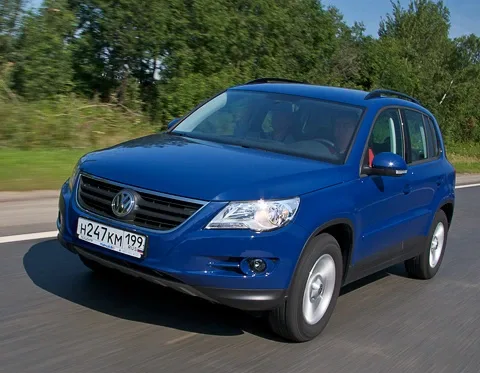
The suspension is excellent! And it fully matches the formula: "The higher the speed, the fewer the potholes."
It's known that Russians love fast driving, but our roads... However, the Russified "German" clearly likes Kaluga roads. The dense, springy suspension comfortably swallows even sections that look frightening. Only muffled echoes of the struggle in the contact patch reach the cabin. On a straight line, the steering with electric power assist feels a bit empty, but in corners it fills with pleasant effort: the crossover traces arcs precisely, clings tenaciously to the line, and ESP doesn't even intervene. It's a different story on dirt roads: as soon as the car starts to slide, the non-defeatable stability control immediately brings the Tiguan back into strict bounds with soft but insistent "kicks."
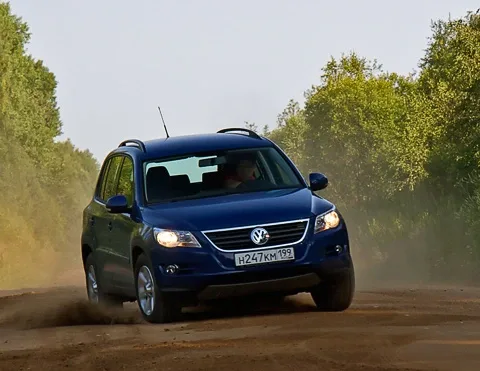
The non-defeatable ESP system wakes up as soon as it senses the danger of skidding.
In short, the "manual" Tiguan drives great. Much better than it looks. And more expensive than it costs. More expensive, perhaps, than the Toyota RAV4 — the main rival, in defiance of which, as the creators say, they brought out their fairy-tale predator.
Specifications
| Characteristics | Volkswagen Tiguan 1.4 TSI Track & Field |
|---|---|
| Body | |
| Number of doors/seats | 5/5 |
| Length, mm | 4457 |
| Width, mm | 1809 |
| Height, mm | 1686 |
| Wheelbase, mm | 2604 |
| Front/rear track, mm | 1570/1570 |
| Curb weight, kg | 1546 |
| Gross weight, kg | 2170 |
| Trunk volume, l | 470–1510 |
| Engine | |
| Type | petrol |
| Location | front, transverse |
| Number and arrangement of cylinders | 4, in-line |
| Number of valves | 16 |
| Displacement, cm3 | 1390 |
| Max power, hp/rpm | 150/5800 |
| Max torque, N•m/rpm | 240/1750–4000 |
| Transmission | |
| Gearbox | manual, six-speed |
| Drive | all-wheel drive |
| Chassis | |
| Front suspension | independent, coil spring, McPherson |
| Rear suspension | independent, coil spring, multi-link |
| Front brakes | disc, ventilated |
| Rear brakes | disc |
| Ground clearance, mm | 195 |
| Performance characteristics | |
| Maximum speed, km/h | 192 |
| Acceleration time 0–100 km/h, s | 9.6 |
| Fuel consumption, l/100 km | |
| urban cycle | 10.6 |
| extra-urban cycle | 7 |
| combined cycle | 8.4 |
| Emission standard | Euro-4 |
| Fuel tank capacity, l | 64 |
| Fuel | AI-95 |
Tested vehicle equipment Standard equipment
- ABS
- ESP
- Front airbags
- Side airbags
- Curtain airbags
- Fog lights
- Steering column adjustment for height and reach
- Driver's seat height adjustment
- Driver's seat lumbar support adjustment
- Heated front seats
- Folding front passenger seat backrest
- Power-adjustable and heated exterior mirrors
- Power windows
- Audio system with MP3 support
- Tire pressure sensor
- Dual-zone climate control
- Multi-function display
- Offroad package
- Central locking
Exterior and equipment
The Tiguan's exterior can hardly be called revolutionary — it's a typical Volkswagen in every way. But at the same time, it looks fresh and modern, especially thanks to the LED daytime running lights, which are standard on the Sport&Style version. Inside, the design is familiar from the Golf, but with some differences: for example, the front seats have a more sporty profile, and the center console is turned toward the driver. The trim materials are top-notch, as is the assembly, but the hard plastic at the bottom of the cabin reminds you that this is still a compact crossover, not a business sedan.
The driver's seating position is pleasing: the seat has strong lateral support, the steering wheel adjusts in two planes, and visibility is good. In the back, there isn't as much space as in the Passat, but three passengers can sit comfortably here. The 470-liter trunk isn't a record, but it's sufficient for everyday tasks. However, the folding seats allow you to transport long items.
The equipment of the tested car includes dual-zone climate control, xenon headlights, parking sensors, roof rails, alloy wheels R16, a tire repair kit, as well as a spare wheel and jack. The metallic color adds a bit more to the cost. The base version is priced at 904,000 rubles ($38,632), while the tested example costs 921,063 rubles ($39,362).
Technology
The Tiguan is a vivid example of the unification that permeates the entire VW group. Many elements relate it to the Golf, Golf Plus, Touran, and even the T5. The four-link rear suspension is almost the same as that of the all-wheel-drive Passat, but with modified subframe and shock absorbers. The front is McPherson on an aluminum subframe.
The rear-wheel drive uses a fourth-generation Haldex coupling. The peculiarity of its settings is that at start, the coupling is always locked, and then it "releases." In normal mode, 90% of the torque goes to the front wheels, but if they lose traction, all the driving force can transfer to the rear. The EDS system simulates a differential lock.
All compact four-cylinder engines in the Tiguan have conventional or combined supercharging. In total, five engines are prepared for the crossover: gasoline — 1.4 (150 hp) or 2.0 (170, 200 hp) and two-liter diesels (140, 170 hp).
Made in Kaluga
Production of cars at the Kaluga plant began on November 28, 2007. Currently, they assemble about two hundred per day. Already 28 thousand cars have been produced: so far, these are three Volkswagen models — Jetta, Passat, and Tiguan, as well as three Škodas — Octavia, Octavia Tour, and Fabia. The ratio of brands in the total output is approximately equal.
By the end of the year, they plan to produce 70 thousand cars, and bring the daily production volume to three and a half hundred. So far, this is about "screwdriver" assembly according to the SKD scheme. The plant continues to be built, and the gradual transition to the full CKD scheme will begin only in February next year. The enterprise will reach full capacity with a daily output of 620 cars no earlier than mid-2010.
Today, the plant assembles thirty Tiguans a day. The quality of each unit is checked in a light tunnel and during tests on stands and the factory track.
True, representatives are still cautious about organizing full-scale production. They are, for example, interested in localization — primarily of seats and plastic parts. But they speak of potential Russian suppliers without enthusiasm. They say, we are just looking, for us the main thing is quality.
Quantity, of course, too. In 2012, the representative office plans to bring the Volkswagen brand into the top five best-selling foreign cars in Russia, largely thanks to the plant's products. Alas, the topic of expanding the production program is still taboo. As if they are afraid of jinxing it. We only know that the next model should be a sedan based on the new Polo, but when — that's the question.
And one more thing. The plant is looking for talent. Six hundred workers work around the clock at the enterprise. But by the end of the year, their number should already be nine hundred, and in 2010, the plant's staff will be expanded to 3,500 people. The average worker's salary is 18,500 rubles, and the requirements for volunteers are quite high. Will there be enough suitable candidates in the Kaluga region? The Germans suggest two options. Either people in search of work will flock to these parts, or — if there still aren't enough personnel — they will have to optimize production and adjust the staffing table.
Behind the scenes
It was unexpected to find a small safari park with a camel in Tsiolkovsky's homeland. And the search for the final point of the route became a real adventure for us. Thanks to the region's residents: their advice turned out to be lifesaving. I wonder how the navigation promised by the Germans will cope here?