
I was lucky: I managed to drive the pre-facelift Tiguan right before my flight to Germany. The perfect car! I know, I know, such things don't exist. If you break the Tiguan down piece by piece, the suspension is too fussy, the automatic gearbox isn't too quick-witted, and the seating position is specific — it doesn't let you relax. You'll also find plenty of little things, like the stubby side mirrors or fuel consumption around fifteen liters per hundred kilometers for a gasoline car with a two-liter engine. But there's the drive! Plus a wide range of advantages: a spacious cabin with impeccable transformation, balanced driving qualities, seasoned with a drop of excitement... In my opinion, there's nothing more to wish for.
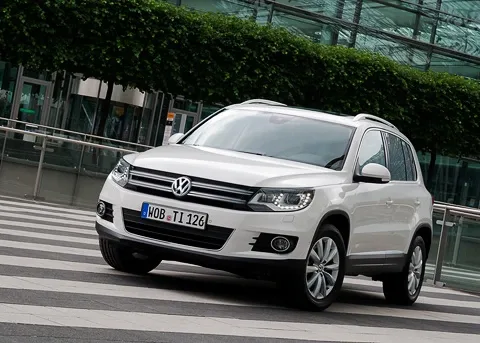
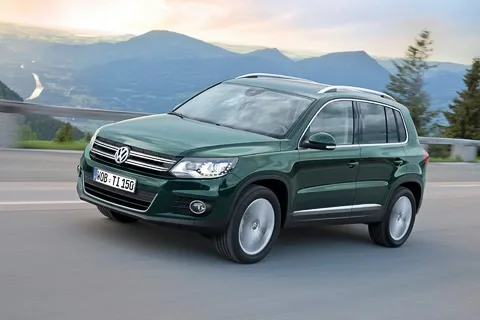
The facelifted Tiguan looks exactly like the Touareg: the characteristic chamfer in the corners of the headlights and the same haughty gaze, emphasized by a garland of daytime running lights.
Except for the exterior. Although the previous Tiguan sold 600,000 units worldwide, securing 12% of the European and 21% of the German markets, it could have been anything — a "Korean," a "Japanese," or even a "Chinese." But not a "German." Even though the car was created under the leadership of then-chief designer Murat Gunak, it seemed born for the de Silva-Bischoff facelift. The question is whether the Tiguan has become too similar to its older "brother." How will this affect Touareg buyers?
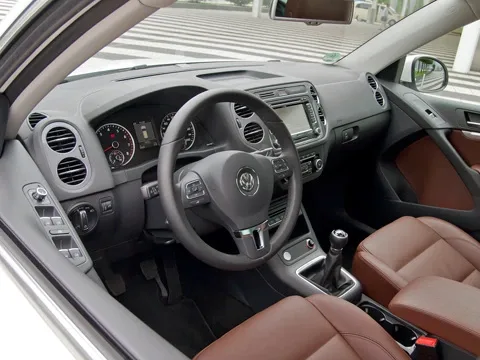
- The office-like strictness of the dashboard suits the updated exterior better. As before, the left group of buttons on the steering wheel controls the "music" and the built-in phone. The right one flips through the trip computer menu, which now has a page dedicated to electronic assistants.
- The selectivity of the manual gearbox is a solid C-minus, and in the final stage of engaging a gear, the lever seems to catch on something.
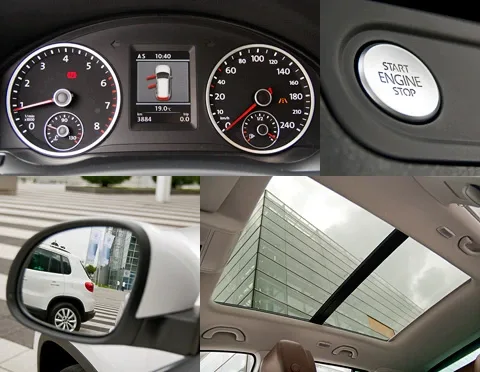
- The color display in the instrument cluster is available for all Tiguans. The engine start button, like the panoramic roof, is an option.
- The Tiguan has no particular visibility problems, but the side mirrors could be larger.
The interior remained almost untouched, and that's good! Which other classmate can boast an instrument cluster hood that flexes a good five centimeters under pressure? Or an abundance of ventilation deflectors that allow you to distribute cool air throughout the cabin in hot weather without fear of catching a cold? Or such "clear" instruments and a logically structured interface for the multimedia system and "climate" control unit? The driver has everything necessary at their disposal, and at the same time, nothing superfluous. It's a pity the Germans didn't bother to change the shape of the side mirrors. Monitoring the rear through the hemispheres of the side mirrors becomes harder the faster you go.
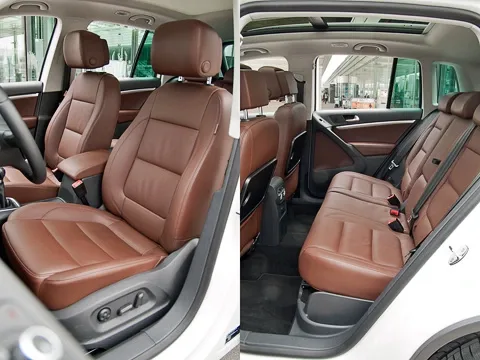
The front seats with firm padding are comfortable. However, you'd want the side support bolsters to hold the body better.
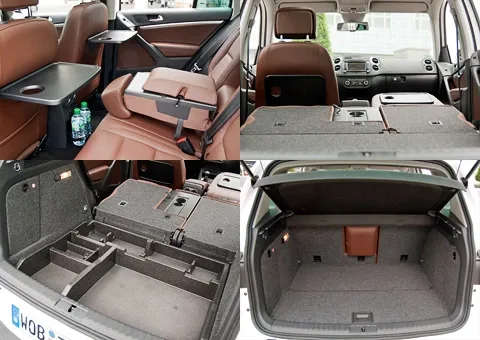
The rear seats allow you to change the backrest angle, turn the middle section into a convenient armrest, or slide the bench forward, increasing the luggage compartment by 16 cm. Its volume can reach 1510 liters, and the cargo length — 2.5 meters.
The Tiguan has gained three new engines at once: for example, the "population" of gasoline engines has doubled. Now the base Tiguan is a front-wheel-drive version with 122 hp, not 150 as before. For Russians, this is much more than just a new engine. The abandonment of twin turbocharging on the EA111 "four" allowed the crossover to get a more humane price tag — the car became almost 100 thousand cheaper.
Even being slightly detuned to 180 "horses," the new two-liter gasoline engine is good! Confident traction across the entire rev range and no hint of turbo lag. Although in the Russian specification, this engine will meet Euro-4 emission standards and develop 170 hp.
The 140-horsepower diesel supplied to us was left untouched by the Germans. But the most popular two-liter version here now comes with the new EA888 engine in two tuning variants. From now on, the lineup is topped by the 200-horsepower Tiguan, which was previously the prerogative of European markets. True, it won't appear here right away. It's a pity that another significant update — the switch from "automatics" to DSG "robots" — won't affect us, alas. In Russia, all crossovers will still come with either a "stick" or the familiar "hydromechanics," also six-speed. What kind of discrimination against one of the fastest-growing markets? The Germans can't give a clear answer, get confused in their statements, and try to reassure: perhaps the "robot" on the Kaluga-produced Tiguan will still appear. In the future.
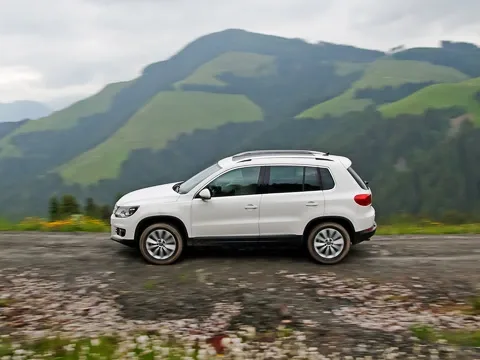
On uneven dirt roads, the Tiguan equipped with adaptive suspension copes best in Normal mode. In "Comfort," excessive body rocking is annoying, and in "Sport," the shock absorbers deliver harsh jolts.
The test Tiguan is gasoline-powered, but less powerful, 180-horsepower, with a manual gearbox. The engine starts not with the usual key, but with a button. The best confirmation that the Tiguan has matured not only externally is my colleague Vitaly, who fell asleep in the back seat as soon as we set off towards Austrian Elmau. In the pre-facelift car with its overly stiff ride, surrendering to Morpheus was much harder.
Here, the optional DCC suspension helps abstract from reality, which, besides sport and normal, also has a comfort mode. On relaxed shock absorbers, the Tiguan allows a soothing, slight vertical rocking. On stiff ones — in "Sport" — it meticulously repeats the road profile. But even so, the updated Tiguan rides noticeably softer than the old car with regular suspension. And quieter! The front line in the war against noise has moved to the engine shield — no matter how much you press the gas pedal now, you won't hear the specific rumble of the "four" with direct injection. The Tiguan only raises the level of a whisper.
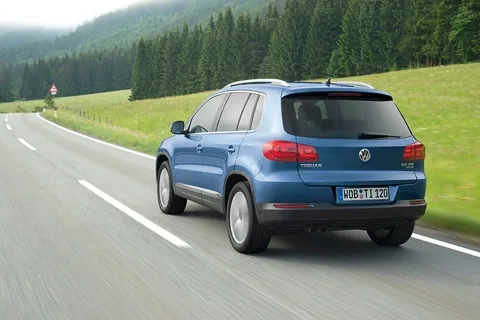
Even at high speed, the breeze only quietly chirps around the side mirrors. The engine isn't heard at all, although the tachometer needle indicates operation almost at the limit.
I, by the way, am also sort of sleeping. First, I smoothly weave along the highway, release the accelerator, and even forget to shift gears. In short, I signal in every way to the widely advertised driver fatigue detection system that I'm tired. No way! Neither a buzzer nor a pictogram with a coffee cup on the instrument panel... And not just for show, but I actually drift into a doze! What's the matter? The steering wheel! If the previous Tiguan kept me informed of all events on the road, this one only transmits hyperlinks to the steering wheel. On straights and gentle curves, the feel of the car has noticeably decreased. The quality of feedback from the steering improves in corners when you have to turn the wheel more than half a turn. But the former excitement of the solidly assembled chassis seems stuck in the wiring harnesses of the electric power steering. However, the body roll, despite the clearly comfort-oriented philosophy of the updates, remained almost at the same level.
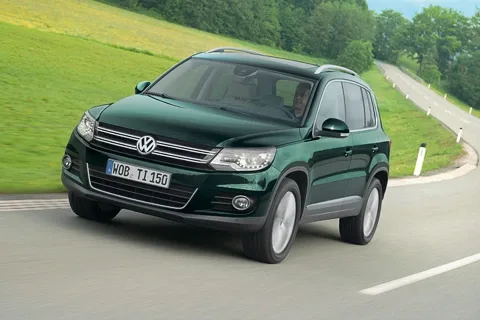
The previous Tiguan followed any road pattern equally well. The new one is more understandable on steeper curves. But on gentle arcs, the steering wheel becomes unpleasantly empty.
And ask me: how does the electronic imitation of the rear differential lock work, which can help tuck the car into a turn via the brakes? I don't know! Because in the new Tiguan, you want to do anything but bring the unloaded wheel to a spin. Go out of town with the family, feed the kids at the folding tables that pop out of the front seatbacks, talk quietly, even sleep at the wheel... But not squeal the tires in narrow Alpine hairpins, letting the brakes transfer some torque to the outer side.
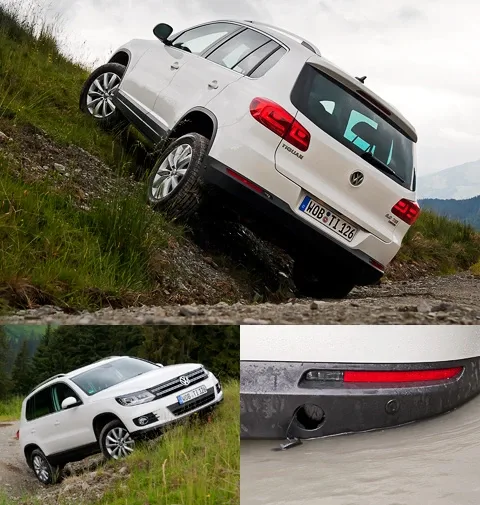
By crossover standards, the Tiguan has excellent off-road manners. The approach angle of the off-road version is 28° (versus 18° for the "urban" one). For road tires, such a slope is the vertical limit, but for the 4Motion all-wheel-drive system, it seems not. However, you shouldn't get carried away with off-roading: the Tiguan has a hatch for the tow hook in the rear bumper, but the threaded socket itself is missing!
Lane Assist is another matter — a lane-keeping assistant. Its work as intended (literally!) evokes only positive emotions. The camera sees both solid and dashed lane markings. If I get distracted and let the car drift to the side without signaling, an invisible hand gently corrects the steering wheel, bringing me back on course. However, sometimes the system misbehaves so much that it makes me uneasy. When on a gentle curve of the autobahn at speeds approaching two hundred, I slightly shift beyond the edge of my lane, the barely perceptible corrective steering from the automation turns out to be, to put it mildly, inappropriate. After all, I am straightening the trajectory precisely to maintain control over the car. And here, imagine, it goes not outward but inward into the turn due to electronics. And this is not a one-time glitch: it happened more than once or twice. Of course, Lane Assist is an optional system, and moreover, it can be partially disabled. But still, I remember the previous Tiguan with a kind word, though not as sophisticated, but it provided a direct transfer of sensations.
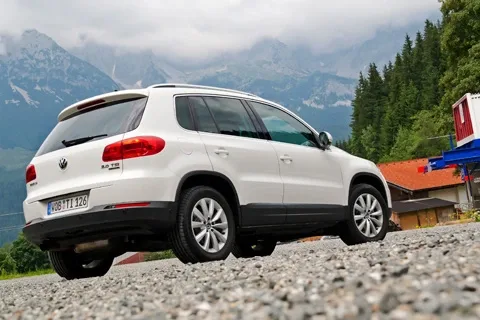
The base Tiguan with the 1.4 engine (122 hp) will cost 896,000 rubles (99 thousand cheaper than before). The price for "two-liter" cars starts at 1,136,000 rubles. Order acceptance will begin any day now, and sales will start at the end of July.
Know this — the updated Tiguan is not a fun-loving girlfriend or a buddy who eggs you on — full speed ahead! This is a Volkswagen as we are used to seeing it today. The reckless youth is in the past. Life is good... And that's it! Without any adrenaline continuation. There is nothing strange about it. With age, we become wiser and nobler. But sometimes you remember your youth — yours or the Tiguan's — and you feel a bit sorry for the rascal. Both for yourself and for it.
Specifications
| Volkwagen Tiguan | 1.4 TSI BlueMotion | 1.4 TSI 4Motion | 2.0 TSI 4Motion | 2.0 TDI 4Motion |
|---|---|---|---|---|
| Body | ||||
| Body type | wagon | wagon | wagon | wagon |
| Number of doors/seats | 5/5 | 5/5 | 5/5 | 5/5 |
| Length, mm | 4426 | 4426 | 4426 | 4426 |
| Width, mm | 1809 | 1809 | 1809 | 1809 |
| Height, mm | 1703 | 1703 | 1703 | 1703 |
| Wheelbase, mm | 2604 | 2604 | 2604 | 2604 |
| Track front/rear, mm | 1569/1571 | 1569/1571 | 1569/1571 | 1569/1571 |
| Curb weight, kg | 1501 | 1621 | 1667 | 1679 |
| Gross weight, kg | 2080 | 2170 | 2220 | 2260 |
| Trunk volume, l | 470/1510 | 470/1510 | 470/1510 | 470/1510 |
| Engine | ||||
| Type | petrol with direct fuel injection and turbocharging | petrol with direct fuel injection and combined supercharging | petrol with direct fuel injection and turbocharging | turbodiesel |
| Location | front, transverse | front, transverse | front, transverse | front, transverse |
| Number and arrangement of cylinders | 4, in-line | 4, in-line | 4, in-line | 4, in-line |
| Number of valves | 16 | 16 | 16 | 16 |
| Displacement, cm? | 1390 | 1390 | 1984 | 1968 |
| Max power, hp/rpm | 122/5000 | 150/5800 | 170/4300 | 140/4200 |
| Max torque, N•m/rpm | 200/1500–4000 | 240/1750–4000 | 280/1700–4200 | 320/1750–2500 |
| Transmission | ||||
| Gearbox | manual six-speed | manual six-speed | automatic six-speed | automatic six-speed |
| Drive | front | permanent all-wheel | permanent all-wheel | permanent all-wheel |
| Chassis | ||||
| Front suspension | independent, spring, McPherson | independent, spring, McPherson | independent, spring, McPherson | independent, spring, McPherson |
| Rear suspension | independent, spring, multi-link | independent, spring, multi-link | independent, spring, multi-link | independent, spring, multi-link |
| Front brakes | ventilated disc | ventilated disc | ventilated disc | ventilated disc |
| Rear brakes | disc | disc | disc | disc |
| Tires | 215/65 R16 | 215/65 R16 | 215/65 R16 | 215/65 R16 |
| Ground clearance, mm | 200 | 200 | 200 | 200 |
| Performance characteristics | ||||
| Maximum speed, km/h | 185 | 192 | 197 | 182 |
| Acceleration time 0-100 km/h, s | 10.9 | 9.6 | 9.9 | 10.7 |
| Fuel consumption, l/100 km | ||||
| — urban cycle | 8.3 | 10.1 | 13.5 | 9.2 |
| — suburban cycle | 5.5 | 6.7 | 7.7 | 5.9 |
| — combined cycle | 6.5 | 8 | 9.9 | 7.1 |
| Toxicity standard | Euro-5 | Euro-5 | Euro-5 | Euro-5 |
| Fuel tank capacity, l | 64 | 64 | 64 | 64 |
| Fuel | AI-95 | AI-95 | AI-95 | diesel |
Technology 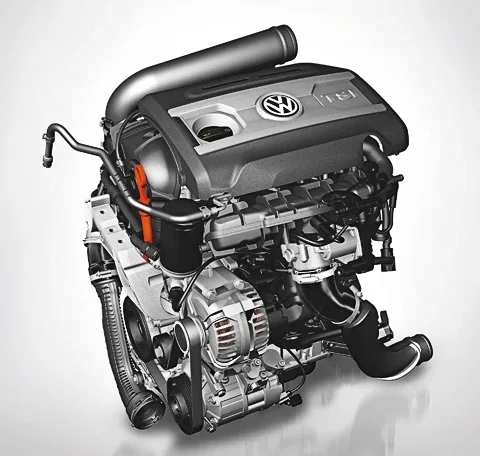
The two-liter "turbo-four" with direct injection EA888 is built on the basis of the EA113 engine. Instead of a belt drive for the gas distribution mechanism, there is a more durable chain and the same phase shifters as on modern Audi engines. The pressure in the injection system increased from 110 to 150 bar, and a BorgWarner K03 turbocharger is used as the supercharger. With an unchanged displacement (1984 cm³), the power of both European versions increased by ten horsepower — to 180 and 210 hp. For the sake of tax savings, Russians are deprived of this increase.
The start/stop system, available for all modifications, can ideally save up to 0.2 liters of fuel per 100 km. It is equipped with a reinforced starter, a voltage converter to maintain a stable load in the on-board network, and a battery with an additional control module, which supposedly is not afraid of deep discharges.
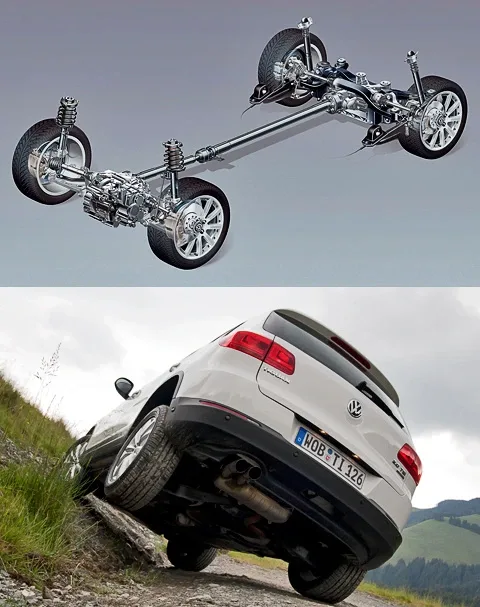
In the 4Motion system, torque to the rear wheels is transmitted via a multi-disc electro-hydraulic clutch with an operating pressure of up to 30 bar. By default, it transfers about 10% of traction to the rear, proactively increasing it when starting from a standstill or under acceleration. In case of diagonal wheel hang, the system can disable the spinning rear axle to avoid "leakage" of torque.
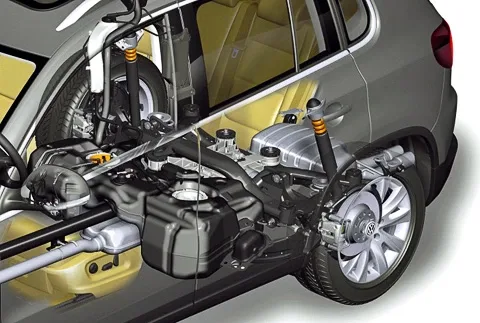
By paying extra for the XDS differential lock simulation system, the customer does not buy additional hardware, but only pays for an extended program of the stability control system. The electronics use the brakes based on data about rotation around the vertical axis, braking the inner rear wheel and creating an additional turning moment.
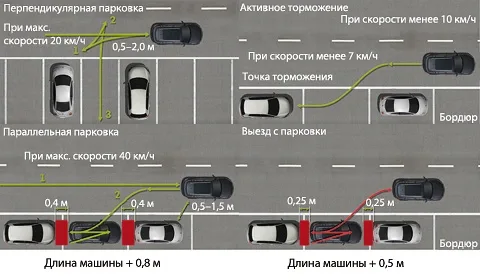
If the old Tiguan could park only parallel to the curb, the new one, thanks to the second-generation Park Assist system, can also park perpendicularly. Twelve ultrasonic sensors with a range of 4.5 m are responsible for the successful execution of the maneuver. Therefore, when parallel parking, the Tiguan needs a clearance of only 40 cm at the front and rear (previously at least 70 cm). Unlike competitor systems, Volkswagen even provided an active braking function, but warned: this is nothing more than insurance. Responsibility for a collision during braking still lies with the driver.
Safety 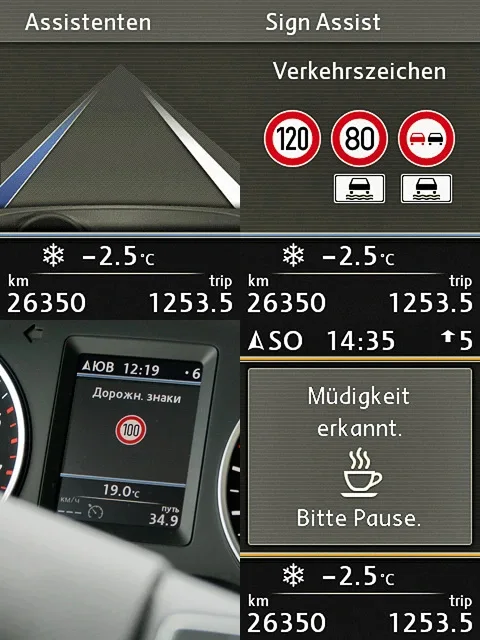
- The Lane Assist system, which monitors road markings, corrects the course by turning the steering wheel and prevents the car from leaving its lane without the turn signal being activated. The assistant works gently, and the driver always has the opportunity to overcome the artificially created force. The system can be turned off via the on-board computer menu, but after 65 km/h it activates itself.
- The updated Tiguan recognizes road signs. Moreover, information about the restriction will remain in the driver's field of view until it is canceled. First on the central display of the instrument cluster, then on the monitor of the navigation system.
- If you see a coffee cup on the display, know that the Tiguan strongly advises you to rest. The driver fatigue recognition system analyzes the characteristic movements of the driver (steering wheel angle, lateral acceleration, gear shifting frequency) and compares them with real ones during the trip. If anomalies are noticed, the menu splash screen is accompanied by a sound signal.
Behind the scenes 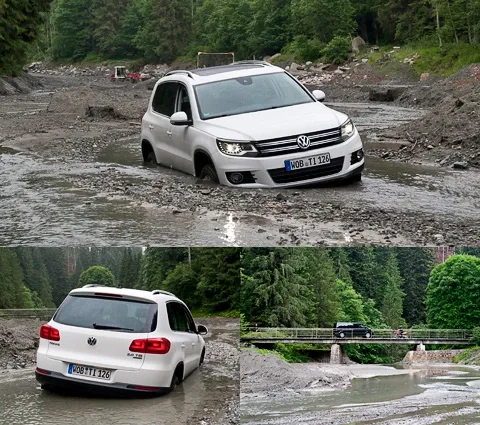
A bad deed is not tricky: I buried the BMW X6 M in a snowdrift, the Mini Countryman in the sand. I turned the Kia Sorento into real estate on the thawed ice of a lake, and the Amarok in a snowy ravine. Now the Tiguan is sitting on its belly in an alpine stream... The difference between those cases and this one is that in a couple of hours we had to be at the airport at all costs, and we were stuck so firmly that there was no talk of getting out without outside help. An hour later, Austrian firefighters pulled us ashore using a winch and an old Unimog, and we somehow made it to the plane. Alas, unlike past feats, this one cannot be counted in our favor. I promise my colleague Vitaliy Kabyshev, who was an involuntary hostage of the situation, the guys from Volkswagen, and all DRIVE.RU readers... to continue to explore the limits of the car.
The DRIVE.RU editorial team thanks Volkswagen Center Vnukovo for providing the pre-restyling Tiguan.