
VW Polo. Playing for High Stakes
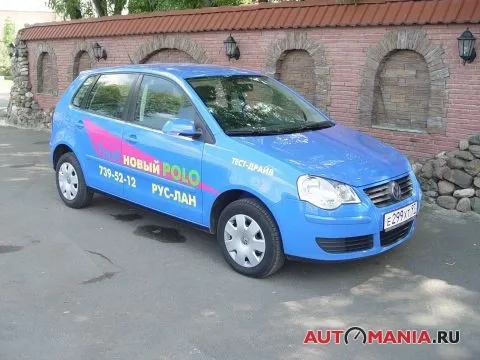
In essence, we have the same Polo from 2001, almost completely copied from the older Golf. Despite claims that this is a completely new development, it's only a serious facelift – much like the one that turned the Passat B3 into the B4 in the early 90s and gave it a second life. The arrow-shaped hood, cast headlights, expressive stampings above the wheel arches... But the profile remains the same, as does the entire rear of the body. The only new feature at the back is the fashionable round diffusers in the taillights. And that's where all the changes end. But, as they say, if it ain't broke, don't fix it, so let's forgive the Polo for this conservatism – especially since such things have happened more than once in the brand's history.
The interior of the compact car is a direct embodiment of the famous Volkswagen rationalism. Inside, there is Teutonic strictness and dry graphics, devoid of any emotion. But upon closer acquaintance with the "assigned" territory, you understand: there is something to it – you can't bring yourself to reproach the cabin for lacking style. And standard assessments like "like it – don't like it" are better saved for a discussion about ergonomics.
In my opinion, ergonomics is another strong point of the VW Polo's interior. You get behind the wheel and feel that the placement of every button, lever, or switch is calibrated with mathematical precision. As a result, you can control everything almost blindly. Both a petite girl and a large man can get comfortable behind the wheel: the three basic seat adjustments and two for the steering column are quite enough to find a comfortable position. However, the seats themselves could be more comfortable. The cushions could be longer, the backrests firmer, and more developed lateral support wouldn't hurt either. As for the rear bench, it's such a delicate issue that it's better not to bring it up at all. In short – it's like in classmates: three we write, two in mind...
It's clear that to reduce the final price, the manufacturer has to save on something. It seems that in the case of the Polo, this resulted in the widespread use of "soapy" plastic, which evokes strong associations with the late Brazilian Pointer, which quietly passed away in our market. Still, despite these concessions to "mass appeal," the rejection of the brand's people's essence in general brought quite tangible financial consequences – VW has become more expensive. And if for the Phaeton or Touareg this is not so critical, then for the compact Polo it's a more than serious drawback.
In Russia, as everywhere else, the Polo is offered in three trim levels: Trendline, Comfortline, and Sportline. The most affordable of them costs at least $13,868. To avoid misleading the reader, let's clarify right away: this is the price of the base version. For this money, you get a "bare" car, and all necessary equipment will have to be purchased separately and, of course, for an additional fee. Without delving into the option jungle, let's just say that if desired, given the high cost of these options, the price of the "people's car" can easily be pushed up to a completely indecent $30,000. How about that? It's logical to assume that if the choice does fall on the Polo, most buyers will settle on the golden mean – the Comfortline version with the minimum necessary additions. This will cost about $15,000–16,000 at the Central Bank exchange rate.
The principle of the "golden mean" will most likely prevail when choosing the power unit, although there is plenty to choose from here as well. Our compatriots have access to this hatchback with as many as five engine options. Two versions of the 1.2-liter engine (55 and 65 hp), another pair – 1.4-liter units with 75 and 80 horsepower, as well as the top 1.6-liter engine from the Golf, producing 105 hp. In the first case, regardless of power, the engine is paired with a standard 5-speed manual. The option to choose between the same manual and a rather old 4-speed automatic appears only for buyers of the second pair of units. And for the most powerful engine, as an alternative to the manual gearbox, dealers will likely offer a new 6-speed automatic Tiptronic.
To avoid extremes, let's turn to the most popular option on our roads – with the 1.4-liter 75-horsepower engine. Paired with the automatic, this engine is a melancholic, a favorite of calm and measured people. But with the manual, the car is noticeably more agile. For example, acceleration to 100 km/h takes just under 13 seconds. Fast, it must be noted, but no one expects sports dynamics or sharp handling from such cars. It drives fine, holds the road well, corners nicely, demonstrating clear predictable reactions to the steering wheel and accelerator. Characteristically, ride smoothness does not suffer. The energy intensity of the suspension is a kind of compromise between comfort and stability: it handles large bumps like speed bumps perhaps a bit harsher than desired, but for a B-class car, such behavior is quite acceptable.
At high speeds, one might complain about acoustics. Here, aerodynamic and mechanical noises mix. The engine stands out especially with its not-so-pleasant "voice," but overall, the situation is far from as critical as, say, with the "French" or "Koreans." However, there are no complaints about the brakes: the informative and effective operation of the system has always been a strong point of all German brands, regardless of class. It's a school, after all.
Now it's time to sum up, and the conclusions, alas, are disappointing. Although, I think few would argue that the Polo is indeed good. In terms of overall qualities, it occupies one of the leading places in its class. But it also has a significant drawback – a high price. Given that most competitors have recently managed to catch up to at least the same level and now are not inferior to it in execution, equipment, or especially design, the Polo will soon have to rely only on true fans of the brand. True, people willing to pay for the brand in this segment are becoming fewer every day.
Technical specifications:
VW Polo
Dimensions:
Length (mm) 3895
Width (mm) 1650
Height (mm) 1470
Wheelbase (mm) 2460
Weight (kg) 1020
Trunk volume (l) 270/1030
Engine displacement (cm3) 1390
Max power (hp) 75 at 5000 rpm
Max torque (Nm) 126 at 3800 rpm
Max speed (km/h) 168
Acceleration 0-100 km/h (s) 15.3
Average fuel consumption (l) 7.4
Price ($): 13,868-19,520
Yuri Goryachev
Source – www.automania.ru