
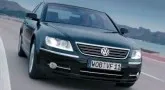
VW Phaeton. Price: from $89,663. On sale: since autumn 2007.
Five years have passed since VW Phaeton dared to challenge the foundations of the premium segment, becoming a pioneer among cars of a people's brand in high society. Like the mythical Phaeton, it dared to break the unwritten rules established by automakers. But today, looking back at the years gone by, its story increasingly resembles Zeno's paradox about Achilles and the tortoise.
VW, like the swift-footed hero, is closing the distance to the class leaders — BMW 7-series, Mercedes-Benz S-class, and Audi A8 — with huge strides. However, competitors are not standing still either, constantly improving. And although the gap between them is steadily shrinking, no one will undertake to predict when this race of the chaser with the trendsetters will end.
In the spring of this year, another modification of the Phaeton appeared, becoming the next step in the model's evolution. Externally, it may not have changed as dramatically as many expected. In the exterior and interior, the changes are quite modest: a more sculpted front bumper, updated bi-xenon headlights with adaptive light system, longitudinal LED daytime running lights, and darkened optics at the rear. The main metamorphoses occurred under the hood. The key novelty was a turbodiesel V6 meeting Euro 5 standards, which will only come into force in a couple of years. But here, unlike in Europe, diesel is not held in high regard, so the main interest lies in the petrol V6, V8, and W12 units.
The most balanced appears to be the V8. For the Russian buyer, the V6 seems insufficient for such a large car, while the W12, on the contrary, is too heavy, which negatively affects the car's behavior. The 4.2-liter engine, producing 335 horsepower, accelerates the Phaeton to 100 km/h in 7.7 seconds — a worthy result for such a beast. The only thing that disappoints is fuel consumption. In the combined cycle, it amounts to 18.9 liters per 100 km. For comparison, the Lexus LS460, which is also a newcomer to this segment and a direct competitor, has a more modest appetite by almost 2.5 liters, despite a larger engine displacement. However, the owner of a car of this level is unlikely to be greatly concerned about fuel costs.
The Phaeton's six-speed automatic transmission pleased. True, there is one peculiarity: during smooth braking, it downshifts with a noticeable delay, only at 1300–1500 rpm, depending on the selected mode. Because of this, during subsequent acceleration, you can fall into a "dead zone": from 1500 to 2500 rpm, the engine seems to lack pull. However, this is perhaps the only complaint about the transmission's operation, and it almost disappears with a more dynamic driving style.
Despite its impressive 2,182 kilograms, the Phaeton with permanent all-wheel drive and a V8 under the hood navigates corners with pleasant neutral handling. Moreover, without the nose-heaviness inherent in the W12 version, where the front axle is overloaded with a heavy engine. There are almost no questions about handling, except for a somewhat "empty" steering wheel at speeds up to 120 km/h. But let's not forget that we have a luxury car before us. In its character, the VW is much closer to the restrained Mercedes-Benz S-class than to the aggressive BMW "seven."
Initially, the Phaeton was designed for measured trips on perfectly smooth German autobahns, which determined the features of its settings. On our broken roads, the suspension seems somewhat stiff. There is adjustment of shock absorbers in four modes, but the difference between them is minimal. Even in the most comfortable position, the car responds unexpectedly loudly to small irregularities. So this option is more of a technical decoration than a truly useful function.
However, the set of auxiliary electronics in the new Phaeton has significantly expanded. Here you have new DVD navigation, upgraded multimedia, and a phone with Bluetooth and voice control. But the most important thing is the appearance of adaptive cruise control ACC with automatic emergency braking function up to a complete stop, the Front Assist brake assist system, and the Side Assist lane change assistant.
It is worth telling about the last two systems in more detail. Front Assist, which is part of ACC, is controlled by buttons on the steering wheel. In the speed range from 30 to 200 km/h, the radar (range 200 meters, tracking angle 12°) monitors the distance to the vehicle ahead. In case of dangerous approach, the system warns the driver and simultaneously brings the brakes to a state of readiness, which is usually activated only after pressing the pedal. Thus, Front Assist functions as a brake assist system.
Side Assist is designed to help when changing lanes. Activating at speeds above 60 km/h, it uses radars in the rear bumper to monitor the "blind spot." The radar monitors the space 50 meters behind and 3.6 meters to the sides. In case of danger, the driver receives a warning via signal lamps in the mirror housing. A small thing, but pleasant.
Well, the technical equipment of the Phaeton is growing rapidly. And this, apparently, is not the limit. After all, the "hunt for tortoises" for the Wolfsburg Achilles is not yet over.
Handcrafted
Klaus Bischoff, head of the Volkswagen design center in Wolfsburg:
— We are already actively thinking about how the interior and exterior of our luxury car should look in the future. We are planning which technologies will form the basis of the next generation Phaeton. We are especially interested in the development of electronic information systems, and we are working very closely in this direction. Such activity requires close cooperation with ergonomics specialists to properly integrate new electronic devices. The current generation Phaeton, in my opinion, is the best car in its class: quiet and comfortable. In the cabin, there is a feeling that everything is made by hand.
Driving
Almost ideal weight distribution across the axles and neutral handling deserve the highest rating.
Interior
The lacquered steering wheel looks luxurious, but feels slippery to the touch.
Comfort
One of the most comfortable cars in its class. However, due to all-wheel drive, the noise level in the rear row is somewhat increased.
Safety
A multitude of electronic assistants have raised the safety bar to the maximum height.
Price
The attractive base price is explained by modest standard equipment.
| Dimensions, mm | 5055x1903x1450 |
| Engine | petrol, 4172 cm3, 335 hp/6500 rpm |
| Transmission | automatic, 6-speed |
| Dynamics 0-100 km/h, s | 7.7 |
| Maximum speed, km/h | 250 |
| Competitors | Mercedes-Benz S-class, BMW 7series, Audi A8, Lexus LS460 |
Advantages and disadvantages
+ Rich equipment with electronic systems and strict neutral handling.
- "Vague" steering wheel at speeds up to 120 km/h. Stiff suspension.
Our opinion
The Volkswagen Phaeton still has a long way to go to stand on par with the premium class leaders in the minds of buyers. And overcoming the barrier of stereotypes is sometimes more difficult than reducing the technical gap. But for those who are free from prejudice, the Phaeton is an excellent choice.
November 30, 2007, Vladimir Makkaveev, "5 Koleso" magazine.