
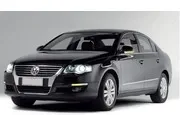
The sixth-generation Passat is a car that clearly succeeded. Perhaps it doesn't fully meet the expectations of those accustomed to the previous version, but new owners are generally pleased with it. The predecessor was based on the Audi A4 platform, had longitudinally mounted engines, and a suspension with double wishbones. The current Passat is built on a modified Golf fifth-generation platform. The engines are now transversely mounted, and the front features a simpler design — MacPherson struts. The rear retains a multi-link setup.
When the model debuted in early 2005, the range of powertrains mirrored that of the Golf. The base engine was a 1.6-liter naturally aspirated petrol with multi-point injection, producing 102 hp. Next came FSI engines with direct injection: a 1.6 with 115 hp and a 2.0 with 150 hp. The top-of-the-line then was the 2.0 TFSI with turbocharging and direct injection, delivering 200 hp. You could also choose one of two TDI turbodiesels with unit injectors: 1.9 (105 hp) or 2.0 (140 hp).
EXPANSION OF THE RANGE
Towards the end of 2005, a flagship petrol V6 — 3.2 FSI with 250 hp — appeared in the lineup. Such a Passat was offered exclusively with all-wheel drive 4motion and a robotic DSG gearbox with dual clutches, which worked brilliantly. In February 2006, a more powerful version of the 2.0 TDI turbodiesel was added, now with 170 hp. In autumn 2007, the naturally aspirated 1.6 FSI was replaced by two new turbocharged direct-injection engines: 1.4 TSI (122 hp) and 1.8 TSI (160 hp). At the same time, the oldest and most modest version, the 1.6 (102 hp), remained in production.
The Passat is indeed a spacious, cozy, quiet, and reliable car. The suspension performs excellently, but it is primarily focused on comfort, while the steering with electric power assist lacks a bit of feedback. Nevertheless, the Passat rarely catches the driver off guard. The brakes are also very decent. Fuel consumption of petrol versions is relatively moderate. Since the model is still quite fresh, the failure statistics are not yet extensive, but some problems have already accumulated.
WEATHER INFLUENCE
Petrol engines FSI and TSI with direct injection show capriciousness when starting in frost. The electronics do not always respond adequately to low temperatures, and the engines start with difficulty. The manufacturer is actively working on this issue. There were also sudden failures of turbochargers, although most often this was a consequence of improper operation. Quite often, complaints arise about the operation of power windows and climate control. But there are significantly fewer complaints about the quality of interior assembly: squeaks and "crickets" on uneven roads appear not so often.
As with many other modern cars, about the Passat it can be said that the abundance of electronics makes its maintenance and repair almost impossible without special diagnostic equipment, such as computer scanners. Even a simple operation like replacing rear brake pads turns out to be inaccessible. The reason is the electromechanical parking brake with automatic control. So comfort in everyday life turns into difficulties during maintenance.
Passat is a spacious and comfortable car. However, owners often complain about reliability, sound insulation, and engine performance. The level of trim also does not always satisfy. Therefore, many consider more prestigious German brands — BMW and Audi — as their next car.
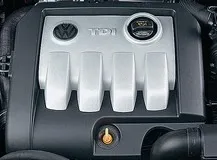 |
CAPRICIOUS DIESELS The 2.0 TDI engine is prone to problems in the fuel system. There are also complaints about turbocharger malfunctions | |||
|
PROBLEMS WITH THE FILTER Early cars with 2.0 TDI had difficulties with self-cleaning of the diesel particulate filter. The manufacturer updated the software, but has not yet fully overcome the ailment | 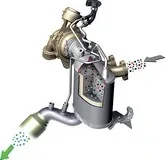 | |||
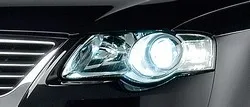 |
LIGHT REFRACTION Some owners noticed moisture ingress into the headlights, but on newer examples this defect no longer occurs. There are also complaints about the short lifespan of bulbs | |||
|
TEMPERATURE FLUCTUATIONS, EXTRA SOUNDS In the climate control, malfunctions occur. The fit of interior parts is not always perfect — when driving on uneven roads sometimes "crickets" appear | 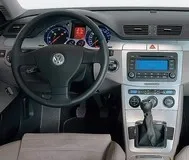 |
Alexey Subbotin