
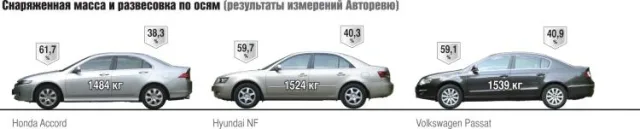
The Korean auto industry is rapidly storming the big league, and judging by the price tags, it's doing quite well. Take Hyundai, for example: the D-class sedan Sonata V cost about $19,000, while its successor, the NF model, is already priced at a minimum of $28,000. For that kind of money, you can already start looking at the Ford Mondeo, Opel Vectra, Volkswagen Passat, or Honda Accord. The Koreans' progress is certainly impressive, but to break into high society like that in just a couple of years... Hyundai representatives themselves believe that their new model with a 2.4-liter engine (161 hp) should primarily compete with the Toyota Camry.
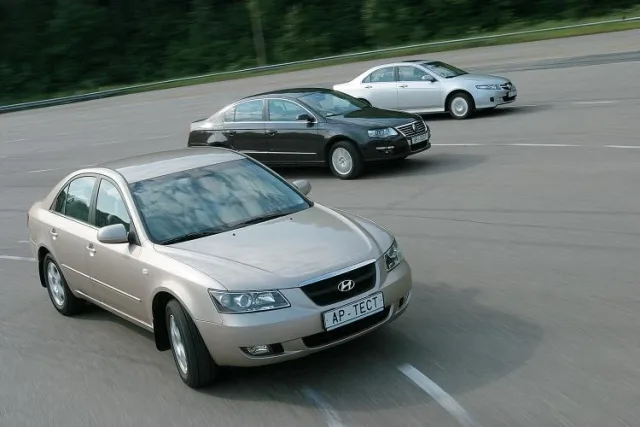
We, however, considered such ambitions premature for now. We've saved the new Toyota Camry sedan for another comparative test (we'll tell you about it in the next issue), and we decided to evaluate the Hyundai NF alongside familiar golf-class sedans — the Honda Accord and Volkswagen Passat. It's a pity that the NF came to us with a manual gearbox, while the competitors had automatics, but as it turned out later, that wasn't what determined the final outcome. Nor was it the power difference: the Honda's engine, with the same displacement, produces 190 hp versus 161 hp for the Korean, while the Passat's two-liter engine develops only 150 hp.
What about prices? The Honda Accord in our trim costs from $32,900 (although a version with a two-liter engine can be found for $28,400), and the Passat with a two-liter engine starts at $28,350. In general, the puzzle fits together.
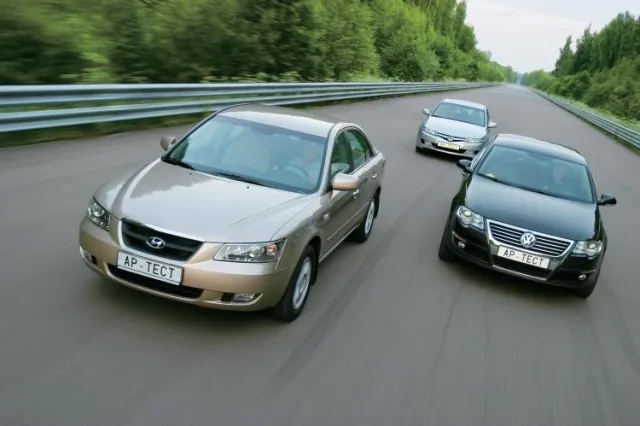
 Externally, the Hyundai NF is just a car. As the English say, just another car. But if you work in the transport department of some special service, it's worth taking a closer look at this model. A car without distinguishing features.
But the Accord won't interest either spies or those who hunt them. The elegant blade of its silhouette literally screams: "Look, it's me, the Honda Accord!" We look, admire, and note that after the recent facelift, the car has become even more dynamic and visually lighter.
The Passat has much better chances of working for special services. But not because of its unremarkable appearance (although, honestly, the Passat B6, despite some design flourishes, has the gift of not drawing attention), but because very soon there will be plenty of such cars on the roads. It's easier to blend into the flow.
 |
| The design of the front panel and the quality of materials in the Hyundai NF resemble American cars from the mid-90s |
Entering the NF's cabin, you won't say the phrase "simple but tasteful." There's no hint of taste here! A bare massive front panel, an inappropriately original insert on the center console — and blatant savings on materials. It's been a long time since we've seen such rough plastic. The huge steering wheel with an unpleasantly slippery rim adjusts in the American way — it rocks on a short lever. The backrest of the amorphous seats turned out to be uncomfortable for drivers of any height and build, although the velour upholstery with good friction properties holds the body well in corners. The climate control is not organized in the best way: there are no separate adjustments for the driver and passenger.
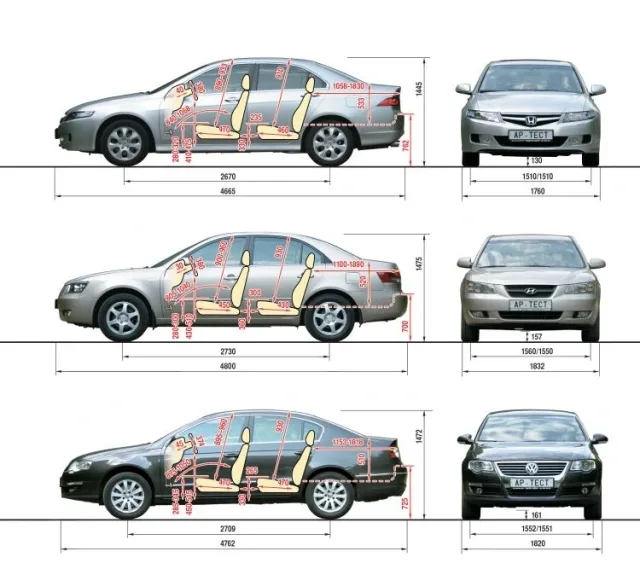
It's also uncomfortable in the back. The interior light is significantly shifted forward, the ceiling handles lack micro-lifts, and the doors have no convenient armrests. However, it's spacious even for three passengers (apparently, this is what allowed company representatives to claim competition with the Toyota Camry).
The trunk is large but impractical. The walls are uneven, and loading is hindered by the protruding bumper. Two things, however, are pleasing. First, in the underfloor there's a full-size spare tire and a tool kit. And second, if you're mistaken for a suitcase and locked in the trunk — no problem! On the back side of the lid, there's a handle with illumination: pull it, and you're free. Such are the requirements of the American market (they say local kids love to hide in trunks).
 |  |  |
| Shifting gears is pleasant: both the lever is comfortable and the mechanism works clearly | The base trim includes a simple stereo and climate control | The soft and wide seat poorly distributes load |
 |  | |
| Rear seat space is like in E-class cars! | The instruments are simple and laconic | The trunk and fuel filler flap release buttons on the driver's door — like in German cars |
 |  | |
| The stereo can be controlled from the steering wheel: this is standard equipment | ||
The Passat immediately gives the impression of a car that's about one and a half times more expensive. Even despite the soft-look plastic and naive "wood" inserts. Because everything here is stylish and solid. All handles and levers are pleasant to the touch and click with a refined resistance, the seat distributes load well, and the steering wheel fits perfectly in your hands... A few clicks of the convenient knob — and a comfortable microclimate is created for each occupant. The instruments are also good. For the sake of order, we'll grumble about the palisade of marks and the poisonous blue backlighting of the instrument panel. Also surprising was the massive knob of the automatic selector with a huge button — as if for a hammer thrower's hand!
In the back, it's not as spacious as in the NF, so it's better to sit two here. And noticeably better. Comfort is created not only by the deep recesses but also by pleasant little details: from armrests and convenient door handles to the selection of materials and the "seamless" joining of upholstery panels.
The Passat's trunk is small but convenient. The walls are even, there are loops for securing cargo, hooks for string bags, a holder for the lid of the tool and spare tire compartment (also, by the way, full-size). And closing the trunk is convenient — by the wide recess on the lid's upholstery.
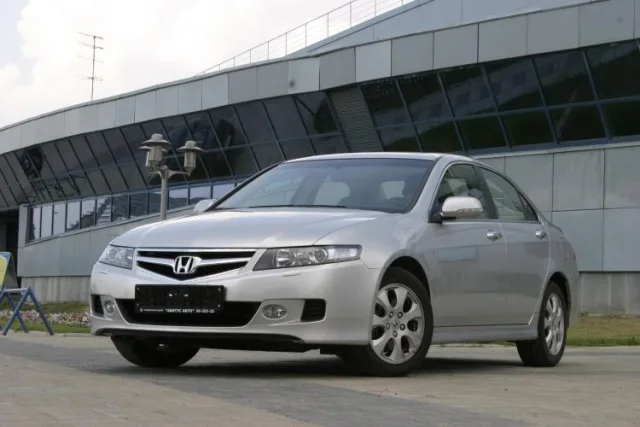
The Honda's cabin has more mood, and not at the expense of quality: the multi-textured panels are fitted impeccably. The ergonomics also please: a grippy three-spoke steering wheel, a seat with pronounced lateral support, an excellent pedal assembly with a "floor-mounted" accelerator... It seems the Accord will keep the driver on their toes. The instruments mesmerize with their moon-like scales, and information is read "at a glance." The convenience of climate control is roughly at the NF's level, but the temperature can be set separately for the driver and passenger.
 |  |  |
| Sporty spirit! It smells like Honda here... | The Honda automatic works overly smoothly | Dual-zone climate control is available in all Accords |
 |  |  |
| Lateral support is good, but the leather is slippery | High tunnel and tight shoulders: uncomfortable for three | It's impossible to take your eyes off the magnificent scales |
But in the back, the Accord is even tighter than the Passat. The trunk also didn't cause delight: due to the high bumper, it's inconvenient to use, the walls are of intricate shape, and under the humped floor there's only a "donut" spare tire.
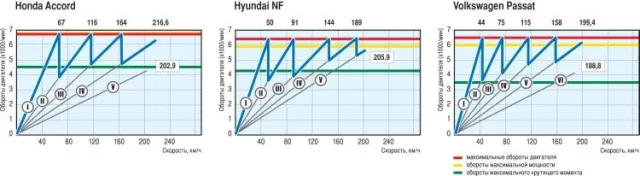
Unsurprisingly, on the dynamometer road, the Accord turned out to be the quickest. But we admit we expected more: up to 3500–4000 rpm, the engine revs without much spark.
Subjectively, the Hyundai NF accelerates no worse than its competitors. And the measurements confirmed this: a serious lag begins only at high speeds, and the top speed is 10 km/h lower. At the same time, the engine's characteristics seemed even more successful to us: the motor comes alive already at 3000 rpm.
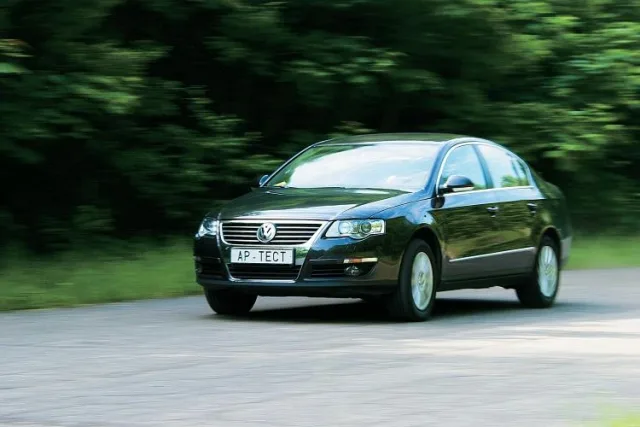
The Passat, on the contrary, lags behind. Again, by feel. But the instruments say the opposite! Despite being 40 horsepower weaker than the Honda, it reaches the first hundred almost in the same time! However, at high speeds the Passat runs out of steam, and the top speed is already 15 km/h lower.
 |  |  |
| The "two-story" front panel of the Passat looks fresh and stylish | The rapid-fire "automatic" of the Passat is a role model | In the luxurious seats with suede inserts of the Highline version, you sit as if glued |
 |  |  |
| In the back — coziness and comfort, but only for two | The stylish instruments are spoiled by a palisade of marks and poisonous backlighting |
The brake mechanisms of all three cars are tuned impeccably. But the Passat stands out: thanks to the excellent informativeness of the drive, you can precisely dose the effort from the very first press. And the ABS most effectively holds the car on a "mix" when there is different surface under the wheels. However, during emergency braking from 100 km/h, the Volkswagen loses four meters to the Honda — that's significant. Moreover, after a couple of such brakings, the effectiveness drops. In this regard, the Hyundai NF turned out to be even preferable.
But handling is not its strong point. Both the Honda and the Volkswagen are head and shoulders above the Korean car. The Hyundai reacts to the steering wheel too sluggishly. On a high-speed straight, the car seems to live its own life, yawing from side to side. But most annoying are the jerks on hard bumps — the steering wheel is literally torn from your hands! In a limit turn, there is a clear understeer, and neither lifting off the gas nor steering helps. More precisely, they help, but after a long and unpleasant wait. The only plus is the clear reactive force on the steering wheel.
The Honda Accord is noticeably sharper, but at speed this is not stressful. But the ambiguous reactions to steering actions were alarming: first sluggishness, and then, with increasing roll, a sharp throw to the side. Plus, the Honda is knocked off course by hard bumps. As a result, you can't relax behind the wheel. But in corners, the Honda is the most exciting!
It's hard to find fault with the Passat's handling. On a straight line, it goes like a tank: neither ruts nor other irregularities knock it off course. Sensitivity is moderate, the steering wheel is informativeness itself. And how calmly and accurately it obeys the driver even at speeds under 200! Rolls are noticeably less than others, and diagonal pitching is also less. And on a corner arc, the Passat holds at the highest speed, showing no clear tendency to understeer or oversteer. Very reliable and safe behavior: that's what a family sedan should be.
Apparently, to please the Americans, the suspension of the Korean car was made too soft. Hence, the car sways on waves and potholes, and the suspension itself occasionally bottoms out. But if you reduce the speed to 40 km/h, then the uneven asphalt turns into a carpet path. It's a pity that higher-frequency oscillations (vibrations) annoy almost always, and they come not only from the road but also from the powertrain, including at idle.
We wouldn't call the car noisy. Still, sometimes the intrusive hissing of tires and unpleasant knocks on bumps are annoying, causing a feeling of looseness. The engine makes itself known only after 4000 rpm, and aerodynamic noises — after 120 km/h.
 |  |  |
| The high bumper hinders loading the small trunk of the Honda | Convenient loading and proper shape — that's not about the Hyundai | Passat: the trunk is neat and convenient |
The Honda's suspension does not allow pitching, but forces the body to follow the road profile. A stiff car. But the suspension is commendably energy-intensive: the Accord overcomes large potholes better than all, and without loud impacts.
It's a pity that very early, from 80 km/h, an aerodynamic whistle begins to be heard. And with increasing speed, it covers the noises from the engine and tires. But it must be admitted that both the engine and tires are "quiet" here: overall, in terms of vibration-acoustic comfort, the Accord is head and shoulders above the NF.
The Passat rides softest of all. Even though its suspension doesn't feel as unbreakable as the Honda's, the Passat smooths out road irregularities better. And only large potholes are felt as noticeable jolts, and at high speed the Passat sometimes begins to sway on gentle waves, like an ocean liner.
The Passat has the "loudest" tires: on rough surfaces, their noise becomes unbearable. But aerodynamic noises are noticeable only after 120 km/h. The engine is louder than in the Honda, but this sound is the most pleasant.
 |  |  |
| Thanks to the i-VTEC system, the Honda engine develops as much as 190 hp | The conservative-by-design Hyundai engine loses as much as 30 hp to the Honda engine of equal displacement | Volkswagen does not lag far behind competitors thanks to the tractability of the 2.0 FSI engine |
 | ||
What's the bottom line? The choice of reason is the Volkswagen Passat. The car is strict, solid, endowed with reliable handling, and pleases with decent comfort.
The Accord is chosen with the heart — for its swift appearance, for its excellent interior. It's a pity that thieves also share this passion: the Honda Accord, like the Passat, is one of the most stolen cars.
But what and why to choose the Hyundai NF for is still unclear to us. Especially considering that the car costs almost the same as the "base" Passat or Accord. Yes, there is more space in the back seats. But to stand in the same row as the best cars of the D segment — that's not enough. If the Hyundai NF were cheaper by about five thousand, we would advise running to the dealers without losing a minute. But as it is... Maybe it's really worth comparing the Hyundai NF with the Camry, a car of the E segment? It's possible that then we could say: the car is not so much worse as it is cheaper...
"Moose Test"
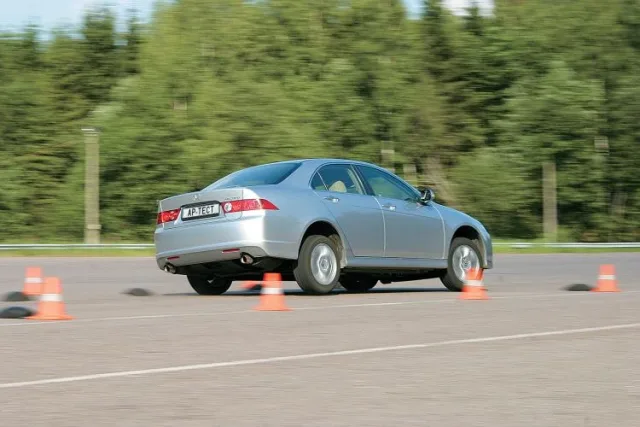
As usual, tests simulating avoiding a suddenly appeared obstacle were conducted in two stages. First, five drivers, already accustomed to the cars in "standard" driving modes, tried to "avoid the moose" at a speed of 65 km/h with the first and only attempt. Then the tester, in a series of runs, determined the maximum speed of performing the maneuver.
The lowest speed was demonstrated by the Hyundai NF — 72.6 km/h. The tester was hindered by pronounced understeer and low sensitivity to steering wheel turns. Nevertheless, four out of five "volunteers" successfully performed the maneuver, working intensively with the steering wheel — despite sluggish responses, the informativeness of the steering and predictability of reactions were at a high level.
The Volkswagen Passat turned out to be faster in the tester's hands (75.6 km/h) and much friendlier to "ordinary" drivers: a light but informative steering wheel, optimal sensitivity, clear responses, and excellent directional stability. Still, one driver out of five could not cleanly pass the corridor marked with cones.

The Honda Accord, showing the best result in the "moose test" (78.9 km/h), at the same time frayed the expert's nerves considerably. The car instantly reacts to steering wheel turns, but the steering wheel is not very informative, and directional stability leaves much to be desired — a combination that keeps you on edge. Of the five drivers, four coped with the exercise, but passed it almost at the limit of capabilities, with the deepest drifts.
| Maximum speed during the moose test, km/h | |
| Car | Speed |
| Honda Accord | 78.9 |
| Hyundai NF | 72.6 |
| Volkswagen Passat | 75.6 |
| Moose test on the first attempt at 65 km/h* | |
| Car | Maneuver completed |
| Honda Accord | 4 out of 5 drivers |
| Hyundai NF | 4 out of 5 drivers |
| Volkswagen Passat | 4 out of 5 drivers |
| * Five drivers participated in the tests | |
| Honda Accord 2.4, Hyundai NF 2.4, Volkswagen Passat 2.0 FSI (manufacturer data) | |||
| Car | Honda Accord | Hyundai NF | Volkswagen Passat |
| Body type | 4-door sedan | 4-door sedan | 4-door sedan |
| Number of seats | 5 | 5 | 5 |
| Length, mm | 4665 | 4800 | 4762 |
| Width, mm | 1760 | 1832 | 1820 |
| Height, mm | 1445 | 1475 | 1472 |
| Wheelbase, mm | 2670 | 2730 | 2709 |
| Front track, mm | 1510 | 1560 | 1552 |
| Rear track, mm | 1510 | 1550 | 1551 |
| Trunk volume, l | 459 | 462 | 565 |
| Curb weight, kg | 1483 | 1463 | 1418 |
| Gross weight, kg | 1930 | 2030 | 2000 |
| Engine | petrol, with distributed injection | petrol, with distributed injection | petrol, with direct injection |
| Location | front, transverse | front, transverse | front, transverse |
| Number and arrangement of cylinders | 4, in-line | 4, in-line | 4, in-line |
| Displacement, cm³ | 2354 | 2359 | 1984 |
| Cylinder bore/stroke, mm | 87/99 | 86.5/100 | 82.5/92.8 |
| Compression ratio | 10.5:1 | 10.1:1 | 11.5:1 |
| Number of valves | 16 | 16 | 16 |
| Maximum power, hp/kW/rpm | 190/140/6800 | 161/118/5800 | 150/110/6000 |
| Maximum torque, Nm/rpm | 223/4500 | 219/4250 | 200/3500 |
| Gearbox | automatic, 5-speed | automatic, 4-speed | automatic, 6-speed |
| Gear ratios | |||
| I | 2.64 | 2.84 (3.27)* | 4.15 |
| II | 1.52 | 1.53 (1.79) | 2.37 |
| III | 1.08 | 1.00 (1.55) | 1.56 |
| IV | 0.77 | 0.71 (1.18) | 1.15 |
| V | 0.57 | — (0.97) | 0.86 |
| VI | — | — | 0.69 |
| Reverse | 2 | 2.48 (3.42) | 3.39 |
| Final drive | 4.44 | 3.77 (3.44) | 3.44 |
| Drive | front-wheel drive | front-wheel drive | front-wheel drive |
| Front suspension | independent, coil spring, double wishbone | independent, coil spring, double wishbone | independent, coil spring, McPherson |
| Rear suspension | independent, coil spring, five-link | independent, coil spring, multi-link | independent, coil spring, four-link |
| Front brakes | disc, ventilated | disc, ventilated | disc, ventilated |
| Rear brakes | disc | disc | disc |
| Tires | 205/55 R16 | 215/60 R16 | 205/55 R16 |
| Maximum speed, km/h | 227 | 202 (212) | 208 |
| Acceleration time 0-100 km/h, s | 9.2 | 10.4 (8.8) | 10.2 |
| Fuel consumption, l/100 km | |||
| Urban cycle | 13.7 | 12.3 (11.8) | 12.6 |
| Extra-urban cycle | 6.9 | 7.0 (6.5) | 6.3 |
| Combined cycle | 9.4 | 8.9 (8.5) | 8.7 |
| Fuel tank capacity, l | 65 | 70 | 70 |
| Fuel | AI-95 | AI-95 | AI-95-98 |
| * In parentheses - data for the car with a five-speed manual gearbox | |||
Now about prices and trim levels.
The base Accord with a 2.0-liter engine (155 hp) and manual gearbox in Comfort trim, which includes dual-zone climate control, stability control, full power accessories, and CD stereo, costs $28,400. The Sport version with automatic transmission, alloy wheels, cruise control, and rain sensor will cost $2,500 more. For the top Executive 2.4 version (automatic, leather interior, power driver's seat, CD changer, sunroof) they ask $35,900 - this is exactly the car that participated in the test. But for the sporty Type-S version with a 190-hp engine and manual transmission, you will have to pay from $32,900; the surcharge for the automatic is $1,000. For two-liter modifications, the waiting list is about a month.
The warranty on the Accord is 3 years or 100,000 km. In Russia, the car is sold by 24 dealers in 14 cities.
The Hyundai NF is sold only with a 2.4-liter engine (161 hp). The base version with manual gearbox, power accessories, climate control, and CD stereo costs $27,990 - this is slightly cheaper than the base Accord. It was in this configuration that the car was tested. For the automatic, you will have to pay an extra $1,000, and the same amount for the stability control system with Brake Assist function. The top version with leather interior, power driver's seat adjustments, and light sensor costs $31,190.
The warranty on the Hyundai is 5 years or 120,000 km. The car is sold by 63 dealers in 47 cities in Russia.
The Volkswagen Passat in the base trim is noticeably more affordable than its competitors - from $24,738, but under the hood there is a modest 1.6-liter engine with 102 hp. However, the choice of engines is huge: petrol 1.6 FSI (115 hp) from $26,100, 2.0 FSI (150 hp) from $28,408, 2.0 TFSI (200 hp) from $37,830, V6 3.2 FSI (250 hp) from $48,520, as well as two 2.0-liter turbodiesels - 105 hp from $29,110 and 140 hp from $30,680. The intermediate Comfortline trim (power driver's seat, cruise control, full power accessories) costs $730-1,250 more than the base. The top Highline (leather, sport steering wheel, dual-zone climate, rain sensor, alloy wheels) is $2,720-4,000 more expensive. The automatic gearbox is an extra charge from $2,170 to $2,700. The Passat 2.0 FSI AT Highline that participated in the test is estimated at $33,753. The prestigious DSG gearbox and all-wheel drive are available only on versions with the 140-hp diesel and the petrol V6. A custom-ordered car will have to wait one and a half to two months.
The warranty on the Passat is 2 years without mileage limit. In Russia, the brand is represented by 44 dealers in 29 cities.
| Equipment of the cars participating in the test | |||
| Make | Honda | Hyundai | Volkswagen |
| Model | Accord 2.4l | NF 2.4l | Passat 2.0l |
| Base version price, $ | 28350 | 27990 | 28408 |
| Front airbags | + | + | + |
| Side airbags | + | + | O |
| Inflatable curtains | + | + | O |
| ABS | + | + | + |
| Dynamic stability control | O | – | + |
| Automatic transmission | O | – | O |
| Adjustable steering column (rake and reach) | + | + | + |
| Leather steering wheel | O | + | O |
| Multifunction steering wheel | O | + | + |
| Power-adjustable front seats | O | – | O |
| Driver seat memory | – | – | + |
| Heated front seats | + | + | O |
| Heated windshield | – | O* | O* |
| Auto-dimming rearview mirror | + | – | O |
| Single-zone climate control | – | + | – |
| Dual-zone climate control | + | – | O |
| Built-in phone | – | – | O |
| Headlight washer | O | – | O |
| Central locking with keyless entry | + | +** | + |
| Power-folding mirrors | + | – | O |
| Power and heated exterior mirrors | + | + | + |
| Automatic power windows front and rear | + | + | + |
| Light sensor | O | – | + |
| Rain sensor | + | – | O |
| Trip computer | + | + | + |
| Split-folding rear seat | + | + | + |
| Ski hatch | – | – | + |
| CD audio system | + | +*** | + |
| CD changer | O | – | O |
| Fog lights | O | + | O |
| Full-size spare wheel | – | + | O |
| Metal engine underbody protection | – | – | + |
| Alloy wheels | + | + | O |
| Metallic paint | + | + | O |
| Power sunroof | O | – | – |
| Cruise control | O | – | O |
| Front and rear parking sensors | – | – | O |
| Leather interior | O | – | O |
| Remote trunk release | + | + | + |
| Remote fuel filler flap release | + | + | + |
| Xenon low beam | O | – | O |
| Bi-xenon headlights | – | – | O |
| Cornering low beam | – | – | O |
| Price of tested car, $ | 35900 | 27990 | 33753 |
| * In the wiper area | |||
| ** Central locking without remote control | |||
| *** Multi-format plus cassette | |||
| (+) Included in base version | |||
| (–) Not available in base version | |||
| (O) Options installed on the cars participating in the test | |||

| Speedometer accuracy | ||||||||||
| Speedometer reading, km/h | 40 | 60 | 80 | 100 | 120 | 140 | 160 | 180 | 200 | 220 |
| True speed, km/h | ||||||||||
| Honda Accord | 37 | 57 | 75 | 95 | 114 | 133 | 151 | 170 | 190 | 209 |
| Hyundai NF | 36 | 56 | 76 | 95 | 115 | 135 | 155 | 174 | 194 | — |
| Volkswagen Passat | 39 | 59 | 78 | 98 | 117 | 136 | 156 | 176 | 196 | — |
| Approximate prices for body parts in Moscow, $ | |||
| Part | Honda Accord | Hyundai NF | Volkswagen Passat |
| Front fender | 340 | 280 | 230 |
| Front bumper | 470 | 460 | 490 |
| Headlight | 550 | 390 | 740 |
| Hood | 480 | 410 | 480 |
| Windshield | 620 | 440 | 570 |
| Some Autoreview measurement results | |||
| Car | Honda Accord | Hyundai NF | Volkswagen Passat |
| Maximum speed, km/h | 216.6 | 205.9 | 199.4 |
| Acceleration time, s | |||
| 0—50 km/h | 3.8 | 3.5 | 3.6 |
| 0—100 km/h | 10.4 | 10.6 | 10.8 |
| 0—150 km/h | 21.8 | 23.7 | 25 |
| 0—200 km/h | 52.9 | 65.6 | — |
| over 400 m | 17.4 | 17.4 | 17.4 |
| over 1000 m | 31.2 | 31.7 | 32 |
| 60—100 km/h (III) | 8 | 7.7 | — |
| 60—100 km/h (IV) | 11.2 | 10.6 | — |
| 80—120 km/h (V) | 20.1 | 14.7 | — |
| 60—100 km/h (D) | 6.3 | — | 7.3 |
| 80—120 km/h (D) | 7.8 | — | 8.7 |
| Coast-down, m | |||
| from 50 km/h | 789 | 843 | 650 |
| 130—80 km/h | 1340 | 1238 | 1068 |
| 160—80 km/h | 2017 | 1845 | 1525 |
| Braking from 100 km/h | |||
| distance, m | 40.5 | 41.6 | 44.2 |
| deceleration, m/s² | 9.5 | 9.3 | 8.7 |
| Braking from 150 km/h | |||
| distance, m | 92.5 | 97.5 | 89.3 |
| deceleration, m/s² | 9.4 | 8.9 | 9.7 |