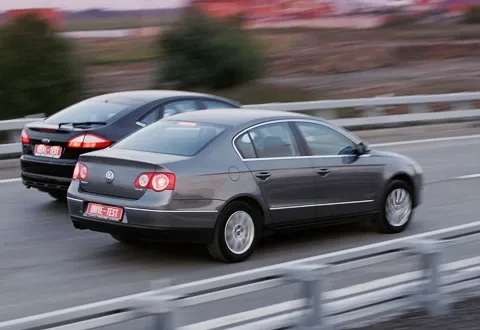
Well, both cars have finally made it to our editorial office and are parked somewhere within a kilometer of it — finding a parking spot near the entrance in the city center is nearly impossible. True, we didn't get a perfect match in trim levels. For the Ford, we could only get a two-liter Mondeo hatchback in Titanium version with a five-speed manual. And at Volkswagen at that moment, there was only a Passat sedan with an automatic and rather modest equipment. We won't comment on the exterior. Some will like Ford's kinetic lines, while others will say they are overly cluttered with details. Some will love the restrained classic of the Passat, while others will yawn at first glance and add that the chrome grille is a sign of bad taste. We're not going to convince anyone. We'll just get behind the wheel and head away from the city bustle. First, let's load all our equipment into the trunks — although their volumes are decent (540 liters for the Mondeo and 565 for the Passat), all the gear didn't fit in one car, so we had to split it. We also noticed that loading the Ford is more convenient: its opening is wider and lower. The Passat responds with thoughtful space organization — niches for small items on the sides, hooks for bags, and the warning triangle is secured in a dedicated spot inside the lid. The Mondeo's interior tries its best to please — and it succeeds. Leather with Alcantara, quality plastic, expressive design, a large color screen in the center of the dashboard, generous equipment. Who wouldn't like that? The ergonomics are almost flawless: large adjustment ranges for the seats and steering wheel, the gear lever is at hand and delights with its precise action. The Convers+ onboard computer interface, controlled via buttons on the steering wheel, is also a successful find. But the seats with rigid backrests raise questions, and their heating works as if winter won't come anytime soon. The audio and climate control knobs are uncomfortable, the center panel looks garish, and the abundance of "aluminum-look" plastic quickly gets tiresome. The leather stitching is rough in places. The Passat's interior, on the contrary, is very restrained — perhaps even overly so. Calm lines, simple design. The only detail that catches the eye is the instruments: recessed violet dials in chrome bezels, resembling expensive watches. Everything else is boring, but the driver isn't distracted from the road. Unlike the Mondeo, the Passat has almost nothing to criticize. The plastic is slightly simpler, but the aluminum is real. The impression of the interior can be summed up in one word — expensive. However, the rearview mirrors on the Volkswagen disappoint, while the big "burdocks" on the Ford provide excellent visibility. The Passat's ergonomics are impeccable. The seats aren't as sporty as in the Mondeo, but oddly enough, they are noticeably more comfortable and hold you in corners just as well. The floor-mounted gas pedal is very convenient, and the footrest for the left foot is ideal. The Climatronic climate system on the Passat is a benchmark. Set the temperature on the left and right and forget about it. The system works quietly and unobtrusively, maintaining the microclimate like a good servant. The dual-zone climate in the Mondeo also copes, but sometimes it blows too insistently either in the face or at the feet — intrusive. When stuck in traffic, there's plenty of time to study the interior details. So, the Germans have thought of everything down to the last screw: every spring and fastener is covered with a plastic cap. Whether it's necessary is a question, but such thoroughness is appealing. And it instills confidence: if they paid so much attention to trifles, they certainly didn't spare time on tuning the chassis. We hit the highway — and realize that's exactly the case. The Passat behaves exemplarily: lively steering responses combine with complete composure on bumps and ruts. And the steering effort on a high-speed curve is pure pleasure! With such a car, you could go around the world — if only the road were smooth. However, even on not-so-smooth roads, the Passat handles it decently. The suspension is short-travel but energy-intensive, swallowing small bumps without question, and there's almost no pitching on waves. The new Mondeo is also good, damn it! If its owner complains about fatigue on a long trip — either they drove too long or they're lying. On the highway, the Ford doesn't strain, although it yields to the Volkswagen in ride smoothness: it's more finicky about road surface quality. But overall, it's still worthy. The threshold of comfortable speed for both cars is limited only by the road conditions and engine capabilities. And here's where the Mondeo starts having problems. Its 145-horsepower engine is lazy at low revs — to drive briskly, you have to keep the tachometer needle at no less than three thousand rpm, preferably four. The precise manual transmission sweetens the process, but sooner or later it gets tiring. And during overtaking, the damped gas pedal complicates rev-matching: you engage neutral, press — and the needle creeps up only after half a second. Recently, we were bored behind the wheel of a Skoda Octavia with a two-liter FSI and a manual — the engine was dull. But now it pleasantly surprised us! With this torquey engine, the Passat even with an automatic doesn't lag behind the Mondeo. And the gearbox is just a dream: quick and smooth shifting in response to pedal input. In sport mode — pure fun. So the Mondeo only pulls ahead in the evening: we let its bright xenon headlights (even too bright for oncoming traffic) light the road. But it still won't break away from the Passat. The Mondeo's handling is brilliantly tuned! The chassis is even nimbler than the Volkswagen's, holds the line excellently, and rolls less. But the reactive effort on the steering wheel isn't as convincing, and with quick rotation, there's a slight "step" in effort. The Passat is smoother but more correct. The steering effort is clearer, reactions are precise and unambiguous — no complaints. The sense of unity with the car here is perhaps even greater.
test-drive-13.jpg
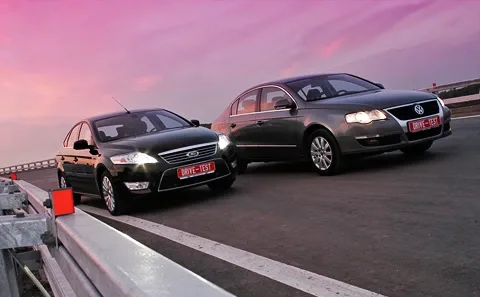
Even with the "automatic," the two-liter Passat doesn't lag behind the Mondeo.
As for the results, both cars deserve the highest marks for road behavior, and here everyone chooses for themselves. One will like the smooth and more refined Passat, the other — the more spirited but not flawless Mondeo. Don't forget that the test Volkswagen stood on rather worn 16-inch wheels, while the Ford was shod with 17-inch tires. Most likely, this difference gave the Passat an advantage in ride smoothness but cost it some points in handling. However, one thing is certain: behind the wheel of either of these sedans, the driver will get plenty of pleasure.
Besides the driver's seat, both cars have room for four more passengers. And here, the Mondeo becomes the undisputed leader — not for nothing did it grow so much in size in its third generation. The Passat certainly can't be called cramped, but in the Ford, rear passengers will feel more comfortable — as they say, both in soul and body.
test-drive-14.jpg
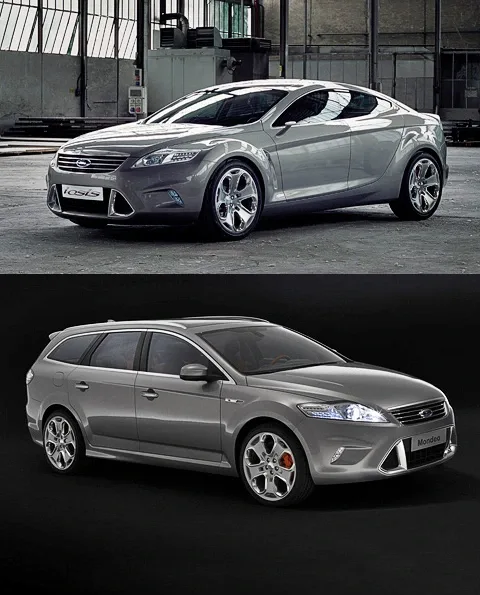
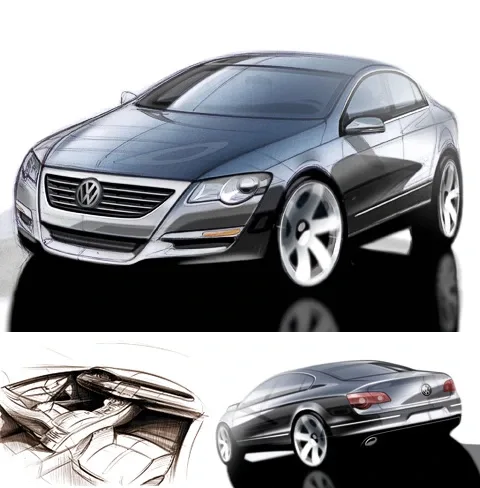
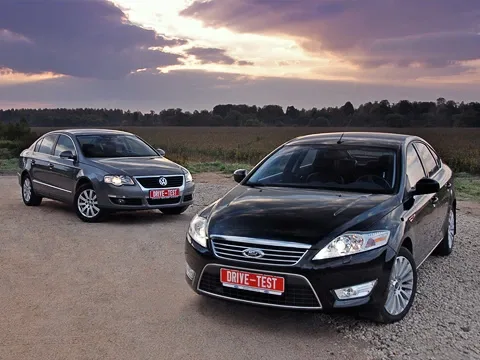
One can argue for hours about the design of the Mondeo and Passat. But the fact is — the Ford looks bolder.
So is it fair to claim that the Mondeo surpasses the Passat? Not at all. Yes, the Ford has its trump cards: a spacious interior, a roomy trunk, and excellent chassis. But it lacks that solidity, thoughtfulness, and harmony that its competitor possesses. At the same time, the fact that the Mondeo is among the best in the D-class remains a fact! The Ford is still damn good! And its main trump card is a noticeably lower price. In comparable trims, the Mondeo will cost three to four thousand dollars less than the Volkswagen Passat. And if not everyone can recognize the nuances of handling and suspension tuning, only the blind would miss the price difference.
Specifications
Characteristics Ford Mondeo Volkswagen Passat
Body
Number of doors/seats 5/5 4/5
Length, mm 4778 4762
Width, mm 1886 1820
Height, mm 1500 1472
Curb weight, kg 1491 1418
Gross weight, kg 2090 2030
Trunk volume, l 540–1460 565
Engine
Type Petrol, with distributed injection Petrol, with direct injection
Location Front, transverse Front, transverse
Number and arrangement of cylinders 4, in-line 4, in-line
Number of valves 16 16
Displacement, cm3 1999 1984
Max power, hp/rpm 145/6000 150/6000
Max torque, Nm/rpm 185/4500 200/3500
Transmission
Gearbox Manual, five-speed Automatic, six-speed
Drive Front
Chassis
Front suspension Independent, McPherson
Rear suspension Independent, multi-link
Front brakes Disc, ventilated
Rear brakes Disc
Ground clearance, mm 130 155
Performance characteristics
Maximum speed, km/h 210 208
Acceleration time from 0 to 100 km/h, s 9.9 10.2
Fuel consumption, l/100 km
urban cycle 11.2 12.6
extra-urban cycle 6 6.3
combined cycle 7.9 8.7
Toxicity standard Euro-4
Fuel tank capacity, l 70
Fuel AI-95 AI-95–98
Equipment of tested cars
Trim levels Mondeo Titanium Passat Comfortline
Price of base version, $ 30 760 32 785
Bi-xenon headlights O -
Fog lights + O
Electric windows front and rear + +
Exterior mirrors with electric adjustment and heating O +
Heated front seats + +
Heated windshield + +
Adjustable steering column for height and reach + +
Interior trim with leather and alcantara + -
Leather steering wheel + O
Electric seat height adjustment + -
Electric seat backrest angle adjustment - +
Front airbags + +
Side airbags + +
Inflatable safety curtains + -
Active headrests + +
Stability control system + +
Immobilizer + +
CD audio system O O
Rain sensor + O
Engine start button O O
Dual-zone climate control + O
Cruise control + +
Interior trim with aluminum and wood - O
Front parking sensors O O
Rear parking sensors O O
Alloy wheels + +
Price of tested car, $ 39 358 36 826
Designations: + included in base trim; - not available; o option installed on the tested car.
Cars for the test were provided by the official Ford representative and EuropMobilRus.
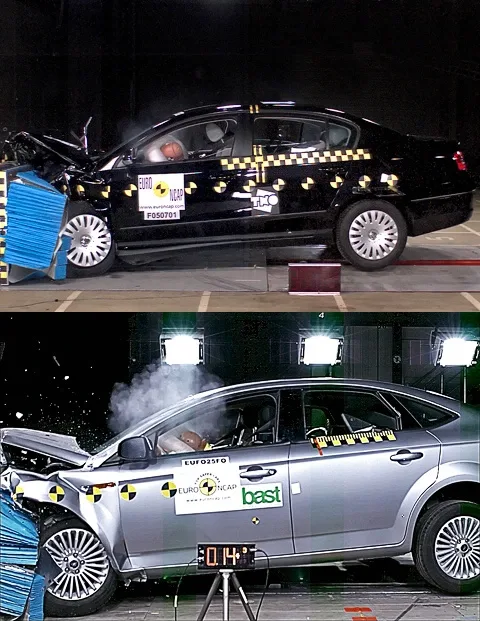
Safety
test-drive-15.jpg
Design
test-drive-16.jpg
test-drive-17.jpg
Behind the scenes
test-drive-18.jpg