
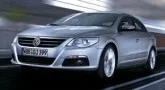
The appearance of the Volkswagen Passat CC can deceive an unprepared viewer. This car resembles a sleeping volcano: on the outside — icy calm, and inside — readiness for a powerful burst of energy. Deceptive serenity — that is what hides behind this look.
From the front, the coupe clearly inherits the features of the regular Passat, but the designers added enough individuality. The sedan and coupe seem to merge in one body. The radiator grille with a pair of wide horizontal slats and the VW emblem looks more imposing. Three large air intakes are integrated into the bumper, as well as fog lights and turn signals. Below them is a sporty spoiler, which, as intended, should increase downforce at speed.
The body pleases with smooth lines. The sloping roof without sharp transitions flows from the windshield to the trunk, extending behind the rear pillars. The frameless side windows are stretched into a narrow arc and framed with chrome — this adds a sporty character. Special attention deserves the pronounced shoulder line, called the "tornado line": it stretches from the front wheel arches to the rear lights. The top of the doors above the chrome trims looks solid, and the widened wheel arches perfectly combine with standard 17-inch wheels. If you want more — there is an option with 18-inch wheels.
For those who live in a land where the sun is a rarity, an interesting option is provided: a panoramic roof with electric drive, created specifically for this model. Its length is 750 mm, width — 1120 mm, so the space from the front part of the roof to the middle pillars is completely transparent. The black crossbar of the frame above the windshield looks very organic.
Now about the interior. Despite the coupe positioning, inside it is surprisingly spacious. In the back row, two adults can easily fit, and their knees will not touch the backs of the front seats. The seats themselves — both front and rear — are a successful compromise: moderately firm, with adequate lateral support and quality upholstery. Plus, active ventilation of the cushions and backrests. Almost silent fans push up to 320 liters of air per minute through them.
Comfort continues in the details. The Passat CC became the first VW model where the climate control received an intuitive menu. Control is via rotary knobs that also serve as mini-screens: the selected temperature is displayed directly on them. The information is also duplicated on the audio system display.
Trim — to choose from: inserts of natural wood or matte aluminum. And in the decorative door panels along the contour, you can integrate backlighting that will create a cozy atmosphere in the cabin in the dark.
Moving on to the engines. The base version is a petrol TSI with 160 hp at 5000 rpm. The turbocharged engine pleases with efficiency: on average 7.6 liters per 100 km. Acceleration to 100 km/h — 8.6 seconds, top speed — 222 km/h. In the base — 6-speed manual, optionally — 7-speed DSG.
The middle step is a 200-horsepower four-cylinder turbo version TSI. But for the test we got the flagship: a V6 with a volume of 3.6 liters, producing 300 hp. With it, the coupe accelerates to 100 km/h in 5.6 seconds. And here is what is surprising: the average consumption is 10.1 liters! We checked this in practice during an eight-hour marathon along Alpine serpentines. The driving was dynamic, but the onboard computer stubbornly showed 9–10 liters. Bravo! The top speed is electronically limited to 250 km/h. Interesting, what is this CC capable of without the limiter?
In the mountains, the CC obeyed the steering wheel unquestioningly. Importantly: the 300-horsepower version comes only with all-wheel drive 4Motion, there are no other options. The adaptive suspension offers three modes: Normal, Sport, and Comfort, switched by a key to the right of the gear lever. The stiffness changes constantly, adapting to the road, as well as to acceleration, braking, and steering turns.
Robot instead of a human
Among the most interesting options is the Lane Assist system. If the driver accidentally crosses the lane marking, the electronics themselves correct the trajectory and return the car to the lane. This significantly increases comfort and safety. European statistics say that 14% of accidents with injuries occur due to leaving one's lane. Lane Assist could reduce these figures. The system turns off as soon as the driver activates the turn signal. It is activated through the multifunction display: you select a menu item — and after 65 km/h the system takes over. The camera, hidden near the rearview mirror and rain sensor, recognizes both broken and solid markings.
Driving
The swift Passat CC looks impressive on city streets.
Interior
The quality of trim materials deserves the highest praise.
Comfort
Unlike many coupes, the Passat CC gives comfort not only to the driver and front passenger, but also to those in the back.
Safety
The car is equipped with the latest safety systems. Few doubt that the Passat CC will receive the highest EuroNCAP ratings.
Price
The price of the car, which will go on sale only in November, has not yet been determined.
Advantages and disadvantages
- + Excellent handling, acceleration dynamics, comfort, efficiency, design.
- - Complex algorithm of the Lane Assist system.
Technical specifications
- Make and model — VW Passat CC
- Dimensions — 4795x1855x1420 mm
- Engine — petrol, 3597 cm³, 300 hp
- Transmission — DSG, 7-speed
- Dynamics — max 250 km/h; 5.6 s to 100 km/h
- Competitors — Mercedes-Benz CLS
Our opinion
Volkswagen Passat CC in terms of its driving qualities and comfort level almost reached those cars that are usually considered premium. At the same time, solutions such as economical powertrains and DSG transmission give the German brand, positioning itself as "people's", a tangible advantage. The appearance also deserves special words — taking the regular Passat as a basis, the designers managed to make a truly beautiful car.
© 5 Koleso