
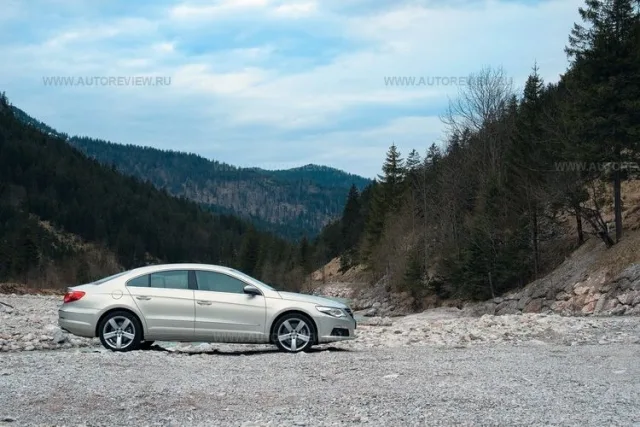
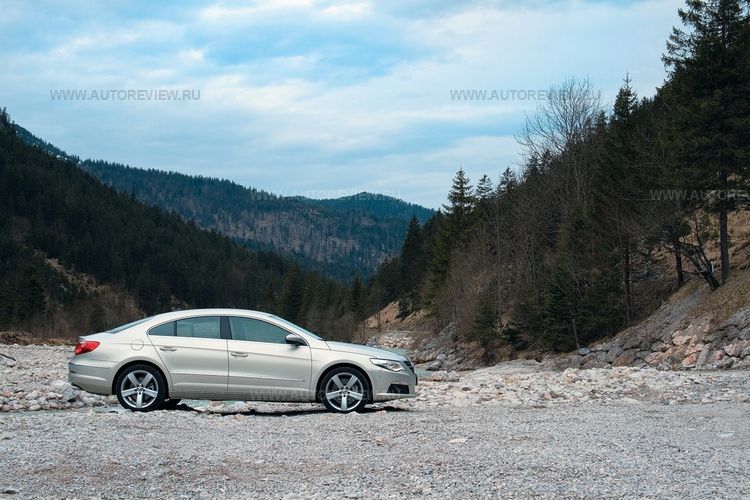
A smooth line runs across the hood, glides over the windshield, pauses for a moment at the highest point of the roof — and, gaining momentum, dissolves, leaving behind red streaks of the taillights. The length of this wave is four meters and eighty centimeters, and its name is Volkswagen Passat CC.
— So where are the photos? Where's the convertible? — marveled Mikhail Mandrika, the executive secretary of Autoreview. — Why did they even send you to Munich?
Oh, the folks at Volkswagen messed up... We're used to the abbreviation CC meaning Coupe Cabriolet. But the Volkswagen Passat CC is not a convertible at all. And not even a coupe. So what is it then?
 |
 |
|
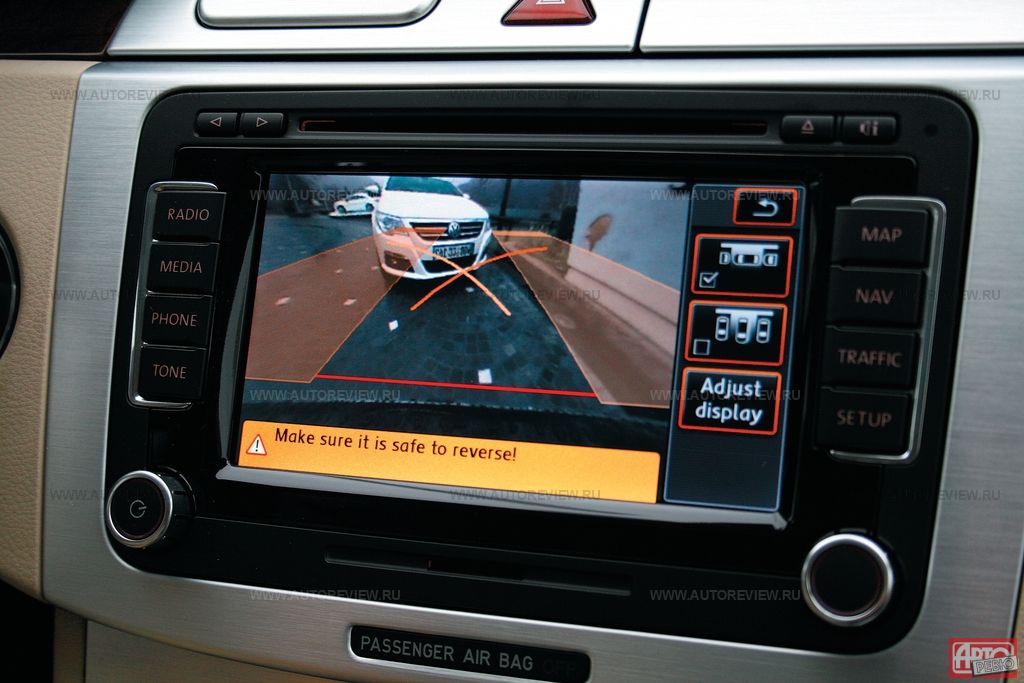
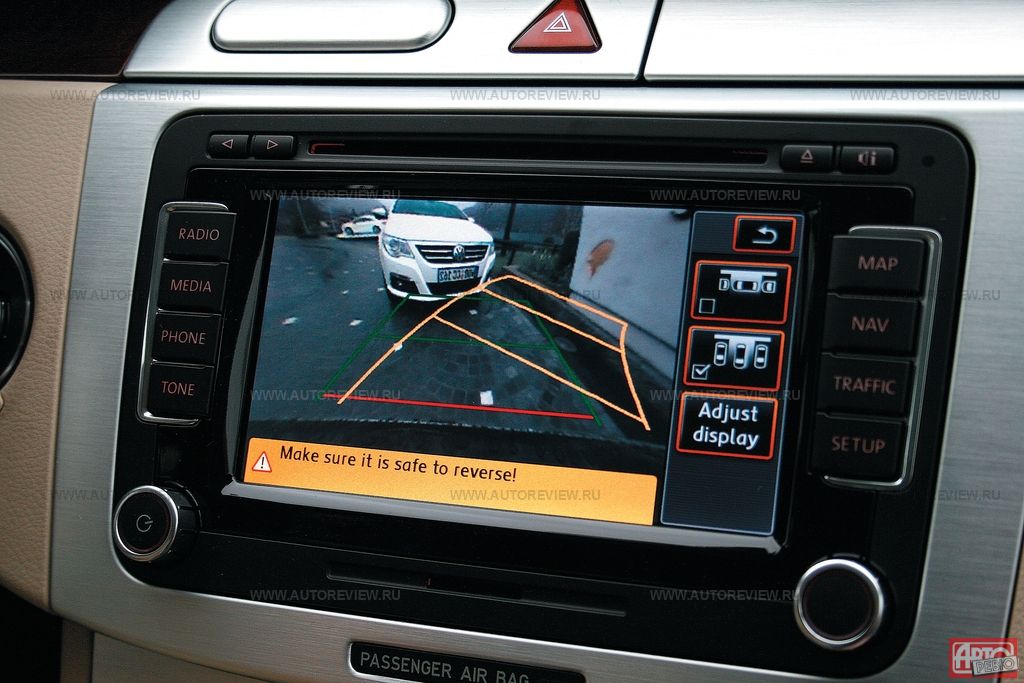
| The rear-view camera is hidden under the emblem on the trunk lid, protected from dirt and vandals. The emblem still works as a button to open the lock, but then the camera stays inside. The image on the touchscreen can be supplemented with one of two "hints" — for parking parallel to the curb or at a right angle | ||
By all classic standards, this is a true sedan. Four doors, seats — not five, but four, although the rear bench has a fold-down armrest, and in a pinch, three can squeeze in. But for such a body with a lowered roofline and frameless doors, marketers four years ago coined the term "four-door coupe" — that's what they call the Mercedes CLS. And in the Volkswagen Group, their sedan based on the Passat was dubbed the "comfort coupe" — Comfort Coupe, or CC for short.
 |
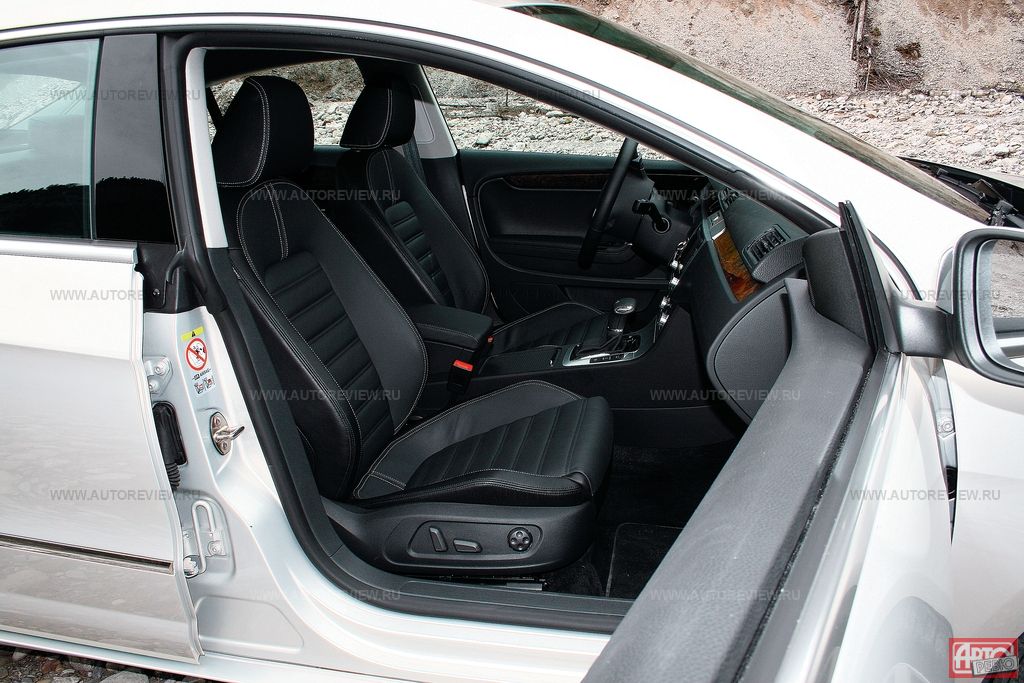 |
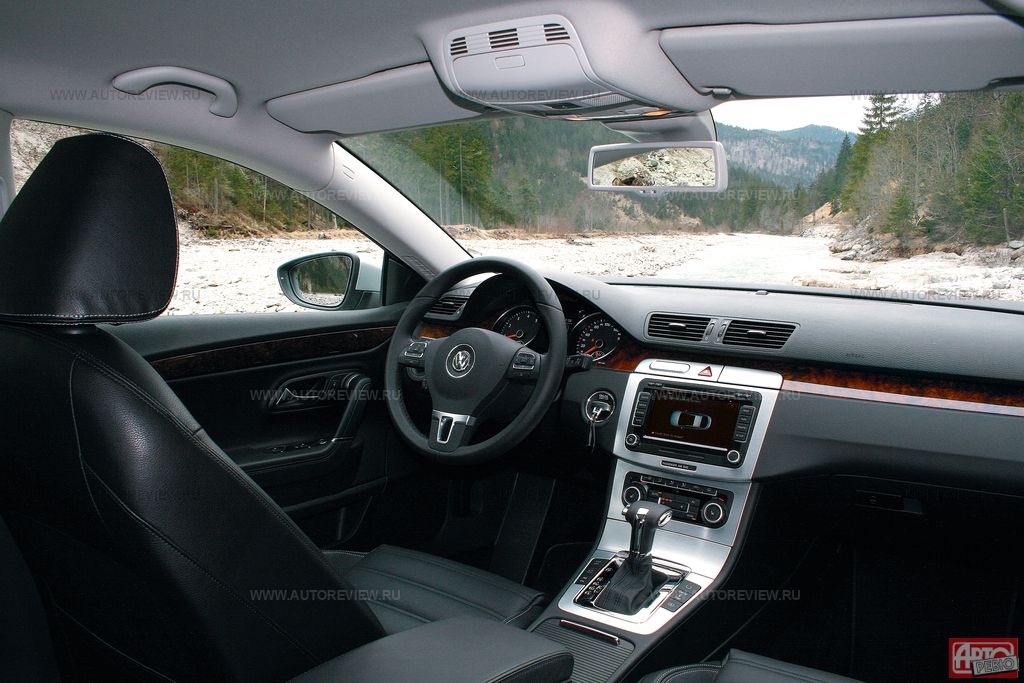
| The interior is impeccably finished: even the aluminum on the center console is real. But why the Germans updated the climate control unit is a mystery. The temperature is now shown not on a display, but in small digits with internal backlighting | The front seats are a bit firm, the side bolsters have become slightly more pronounced, but far from sporty ultimatum. Ventilated seats are available as an option |
 |
 |
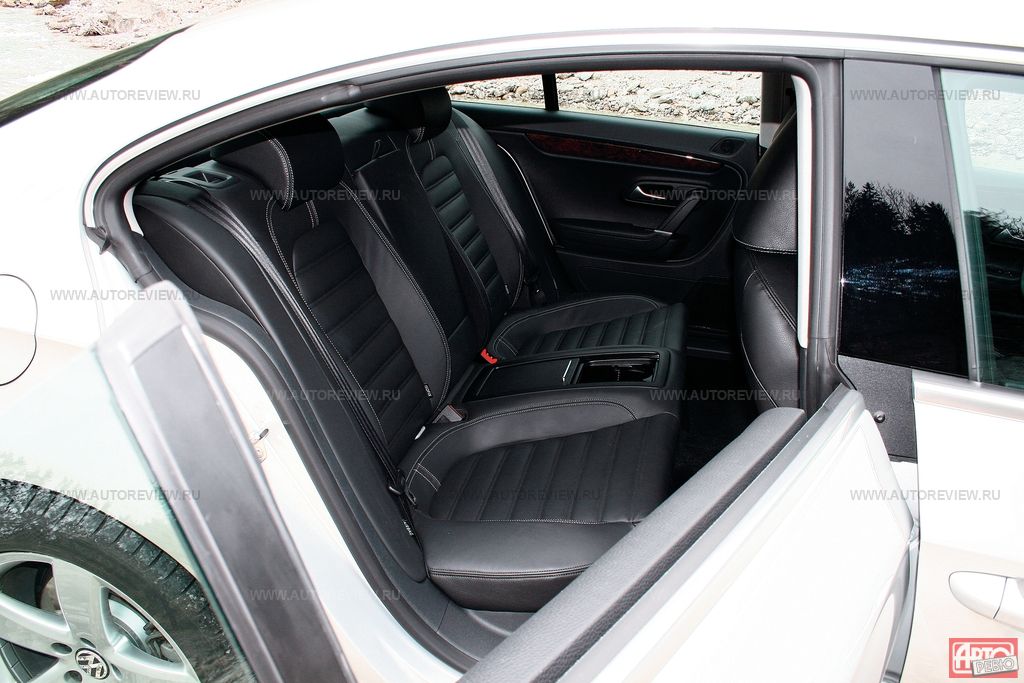
| The wheelbase of the Passat is the same — the rear is comfortable. But if the passenger's height exceeds 185 cm, the top of the head will definitely meet the ceiling |
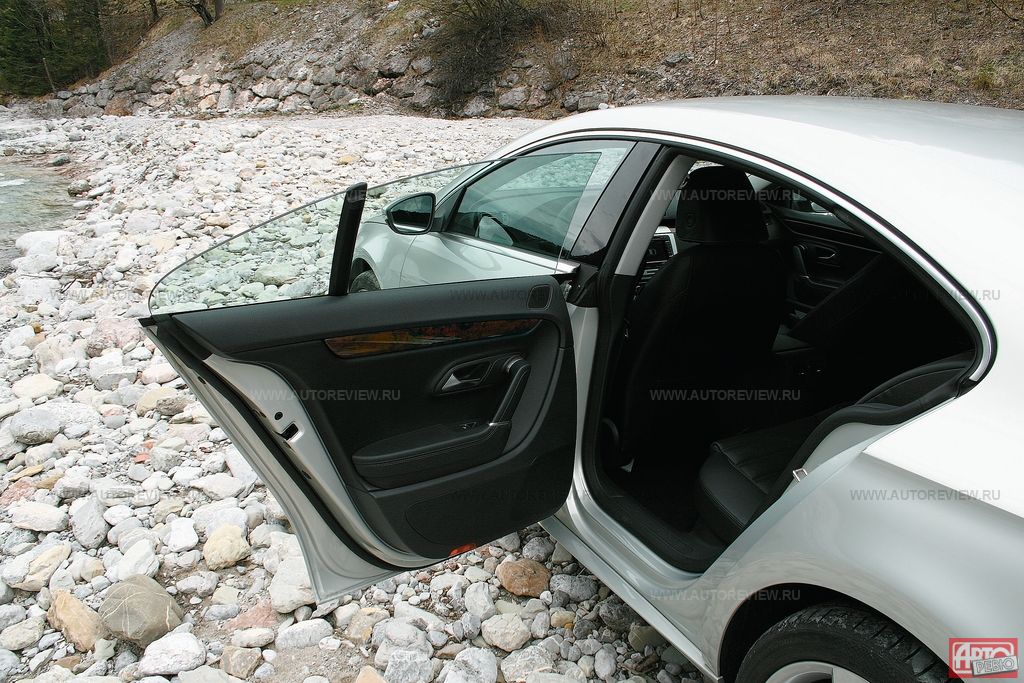
Frameless windows lower by 13 mm when the doors open. According to the Germans, this happens a quarter faster on the Passat than on any other car with such doors |
You can joke about the "coupe-ness" until the Passat CC becomes a two-door, but comfort is serious business. The springs on the Passat CC are slightly softer, the trim is richer, and the list of optional equipment is more impressive than that of the flagship Phaeton!
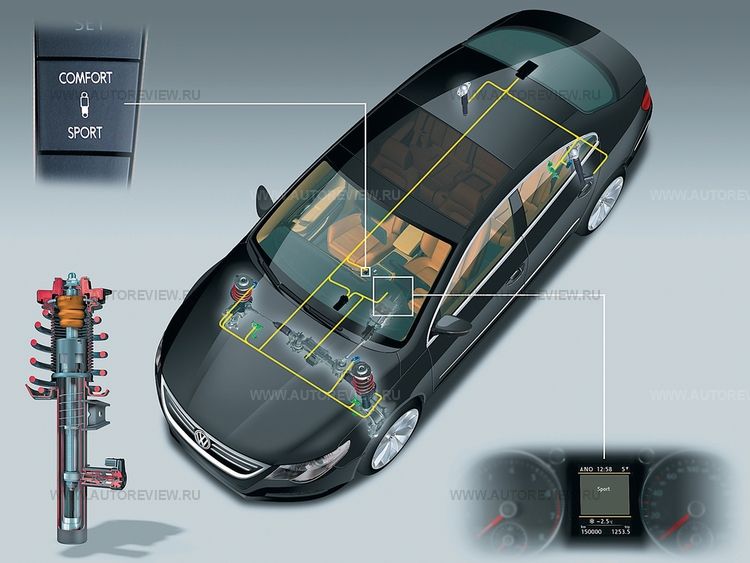
The springs of the "comfort coupe" are 15% softer than the sedan's, and shock absorbers can be ordered with active DCC control. The computer, receiving data on wheel travel, accelerations, and steering angle, changes the cross-section of the shock absorber valves, adapting them to the road. The driver has three basic modes — Comfort, Normal, and Sport. When Sport is selected, the electric power steering algorithm also changes. The Passat CC with the "six" gets DCC as standard
Take the shock absorbers, for example — electronics control them in three modes: Comfort, Sport, and Normal. Under the front emblem hides the radar of the active cruise control ACC — the same as on the updated Touareg, with automatic braking to a full stop (deceleration no more than 0.4 g). From under the rear emblem, when reverse gear is engaged, a dirt-protected camera emerges, and its image on the display can show hints for "parallel" or "perpendicular" parking. You can even trust the "electronic parking attendant" Park Assist — as on the Touran minivan (see AR No. 23, 2007).
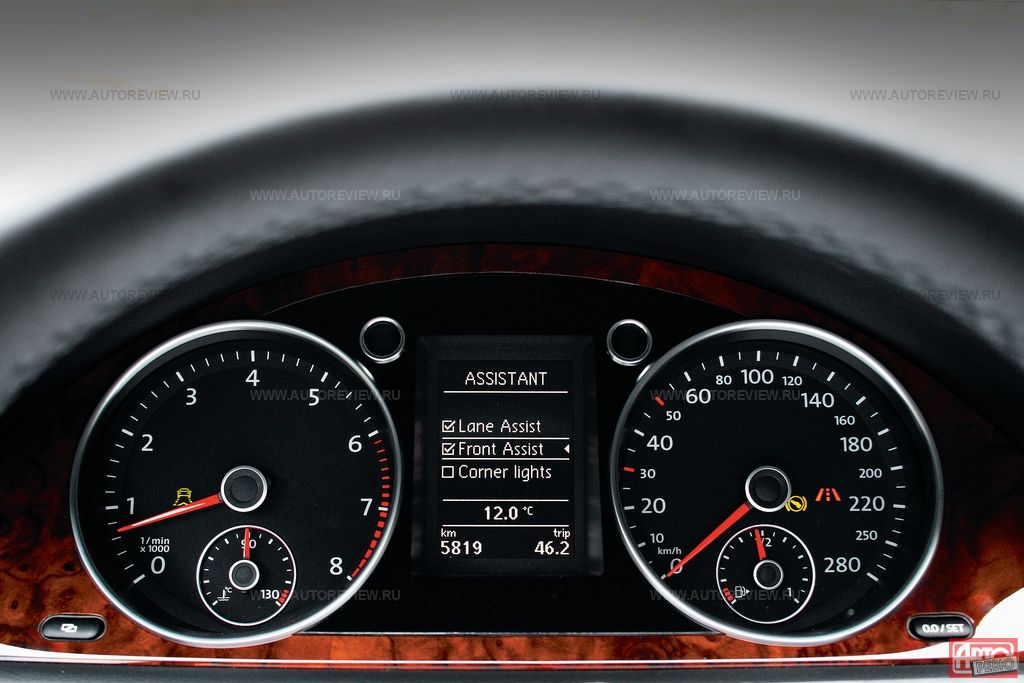
In the cozy interior, much is familiar from the regular Passat: the same dashboard, the same wide seats, though with slightly more pronounced side support. The new steering wheel with two "joysticks" is good, and the door panels have changed. But the main thing is the new instrument cluster. Just like the old joke: "How to make a person feel good? Make it bad, then return it as it was." Light backlighting instead of blue, a white-black display in the center instead of bright red... And how convenient it has become!
 |
|
| The instruments are magnificent — simple and clear! If only the onboard computer could speak Russian... |
Active cruise control ACC — like on the Touareg SUV. The radar's "viewing" angle is 12 degrees. If the car ahead disappears from the "field of view," the Passat CC will start accelerating to the set speed only after it confirms it has reached a straight. For this, the ACC even has a gyro sensor! Whether such cruise control will appear on Russian Passats is still unclear |
Compared to the regular Passat, the roof of the "comfort coupe" is 50 millimeters lower, but the edge of the glass doesn't "press" on the driver. In the rearview mirror, there's a low window opening, but the view into the distance doesn't suffer. It seems they learned the lessons of the Mercedes CLS well in Wolfsburg: even on the rear bench, you don't feel trapped in a dungeon. Except that a tall passenger's head hits the ceiling. And this is despite the sunroof not sliding back but only tilting up, so as not to take away the last centimeters from passengers.
Initially, the Passat CC will be offered with three engines to choose from. The hit in Europe promises to be the 140-horsepower two-liter turbodiesel, already meeting Euro-5 standards, while in Russia, the new 1.8-liter gasoline turbo engine TSI with 160 hp will "sell" best.
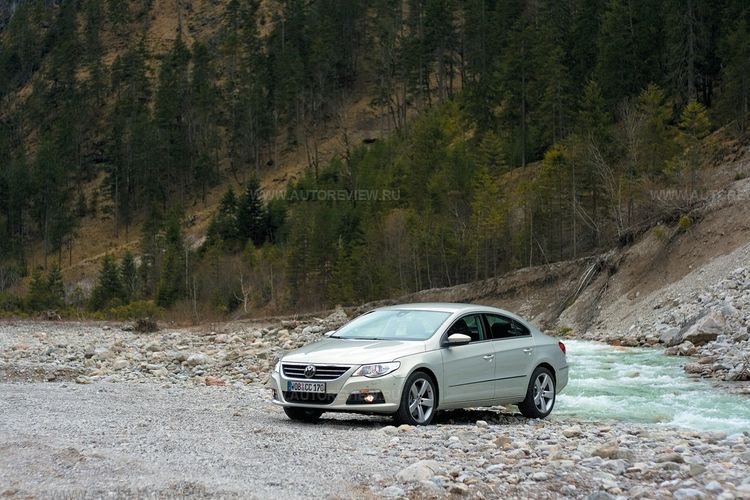
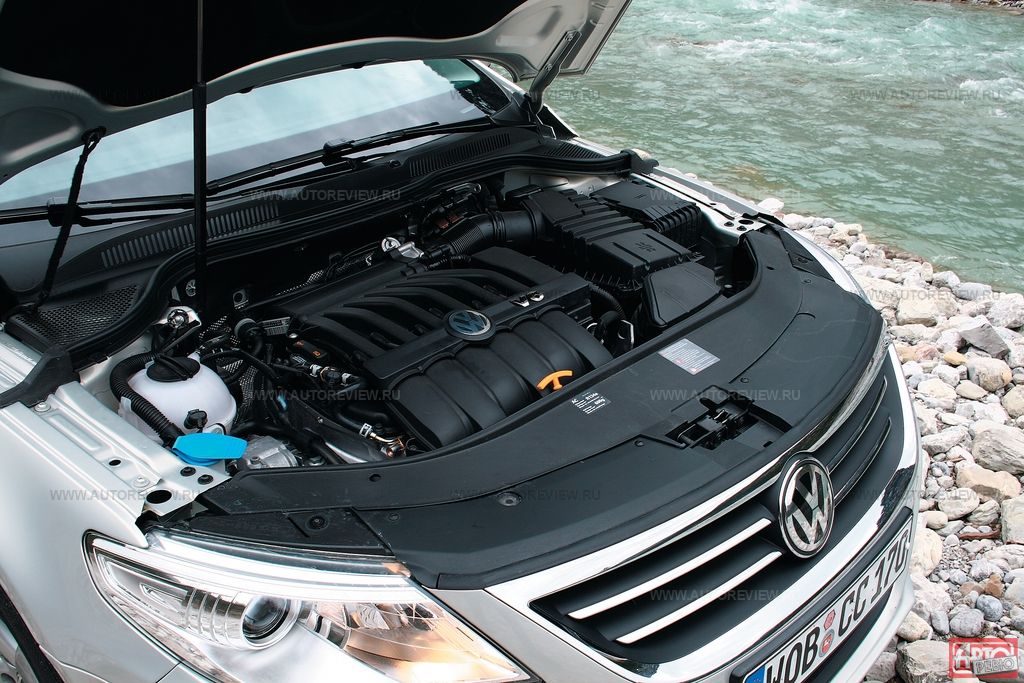
But I first took the top version — with the 3.6 engine producing 300 hp from the Passat R36. In Europe, such cars are equipped only with the six-speed robotic gearbox DSG and all-wheel drive with the updated fourth-generation Haldex clutch.
The 300-horsepower Passat CC accelerates smoothly, like an express train. But without expression. The same 5.6 seconds to 100 km/h in any "real" sports coupe feels much sharper. There's no sharpness in handling either — the "coupe" is comfortable! But reactions are extremely precise, the steering wheel pleasantly weights up with speed, and the grip reserve of the Continental SportContact3 tires is enormous — at least on dry asphalt. When the tires can no longer hold the road, the Passat CC simply slides outward with the front end.
And what about the Passat CC with the 1.8 TSI engine? With the six-speed manual, it's only slightly slower and, imagine, not a bit more boring! The loss in power and torque (250 Nm vs 350 Nm) is compensated by the front-wheel-drive car's lower weight — as much as 200 kilograms! So it has plenty of dynamics — especially since the torque "shelf" begins soon after idle.
 |
 |
 |
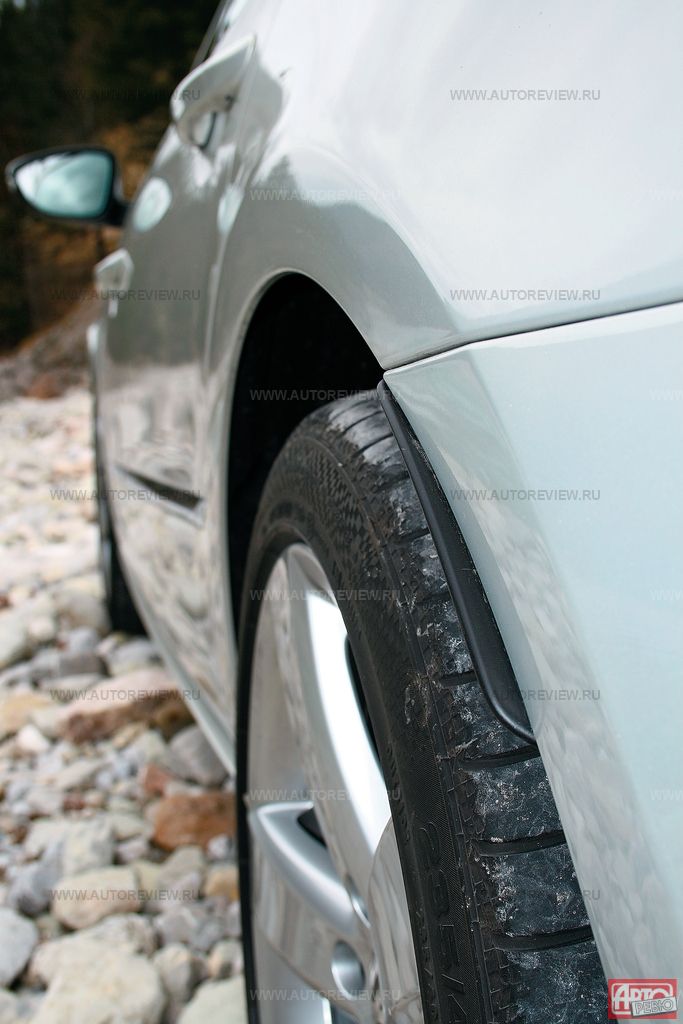
| The small plastic shields on the rear wheel arches are not for aerodynamics, but so that the optional 18-inch tires don't protrude beyond the body perimeter when viewed from above: such are the certification requirements |
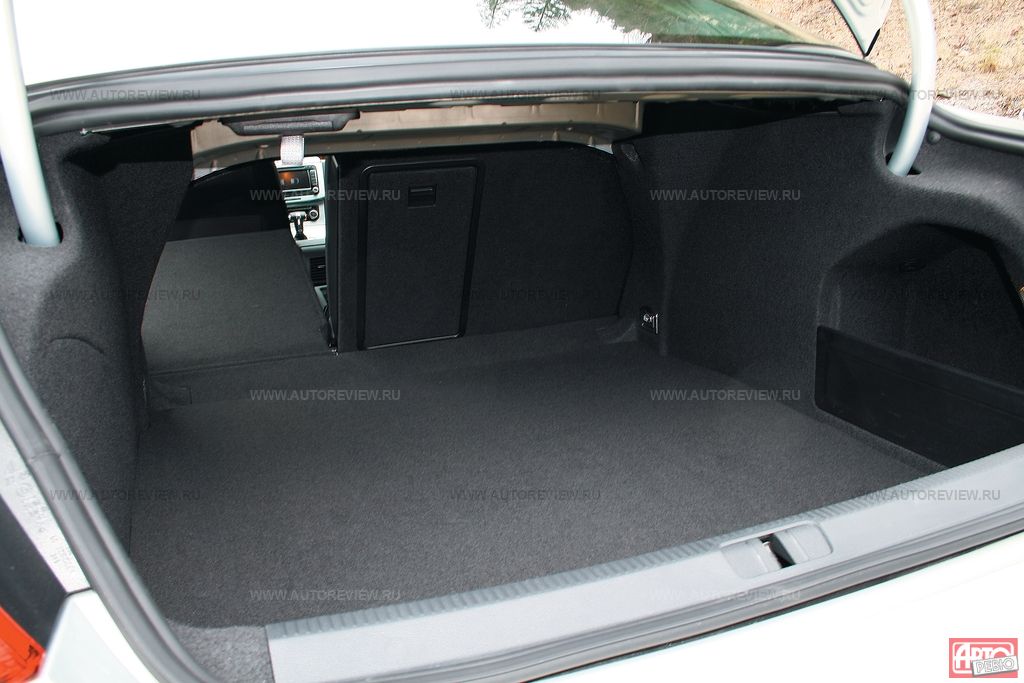
The trunk lost about 30 liters, but 532 liters is still a good figure. The folding rear seat backs are |
Active shock absorbers, frankly, didn't impress me. All three modes are well-tuned and balanced. In "Sport," the Passat CC becomes a bit stiffer, but on an uneven turn it doesn't break from the trajectory, and in "Comfort" it becomes softer but doesn't rock on waves. On European roads, I'd choose the sport mode — thanks to the different electric power steering program, the steering wheel gets better response near zero. But still, the DCC chassis is more of a toy. Switching modes will quickly get boring, if only because of the inconvenient button hidden behind the gear lever and indistinguishable by touch.
If you don't nitpick, the Passat CC is a remarkably cohesive car. On one hand, it's still a Passat: excellent chassis, solid interior, and a sense of substance. But the regular Passat sedan is in almost every yard, and now it's unlikely to help the owner stand out.
But the Passat CC will definitely make you stand out!
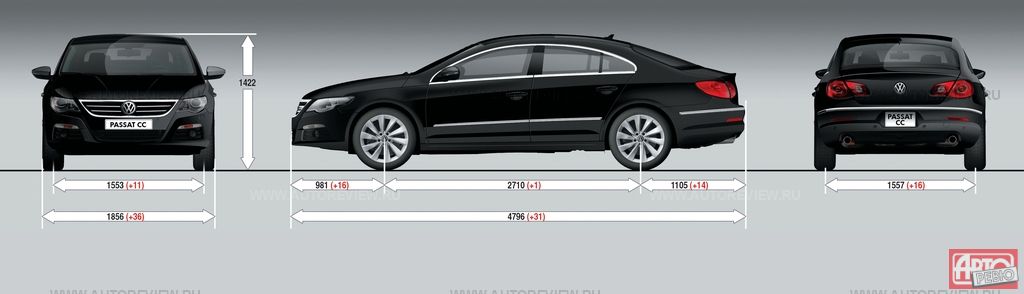
All exterior dimensions are increased compared to the Passat sedan — except for height, which has become 50 mm less
However, Volkswagen is still cautiously assessing the prospects of the new model and speaks of production plans only "in the long term" — over the entire life cycle of the model, they intend to make 300 thousand "comfort coupes." Currently, the Passat CC is sold only in Germany, where prices start from 30 thousand euros — about two thousand more than an equivalently equipped Passat. In Russia, the price range will be noticeably wider — the car will be brought only from Germany, leaving out the Kaluga assembly with its lower price. Specific figures will be announced only in the fall, closer to the start of sales, scheduled for November.
But actually, the Passat CC was not made for Russia. And not even so much for Europe as for America. There they value coupes, comfort, and beauty... And they like everything at once.
The Passat CC has no direct competitors yet — even overseas. Mercedes CLS? It's twice as expensive!
| Specifications | |||
| Parameters | Vehicle | ||
| Volkswagen Passat CC | |||
| Modification | 2.0 TDI | 1.8 TSI | 3.6 FSI |
| Body type | four-door sedan | four-door sedan | four-door sedan |
| Number of seats | 4—5 | 4—5 | 4—5 |
| Trunk volume, l | 532 | 532 | 532 |
| Curb weight, kg | 1466 | 1430 | 1632 |
| Gross weight, kg | 1960 | 1920 | 2110 |
| Engine | diesel, common rail, turbocharged with intercooler | gasoline, direct injection, turbocharged with intercooler | gasoline, direct injection |
| Location | front, transverse | front, transverse | front, transverse |
| Number and arrangement of cylinders | 4, in-line | 4, in-line | 6, V-shaped |
| Displacement, cm3 | 1968 | 1798 | 3597 |
| Cylinder bore/piston stroke, mm | 81.0/95.5 | 82.5/84.2 | 89.0/96.4 |
| Number of valves | 16 | 16 | 24 |
| Compression ratio | 16.5:1 | 9.8:1 | 11.4:1 |
| Max power, hp/kW/rpm | 140/103/4200 | 160/118/5000 | 300/220/6600 |
| Max torque, Nm/rpm | 320/1750—2500 | 250/1500—4200 | 350/2400—5300 |
| Emission class | Euro-5 | Euro-4 | Euro-4 |
| Gearbox | manual, 6-speed | manual, 6-speed | automated manual, 6-speed |
| Drive | front | front | all-wheel |
| Front suspension | independent, coil spring, McPherson | ||
| Rear suspension | independent, coil spring, multi-link | ||
| Front brakes | disc, ventilated | disc, ventilated | disc, ventilated |
| Disc diameter, mm | 312 | 312 | 345 |
| Rear brakes | disc | disc | disc, ventilated |
| Disc diameter, mm | 282 | 282 | 310 |
| Tires | 235/45 R17 | 235/45 R17 | 235/45 R17 |
| Maximum speed, km/h | 213 | 222 | 250 |
| Acceleration time 0—100 km/h, s | 9.8 | 8.6 | 5.6 |
| Fuel consumption, l/100 km | |||
| urban cycle | 7.5 | 10.4 | 15.1 |
| extra-urban cycle | 4.8 | 6.0 | 7.3 |
| combined cycle | 5.8 | 7.6 | 10.1 |
| CO₂ emissions, g/km, combined cycle | 153 | 180 | 242 |
| Fuel tank capacity, l | 70 | 70 | 68 |
| Fuel | diesel with cetane number at least 51 | gasoline AI-95 | gasoline AI-98 |
Self-control
Isn't it nice when a beautiful car, like a woman, can also do a lot? Well, the Passat CC is trained to independently stay within one lane — using the Lane Assist system. As on the Audi Q7, a video camera is installed in front of the rearview mirror in the wiper cleaning zone. The controller located in the same block with a processor clock frequency of 120 MHz "calculates" the image, extracting lane markings from it, and determines the moment of their "unauthorized" crossing (without turning on turn signals). But if Audi only warns about leaving the lane with vibration on the steering wheel, the Passat CC itself turns the steering wheel, as the Honda Accord could do for the Japanese market back in 2003 (see AR No. 21, 2003). At the same time, the standard electric power steering motor is specially designed not to create a torque on the steering wheel of more than 3 Nm, so that the driver can easily "overpower" the electronics.
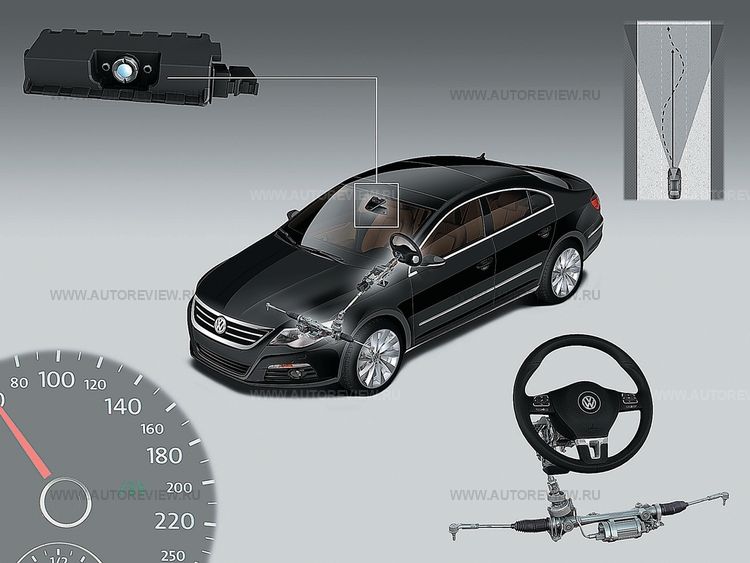
The electromechanical power steering has changed. Now the electric motor is located parallel to the steering rack axis, and they are connected by a "screw-nut" transmission, not a worm gear as before (see AR No. 7, 2008). This design, "tested" on the Tiguan crossover, better dampens road irregularities
When the turn signal is turned on, Lane Assist does not interfere with lane changing at all, and if you take your hands off the steering wheel for more than eight seconds (which is calculated by the absence of torque on the steering wheel), Lane Assist turns off with a loud protest "beep."
Lane Assist works at speeds above 65 km/h, and for confident "grip" the electronics require two lines — on the right and left. True, sometimes the system works on a two-lane road with a central lane marking, but only because the electronics take the contrasting roadside as the right line. Heavy rain or fog can interfere with the system's operation — but not darkness.
Four motion
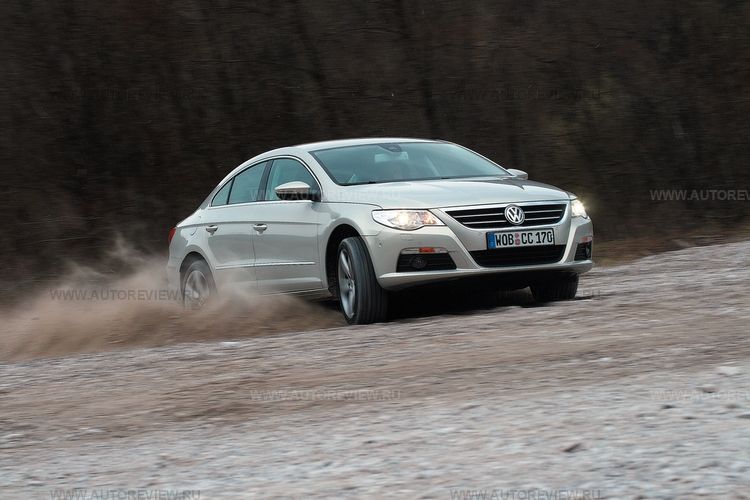
The Passat CC 4motion wagon, like its crossover sibling Tiguan, received a modernized Haldex coupling of the fourth generation, where they abandoned the differential hydraulic pump with mechanical drive. Oil pressure reaching 30 bar is created exclusively by an electric pump, and its support is provided by a hydraulic accumulator.
I had the opportunity to test the all-wheel-drive Passat CC on a slippery road — however, the stability system was not fully disabled, so I had to drive under its control. Within the limits allowed by the electronics, 4motion left a pleasant impression: in skids, the car behaves smoothly and predictably, traction is easy to manage, and the response to pressing the gas pedal, although not instantaneous, has a very small delay.