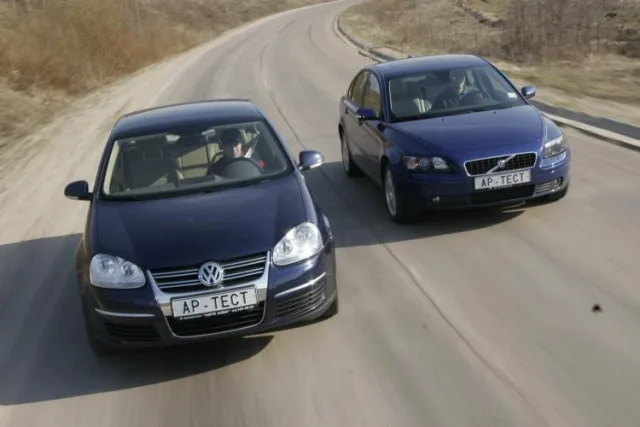
When the new Volvo S40 went on sale in Russia, we were at a loss. What should we compare the "forty" with? With ordinary golf-class sedans? No — Volvo is more expensive. With cars of a higher class D? Also no — they are larger. There is, of course, the Audi A3 — also a compact and expensive car. But there is no sedan in the A3 lineup, and none is expected yet.
Now a worthy competitor has finally appeared — the Volkswagen Jetta. Which of the "small business class" sedans is better suited for our roads?
 |  |
| Volkswagen: poisonous blue instrument lighting | Volvo S40 already "knows" Russian |
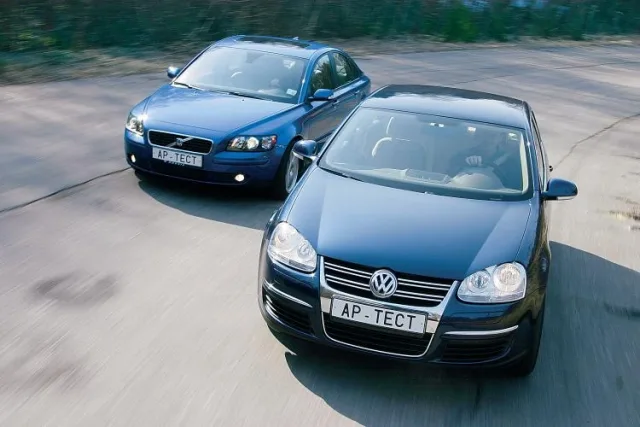
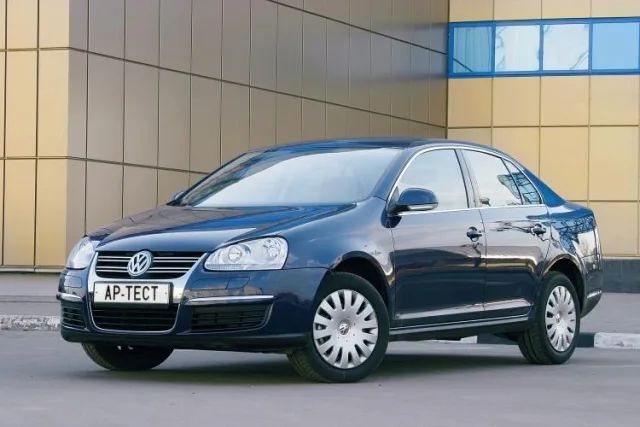
Who is more beautiful can be said immediately and without hesitation — Volvo. Unfortunately, the Jetta looks heavy outside, and inside — like the "donor" Volkswagen Golf, it is rather boring. However, the Jetta resembles the larger Volkswagen Passat — if that was the designers' goal, then it has been achieved.
The Volvo S40 can also be mistaken for a larger car — the Volvo S60. But the proportions are different — more compact and muscular. And how pleasing is the interior with a refined (literally) console separated from the panel!
 |  |
| Volkswagen Jetta does not shine with design delights — neither outside nor inside | Volvo S40: beautiful appearance, interesting interior |
 |  |
 |  |
| The Jetta's six-speed manual shifts precisely | The Volvo's five-speed automatic could be more responsive |
But as for the quality of finishing, both sedans are equally good — everything is done expensively and solidly. It is pleasant to hold the steering wheel, pleasant to press the power window buttons, pleasant to turn the radio adjustment knobs…
In terms of ergonomics, Volkswagen is preferable. The driver's seat adjustments have huge ranges — both a fragile girl and a two-meter giant can easily sit behind the wheel. The seat is not sporty, but the profile and firmness are chosen perfectly — it is comfortable, and you feel the car with your whole body. If you like having support for your right elbow — please, the armrest lid slides forward ten centimeters. If not — slide it back, it won't interfere. The rounded gear shift knob fits perfectly in the palm, the well-tuned mechanism works with the precision of a rifle bolt. The widely spaced pedals are comfortable, and the large footrest for the left foot, located at the same level as the floor-mounted accelerator pedal, ensures a proper seating position.
Only the long-travel clutch pedal… It seems this "disease" of Volkswagen cars is becoming chronic. Just like the notorious poisonous blue instrument lighting.
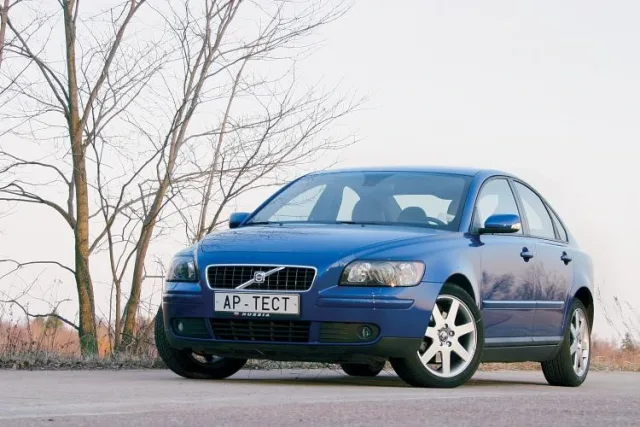
In the Volvo, sitting behind the wheel is also comfortable. On the neat steering wheel there are audio system control buttons, excellent instruments are well readable both day and night, and the onboard computer display can show all messages in native Cyrillic. The automatic transmission selector has an optimal scheme without unnecessary positions: lever towards you — Drive mode, to the right — manual mode. There is also an indicator — in the window on the instrument cluster.
 |  |
| Leather seats with servos — an expensive option | A pull-out cushion for children is built into the rear "sofa" |
 |  |
| The "floating" console is a striking solution | The Volvo's trunk is small, the opening is narrow. But there is a folding partition |
But the accelerator pedal is squeezed between the brake pedal and the central tunnel — a wide boot barely fits into this gap. The seat does not offer the same freedom of adjustment as in the Jetta, and the seat shape is slightly worse. And the main problem of the Volvo is the small buttons on the central console. On a rough road, and especially with a lady's finger with long manicure, it will be difficult to turn on the air recirculation in the cabin.
 |
| Volkswagen pleases with exemplary ease of climate control operation |
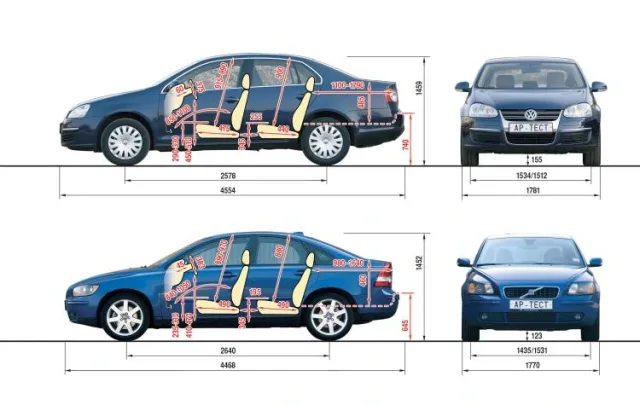
For rear passengers, Volkswagen is also preferable. Despite the higher central tunnel, there is more legroom in the "people's car" — it is easier to get in, and there is plenty of space for feet under the front seats. In the Volvo, you have to squeeze your legs into a narrow gap under the front seats: uncomfortable. Moreover, the ceiling in the Volvo is lower. And despite the rich equipment, the S40 has no rear air vents. But the Jetta has them.
The Volvo's trunk is 120 liters smaller than the Jetta's. And this is despite the fact that the Volvo has a "doughnut" spare under the floor, while the Jetta has a full-size spare. In terms of opening width, Volkswagen also wins — it is more convenient to load large items here. In addition, the Volkswagen trunk lid rises by itself on gas springs — you just need to press the button on the key fob. Finally, the Jetta pleases with "trunk" conveniences — folding hooks and a spacious pocket that helps secure small bags. What can the Volvo answer? Perhaps only a flimsy plywood partition that can divide the luggage compartment into two parts.
As for the powertrains, we took for the test a Volkswagen with a two-liter 2.0 FSI engine producing 150 hp and a Volvo with a 170-horsepower 2.4-liter engine. Unfortunately, there was no "transmission" parity at all: the Jetta had a six-speed manual, and the Volvo S40 had a five-speed automatic. So acceleration dynamics can only be compared with this caveat.
 |  | |
| On the ceiling — a glasses holder | The glove box is cooled | The 2.0 FSI engine requires AI-98 gasoline. At worst, AI-95 will do… |
 |  |  |
| The Jetta's trunk is 120 liters larger than the Volvo's | Firm seats distribute load well | It is more comfortable to sit in the back of the Jetta than in the S40 |
The ultimate capabilities of both cars are approximately the same — both in acceleration dynamics and in top speed. Controlling the Jetta's acceleration is a pleasure. Gears shift precisely, the engine pulls from 2000 rpm, and the gear ratios are well chosen. And what about the Volvo? The engine is also good here, but the five-speed automatic even in manual mode works unhurriedly. For calm city driving — just what you need. But during highway overtaking, the Volvo makes you nervous: the gearbox is in no hurry to downshift when you press the gas pedal. At least the automatic works flawlessly at the start — with a sharp press on the accelerator, the S40 instantly takes off and can even please the driver with a slight wheelspin of the front wheels.
Both cars brake effectively, the anti-lock braking systems work well, and the pedals have good feedback. True, the Volkswagen was slightly inferior to the Volvo in braking distance, but we attribute this to the tires: the Jetta was fitted with economical Michelin Energy tires, whose main advantage is low rolling resistance. The Volvo sedan, on the other hand, ran on more sporty and, we note, more expensive Pirelli P7 tires.
In terms of handling, the Golf platform is one of the best in its class, and the Jetta confirmed this once again. How pleasant it is to drive a Volkswagen! High-speed straights, bends of any steepness — the Jetta handles it all. Quick and unambiguous responses, excellent grip in corners, superb feedback from the electric power steering — perhaps still the best among "purely electromechanical" devices... The only concern is a tendency to oversteer when lifting off the throttle in a极限 corner. But it's worth paying extra for the ESP stability system, and you needn't fear oversteer.
The Volvo also handles well — the chassis based on the new Focus platform is excellently tuned, and the steering is even "heavier" in corners than the Jetta's. However, in corners, the Volvo's steering is less informative — the effort at the wheel builds up sluggishly as the steering angle increases. As a result, you feel the car less, especially at the start of a maneuver. So initially, we were cautious in corners with the Volvo — and only later realized we could go much faster. Not slower than the Jetta! Well, maybe just a tiny bit: the "moose test," i.e., simulating an avoidance maneuver around a suddenly appearing obstacle, was performed by the "forty" at a lower speed. And this despite low-profile and stickier tires.
However, for most drivers, this is not significant. But the presence of the DSTC stability system is a notable plus. Moreover, the electronics don't doze off even after its formal deactivation — when the DSTC deactivation button is pressed, the system allows some sliding but confidently suppresses deep oversteer.
Both the Volvo and the Volkswagen are somewhat stiff. On relatively smooth asphalt and at speeds below 100 km/h, the Volvo feels more comfortable — there's less vibration in the cabin than in the Jetta, which faithfully replicates the road profile. But once you speed up, the Jetta takes over — its suspension is more energy-intensive, so the body rocks less over bumps. Even fully loaded with five passengers, the Volkswagen handles broken roads excellently. The Volvo's suspension, however, can't absorb impacts in such conditions — the compression bump stops often engage harshly.
On the other hand, the Jetta is noticeably noisier. The engine runs louder and harsher (emitting sharp sounds at startup, like a diesel), and the tires are noisier — on any surface, the cabin fills with an unpleasant hum. Apparently, it's due to insufficient sound insulation of the wheel arches and the acoustic properties of the body — as if it acts like a megaphone, resonantly amplifying road noise.
The conclusion is this. Even though the Jetta isn't as beautiful as the Volvo, it's more practical and better suited to our roads. What matters more in the "small business class" — design or functionality? If it were about mass-market cars, the answer would be clear — the Volkswagen is preferable. But with the Jetta and Volvo S40, it's different — many buyers of such cars don't need space in the back seat. They need status. The awareness that they chose a compact and expensive car, although for the same money, $23,000–40,000, they could easily have bought a car a class higher. But — not as prestigious.
So the Volvo S40 will definitely never become a bestseller — it's a "status" car. But the Jetta... If it were (purely hypothetically) produced at the planned assembly plant in Kaluga with a corresponding price reduction, it would certainly become popular in Russia. Why not? After all, the Jetta is, ultimately, a "Golf with a separate trunk."
What's the price?
Volkswagen Jetta sedans are on average $3,000 more expensive than Volkswagen Golf hatchbacks. The most affordable Jetta 1.6 (102 hp) in Trendline trim (ABS, traction control, six airbags, air conditioning, audio preparation, central locking, electric windows and mirrors) costs $22,909. The surcharge for a six-speed automatic is $2,322. Prices for two-liter versions 2.0 FSI (150 hp) start at $28,901, for diesel versions — from $27,049 (1.9 TDI, 105 hp) or from $30,206 (2.0 TDI, 140 hp). For turbodiesel cars, you can order a robotic preselective DSG gearbox ($1,800). All-wheel-drive 4Motion versions are not yet offered by dealers.
Warranty — 2 years without mileage limit.
The Volvo S40 is supplied to Russia only with petrol engines, but their range is noticeably wider. With a 1.6-liter engine (100 hp), the Volvo S40 costs the same as the base Jetta — $22,900. The equipment is also similar. True, there are only four airbags, but a CD audio system is already offered as standard. The five-speed automatic on the Volvo is cheaper — $1,550. With a 1.8-liter engine (125 hp) and manual gearbox, the S40 costs $25,900. The next step is five-cylinder engines with a volume of 2.4 liters (140 or 170 hp, $28,900 or $30,900, respectively). Our test featured a richly equipped 170-horsepower car for $49,741. And at the top of the range is the all-wheel-drive S40 2.5T AWD sedan with a 220-horsepower turbo engine for $43,400.
Warranty — 2 years or 100,000 km.
"Moose test"
Both sedans successfully passed the "moose test." But the Jetta is better suited to such situations — even despite the lack of a stability system, the expert behind the wheel of the Volkswagen managed to achieve a higher speed and easily handled the oversteer when returning to their lane. The "random" runs, in which four drivers attempted to perform the avoidance maneuver at 65 km/h on the first try, also went more successfully — only one person made a mistake.
 |  |
In the Volvo, experts complained about the lack of steering feedback — it's harder to work the wheel precisely here. Moreover, even the active DSTC system sometimes didn't help keep the car within the lane due to deep oversteer. And in the "random" runs, two out of four drivers made mistakes.

| Autoreview test results | |||||
| Cars | Speed* | Experts | |||
| 1 | 2 | 3 | 4 | ||
| Volkswagen | 72.7 | + | + | + | – |
| Volvo | 71.2 | – | + | + | – |
| * Maximum speed of maneuver achieved by the expert, km/h | |||||
| (+) Maneuver completed | |||||
| (–) Maneuver not completed | |||||
Equipment of the cars participating in the test
| Car | Volkswagen Jetta 2.0 FSI | Volvo S40 2.4i |
| Base price of the car, $ | 29909 | 30900 |
| Front airbags | + | + |
| Inflatable curtains | + | + |
| ABS | + | + |
| Traction control system | + | O |
| Dynamic stability control system | – | O |
| Power steering | + | + |
| Automatic transmission | – | O* |
| Adjustable steering column (height/reach) | +/+ | +/+ |
| Leather steering wheel | O | O |
| Multifunction steering wheel | O | O |
| Power-adjustable front seats | – | O |
| Driver's seat memory | – | O |
| Heated front seats | + | + |
| Auto-dimming rearview mirror | – | O |
| Compass in rearview mirror | – | O |
| Dual-zone climate control | O | O |
| Built-in phone | – | O |
| Headlight washers | + | + |
| Central locking (remote) | + | + |
| Keyless entry | — | O |
| Immobilizer | + | + |
| Power-folding mirrors | – | O |
| Power and heated exterior mirrors | + | + |
| Power windows front/rear | +/+ | +/+ |
| Rain sensor | – | O |
| Trip computer | + | + |
| Split-folding rear seat | + | + |
| Built-in child seats | – | O |
| Ski hatch | + | – |
| CD audio system | O | O |
| CD changer | – | O |
| Fog lights | – | O |
| Full-size spare wheel | + | – |
| Metal engine underbody protection | + | – |
| Alloy wheels | – | O |
| Metallic paint | O | O |
| Power sunroof | – | O |
| Child safety rear door locks (remote) | – | O |
| Cruise control | + | O |
| Rear parking sensors | – | O |
| Leather interior | – | O |
| Remote fuel filler flap lock | + | + |
| Xenon low-beam headlights | – | O |
| Price of tested car, $ | 30577 | 49741 |
| (+) Included in base version | ||
| (–) Not available in base version | ||
| (O) Options installed on tested cars | ||
| * Manual gear selection possible | ||
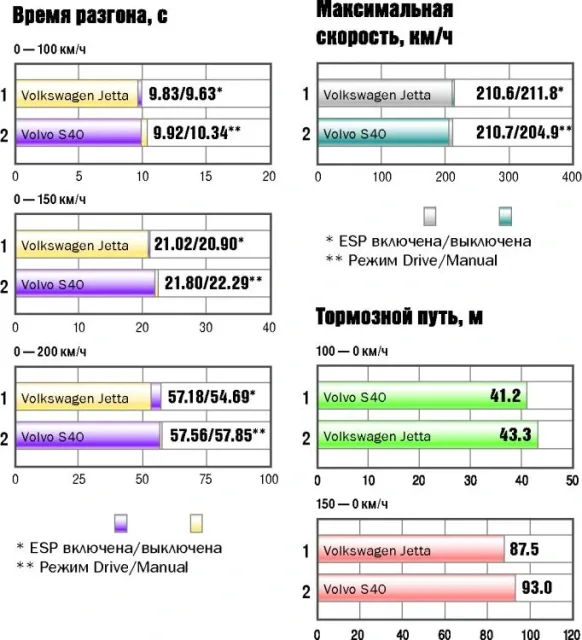
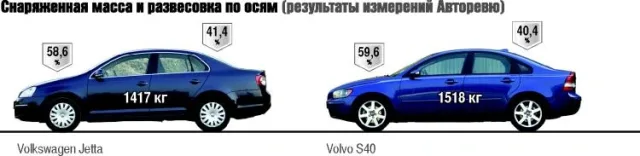
| Some Autoreview measurement results | ||
| Car | Volkswagen | Volvo |
| Jetta | S40 | |
| Maximum speed, km/h | 210.6 (211.8)* | 210.70 (204.85)** |
| Acceleration time, s | ||
| 0—50 km/h | 3.29 (3.15)* | 3.44 (3.48)** |
| 0—100 km/h | 9.83 (9.63)* | 9.92 (10.34)** |
| 0—150 km/h | 21.02 (20.90)* | 21.80 (22.29)** |
| 0—200 km/h | 57.18 (54.69)* | 57.56 (57.85)** |
| over 400 m | 16.94 (16.84)* | 17.10 (17.32)** |
| over 1000 m | 30.74 (30.64)* | 31.09 (31.37)** |
| 60—100 km/h (III)/(IV)/(D) | 5.93/7.38/— | 7.44/12.7/6.06 |
| 80—120 km/h (V)/(VI)/(D) | 10.12/12.65/— | 21.58/—/7.65 |
| Coast-down, m | ||
| from 50 km/h | 743 | 621 |
| 130—80 km/h | 1162 | 1115 |
| 160—80 km/h | 1733 | 1666 |
| Braking distance | ||
| from 100 km/h, m | 43.3 | 41.2 |
| deceleration, m/s² | 8.9 | 9.4 |
| from 150 km/h, m | 87.5 | 93 |
| deceleration, m/s² | 9.9 | 9.3 |
| * ESP on (off) | ||
| ** Drive mode (Manual mode) | ||
| Autoreview expert ratings | |||
| Parameter | Max. score | Volkswagen | Volvo |
| Design | 160 | 125 | 140 |
| Exterior | 80 | 60 | 70 |
| Interior | 80 | 65 | 70 |
| Ergonomics | 160 | 135 | 125 |
| Driver's workplace | 80 | 75 | 70 |
| Visibility | 80 | 60 | 55 |
| Dynamics | 290 | 250 | 245 |
| Acceleration dynamics | 90 | 75 | 70 |
| Braking dynamics | 100 | 90 | 90 |
| Handling | 100 | 85 | 85 |
| Ride comfort | 210 | 170 | 170 |
| Ride smoothness and vibration protection | 80 | 60 | 55 |
| Acoustic comfort | 70 | 55 | 65 |
| Climate control | 60 | 55 | 50 |
| Interior comfort | 180 | 155 | 140 |
| Passenger seats | 70 | 60 | 55 |
| Trunk | 60 | 55 | 45 |
| Interior transformation | 50 | 40 | 40 |
| Total | 1000 | 835 | 820 |
 |  |
 |  |
| Speedometer accuracy | |||||||||
| Speedometer reading, km/h | 40 | 60 | 80 | 100 | 120 | 140 | 160 | 180 | 200 |
| True speed, km/h | |||||||||
| Volkswagen Jetta | 38 | 57 | 76 | 94 | 112 | 132 | 151 | 169 | 187 |
| Volvo S40 | 41 | 61 | 80 | 101 | 120 | 141 | 160 | 180 | 201 |
| Volkswagen Jetta 2.0 FSI, Volvo S40 2.4i (manufacturer data) | ||
| Vehicle | Volkswagen | Volvo |
| Body type | 4-door sedan | 4-door sedan |
| Number of seats | 5 | 5 |
| Trunk volume, l | 527 | 404 |
| Curb weight, kg | 1319 | 1369 |
| Gross weight, kg | 1910 | 1960 |
| Engine | petrol, with direct fuel injection | petrol, with distributed fuel injection |
| Location | front, transverse | front, transverse |
| Number and arrangement of cylinders | 4, in-line | 5, in-line |
| Displacement, cm3 | 1984 | 2435 |
| Compression ratio | 11.5:1 | 10.3:1 |
| Number of valves | 16 | 20 |
| Maximum power, hp/kW/rpm | 150/110/6000 | 170/125/6000 |
| Maximum torque, Nm/rpm | 200/3500 | 230/4400 |
| Gearbox | manual, 6-speed | automatic, 5-speed |
| Gear ratios: | ||
| I | 3.78 | 4.66 |
| II | 2.27 | 3.03 |
| III | 1.52 | 1.98 |
| IV | 1.19 | 1.34 |
| V | 0.97 | 1.02 |
| VI | 0.82 | — |
| reverse | 3.6 | 5.11 |
| final drive | 4.27 | 2.44 |
| Drive | front-wheel | front-wheel |
| Front suspension | independent, coil spring, McPherson, with stabilizer | independent, coil spring, McPherson, with stabilizer |
| Rear suspension | independent, coil spring, multi-link, with stabilizer | independent, coil spring, multi-link, with stabilizer |
| Front brakes | disc, ventilated | disc, ventilated |
| Rear brakes | disc | disc |
| Tires | 205/55 R16 | 205/50 R17 |
| Maximum speed, km/h | 211 | 215 |
| Acceleration time 0-100 km/h, s | 9.2 | 8.9 |
| Fuel consumption, l/100 km | ||
| urban cycle | 9 | 13.2 |
| extra-urban cycle | 5.6 | 6.7 |
| combined cycle | 6.9 | 9.1 |
| Fuel tank capacity, l | 55 | 62 |
| Fuel | petrol AI-95-98 | petrol AI-91-98 |