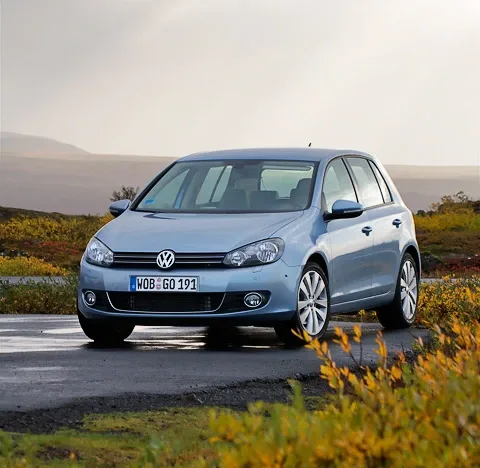
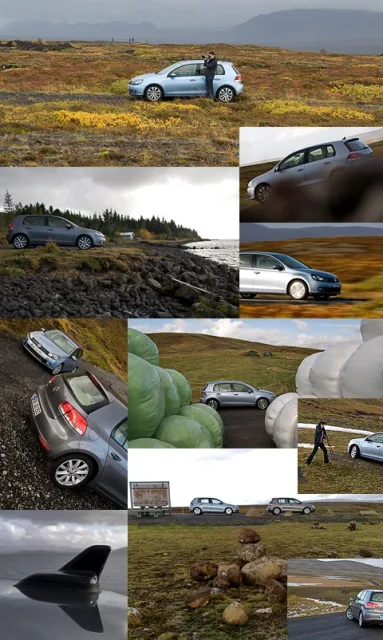
You can be sure — they will come. After all, the Golf has an incredibly loyal audience: about 70% of owners choose the new generation of the same model when changing cars. You just need to let them know. That's why when I asked how much was invested in the new Golf, they simply waved their hand: like, what difference does it make, why do you need these numbers? Get behind the wheel and tell everyone that the new Golf has arrived. And it has become better!
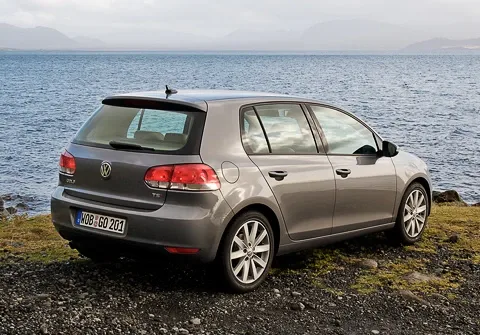
The rear lights are perhaps the most controversial detail of the exterior. From most angles they look overly large and amorphous, although the contours themselves are drawn elegantly. Alas, the Golf belongs to those cars whose perception changes greatly depending on lighting: the sides either effectively "play" or swell into shapeless bubbles.
So, the new Golf has become better. Could we stop there? But let's count: the fifth generation sold 2.2–2.3 million units. This means the Germans already have one and a half million guaranteed sales in their pocket. With a planned 600 thousand cars per year, you can calmly work for a couple of years just on moving owners of the "fifth" Golf to the "sixth". And considering that the company's plans regularly fail (in its best year, the "fifth" Golf never reached the declared 600 thousand at launch), customer loyalty alone will last until the very restyling.
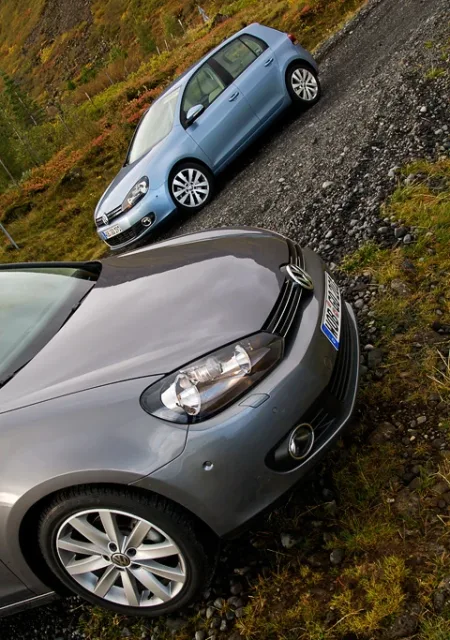
The rear overhang was increased by 7 mm, but the overall body length was reduced by half a centimeter. The secret is that 12 mm were removed from the front overhang — and this is purely a design decision. Behind the false radiator grille hides a new, more compact cooling system.
I, however, am haunted by professional curiosity: how much money is invested in this car? After all, its philosophy is to be more expensive in essence, but sell for the same money. It looks more solid, the interior seems higher quality, the base already has ESP and seven airbags, and the list of options is like a car a class higher. At the same time, European dealers should not raise the price by more than 200 euros. How is that possible?
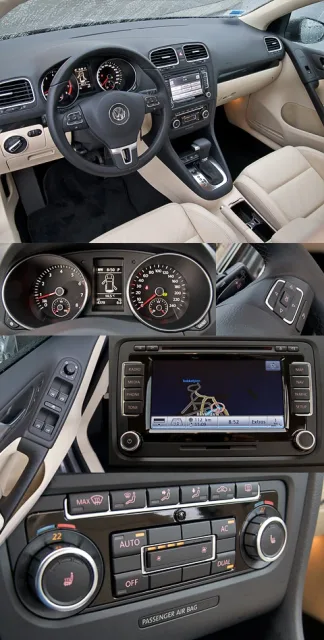
- With the disappearance of the poisonous blue instrument lighting, the interior has become noticeably cozier. Trim materials are noticeably better than before. The seating position is still impeccable, and the window lift control block has moved higher, onto the door panel protrusion.
- However, ergonomic flaws are still present. Knees still catch the steering column and press against the side of the center console. The force on the climate control knobs seems insufficiently solid, the numbers on the rings are hard to read, and the two-arm key for adjusting airflow intensity is inconvenient. True, with such climate control operation, the control unit is more of a decorative element: during the entire test, I turned to it only once.
- The temperature can now be changed in one-degree increments. Previously, the step was half a degree — and I used that. The climate control readings are duplicated on the large screen of the optional multimedia system, which is also touch-sensitive — like in the Passat CC sedan.
Vice President Detlef Wittig, one of Volkswagen's chief financiers, revealed the secret: it's all about the genie. In the previous Golf lived a genie-engineer, and in the current one — an accountant.
— The "fifth" Golf was too complex and expensive to produce, so the "sixth" appeared ahead of schedule. The main task of the project was to simplify the design in terms of assembly. And we managed to reduce the production cycle of one car from 35 to 25 hours!
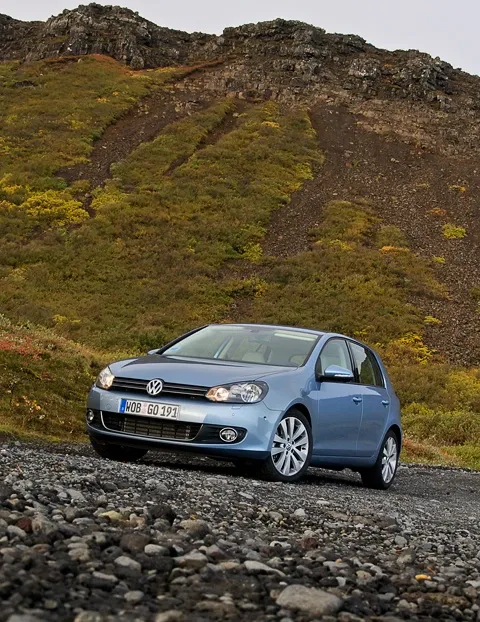
The Golf will arrive in Russia in March and only with gasoline engines: 1.6 (102 hp) and 1.4 TSI (122 hp). The more powerful 160-horsepower TSI version is too expensive, and Euro-5 turbodiesels with particulate filters are not adapted to our fuel. However, we expect a certain 110-horsepower turbodiesel with a volume of 1.6 liters. Prices will most likely rise.
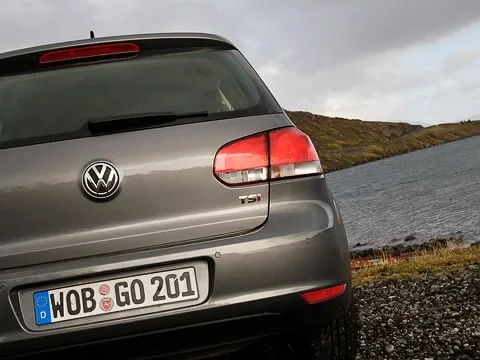
From under the Volkswagen emblem on the fifth door, a rear-view camera emerges with a slight noise, transmitting a color image to the multimedia system display.
Ten hours is at least 500 euros saved on each car just in labor costs. They plan to produce 600 thousand Golfs per year — here you have 300 million euros of free funds. Over four years of production, that adds up to 1.2 billion. There's room to roam. True, this is still less than what the French invested in the new Megane. But Volkswagen is simply evolving, and it didn't have such quality problems.
Now it's clear why everything here seems familiar to me. Optimization! The power structure of the body has not fundamentally changed, nor has rigidity. Key geometric parameters remain the same. The layout is unchanged. In other words, I'm sitting in exactly the same place, holding a steering wheel of the same diameter, and above my head is the same roof. Under the hood are familiar engines. But the sensations are completely different.
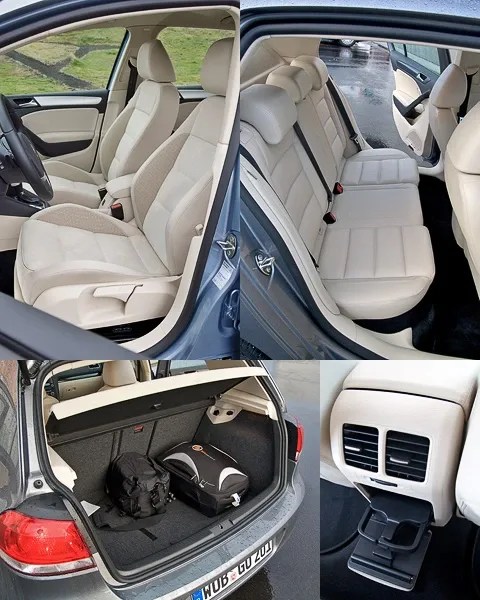
The interior hasn't changed in layout. There's no more space in the back, but at my height of 188 cm, I can easily sit "behind myself". The trunk is exactly like the "fifth" Golf's.
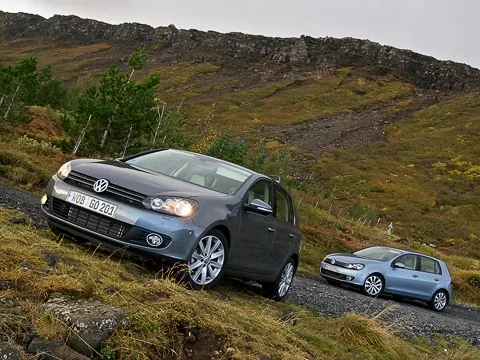
Everything has become more modern, refined, pleasant both to look at and to touch. And most importantly, the new Golf drives in a bourgeois manner. This is especially noticeable on the incredibly grippy Icelandic asphalt, which, like the local buildings, food, and people, is made of volcanic rock. Rough, porous. (A country with such roads simply cannot be bankrupt!) You're racing under a downpour along a mountain serpentine and can't believe your eyes: the speedometer shows 140, 160, 180... And you don't feel the speed!
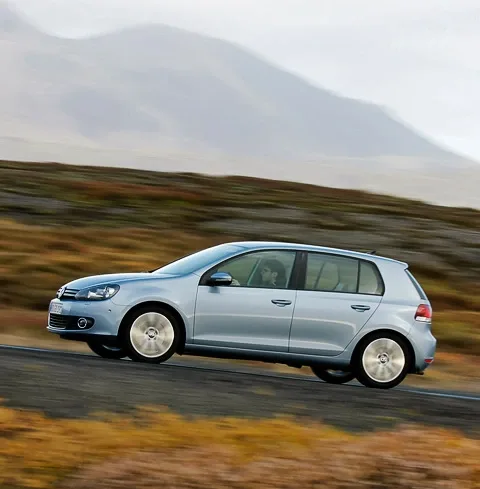
Silence in the cabin, worthy ride smoothness, detachment from the outside world — on the move, the Golf feels like a car a class higher.
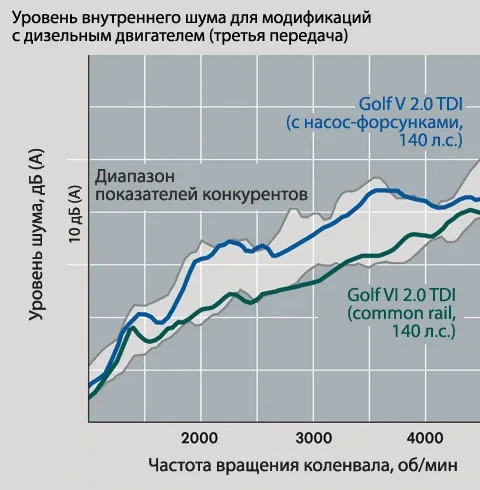
Only the vestibular apparatus gets hysterical: by the overloads, it's clear that the speed is considerable. But the other feedback channels are either turned off or maximally muted. Firstly, the car is unusually quiet. The Germans paid special attention to acoustic comfort, because it's one of the most effective ways to create the feeling of an expensive car.
Secondly, the former crystal-clear steering response after installing electronically controlled shock absorbers drowned in increased effort. And this "fat" in handling also works for the image. The driver seems distanced from the road: the car reacts precisely, but unhurriedly. The steering wheel makes a full three turns from lock to lock, and during active driving, you constantly have to correct it — it seems like you're driving a larger and heavier car. Although the Golf has become lighter by about 20–50 kg depending on the engine.
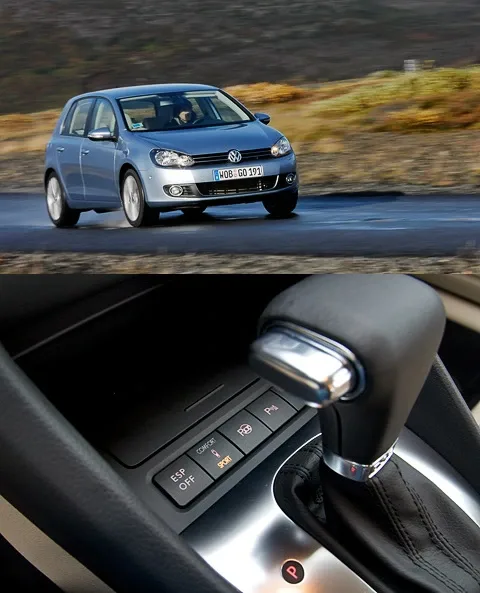
- Only in the most non-driver mode, Comfort, is the steering wheel light enough to properly "probe" the contact patch. But from the chassis in this mode, you want more composure. Normal is optimal in this regard, and Sport is excellent (although it already shakes there), but the steering wheel in these modes is over-weighted. No, it's not for such settings that the Golf's electric power steering received the unofficial title of best in class!
- Instead of "automatics", there are now only DSG "robots".
Finally, the responses to the gas pedal are heavily damped. It's clear that this is how they achieved Euro-5 emissions and better fuel economy. But this sluggishness of responses again doesn't stand out from the overall picture. The whole surreal thing is that even with weakened feedback, I don't feel uncertainty. The grip reserve is colossal. You can make the Golf slip only with outright provocation, and then the non-switchable stability system tactfully intervenes. It doesn't interfere: on a car that wants to seem more massive than it is, such ESP settings are perceived naturally. It's just the specialization of the new genie.
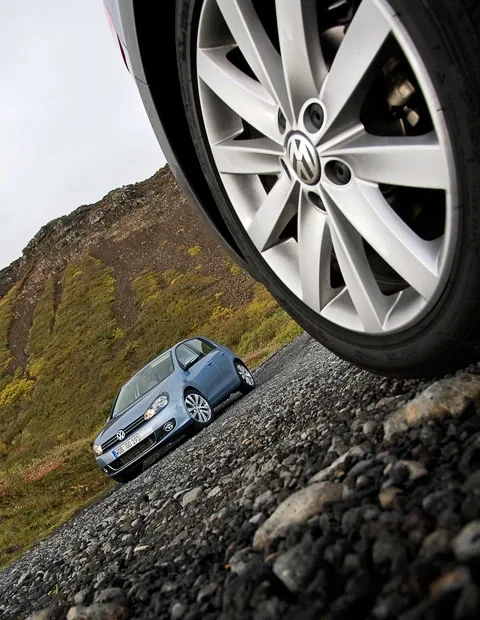
Despite the desire to cheapen production, the Golf retained the multi-link suspension, which has already become optional in the modern environment, and rear disc brakes even on the 80-horsepower version.
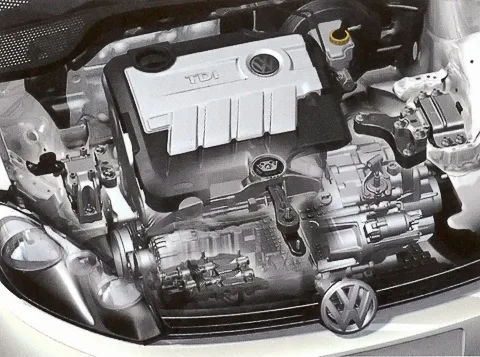
My hatchback is diesel. But you've probably already understood: the Golf 2.0 TDI in the usual sense doesn't fit into the new refined concept. The engine compartment is wrapped in additional sound insulation, even the decorative engine cover is partially made of soft sound-absorbing "rubber". The engine itself is mounted on advanced hydraulic mounts. Individual pump injectors were abandoned in favor of a progressive fuel rail — it's quieter. And in the oil pan of the crankcase, a couple of metal "sausages" are now welded — balance shafts.
The engine reveals its proletarian origins only when cold. On the move, the two-liter 140-horsepower four-cylinder hums with a noble baritone — quite gasoline-like. And it pulls the same way, thoughtfully revving up to the red zone. But I somehow don't feel the advantage of a solid 120 newton-meters over the less powerful 122-horsepower 1.4 turbo gasoline engine.
Even according to the official data, the diesel Golf beats the gasoline one in the sprint to 100 km/h by only 0.2 seconds. In real driving, this difference is practically impossible to feel. On both engines, overtaking requires caution and calculation. Maybe the six-speed DSG robot gearbox is to blame, eating up the diesel's traction advantage? After all, the gasoline engine with less torque got a seven-speed gearbox with closer ratios.
However, the 160-horsepower gasoline version also doesn't make your heart race. It's just that the breathtaking landscapes outside the windows change faster, and the driver doesn't need to exert the slightest effort. We enter corners a bit earlier, press the brake a bit more actively, and switch the suspension to sport mode a bit more often. The genie from the new lamp isn't capable of destroying cities — its lot is to turn the most dizzying serpentines into safe highways. Fast, comfortable, cozy, and reliable.
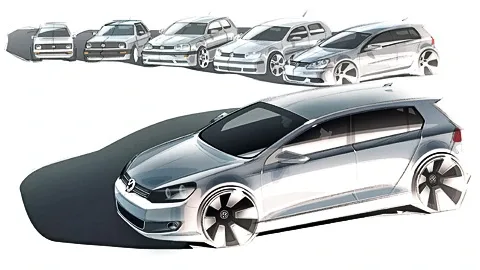
Can such a sybarite be kept in any other "packaging"? Could the Golf have looked different? It turns out that former chief designer Murat Gunak had an idea to shake up the usual perceptions of the Golf! Before Walter de Silva took over as chief designer, Gunak's team was working on a more emotional and expressive version.
What a twist! And I thought Gunak, the creator of the fifth Golf, was, on the contrary, a proponent of boring conservatism. And then the poet de Silva, who gave the world the Alfa 156 and the new Seats, flew in on a Pegasus — and breathed life into the Golf. He trimmed a corner here, added a crease there... But, as it turns out, it was de Silva who made the car so restrained. If the new Volkswagen boss Winterkorn hadn't brought de Silva from Audi, we might well have seen a fundamentally different Golf.
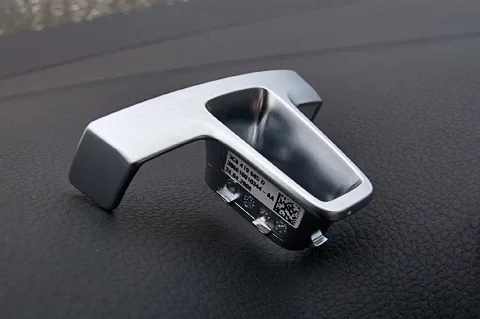
But millions of loyal customers aren't risked. There can be no talk of any radicalism — this isn't some Megane! That's why the new Golf looks so much like everything that came before. Only one detail remains from the buried Gunak project — a metallic insert on the steering wheel. This is the brightest element of the interior, the only thing that stays in memory half an hour after the ride. Within ten minutes, the new instrument panel with scales like the Passat CC and white backlighting is forgotten. Within an hour, the new climate control unit. And by morning, the interior features can only be reconstructed from photographs.
But the most amazing thing is that it's completely impossible to remember what the Golf was like before! The new car completely erases memories of its predecessor. And that's how it should be: why should the owner of a sixth Golf remember how good it was in the beloved fifth? The main thing is that it's a Golf. And the genie is in place. Only the slave of the lamp is not it, but you. So when a voice from a window or TV says "Old lamps for new!" — change your old lamps for new ones. And I feel sorry for the old memories — the new ones destroyed them and vanished, leaving nothing in return.
Technical specifications
| Specifications |
1.4 |
1.6 |
1.4 TSI |
1.4 TSI |
2.0 TDI |
2.0 TDI |
| Body type |
3/5-door hatchback |
| Number of seats |
5 |
| Length, mm |
4199 |
| Width, mm |
1779 |
| Height, mm |
1479 |
| Wheelbase, mm |
2578 |
| Track front/rear, mm |
1540/1513 |
| Curb weight, kg |
1142 |
1157 |
1215 (1241)* |
1271 (1286) |
1266 |
1299 (1322) |
| Gross weight, kg |
1750 |
1780 |
1820 (1850) |
1840 (1860) |
1840 |
1910 (1930) |
| Trunk volume, l |
350–1305 |
| Engine |
| Type |
gasoline, with distributed fuel injection |
gasoline, with direct fuel injection and turbocharging |
gasoline, with direct fuel injection and combined supercharging |
turbodiesel with accumulator fuel injection |
| Location |
front, transverse |
| Number and arrangement of cylinders |
4, in-line |
| Number of valves |
16 |
8 |
16 |
16 |
16 |
16 |
| Displacement, cm3 |
1390 |
1595 |
1390 |
1390 |
1968 |
1968 |
| Max power, hp/rpm |
80/5000 |
102/5600 |
122/5000 |
160/5800 |
110/4200 |
140/4200 |
| Max torque, N•m/rpm |
132/3800 |
148/3800 |
200/1500–4000 |
240/1500–4500 |
250/1500–2500 |
320/1750–2500 |
| Transmission |
| Gearbox |
M5** |
M5 |
M6 (R7) |
M6 (R7) |
M5 |
M6 (R6) |
| Drive |
front |
| Chassis |
| Front suspension |
independent, spring, McPherson |
| Rear suspension |
independent, spring, multi-link |
| Front brakes |
disc, ventilated |
| Rear brakes |
disc |
| Performance characteristics |
| Maximum speed, km/h |
172 |
188 |
200 |
220 |
194 |
209 (207) |
| Acceleration time 0–100 km/h, s |
13.9 |
11.3 |
9.5 |
8 |
10.7 |
9.3 |
| Fuel consumption, l/100 km |
| urban cycle |
8.5 |
9.7 |
8.2 (7.7) |
8.1 (7.5) |
6 |
6.4 (7.1) |
| extra-urban cycle |
5.1 |
5.6 |
5.1 (5.0) |
5.2 (5.2) |
3.7 |
4 (4.5) |
| combined cycle |
6.4 |
7.1 |
6.2 (6.0) |
6.3 (6.0) |
4.5 |
4.9 (5.4) |
| Emission standard |
Euro-5 |
| Fuel tank capacity, l |
55 |
| Fuel |
AI-95 |
diesel |
* In parentheses, data for modifications with robotic gearbox.
** Gearboxes: M5 — manual five-speed, M6 — manual six-speed, R6 — robotic six-speed, R7 — robotic seven-speed.
Technology
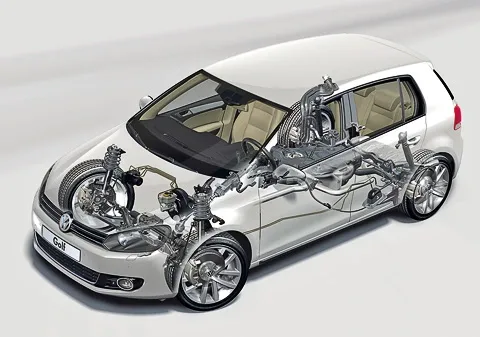
The four-link rear suspension on a subframe, front McPherson struts, and electromechanical power steering — the Golf's platform hasn't changed. Only the springs have been recalibrated for better interaction with the optional adaptive dampers.
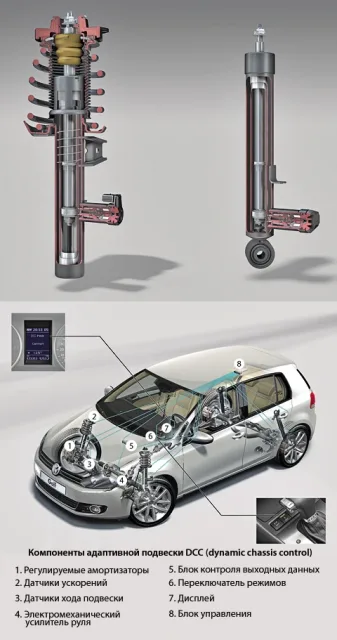
The DCC system is based on Ohlins twin-tube dampers with electromagnetic valves and suspension travel sensors, from which information goes to the control unit a thousand times per second. The computer commands a change in the valve cross-section, varying resistance on compression and rebound strokes.
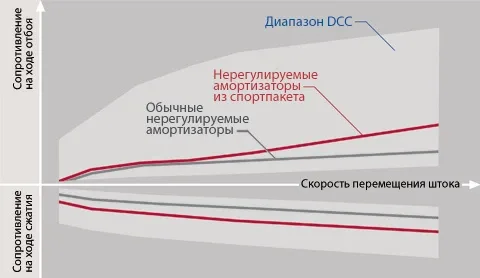
The electronics allow the adaptive dampers to be softer than the standard "passive" suspension when needed, and stiffer than the optional sport struts when required. In Normal mode, the valves continue to operate on a free program — across the entire range of available settings. Comfort mode uses the softest zone, while Sport mode, on the contrary, is extremely stiff.
Safety
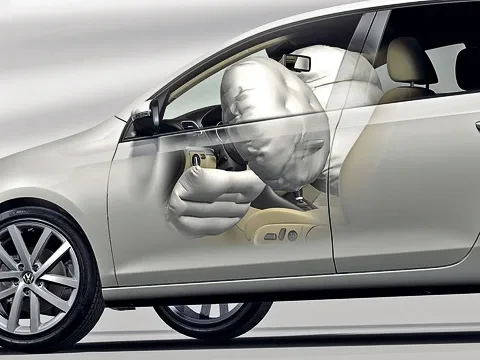
The task of the knee airbag is not only to prevent contact with the dashboard but also to help secure the driver's body for optimal operation of other restraint systems.
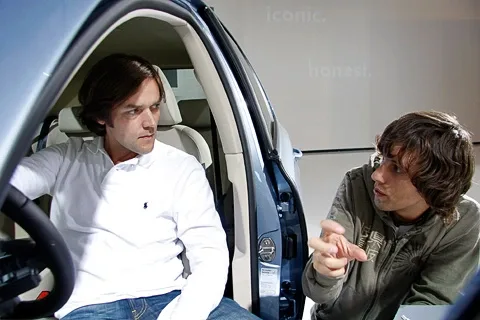
Tomasz Baczorski, the designer of the new interior, explained the issue with the vague resistance on the climate control knobs. It turns out that the torque applied to the knobs and their play are determined by passive safety requirements. The larger the knob, the more pliable it must be. By the way, Volkswagen does not claim a rating higher than five stars from Euro NCAP: only the French can currently count on six stars, as they tailor their cars to European requirements, and for a car sold worldwide, that would be too expensive.
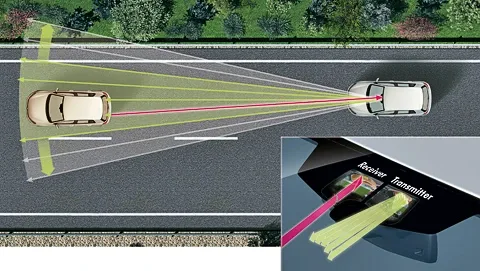
Adaptive cruise control maintains the distance to the vehicle ahead based on commands from a laser rangefinder at speeds from 30 to 210 km/h.
Comfort
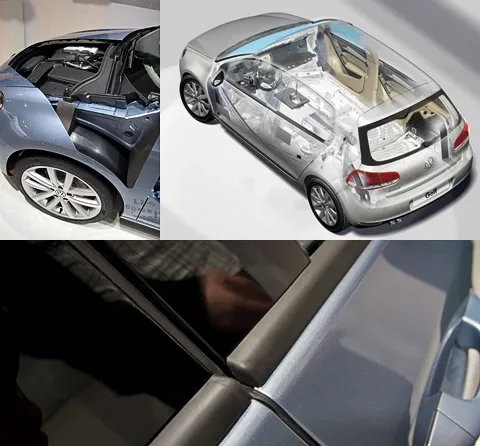
- The central place at the presentation, for which a separate pavilion was built, was occupied by a stand dedicated to improving sound insulation and vibration protection. Among the innovations are a two-layer windshield, double seals on the door windows, as well as new, lighter and more effective soundproofing materials used both outside and inside the cabin.
- An interesting detail: the rubber door seals, which were previously installed as-is with untreated edges, now have rounded end caps — and this also helps reduce noise!
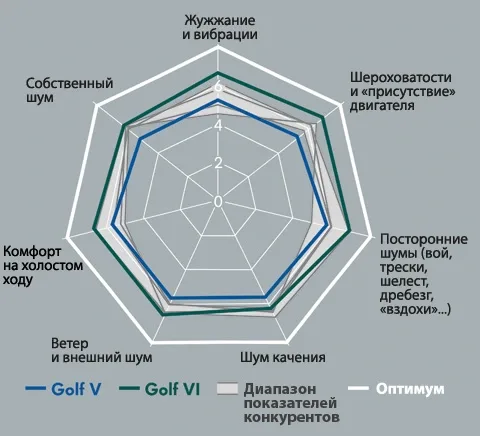
Volkswagen representatives themselves do not hide: since the appearance of the fifth Golf, competitors have seriously caught up in terms of vibration and acoustics. Therefore, the sixth generation aimed to regain leadership in this component. The diagram clearly shows how much the new model outperformed its predecessor and key rivals.
Behind the scenes
The well-mannered Icelanders drive off their excellent asphalt roads onto gravel only in huge SUVs with special low-pressure tires — otherwise, the fragile soil layer could be damaged. And us journalists were chased off the moss in Golfs! Though, all this was before the crisis...