
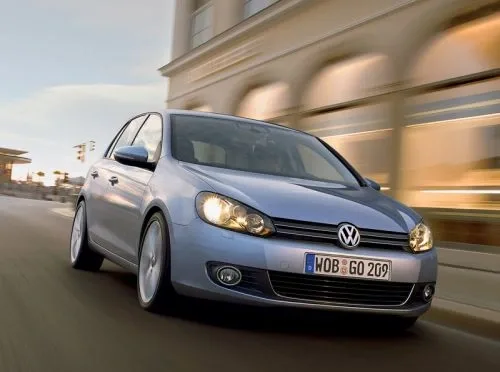
Getting acquainted with any car traditionally begins with an inspection of its exterior. The Volkswagen Golf was no exception, especially since we have waited for the sixth generation of this legendary bestseller. To be honest, the car looks rather modest on the outside. Having walked around the body, I did not find a single detail that would be memorable: everything is smooth and streamlined. Some liveliness is added by unusual wheel rims and front optics, somewhat reminiscent of slightly slanted female eyes. Otherwise, it is pure minimalism and simplicity.
But behind this external simplicity lies a carefully thought-out design concept that traces its lineage back to the first Golf. And it must be admitted that the creators of the next generation have fully earned the right to experiment. Their confidence is reinforced by the fact that no car in the world has sold in such volumes as the Golf. Moreover, disputes about the appearance accompanied all generations of this model, but in the end Volkswagen always came out on top.
On the streets of rainy and cold Reykjavik, where the test of the new model took place, one could encounter a variety of variations on the theme of Golf. Except that the first generation of 1974 is almost never seen anymore. But the rest of the family are represented in all their glory. If you place the new Golf next to its predecessors, family traits are immediately visible, although different designers worked on different generations. For example, the author of the third generation now heads the Renault design center.
The current artists approached the matter thoroughly. They did not reinvent everything from scratch but gathered the characteristic features of all descendants and the entire VW model range. Such features include the clear lines of the front part from the first generation and the rear pillar perfected in the fourth generation. An expressive line running from the front headlights to the rear ones makes the roof widen along the shoulder line, as in the Scirocco. Thanks to this, the silhouette of the new Golf looks lower and more massive.
The length of the new Golf is 4199 mm — 5 mm less than its predecessor. However, the width has increased by 20 mm, while the height remains the same. Nevertheless, the sixth generation looks more elongated thanks to well-chosen proportions.
In the front design, between the headlights, there is a grille painted in glossy black. The bumper lines combine well with the radiator design. Below is a widened air intake, also black. On the black base are chrome headlight frames that add dynamism to the car.
The rear part is built on horizontal lines. Widely spaced taillights make the car's night appearance memorable. The clarity of the lines of the light-signaling devices and reverse lights echoes the rear lights of the Touareg. In other words, the external simplicity is deceptive: the longer you study the new Golf, the more you understand that it is a cunning one in a simple wrapper.
The interior is not as simple as the exterior. Inside, you get the feeling of being in a car of almost premium class. It must be said that the Golf has more than once revolutionized the quality of finishing materials, and apparently, this is happening again. Chrome trims with a silky matte shine or the rounded contours of the instruments and steering wheel, borrowed from the Passat CC, create the impression that the car belongs to a higher class. And this is true not only for the improved Comfortline and Highline trims but also for the base Trendline.
For the European market, Volkswagen offers the new Golf with four petrol and two diesel engines ranging from 80 to 160 hp. True, not all of them will reach our country. For the test, we chose the new two-liter diesel, which, according to our data, should appear in Russia. This 110-horsepower TDI, debuting on the Golf, works in tandem with a 6-speed automatic. The engine boasts outstanding fuel consumption in the combined cycle — only 4.5 liters per 100 km. At the same time, the dynamics are quite normal: acceleration to 100 km/h takes 10.7 seconds, and the top speed is 194 km/h.
Icelandic roads are a separate topic. In the vicinity of Reykjavik, they are an endless series of turns left and right, but without serious elevation changes. This is where handling is best tested. No matter how you look at it, the Golf is a very distant but still a relative of Porsche. Apparently, this genetics explains the refined handling of the founder of the golf class. The car simply and even a bit boringly executes the driver's commands, without giving the slightest reason to doubt its loyalty. And when obedience begins to irritate the driver and he deliberately makes a mistake, the Volkswagen, equipped in the base version with the ESP system, quickly cools the ardor. The car begins to slow down, preventing dangerous tendencies. Don't misbehave!
The price of the new Golf has not yet been announced, but it is known that in European countries the new model will cost on average 200 euros more than its predecessor. True, the equipment of the cars will also become richer.
Appearance for an amateur
There are cars that attract attention with their appearance. Buyers of such cars often do not care what is under the hood and what the characteristics are. The new VW Golf, on the contrary, does not catch the eye with anything special. At first glance, there is nothing to grab onto. But the longer you interact with the new model, the clearer it becomes that it is not so simple. In the front design, a horizontally positioned grille between the headlights, painted in glossy black, is used. The bumper lines harmoniously combine with the radiator design. At the bottom is a widened air intake, painted, like the grille, in black. Due to the expressive line running from the front headlights to the rear ones, the roof widens along the shoulder line.
Driving
The Golf simply and somewhat boringly executes the driver's commands, without giving reason to doubt its loyalty.
Interior
The interior uses materials of the highest quality. You get the impression of being in a car of a higher class.
Comfort
The VW Golf is as comfortable as a car of this size can be. At least, my colleague, tired from a long flight, slept in the back seat for about an hour. That says a lot.
Safety
The car, whose body is made using high-strength steel grades, is equipped with the most modern protection means. There is no doubt that it will receive five stars in Euro NCAP tests.
Price
The price of the car will be determined closer to the start of sales, which will begin in March next year.
The new Golf from Volkswagen is not as simple a car as it might seem at first glance. Behind the restrained and even somewhat ascetic exterior hides a true athlete, ready to cope with a variety of tasks set by the owner. As for the technical content, not every competitor can boast such a list of standard and additional equipment. Take, for example, the automatic parking system that works without driver involvement.
In handling, the car pleases with precision and responsiveness, and the interior trim materials are selected to be high-quality and pleasant to the touch. The engine range is wide, and all of them are distinguished by enviable efficiency. The only thing to find fault with is the exterior design, which clearly lacks emotional solutions capable of evoking admiration.
Technical specifications
- Make and model — VW Golf VI
- Dimensions — 4199x1779x1479 mm
- Engine — turbodiesel, 1968 cm³, 140 hp/4200 rpm
- Transmission — automatic, 6-speed
- Dynamics — max 209 km/h; 9.3 s to 100 km/h
- Competitors — Mitsubishi Lancer, Toyota Corolla, Renault Megane, Mazda3
Our opinion
This car knows how to surprise: it looks simple on the outside, but inside it hides real potential. Handling is top-notch, finishing materials please with quality, and the choice of economical engines is impressive. However, the body design does not evoke emotions — it lacks bold and bright solutions.