

Volkswagen first presented the “hot” version of its golf-class model to the public at the Frankfurt Motor Show back in 1975. The engine of that time, with a displacement of 1588 cc and an output of 110 hp, allowed the GTI to reach a top speed of 182 km/h.
Thirty-three years have passed, and here is Paris. On stage again is a “hot” Golf, but now under the hood there are already 210 “horses,” the displacement has grown to two liters, and the top speed has reached the 240 km/h mark.
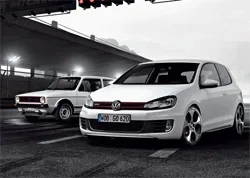
Over the years, anything has happened: there was an “anniversary” modification with 230 horsepower, timed to the model’s thirtieth anniversary, and the impressive R32 with its 250 hp. But to realize the scale of change, it is enough to look at the numbers: the first GTI weighed only 810 kg, while the sixth already weighs 1286 kg. Almost everything has changed: technologies, safety requirements, trim levels, electronic assistants. And despite this, over three decades the GTI has remained true to itself. The idea is the same — a combination of audacity with practicality. Unsurprisingly, the five previous generations have sold 1.7 million units worldwide. In essence, the current car is a tribute to history, a modern reading of that very 1975 car.
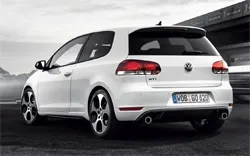
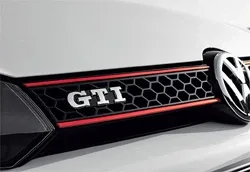
Volkswagen’s chief designer Walter de Silva explained: “We aimed for the exterior to show continuity with our heritage. So that power is expressed in a concrete, recognizable style.” No excesses! The rear spoiler, rounded rear end, a pair of round exhaust tips, 18-inch wheels, and a radiator grille with red trim inherited from the very first generation — everything points to this being a GTI. It points, but does not shout.
The “honeycomb” grille, which debuted on the Golf V, remains in place, as does the shape of the hood, echoing its predecessor. But the bumpers and optics are already new. Dimensions: width 1.78 meters, height 1.47 meters. Under the hood is a two-liter gasoline engine with direct injection and a turbo, producing 210 hp, which is 10 horsepower more than the engine of the previous generation. Peak torque is 280 Nm already at 1800 rpm. The ground clearance has been reduced by 22 mm thanks to new springs and shock absorbers. At the front are MacPherson struts, at the rear a multi-link scheme.
The differential has an electronic lock. For an additional cost, adaptive suspension is available with adjustable settings depending on the selected driving mode.
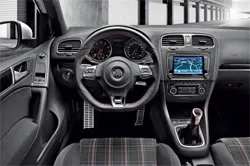
Inside, the sporty character is emphasized by the gearshift knob and pedals with aluminum inserts, a smaller-diameter steering wheel, and anatomical seats with leather elements. Equipment includes climate control and a radio with built-in navigation. The Golf VI GTI is expected to appear at dealers in mid-2009.
 |  |
 |  |
Specifications
ENGINES
TSI 2 l, 210 hp
CHASSIS
front — MacPherson, rear — multi-link, ground clearance reduced by 22 mm
DIMENSIONS (mm)
length — 4200
width — 1780
height — 1470
SALES START
from the second half of 2009
Power growth
1976 — debut of the GTI with a 1.6 engine (110 hp).
1986 — 1.8 l engine (139 hp).
2002 — turbocharged engine (180 hp).
The most powerful GTI is the “anniversary” one, timed to the 30th anniversary: 2 liters and 230 horsepower