
The discussion will not be about diesel units. Volkswagen gathered journalists at the Dmitrov test track to showcase a new product — a 1.4-liter gasoline engine from the TSI family, presented in two power variants. The test subjects were the Touran with the 140-horsepower version and the Golf GT, under whose hood 170 "horses" are hidden. To understand the scale: a conventional naturally aspirated engine with similar output would have a displacement of about 2.4 liters and would consume fuel much more eagerly.
Unsurprisingly, VW engineers are so proud of their creation. They managed to create an economical unit with a small displacement and impressive power based on the well-known 1.6-liter FSI. Moreover, this is the world's first production gasoline engine where direct injection is combined with twin charging.
The Germans' efforts did not go unnoticed — the engine received an award at the "Engine of the Year" competition in the category "Best unit with a displacement from 1 to 1.4 liters." The secret of success, besides many technical solutions, lies in the excellent coordination of the turbocharger and the mechanical supercharger.
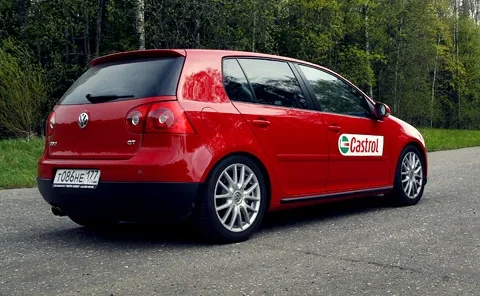
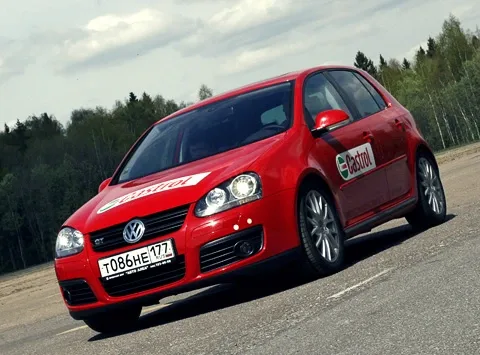
From the outside, the GT looks almost like the Golf GTI. Only one letter is missing on the badges.
The pair works so harmoniously that the 1.4-liter engine is unfamiliar with the concepts of "turbo lag" or lack of torque. While the turbo cannot create the necessary pressure at low and medium revs (up to 2.5 thousand per minute), the mechanical compressor comes into play. It quickly raises the pressure to the required level, providing the driver with the necessary thrust at the right moment. At high revs, the supercharger disengages, and the turbo continues to work alone. Therefore, cars with TSI drive equally confidently both at low and high revs.
Small dimensions, light weight, and modest displacement do not prevent this engine from delivering solid power and torque while remaining economical. All this is the merit of the friendly work of the compressor and turbo.
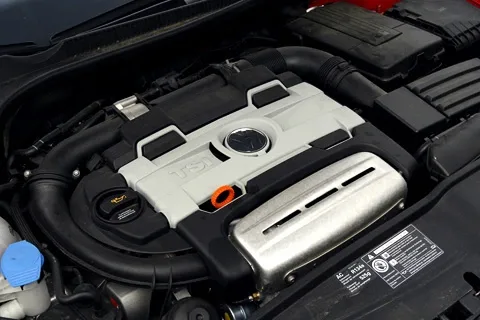
The Germans managed to make this small-sized, light-weight, and modest-displacement engine produce a lot of power and torque while consuming little fuel. The credit goes to the coordinated work of the compressor and turbo.
All these praises were confirmed by short tests of the mentioned cars. The family Touran, delivering 220 Nm already at low revs and working in tandem with DSG, looks like a serious rival not only for other "family cars" but also for the regular city traffic. Acceleration to 100 km/h takes just 8.8 seconds, and the top speed reaches 205 km/h — more than enough for a family car. The claimed average fuel consumption is 7.1 liters per 100 kilometers. True, these are manufacturer data, and in practice, the appetite will be slightly higher.
The 170-horsepower Golf GT is even hotter. Torque has grown to 240 Nm, and the dynamics have become more interesting. Such a hatchback hits 100 km/h in 7.8 seconds, and the speed limit is 215 km/h. But this is with the 6-speed manual, and with DSG the dynamics are slightly more modest. The Golf GT's appetite is also pleasing — just 7.3 liters per "hundred."
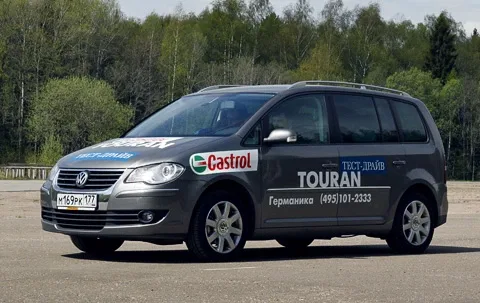
However, the driving impressions turned out to be mixed. On one hand, the instruments are pleasing: the engine revs calmly up to 7 thousand rpm, and the cars — regardless of load — accelerate confidently and tackle inclines without problems. On the other hand, on the empty roads of the test track, speed and acceleration are not felt at all, but in city traffic it would be more interesting. By the way, about the instruments: in the Golf GT's cabin, instead of the coolant temperature gauge, a boost pressure sensor has appeared, showing how fully you are using the engine's potential.
The main thing is that behind the wheel of a Golf or Touran with TSI, you do not experience a lack of torque. It is always there, and the engine's efficiency, despite the small displacement, is very high. And visits to the gas station for the owner of such a car will become less frequent. Unless, of course, the price scares you off. But that is a personal choice for everyone: the base Touran TSI with manual transmission and 140 horsepower costs $26.5 thousand. For the version with 170 "horses" and DSG, you will have to pay at least $33407.
The Golf, of course, is cheaper, but prices have so far been announced only for the 140-horsepower modification. It costs $22425 with a manual gearbox and $25448 for the base trim with DSG. For the GT, you need to shell out $30512. But TSI badges are worn not only by Golf and Touran. In Russia, Jetta TSI (from $27835 to $34826) and Golf Plus TSI (from $22478 to $27150) are already on sale. By the way, soon the same engine will appear on the Passat, and closer to autumn, a station wagon based on the Golf will debut, which will also get TSI under the hood. The only open question remains the reliability of such engines. Volkswagen claims that only an aluminum basin can be more reliable, but what else could they say?