
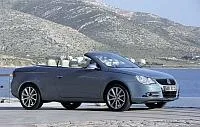
The right convertible could be anything — new or used, from Italy or from across the ocean. Slowly cruising along the southern coast of Greece, basking in the sun and catching the sea breeze is possible in any open car, even a truck without a roof. But if you want — and you do! — to attract admiring glances, the car must be not just new, but truly striking. The Volkswagen Eos was perfect for this role.
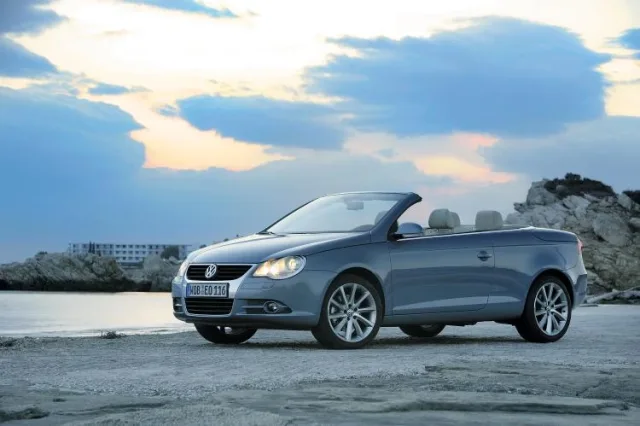
Volkswagen knows how to make cars for pleasure. Convertibles based on the first and third generation Golfs were highly sought after, and the New Beetle Convertible, which replaced them, sold tens of thousands of units worldwide last year alone. The main market is the United States. Pragmatic Europeans are not so eager to spend money on a weekend car, but the French duo of Peugeot 307 CC and Renault Megane CC managed to convince them: such coupe-cabriolets are suitable for sunny outings, daily commutes to work, and family vacations. The Germans quickly reacted to the trend — in spring 2004, they showed the Volkswagen Concept C concept in Geneva, which became the precursor to the Eos. Then Opel Astra Twin-Top joined in, and closer to the end of the year, the Ford Focus CC is expected. The rivalry promises to be fierce.
 |
| The strict interior in the spirit of the Golf is slightly enlivened by modified air vents |
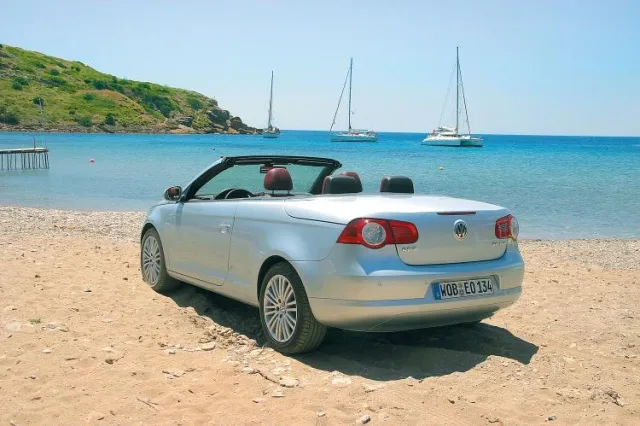
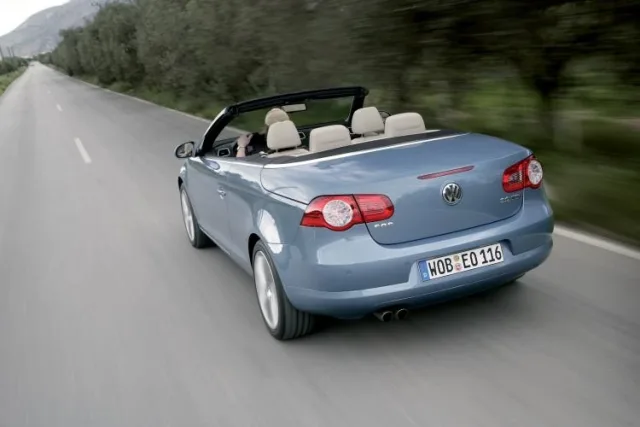
Who will emerge victorious in this battle? Most likely, the one who turns out to be the most attractive. The goddess of dawn — for that is what Eos was called in Greek myths — looks quite photogenic: expressive eyes, a charming smile, a neat, toned figure. But the Eos looks especially seductive from behind when the roof is down. Like in a short dress, and with bare shoulders at that. And the raised roof does not spoil the image, but rather teases the imagination: it's interesting to see how this lady would look if, instead of a strict suit, she wore something light and flirtatious?
However, the interior hints: there is no frivolity in this goddess. The solid front panel from the Golf, the familiar steering wheel, excellent front seats with a strict profile — everything is grown-up, and you can't just waltz up to her. The pedals are conveniently placed, with a floor-mounted accelerator and a long-travel clutch, all buttons and levers at hand... But if, as I usually do, you lower the front seat to the limit, the steering wheel adjustment range is no longer enough — it ends up too high. I also didn't like the small mirrors with strong curvature, hinting at non-Euclidean geometry: parallel lines here might well intersect. For a goddess, that's forgivable.
The trunk isn't perfect either. In "cabrio" mode, it holds a couple of medium suitcases, but to do that, you'll have to raise the roof. So we press the magic button between the front seats. Roof, up!
 |  |  |
 |  | The special feature of the Eos folding roof is that its sections don't trace spectacular arcs, but simply slide over each other. So you can raise it even in a tight garage |
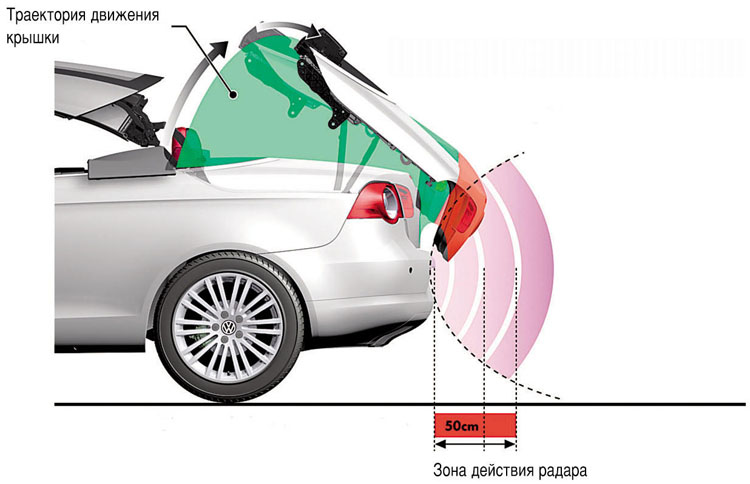 |
| To avoid hitting the plastic trunk lid, a radar behind the rear bumper scans the space behind the car: if there's an obstacle, the roof won't fold |
In the back, you can seat two fragile girls, but tall men have nothing to do there, especially with the roof up. Sitting "behind myself" (and I'm only 176 cm), I pressed my knees into the front seat and my head into the ceiling. It's also cramped width-wise: the folding roof elements forced the rear row to be narrowed by about forty centimeters.
Racing down the autobahn in a car with a 140-horsepower turbodiesel is pure pleasure. But in the first town, the drawbacks emerged. Getting moving without revving the engine above 1500 rpm is already a problem: there's not enough torque at low revs. Sharp acceleration without shifting is also a problem. The working range is narrow: from 2500 to 4000 rpm. You can't even crawl in traffic in second gear: the engine starts to jerk, and if the revs drop below 1400, it might stall on an incline. I wasn't impressed.
 |  |  |
| By convertible standards, it's quite spacious in the back | The cabin aerodynamics are good even without a wind deflector | In the armrest — a CD changer |
The gasoline turbo version is a completely different story! Now that's more like a goddess. The 200-horsepower 2.0 TFSI has a smooth and docile character. It doesn't scare you with sharp jerks, pulls confidently from 1500 rpm, but closer to the top end, between 5000 and 7000 rpm, it becomes a bit sluggish.
The naturally aspirated 2.0 FSI (150 hp) pulls evenly from idle to the cut-off at 7200 rpm. Reliable, understandable, confident, boring. But I suspect that it's with this engine that the Eos will be most in demand outside "diesel" Western Europe, including Russia. Partly because this engine character allows smoothing out the main drawback of the provided cars — the lack of an automatic transmission. And yet: a coupe-cabriolet vitally needs an "automatic"! Or rather, not the car itself, but the ladies who will be drawn to it. But a regular torque-converter automatic won't appear on the Eos — by the end of the year, there will be the miracle DSG gearbox, which shifts as smoothly as it does quickly. By the way, engineer Heiko Naus told me that in the next year or two, DSG will completely replace traditional "automatics" in all cars from Wolfsburg!
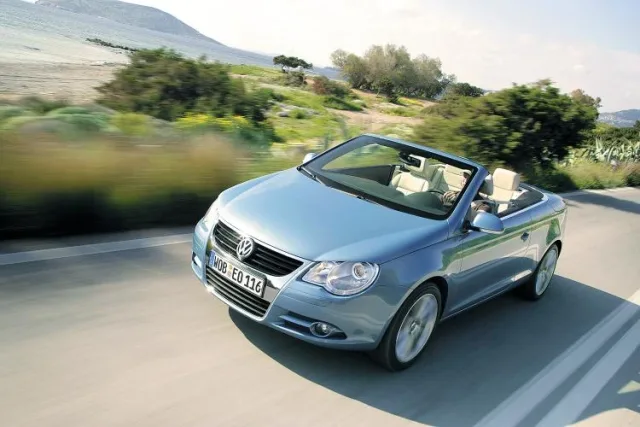
On the highway, the handling didn't spring any surprises — moderate sensitivity during lane changes, dense reactive force on the steering wheel, a clear "zero" position, the car holds its course tenaciously. But on the twists of the coastal road, the fun began. I wanted to shout: "Goddess!" Understeer at turn-in is minimal, and on the arc, you can do anything with the car — just barely noticeable movements of your hands and right foot. A slight turn and a slight lift off the gas — the car starts to waltz; a slight straighten and add throttle — it smoothly stabilizes. And ESP doesn't interfere: the stability system only intervenes when the slides become truly deep. True, it intervenes rather roughly.
 |  | |
| The rear four-link suspension is borrowed from the Passat | The roof pillars fold into niches on the sides of the rear seat | The small black button only retracts the sunroof, while the roof mechanism is controlled by the silver key between the front seats |
I had no worthy rivals on the 70-kilometer race along the coast. Such speed in slippery corners with the specific Greek surface (marble chips are added to the asphalt to keep it "sticky" in the heat) was unattainable for the local "sportsmen" in "hot" Seats, Renaults, and Fords. And Porsches and Lamborghinis, as luck would have it, only came in the opposite direction. And maybe that's for the best.
 |
| The 2.0 FSI engine is the optimum for a "ladies'" car |
When the roof is up, the pleasure of driving diminishes. The steering responds a bit sharper, but the balance shifts toward understeer, which is especially noticeable in the version with the hefty diesel. In Wolfsburg, they assure that the torsional rigidity of the body does not depend on the roof position — they say the locking is not rigid — but the difference is felt. Confirmation is that bumps on the far-from-ideal Greek roads are noticeably more pronounced at the driver's seat. However, the overall ride smoothness is decent, and the shock absorbers could use more stiffness: on short asphalt waves, the car rocks, and the suspension lacks energy capacity.
Understandably, compared to comfortable sedans, this coupe-cabriolet is a noisy creation. At idle, the engines rattle, and not just the diesel. After 100 km/h, wind begins to howl at the roof joints. But the delicate rustle of tires and excellent sound insulation of the wheel arches remind us that this is a true Volkswagen.
Without the roof — a completely different matter! Even with the windows down, the airflow does not reach the windshield, and noise is not a concern up to 80 km/h. Nothing creaks or rattles in the cabin. An ideal mode for seaside drives! And if you press the gas harder? Nothing terrible; the wind deflector can even be left off — just raise the windows, and up to 180 km/h the wind will only slightly tousle your hair. True, the hum from it is already considerable.
 |  |  |
| Eos in the rain chamber: no need to fear leaks | The trunk is convenient — at least compared to other coupe-cabriolets | |
The car is a success. Metrosexuals and fans of "mass prestige" will surely appreciate the "goddess of the dawn" and will snap up the entire annual production of the new icon — 120,000 units. The lion's share of cars (30%) will stay at home in Germany. Almost as many (29%) will go overseas to America. And to Russia, the "goddess" will arrive only at the end of July. Prices have not yet been announced. But if in Germany the "base" Peugeot 307 CC and Volkswagen Eos cost 23,500 and 25,950 euros respectively, then here, where the Peugeot coupe-cabriolet sells from $35,000, for the Volkswagen they will likely ask about $39,000. A bit pricey. And yet, although I have not yet become a follower of "mass prestige," I would partake. But only of the "goddess" with the turbo engine and DSG gearbox. On weekdays and in cloudy weather, I would drive the coupe, and on sunny weekends — the cabriolet. It's just a pity that such a goddess will demand even more generous offerings.
Divine Body
There is no revolution in the body construction. High torsional rigidity is achieved through classic cabriolet techniques: reinforcements and struts made of high-strength steel. These include inserts in the windshield frame, a transverse tube behind the front seats, and braces connecting the rear suspension subframe to the sills. The same steel is used for key passive safety elements: the front bumper beam, door reinforcements, and structural boxes for the aluminum "pop-up" rollover bars.
Among the interesting solutions, the powerful aluminum protection for the engine compartment stands out. It will be appreciated not only in Russia — it is integrated into the body's structural framework and significantly increases the rigidity of the front section. This approach is typical for sports cars, but rarely seen on "civilian" vehicles. The Germans keep the exact torsional rigidity value a secret, mentioning only the natural frequency of vibration. It reflects the body's rigidity under dynamic loads in motion, not static ones on a test bench. According to the manufacturer, the frequency is the same for both open and closed versions and is 24 Hz. For comparison, the fifth-generation Golf has this figure at 44 Hz. And competitors, Renault Megane CC and Peugeot 307 CC, have 26 Hz with the roof up and 20 Hz with it down.
 |  |
| The high-strength front bumper beam allows effective load distribution in an offset frontal collision | Braces from the sills to the rear suspension subframe are a proven technique for increasing body rigidity in cabriolets. However, the integrated structural protection of the engine compartment is rarely used for this purpose |
The folding hardtop, created by Webasto, fundamentally differs from competitors in that it essentially does not fold. The huge glass sunroof slides back, the rear window moves over it, and this "sandwich" is placed into the trunk. The side roof pillars hide in niches on the sides of the rear seats. Rear passengers, of course, can no longer stretch their shoulders freely, but the car's silhouette turned out harmonious.
The roof, consisting of 470 parts, raises and retracts slightly faster than the Volvo C70 or Opel Astra Twin-Top — in 25 seconds. The process is fully automated and controlled by 250 parameters. But the button between the front seats must be held until the transformation is complete. The declared service life of the sunroof is 160,000 open-close cycles, and the entire roof — half that. According to specialists' calculations, this is enough for 8 years of active use.
 |  |
| The American crash test (a direct frontal impact into a concrete wall with unbelted dummies) was passed successfully | Elements made of high-strength steel are colored green |
If you slide the wide 12-kilogram sunroof all the way back, the Volkswagen turns into a coupe-targa. In this form, as in "cabrio" mode, a spoiler automatically extends from the windshield frame, forcing the oncoming airflow to bypass the cabin.
Aerodynamics received a lot of attention: 350 hours in the wind tunnel were not in vain. With the roof closed, the drag coefficient Cx is only 0.325 — an excellent result for this body type. The Germans modestly remain silent about resistance with the top open. But is that so important for a cabriolet? The main thing is that at speed, the wind does not gust through the cabin. And with this, Volkswagen is in perfect order — the engineers managed to tame the vortices behind the windshield. So much so that with the windows raised, the wind deflector seems like a superfluous accessory — its effect is almost imperceptible.
Volkswagen Eos (manufacturer's data)
| Version | 2.0 TDI | 2.0 FSI | 2.0 TFSI |
| Body type | two-door coupe-cabriolet | ||
| Number of seats | 4 | ||
| Length, mm | 4407 | ||
| Width, mm | 1791 | ||
| Height, mm | 1443 | ||
| Wheelbase, mm | 2578 | ||
| Track, mm | 1545/1553 | ||
| Trunk volume, l | 380/205* | ||
| Curb weight, kg | 1473 | 1406 | 1464 |
| Gross weight, kg | 2010 | 1950 | 2000 |
| Engine | diesel, turbocharged | with direct fuel injection | with direct fuel injection and turbocharging |
| Location | front, transverse | ||
| Number and arrangement of cylinders | 4, in-line | ||
| Number of valves | 16 | ||
| Cylinder bore/piston stroke, mm | 81.0/95.5 | 82.5/92.8 | 82.5/92.8 |
| Displacement, cm3 | 1968 | 1984 | 1984 |
| Compression ratio | 18.5:1 | 11.5:1 | 10.3:1 |
| Maximum power, hp/kW/rpm | 140/103/4000 | 150/110/6000 | 200/147/5100 |
| Maximum torque, Nm/rpm | 320/1750—2500 | 200/3500 | 280/1800—5000 |
| Drive | front-wheel drive | ||
| Transmission | 6-speed, manual | ||
| Gear ratios | |||
| I | 3.77 | 3.78 | 3.36 |
| II | 2.09 | 2.27 | 2.09 |
| III | 1.32 | 1.65 | 1.47 |
| IV | 0.98 | 1.27 | 1.1 |
| V | 0.78 | 1.03 | 0.87 |
| VI | 0.65 | 0.87 | 0.73 |
| reverse | 3.64 | 3.6 | 3.12 |
| final drive | 3.45 | 3.94 | 3.94 |
| Front suspension | independent, coil spring, McPherson, with stabilizer | ||
| Rear suspension | independent, coil spring, multi-link, with stabilizer | ||
| Front brakes | disc, ventilated | ||
| Rear brakes | disc | ||
| Tires | 215/55 R16 | ||
| Maximum speed, km/h | 206 | 210 | 232 |
| Acceleration time 0—100 km/h, s | 10.3 | 9.8 | 7.8 |
| Fuel consumption, l/100 km | |||
| urban cycle | 8 | 11.3 | 11.2 |
| extra-urban cycle | 5 | 6.4 | 6.5 |
| combined cycle | 6 | 8.2 | 8.2 |
| Fuel tank capacity, l | 55 | 55 | 55 |
| * With folded roof | |||