

Retro moods today dominate not only the world of fashion. Furniture designers, tableware creators and, of course, car manufacturers are actively drawing inspiration from the past. Toyota did not stand aside either, presenting a modern interpretation of its legendary FJ40 SUV. The new model was named FJ Cruiser.
In America, this car has been known to buyers since 2006, but for our latitudes it remains a real curiosity. The reason is simple: the FJ Cruiser is not officially supplied to our country. Apparently, Toyota does not see serious market potential for it, so you won't find it even in a picture in official dealer showrooms. Nevertheless, thanks to the efforts of "gray" importers, individual units still reach us. Rarely, piece by piece, but they do. And, you must agree, missing the chance to get acquainted with the heir to the cult FJ40 would be a real sin.
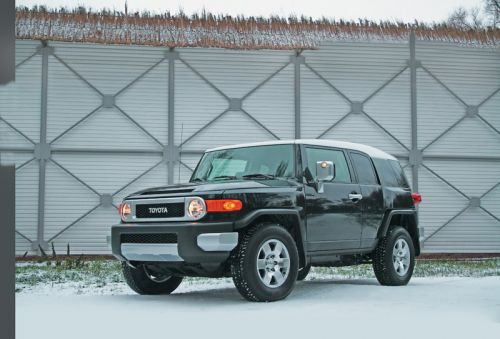
2006 Toyota FJ Cruiser
© Photo: Igor Kuznetsov, 5 Koleso
The resemblance of the FJ Cruiser to its legendary ancestor is striking at first glance. The car has become larger and more solid, but in every detail you can recognize that very FJ, which fans still sigh over. Here you have the narrow radiator grille, headlights shifted towards the center, a separate bumper, a roof painted in a color different from the body, a panoramic windshield, and even the complete absence of an emblem — in the sixties Toyota did not yet adorn its cars with them. The designers also preserved the three-door silhouette, paying tribute to tradition.
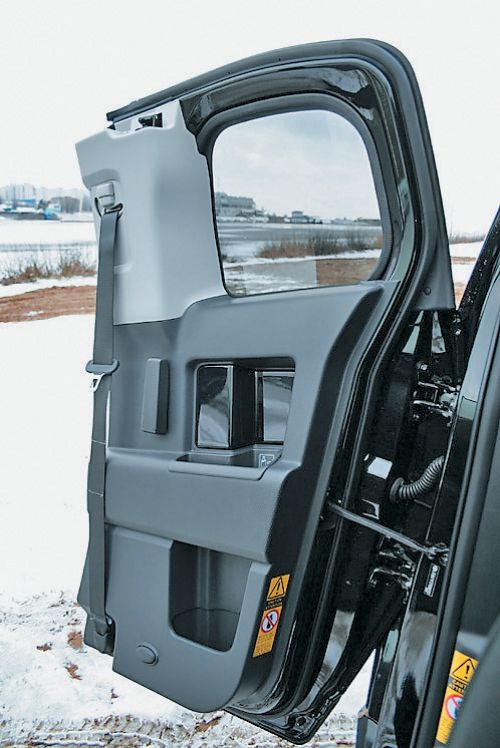
2006 Toyota FJ Cruiser
© Photo: Igor Kuznetsov, 5 Koleso
However, the three-door design here is merely a stylistic device, because in reality the car is five-door. To ensure convenient access to the rear seats, the body was deprived of the central pillar, and the rear doors were made hinged, opening against the direction of travel. The idea is not new — something similar has long been used on American pickup trucks — but it is this design that provides fairly convenient access to the interior from outside. True, with one caveat: the rear door cannot be opened without opening the front one, so when boarding or alighting a passenger in the second row, you will have to swing both open each time.
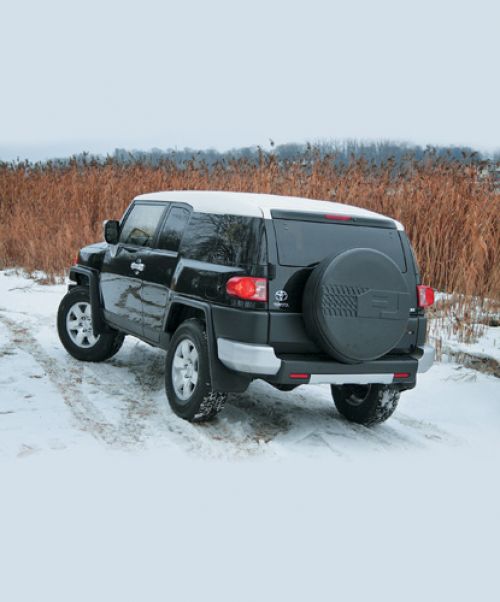
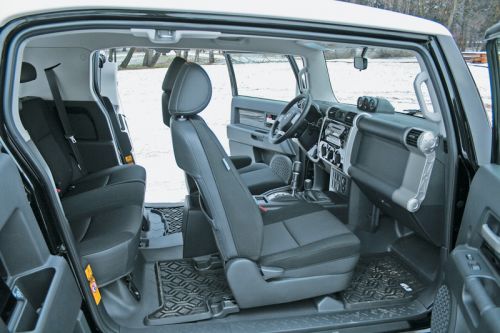
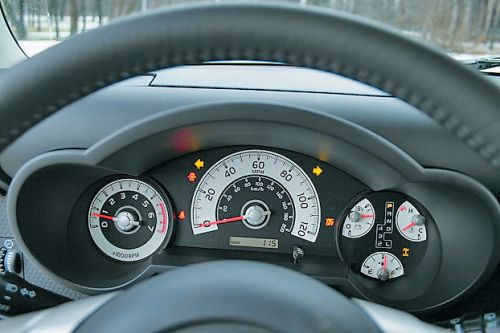
The interior is also styled in the spirit of the sixties. At first it seems overly simple, but simplicity here does not equal primitiveness. Firstly, the ergonomics are thought out to the smallest detail: the buttons on the center console are so large that you can't miss them even in harsh off-road conditions. Secondly, the cabin is generously filled with the benefits of civilization that people in the sixties could not even dream of. Thirdly, it is very spacious inside — you cannot complain about a lack of space. The trunk also impresses with its capacity, and its shape allows transporting large-sized cargo. To prevent the contents from rattling around the trunk, special tie-down loops are provided on the floor and sides. Access to the luggage compartment is possible both through the door and through the lowering glass, but using this is not very convenient — the spare wheel gets in the way.
The spare tire, by the way, also significantly limits visibility. If not for the huge exterior mirrors, reversing in the FJ Cruiser would turn into a real lottery. The mirrors are elongated vertically, allowing you to control the space along the side almost from the roof to the ground. This is very convenient, especially when parking in tight spaces.
At first, we feared that due to the narrow, embrasure-like windshield, visibility would be insufficient. However, after spending a whole day behind the wheel, we were convinced that everything is fine. By the way, we cannot recall any other SUV that has three wipers installed on the windshield at once.
2006 Toyota FJ Cruiser
© Photo: Igor Kuznetsov, 5 Koleso
Remembering that the FJ40 was an off-road vehicle to the core, the developers of the new model did not deviate from this principle. As befits a true off-roader, the FJ Cruiser is built on a ladder frame. It, like most of the chassis components, was borrowed from the no less famous Toyota 4Runner, adapted to modern requirements. This provided the car not only with the proper safety margin off-road, but also with a fairly smooth ride on the highway. Of course, if there were an independent suspension at the rear, like at the front, comfort would be even higher, but even with the current design we had no particular complaints about ride smoothness. Tram tracks, speed bumps and potholes during the test did not cause any trouble — the pace did not drop. Things just went under the wheels, and that was it.
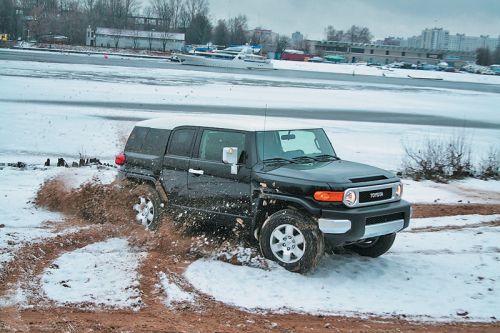
Since we are talking about pace, it is worth saying how the car behaves in city traffic. Despite its brutal appearance and off-road content, the FJ Cruiser turned out to be surprisingly nimble. However, if you remember that under the hood there is a V-shaped "six" with 242 hp, all doubts about dynamics disappear by themselves. The car is truly dynamic, and you can get pleasure from speed both on straights and during maneuvers. But, as they say, within reasonable limits. After all, no matter how good this car is on asphalt, its element is off-road. To conquer "directions", everything you need is here: from a pluggable front axle to a rear differential lock. The latter is activated by a button on the center console, but only when the low range is engaged. Honestly, we never got around to using it. If we had gotten into some wilderness, we might have had to use it, but this time adventures with torn cables and dented engine protection were not part of our plans (the car had already been sold), so we limited ourselves to light off-roading. But even by the way the FJ Cruiser confidently raced along the dirt road, stormed steep climbs and scattered sand in ditches, it was clear: the potential of this car is enormous.
Driving
The FJ Cruiser turned out to be surprisingly versatile. It is equally comfortable to drive on the highway and off-road.
2006 Toyota FJ Cruiser
© Photo: Igor Kuznetsov, 5 Koleso
Interior
Ergonomics are thought out to the smallest detail. All controls are at hand.
Comfort
Despite the apparent asceticism, the car provides a high level of comfort.
Safety
Four airbags, electronic stability control system, anti-lock braking system.
Price
Clearly overpriced due to exclusivity.
Advantages and disadvantages
+ Predictable handling, effective brakes, comfortable cabin.
2006 Toyota FJ Cruiser
© Photo: Igor Kuznetsov, 5 Koleso
- Some sluggishness on acceleration, high price, high fuel consumption on the highway.
Specifications
Make and model — Toyota FJ Cruiser
Dimensions — 4671/1895/1819 mm
Engine — petrol, 3956 cm3, 242 hp/5200 rpm
Transmission — automatic, 5-speed
Dynamics — 232 km/h; 7.2 s to 100 km/h
Competitors — Hummer H2
Our opinion
2006 Toyota FJ Cruiser
© Photo: Igor Kuznetsov, 5 Koleso
Despite all the exclusivity here, in the States the FJ Cruiser is not considered a unique model at all, but is sold as an affordable budget car. The cheapest rear-wheel drive version with a manual gearbox and steel stamped wheels is generally comparable in price to utilitarian pickup trucks. And yet…
© 5 Koleso