

Even though the current Toyota Camry is extremely popular, Toyota decided that to cement its success, the flagship sedan needed an update. The result of this rethinking looks promising.
Although more than ten million Camrys are driven around the world today, just five years ago this business sedan in our country was, if not a curiosity, then certainly not the most prominent player. A successful marketing strategy — both advertising and pricing, as well as a fortunate confluence of market circumstances, did their job, and now the Camry in Russia is at the peak of demand.
However, according to the laws of the genre, which require regular generational changes, the baton has passed to a successor. What can the new Toyota Camry do? The answer is obvious: with a slightly increased price, the new model has multiplied the strengths of its predecessor, and at the same time has become noticeably more attractive in appearance.
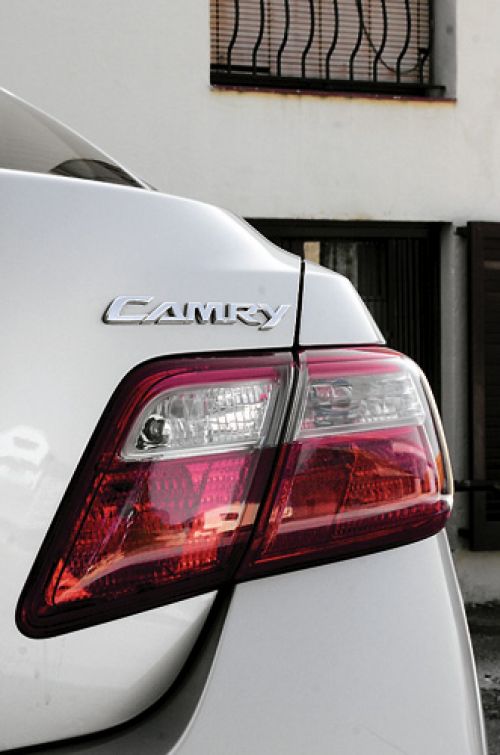
2006 Toyota Camry
© Photo: 5 Koleso
There is no trace left of the muddled appearance of the previous model, which was often criticized. Now the sedan is not just strict and composed — it aspires to be a stylish car. Progress in the exterior is obvious, although it is too early to talk about perfection of forms. However, it is appropriate to recall the saying “there's no accounting for taste...”. Much more significant is that the increase in wheelbase (by 55 mm) and track (front by 30 mm, rear by 40 mm) has improved directional stability. And the volume, and therefore the comfort of the cabin, has also increased.
The living space of the Camry previously met business-class standards. Now there is even more room. This is facilitated not only by the added centimeters, but also by the very “architecture” of the interior. For example, the front seats of the new design (the same as in the Toyota Prius) are spacious, comfortable for people of any build, and provide good protection against “whiplash” injuries to the neck and spine. In addition, the range of longitudinal adjustment has been expanded: for versions with mechanical drive it is 254 mm, and with electric drive — 260 mm. Combined with the steering column adjustable in two directions, this means that even a very tall driver with long legs can easily get comfortable.
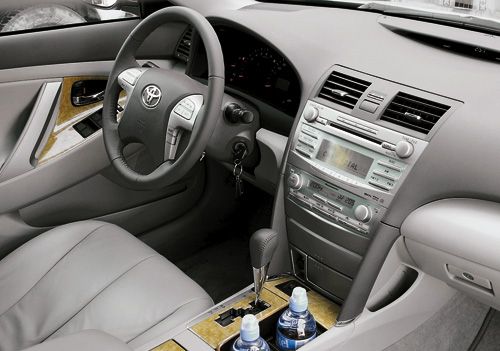
2006 Toyota Camry
© Photo: 5 Koleso
Rear passengers are also lucky: legroom has grown to 970 mm, and three people can sit here quite spaciously. By the way, in the top version, the rear seat backrest can change its angle within eight degrees, which adds convenience.
The trunk of the new Camry holds 535 liters (504 liters in the version with adjustable backrest). It is easy to understand whether this is a lot or a little when five travel bags disappear one after another into the depths of the cargo compartment. And the rear seat can also be folded down.
The feeling of spaciousness in the cabin is enhanced by the two-level front panel with the upper part pushed forward and the voluminous instrument cluster with “optitron” scales. In the dark, the atmosphere is complemented by the backlighting of the center console, which houses a high-quality audio system and dual-zone climate control. The Japanese are especially proud of the ionizer, which significantly reduces the number of microorganisms and odors in the air. The picture of comfort is completed by numerous compartments for small items, additional power outlets, and cup holders. In short, even the most fastidious skeptic is unlikely to find a reason for dissatisfaction.
The new Camry is offered with a four-cylinder 2.4-liter engine producing 167 hp, as well as a 277-horsepower 3.5-liter V6. The first is based on the predecessor's unit but has been seriously refined. Optimization of intake and exhaust, reduced friction, and increased rigidity of the cylinder block with crankcase made it possible to increase power while simultaneously reducing fuel consumption, noise, and vibrations.
The advantages of the new 24-valve V6 with two camshafts and Dual VVT-i variable valve timing system are evident, for example, in the fact that acceleration dynamics improved by 40% compared to the previous Camry with the 3.3-liter V6. In practice, this is felt both as a powerful surge at start and as responsiveness to pressing the gas pedal at high speeds (120–170 km/h). In short, behind the wheel of this Camry you feel like the master of the world.
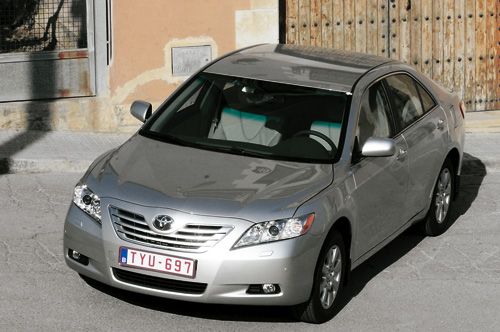
2006 Toyota Camry
© Photo: 5 Koleso
The base version with the 2.4-liter “four”, of course, behaves more calmly, but its reserve is enough to keep the owner's ambitions satisfied. The five-speed automatic working with this engine (a five-speed manual is also available) operates adequately and smoothly, but is inferior in responsiveness to the 6-speed sequential gearbox of the more powerful version. The latter's main trump card is the minimal reaction time to a sharp press of the pedal: only 0.5 seconds, which is twice as fast as the previous model.
On the move, bumps are absorbed without a trace by the energy-intensive suspension, and the car seems to float above the road: the refinement of the chassis (including lengthening the lower arms, changing geometry, and recalibration) has noticeably increased smoothness. True, miracles do not happen, and the Camry confirms this with a slight “American” roll during sharp high-speed lane changes. But the compromise is well chosen, and the sedan's handling is quite decent.
The feeling of comfort is enhanced by the almost complete absence of extraneous noise while driving. Not surprising: in addition to excellent sound insulation, decibels are dampened by flat “wipers” and the almost complete absence of gaps between the glued windows and the body.
2006 Toyota Camry
© Photo: 5 Koleso
The brakes initially seem lazy, but you quickly realize that the first impression is deceptive: it arises from the engineers' desire to make them as informative as possible. Indeed, it is possible to dose the force on the pedal depending on the situation with pharmaceutical precision. And if you need to stop sharply, the emergency braking assist system (available even in the base) allows you to stop on a dime. It is no coincidence that the new Camry uses brake discs of increased diameter and pads with a friction coefficient 10% higher than the previous model.
The steering, although it has a somewhat vague position near zero, allows you to hold the trajectory quite accurately, and the small turning radius makes parking in tight places easier.
The new Toyota Camry is generously equipped with active and passive safety features — from ABS and the stability control system to an energy-absorbing body and six airbags.
Apparently, the new Toyota Camry is destined for success with us. After all, this large, comfortable, attractive, and undoubtedly reliable (after all, it's a Toyota!) sedan costs quite reasonable money: in the base version only $30,900. With this arrangement, the newcomer on our market has practically no competitors. Moreover, we should not forget that at the end of 2007, with the launch of the Toyota plant near St. Petersburg, the new Camry will receive Russian registration and may become even more attractive to potential buyers.
Technical specifications of Toyota Camry 2.4 // Toyota Camry 3.5
Body – sedan
Curb weight, kg – 1390–1490 // 1545
Dimensions, mm:
- length – 4815
- width – 1820
- height – 1460
Wheelbase, mm – 2775
Trunk volume, l – 535
Control fuel consumption, combined cycle, l/100 km – 8.5 (M/T), 9.9 (A/T) // 9.9
Engine:
- type – 4-cylinder, 16-valve // V6, 24-valve
- displacement, cm3 – 2362 // 3456
- power, hp at rpm – 167/6000 // 277/6200
Transmission – 5MT or 6AT // 6AT
Tire size – 215/60R16
Suspension:
- front – McPherson, with stabilizer
- rear – double wishbone, with stabilizer
Brakes (front/rear) – disc, ventilated/disc
Steering – rack and pinion, with power assist
Price, $ – from 30,900 // 43,200
Advantages and disadvantages
+ Comfort, efficiency, relatively low price.
– Vague steering wheel centering, relative roll in corners.
Tomoaki Nishitani, head of the Russian representative office
of Toyota:
Today Russia is among the four most promising automotive markets in the world — along with Brazil, India, and China. That is why we decided to build a plant here: its launch is scheduled for December next year. At the first stage, the enterprise will produce about twenty thousand cars a year, and the design capacity is calculated for fifty thousand. However, we will grow to such volumes gradually, focusing on real demand. Haste is inappropriate here: from the very start, it is important to ensure impeccable quality. Russian buyers, as far as I know, value spacious and comfortable cars with rich equipment and reliable protection. The Camry just meets these expectations. Moreover, it is the flagship of our lineup, which provides a good foundation for a confident start. Each Toyota model undergoes adaptation to Russian conditions: the “bad roads” package is installed, and engines are calibrated for local fuel. First, we will present the new Camry to the public, and only then announce the price. The dealer network will also expand: this year new centers will open in Moscow and St. Petersburg, both for Toyota and Lexus. They will also appear in other regions — first of all, we are interested in cities with a population of over a million, the Urals, the Volga region, and the south of the country. It is too early to talk about exporting the Camry: the main task is to establish production for the Russian market while maintaining the high quality standard of Toyota.