
When we set out to conduct a comparative test of three sedans of the "budget business class," we never thought that one of the participants would surprise us.
Both the Toyota Camry and the Nissan Teana easily handled our standard acceleration and braking measurements. But when the Hyundai Grandeur was pushed to its top speed... That's something we've only seen in Hollywood action movies. The five-kilometer test road ends, the gas is released, we hit the brake — but the Grandeur still flies forward!
During those three seconds, our dynamometer specialist Andrey Mokhov nearly went gray...
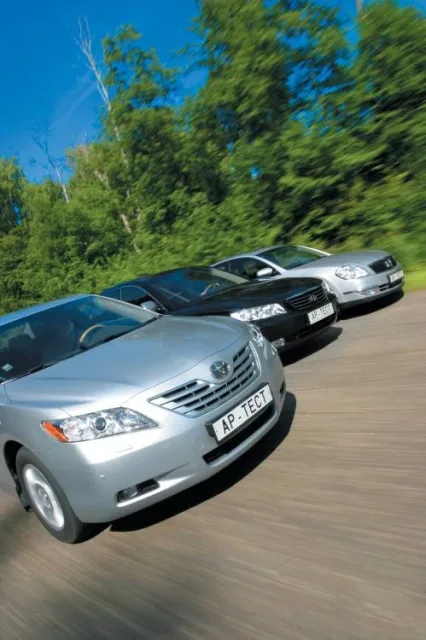
At first, everything seemed harmless. Even though the Teana can be bought with a two-liter engine, and the Camry's base engine is 2.4 liters, we took the top versions with V-shaped "sixes" of 3.3-3.5 liters and automatic transmissions for the test. The prices of all three sedans are almost identical (about $45,000), and the dimensions and equipment are also close... But none of the cars claims to be "driver-oriented" — so we didn't expect anything special from the tests at the Dmitrovsky proving ground. After all, the point of cars like the Camry, Teana, and Grandeur is maximum space and comfort for a moderate price.
 |  | |
| The professional Datron measurement system recorded 208 km/h: the electronic limiter doesn't let the Teana go further | The interior with a "two-story" front panel and wide wooden "shelves" is an acquired taste | If you have a transponder key fob in your pocket, the Teana will open when you press the button on the door handle |
These cars also can't boast of striking design. More precisely, they couldn't before, when the Toyota Camry of the previous generation and the Nissan Maxima were vying for the title of bestseller in the business class. But now everything has changed. Look at the new Camry — it's already trying to be refined and emphasizes its kinship with Lexus. Of course, Toyota's heavy forms are unlikely to please an aesthete, but the mass buyer will surely like this style.
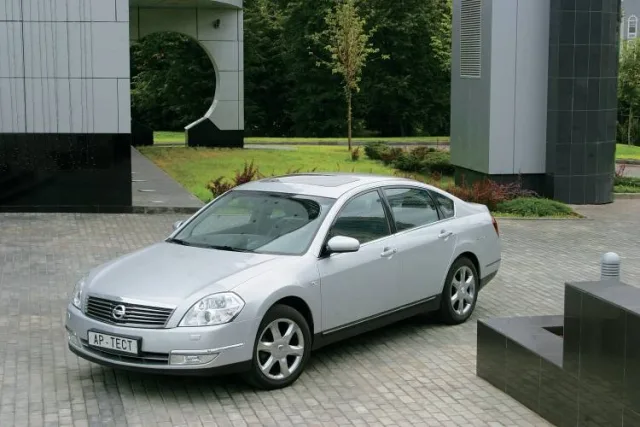
Nissan has gone even further into revolution — the Teana crosses out the restrained Nissan style of past years. Faceted shapes, headlights of unusual form... Original, though not for everyone. And the Hyundai Grandeur, although faceless (literally — the "face" expresses no emotions), is memorable for its rear. Convex "hips," an elegant trunk line, and striking LED taillights. So if you approach the Grandeur from behind in the dark when the "parking lights" are on... Isn't that a BMW "seven"!
 |  |  |
| Audio system and climate control modes are displayed on the color screen | The seatbacks are too curved | In the armrest — two boxes |
 |  | |
| The CVT with manual mode (six fixed "gears") works perfectly | A footrest extends in front of the passenger, and a CD changer is hidden in the "glove box" |
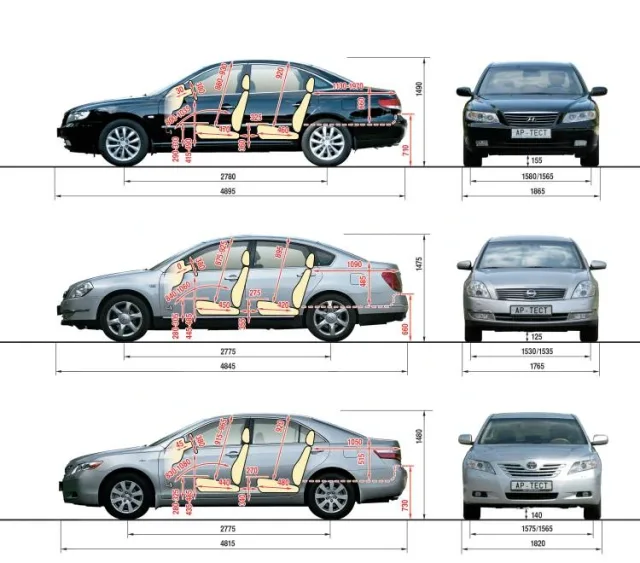
By the way, it's the Grandeur that is the most spacious of this trio. There's noticeably more room in the back than in the other two: a person 190 cm tall sits freely, even if equally tall people sit in front. There's seven centimeters of clearance from the knees to the front seatbacks, and there's no shortage of headroom either. And the seating is comfortable — the widest opening between the pillar and the seat cushion. The trunk here is also the most practical. In terms of "passport liters," it yields to the Japanese rivals, but the opening is the widest of all, and the rear seatback folds down — the Camry and Teana only have hatches for long items. So it's the Hyundai that pulls ahead when it comes to the "amount of car" for that same $45,000.
And what about the "quality of the car"?
Here, Hyundai also didn't disappoint. Wooden inserts on the steering wheel, aluminum details, optitronic instruments, mid-range acoustics, but from the renowned hi-fi brand Infinity... But the plastic doesn't feel as pleasant as in the Japanese cars, and the center console looks old-fashioned. Rear passengers only get a folding armrest and air vents.
In principle, that's already not bad. But Toyota for the same money additionally offers adjustable rear seatback recline — you can lean back almost like on a plane. The Nissan has a regular rear bench, but the armrest hides a music control panel, rear seat heating buttons, and a rear window shade control button. In this class (and at this price) — a unique offering!
 |  |  |
| The rearview camera is a handy thing | In the folding armrest — audio system control panel, seat heating buttons, and shade button | The instruments are beautiful; instead of a temperature gauge — warning lights |
And what about the massage "ottoman" for the front passenger? The right seat in the Teana is not only equipped with a retractable footrest, like in a dentist's chair, but also can massage the back — just press a button, and two powerful "fists" begin to methodically knead the muscles. Nothing like this is available in the competitors.
But as for space, both Toyota and Nissan yield to the "Korean": there's not as much knee room in the back, and the ceiling is lower.
For the driver, the best choice is the Toyota. Here is the most comfortable seat with maximum adjustment ranges, the steering wheel adjusts in two planes, and climate control (with an air ionizer!) can be controlled directly from the steering wheel. The Korean sedan is more modest: it's harder for a tall driver to get comfortable due to smaller adjustment ranges, and the buttons on the steering wheel only change the volume.
 |  |  |
| The Toyota interior is traditional, convenient, and well-made | On the steering wheel spokes — audio system and climate control buttons |
The Nissan Teana is in the rearguard. Not in terms of equipment: here the Teana is again ahead. A contactless transponder key that doesn't need to be taken out of your pocket, a large color screen on the console, a rearview video camera... But drivers taller than 190 cm will notice that the seat lacks travel length, the steering wheel doesn't adjust for reach, and the overly curved seatback is uncomfortable — the shoulder blades don't find support.
But what a CVT the Nissan has!
 |  |  |
| On the steering wheel spokes — audio system and climate control buttons | Playful transparent plastic — a strange choice for the Camry interior | The six-speed "automatic" works quickly and comfortably |
Under the hood of the Teana lies not a classic automatic transmission, but a belt-driven CVT — a unit familiar to us from the Nissan Murano crossover. Handling it is a pleasure: the car responds to the accelerator pedal instantly and precisely, as if guided by an invisible thread. The power reserve is such that for a confident start from a traffic light, it is enough to barely press the accelerator. A full press of the pedal is a different story, though with a nuance: as with the Murano (which we wrote about in AR No. 17, 2003), after a couple of runs at top speed, the electronics play it safe and cut the revs to 3000 rpm, protecting the CVT from overheating.
The surprises don't end there. The claimed 208 km/h is also a result of the electronic "leash." Without its intervention, the Nissan could easily go faster.
 |  |  |
| The Camry has the most comfortable seats | The rear seat backs are adjustable for angle | At high speed, the Camry literally hugs the road |
The Toyota engine is the most powerful of our trio, but in the sprint to 100 km/h it loses to the Nissan. The culprit is the "automatic," which wastes precious moments on shifts. However, at speeds over 200 km/h, the advantage in horsepower shows: the Camry crosses the 200 km/h mark six seconds earlier than the Teana. But here too there is its own "limiter" — the electronics stop acceleration at 224 km/h.
One could complain about the excessive oversight from manufacturers who don't let owners fully unleash the potential of their cars. But their logic is clear: concern for safety. The dynamic reserve beyond 200 km/h is quite enough for the boldest overtaking on the highway. But flying down Russian roads at 240 km/h is not just a violation; it's a direct path to disaster.
 |  | |
| The steering column moves in two directions via electric drive | This is one of the most luxurious Korean interiors. But in design and finish quality, the Grandeur still yields to both "Japanese" cars |
This is especially felt behind the wheel of the Hyundai Grandeur, which we got for the test…
As for acceleration, the Grandeur lags behind its rivals: its "automatic" responds with a delay, even compared to the Toyota's. However, the "Korean" can start off effectively with wheelspin, and a 0-100 km/h time of 8.5 seconds for a car with a curb weight of 1747 kg is quite respectable. But here there are no electronic limiters: on the five-kilometer dynamometer straight, the Grandeur managed to reach almost 227 km/h — more than any of its competitors.
 |  |  |
| The Hyundai's optitronic instruments are beautiful | The control unit for the stereo and climate control is old-fashioned | In terms of "automatic" operation, the Grandeur is only slightly worse than the Camry |
 |  | |
| The glovebox is a bit small — A4 papers don't fit here | The rear seats in the Hyundai are the most spacious | The front seats are the softest, but the range of adjustment in length is limited |
Behind the wheel, as usual, was our expert Ivan Shadrichev, aka Uncle Vanya. Next to him, hunched over a laptop, sat dynamometer engineer Andrei Mokhov. Nothing foreshadowed problems. So what, 227 km/h — we've raced on the "dyno" at three hundred too.
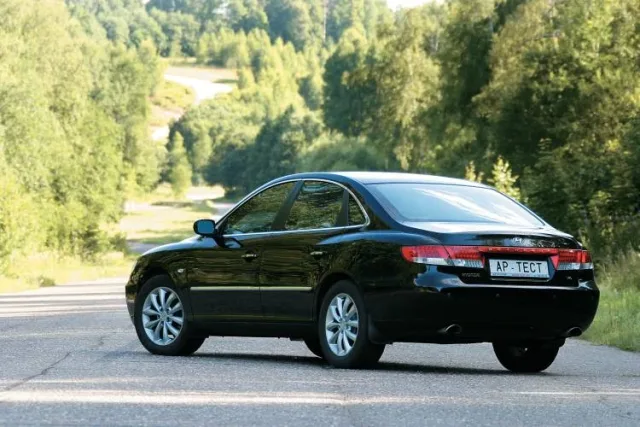
At the end of that same five-kilometer straight, before the turnaround loop, Uncle Vanya habitually lifted off the gas and pressed the brake. But the Hyundai, as if possessed by a demon, kept racing at top speed! No, the brakes didn't fail — they simply proved powerless against the nearly two-ton car hurtling at over 200 km/h with a stuck throttle drive!
Mokhov, seeing the rapidly approaching birch trees, turned pale, and Uncle Vanya reached for the ignition to kill the enraged engine. And at that very moment, the Grandeur finally "came to its senses" and cut the throttle. Phew…
Our Uncle Vanya has nerves of steel. Anyone else would have jumped out of the car, lit a cigarette, or grabbed for valocordin. But Uncle Vanya just turned around and resolutely headed for a second run, to the other end of the "dyno" (we always do several runs in both directions to eliminate wind influence). And history repeated itself: the Grandeur again refused to cut the throttle at top speed! Three seconds in an almost uncontrollable car — it's terrifying to imagine how this could end not on a test track, but, say, on a German autobahn, and not in the hands of an expert of Uncle Vanya's level.
Most likely, it was a fault of this particular example. But that didn't make it any easier for us…
Fortunately, there were no more emergencies.
The Grandeur's brakes pleased: minimal stopping distance. True, it noses over more than its rivals during emergency braking, and as the discs and pads heat up, braking efficiency noticeably drops. There are no complaints about the Nissan and Toyota brakes — except that the Camry, when braking on a split surface where left and right wheels have different grip, pulls slightly to the side.
Handling? As we already noted, none of the sedans claims the title of "driver's car." If you don't delve into details, don't exceed 120 km/h, and take corners carefully, then the Grandeur, Camry, and Teana are all equally light and pleasant to drive. And in a critical situation, you can count on the help of stability control systems.
But if a "hot" driver gets behind the wheel, nuances begin.
For driving at the limit, the Camry is best suited — where the Hyundai and Nissan are already squealing tires, the Toyota drives silently. It confidently holds its line in a corner, and you can feel that lateral loads are distributed evenly among the wheels. The non-switchable stability control intervenes softly and unobtrusively, only in case of gross errors. The only downside is insufficient steering feedback, so on a high-speed arc it's not always clear at what angle to turn the wheel.
The Hyundai Grandeur is the complete opposite. Here the steering is filled with effort, and that's good. But the Grandeur is 170 kg heavier than the Camry, and the chassis isn't ideal: the body rolls noticeably, and the tires start squealing early. However, thanks to its low sensitivity to steering input, the Grandeur responds smoothly and predictably to steering wheel turns even at speeds near 200 km/h, and on uneven corners, the soft suspension handles asphalt waves without issue, not knocking the car off course.
The Nissan, on the other hand, has a tendency to oversteer. If you sharply lift off the gas in a corner, the car squats on the rear loaded wheel and "dives" into the turn. Moreover, the slide develops so rapidly that the stability control doesn't have time to react — corrective action from the driver is required even with ESP on. And with it off… Although with skillful handling, such a character allows faster sharp lane changes. The best confirmation is the maximum speed on the "moose test."
But to be honest, for these cars, comfort matters more.
The leader here is the Nissan Teana, whose suspension copes excellently with our roads. And there's little noise in the cabin — if you don't floor the pedal, causing the characteristic CVT whine of the engine on one note.
The Camry's suspension is stiffer — in the city, the body follows the road profile more closely and reacts harder to small bumps. But at high speed, the Toyota "rides the wave" better — the car literally hugs the asphalt with minimal pitching. The cabin is also quiet: only the tires rustle and occasionally pebbles rattle against the underbody.
But the Hyundai Grandeur isn't as good. It has the softest suspension, so on a good road up to 100 km/h, the Grandeur simply floats, gently rocking on asphalt waves. But once you accelerate to 140 km/h, the suspension can't cope — the body starts to sway, and the rebound limiters kick in from time to time. The Hyundai handles small bumps harshly and loudly, and on bad roads, something thumps under the floor, with noticeable jolts to the steering wheel…
When it comes to broken roads, the Hyundai Grandeur has a clear advantage — ground clearance of 155 mm and standard engine protection (for which they ask an extra 3500 rubles). The other two sedans have uncovered engine bays and more modest ground clearance: the Camry has 140 mm, and the Teana only 125 mm.
So setting priorities is simple.
Yes, all three cars justify their considerable cost — they are spacious, respectable, powerful, and comfortable. But the most refined, the most harmonious, and the most pleasant to drive is the Toyota Camry. And judging by the fact that the queue for the Camry is booked eight months in advance (for any trim level), our verdict fully aligns with buyers' opinions.
The Nissan Teana offers impeccable ride smoothness, a very convenient CVT, and unusual options that can impress passengers and acquaintances. Seat a pretty companion in the front passenger seat, recline the ottoman, turn on the massage... Beautiful! And there's no need to rush to make an impression.
The Hyundai Grandeur, however, is not intended for fast driving. Its strengths are a spacious cabin and a convenient trunk. The lack of an electronic speed limiter is compensated by the "soft" suspension, which makes driving quickly over bumps simply unpleasant.
Even on a German autobahn, we wouldn't hurry in the Grandeur. What if the throttle actuator jams again?
Moose Test
To assess the cars' behavior in an emergency, we simulate avoiding a sudden obstacle — the so-called "moose test." We conduct it in two stages. First, several drivers who have already familiarized themselves with the cars in normal mode try to "avoid the moose" at 65 km/h with a single attempt. Then the test driver, in a series of runs, determines the maximum speed at which this maneuver is possible.
 |  |  |
| Clear steering response helps the Grandeur driver avoid the obstacle | Toyota Camry: the steering feels "empty" during sharp maneuvers | Teana shone in the moose test: quick reactions and the highest speed |
The Teana completed the "lane change" fastest — thanks to sharp steering responses, the expert managed to enter the cone corridor at 80.2 km/h without knocking down a single cone. True, on exiting the last corridor, the Nissan, prone to oversteer, was already "sweeping its tail," and the stability system worked roughly and harshly. But the key point is that the Teana allows you to avoid an obstacle in such a situation. And despite the low steering feedback, all four "regular" drivers managed the maneuver on the first attempt.
The Hyundai Grandeur in the test driver's hands showed the second result — 76.9 km/h. The main complaints are about low steering sensitivity: an unaccustomed driver "under-turns" the wheel. Plus, when quickly turning the wheel, a "step" in effort appears. But this didn't hinder any of the "regular" drivers performing the maneuver at lower speeds. On the contrary, excellent steering feedback and delicate stabilization work helped — not a single cone was knocked down.
The Toyota Camry didn't shine compared to its rivals: three out of four drivers caused an "accident," and the test driver showed the lowest maximum speed in the test — 75.1 km/h. The reasons for the Camry's low result are unexpectedly sluggish reactions and an "empty" steering wheel.

| Moose test on the first attempt at 65 km/h* | |
| Car | Maneuver completed |
| Hyundai Grandeur | 4 out of 4 drivers |
| Nissan Teana | 4 out of 4 drivers |
| Toyota Camry | 1 out of 4 drivers |
| * Four drivers participated in the tests | |
| Maximum speed in the moose test, km/h | |
| Car | Speed |
| Hyundai Grandeur | 76.9 |
| Nissan Teana | 80.2 |
| Toyota Camry | 75.1 |
What's the price?
Nissan Teana: the base version — with a 2.0-liter four-cylinder (136 hp) and a four-speed automatic in the Elegance trim (two airbags, dual-zone climate control, from $29,990). Next comes the Teana in Luxury trim with a 173-hp V6 2.3 for $33,100 — here two side airbags, power driver's seat, audio system with six speakers instead of four, and 16-inch alloy wheels are added. Moving to the Premium trim costs $3,800 — this includes leather interior, power-adjustable driver's seat, active headrests, stability control, rearview camera, bi-xenon headlights, and a six-disc CD changer. Optional extras include cruise control, two-level rear seat heating, and a front passenger seat with massage and Ottoman footrest. At the top of the range is the Teana Premium with a 245-hp V6 3.5 engine and XTronic CVT-M6 with manual shifting of six "fixed" gears. Prices start at $43,990. A ordered car can be received within one to two months.

Warranty — 3 years or 100,000 km. Sales are handled by 31 dealers in 17 Russian cities.
Toyota Camry: prices start at $31,900 for the Camry 2.4 Comfort with an inline four-cylinder engine producing 167 hp and a five-speed manual transmission. This car already has six airbags, dual-zone climate control, an audio system with a six-disc CD changer and six speakers, and a Plasmacluster air ionizer. For an extra $1,600 — the Comfort Plus version with an automatic. Next is the Camry in Elegance trim for $35,900: parking sensors and leather seats (front ones with power adjustment) are added. The Prestige trim is $1,700 more and includes cruise control, stability control, and xenon headlights. The most expensive modification, Luxury, is equipped with a V6 3.5 engine (277 hp) and a six-speed automatic. Price — $44,900. You need to worry about purchasing a Camry in advance — the queue for cars stretches to April next year.
Warranty — 3 years or 100,000 km. Sales are handled by 25 dealers in 14 Russian cities.
The Hyundai Grandeur is sold in a single GLS trim with a 3.3-liter six-cylinder engine (235 hp) and a five-speed automatic transmission. Equipment is quite rich: eight airbags, ABS, stability control, variable-assist power steering, leather interior, dual-zone climate control, full power package (front seats, steering wheel, windows, mirrors), an audio system with eight speakers, rear parking sensors, cruise control, xenon headlights. Price — $44,300. Delivery time — about three months.
Warranty — 5 years or 120,000 km. Sales are handled by 63 dealers in 47 Russian cities.
Autoreview Readers' Forecast
Before this test, visitors to the website www.autoreview.ru were asked to answer the question: "Which of the cars participating in the next Autoreview test would you prefer?" Here's how the votes were distributed:
- Toyota Camry - 64.26%
- Nissan Teana - 30.03%
- Hyundai Grandeur - 5.71%
6,535 people voted
 |  |  |
| Toyota Camry: uneven walls eat up useful trunk volume | Nissan Teana: to fit a full-size spare under the mat, the trunk floor had to be raised using a foam spacer | Hyundai Grandeur: the most convenient trunk plus a folding rear seatback |


Acceleration Graphs
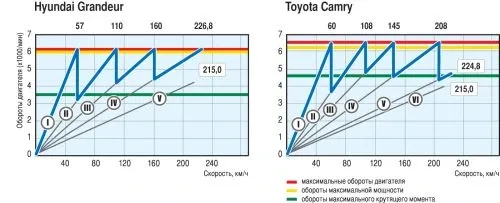
Japanese Classics vs. Korean Challenge
A business-class sedan is not just a means of transportation, but a statement of status. This segment is fiercely competitive, and to understand who today offers the best balance of comfort and dynamics, I took three models for a test at once: Hyundai Grandeur, Nissan Teana, and Toyota Camry. All with powerful V6 engines, all in top trims. Let's see who among them can surprise, and who merely follows proven recipes.
Design and first impression
These cars are contemporaries, but their approaches differ. The Hyundai Grandeur looks the most massive and solid. Its body is the longest and widest in this trio, which gives it solidity, but at the same time somewhat weighs down the image. There is an oriental pomp to it, which, however, does not cross into bad taste.
The Nissan Teana, on the contrary, seems lighter and more dynamic. There is less pathos and more dynamism in its appearance. It looks fresh and even a bit sporty, which sets it apart from its conservative classmates. The Toyota Camry is a model of restrained elegance. It doesn't try to shock, but simply looks expensive and high-quality. Nothing extra, but nothing to fault either.
Inside, the picture repeats itself. In the Grandeur, there is an abundance of wood and leather; everything looks rich, but a bit old-fashioned. The Teana surprises with thoughtfulness: it has a retractable footrest for the front passenger and even a back massage function. This creates a feeling of genuine care. The Camry is strict and laconic inside, but all materials are impeccably chosen, and ergonomics are beyond reproach.
Interior and ergonomics
From the driver's perspective, all three cars are comfortable, but in different ways. In the Hyundai, the steering column is electrically adjustable in two planes, making it easy to set up the driving position. In the Nissan, it adjusts only by height, but the front passenger seat can be turned into a real throne. The Toyota offers a compromise, but it lacks driver's seat memory settings, which is strange for this class.
Rear passengers in the Camry will have a bit less space than in its rivals, but it has a reclining rear seatback. The Teana and Grandeur offer more legroom, but only the Hyundai can boast a folding rear seat. The Nissan and Toyota only have a ski hatch. In terms of equipment, the Grandeur pulls ahead: it is the only one of the trio with side airbags for rear passengers and a rain sensor.
On the move
This is where the fun begins. The Toyota Camry with its 277-horsepower engine is a true sprinter. It accelerates to 100 km/h in 7.4 seconds, faster than all the others. Its 6-speed automatic works crisply and quickly, and the engine revs eagerly to the redline. However, the Camry's suspension felt overly stiff to me. It handles smooth asphalt well, but on bumps it transmits excessive vibration into the cabin. That's the price of sportiness.
The Nissan Teana with its CVT behaves differently. Acceleration is smooth, without jerks, but when you press the gas pedal sharply, the gearbox simulates shifts, which slightly blurs the impression. Dynamics are decent — 7.9 seconds to 100 km/h, but it doesn't feel as lively as the Toyota. However, the Teana offers the best compromise between handling and ride comfort. It feels more composed on the road than the Grandeur, yet not as stiff as the Camry.
The Hyundai Grandeur is a car for relaxed driving. Its 235-horsepower engine is the weakest in the trio, and it shows. Acceleration to 100 km/h takes 7.8 seconds, but the dynamics feel sluggish due to the 5-speed automatic, which is in no hurry to downshift. On the other hand, the Grandeur's suspension is the most comfortable. It swallows bumps with enviable composure, turning the ride into a real pleasure. But you pay for this with body roll in corners and a less communicative steering wheel.
The question of price
Interestingly, all three cars in base versions with V6 engines cost almost the same: Hyundai — $44,300, Nissan — $43,990, Toyota — $44,900. However, equipment differs. The Grandeur already has many options in the base, including xenon headlights, a sunroof, and parking sensors. The Teana is also well-equipped, but it lacks some small things, such as a rain sensor. The Camry is more modest in base, but it has front and rear parking sensors.
The test cars were equipped differently. The price of the Grandeur was $44,431, the Teana — $44,990, and the Camry — $45,000. The difference is minimal, but the choice is still difficult.
Verdict
Each of these cars finds its buyer. The Toyota Camry is the choice of those who value dynamics and are willing to put up with a stiff suspension. The Nissan Teana is a balance of comfort and handling, as well as unique options for passengers. The Hyundai Grandeur is a true mile-eater that delivers maximum comfort and rich equipment, but forgives you for not liking fast driving. My choice? If I had to spend a lot of time behind the wheel every day, I would look at the Grandeur. It may not be the fastest, but it is the most relaxing.
| Expert ratings from Autoreview | ||||
| Parameters | Max score | Cars | ||
| Hyundai Grandeur | Nissan Teana | Toyota Camry | ||
| Design | 180 | 135 | 140 | 150 |
| Exterior | 90 | 70 | 70 | 75 |
| Interior | 90 | 65 | 70 | 75 |
| Ergonomics | 170 | 150 | 145 | 155 |
| Driver's workplace | 90 | 75 | 70 | 80 |
| Visibility | 80 | 75 | 75 | 75 |
| Dynamics | 280 | 235 | 235 | 245 |
| Acceleration dynamics | 90 | 70 | 75 | 75 |
| Braking dynamics | 100 | 90 | 90 | 90 |
| Handling | 90 | 75 | 70 | 80 |
| Ride comfort | 210 | 165 | 175 | 175 |
| Ride smoothness and vibration protection | 80 | 60 | 70 | 65 |
| Acoustic comfort | 70 | 55 | 55 | 55 |
| Climate control | 60 | 50 | 50 | 55 |
| Interior comfort | 160 | 125 | 115 | 115 |
| Passenger seats | 80 | 65 | 65 | 65 |
| Trunk | 60 | 50 | 45 | 45 |
| Interior transformation | 20 | 10 | 5 | 5 |
| Total score | 1000 | 810 | 810 | 840 |
| Some measurement results from Autoreview | ||||
| Car | Hyundai Grandeur | Nissan Teana | Toyota Camry | |
| Maximum speed, km/h | 226.8 | 208 | 224.8 | |
| Acceleration time, s | 0—50 km/h | 3.2 | 3.2 | 3.4 |
| 0—100 km/h | 8.5 | 7.7 | 8 | |
| 0—150 km/h | 17.7 | 15.7 | 15.1 | |
| 0—200 km/h | 39.1 | 34.1 | 28.2 | |
| over 400 m | 16.2 | 15.6 | 15.8 | |
| over 1000 m | 29.3 | 28.2 | 27.9 | |
| 60—100 km/h (III) | 6.7 | — | — | |
| 60—100 km/h (IV) | 9.1 | — | — | |
| 80—120 km/h (V) | 14.1 | — | — | |
| 60—100 km/h (D) | 5.2 | 4.6 | 4.1 | |
| 80—120 km/h (D) | 6.5 | 5.4 | 4.8 | |
| Coast-down, m | from 50 km/h | 585 | 617 | 687 |
| 130—80 km/h | 1145 | 1063 | 1128 | |
| 160—80 km/h | 1749 | 1629 | 1733 | |
| Braking from 100 km/h | distance, m | 39 | 42.3 | 39.9 |
| deceleration, m/s² | 9.9 | 9.1 | 9.7 | |
| Braking from 150 km/h | distance, m | 101.8 | 100.1 | 91.1 |
| deceleration, m/s² | 8.5 | 8.7 | 9.5 | |