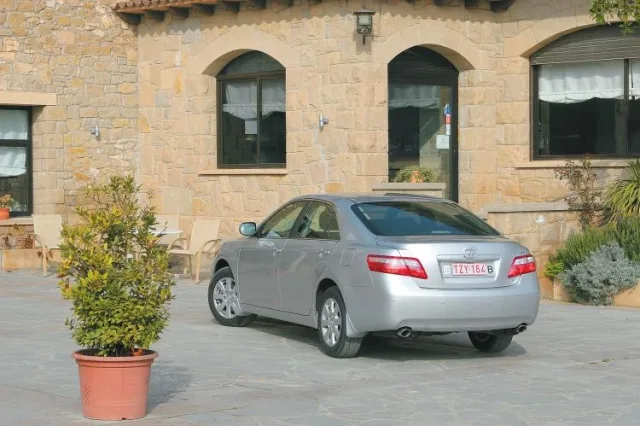
At the traffic light, a battered Fiat shamelessly squeezed in front of me, a daring motorcyclist darted out from the alley, and on the highway an ancient van stubbornly occupied the left lane... Such trifles can throw anyone off balance! But not the driver of the new Toyota Camry sedan—a car created for complete relaxation. Toyota representatives themselves, speaking of the Camry, recall a massage or a jacuzzi—saying the effect is similar. And that's quite close to the truth...
Today, tens of thousands of Russians are relaxing behind the wheel of the previous-generation Camry—only last year, 12,860 units were sold. Such confident leadership in the E-class (the Audi A6 lagged almost five times behind—2,357 cars) is explained simply: the Camry is available for $30,000, while an Audi A6 with a similar engine will cost $50,000. Of course, many Camry owners are not satisfied with the outdated appearance: simple optics, a somewhat short wheelbase, a massive rear... But in terms of price-to-quality ratio, Toyota has no rivals!
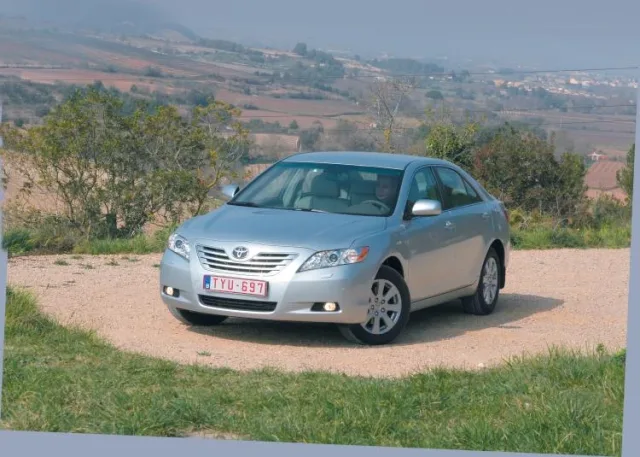
The new generation of the Camry sedan had to look more modern. As usual, the design was chosen through a competition—the American, European, and Japanese divisions of Toyota presented their sketches. And, as with the new RAV4, management liked the "home" project of the Japanese studio. A streamlined body (aerodynamic drag reduced to a coefficient of 0.28), elongated block headlights with sharp edges, a trunk lid raised above the rear fenders. The only controversial spot is the radiator grille with the emblem, seemingly propping up the hood, which makes the Camry resemble the Avensis—a model a class lower.
 |
 |
 |
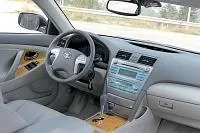
| The interior has become more interesting. Dual-zone climate control and a CD/mp3 changer can be controlled from the steering wheel. But why the playful turquoise plastic? |
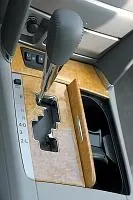
The "automatic" is not too quick, but very smooth in shifts
|
Optitronic instruments with brightness adjustment are good both day and night |
However, the main resemblance is perhaps to the Lexus GS sedan. And in profile, the Camry even vaguely resembles the new Mercedes S-class. Not a bad comparison at all.
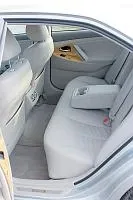
But the new Camry has become more proportional. The overall length remains the same, but the wheelbase has been extended by 55 mm, and the track widened—by 30 mm in front and 40 mm in the rear: the rear seat has noticeably more space. And in the top version, the rear seat backrests can now be adjusted for angle.
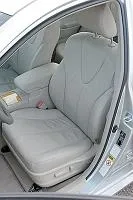
Behind the wheel, the driver's seat pleasantly pleased—both the shape is comfortable and the adjustment ranges are wide. I remember in the old Camry, at 190 cm tall, I wasn't as comfortable. The steering wheel adjusts both in height and reach, and buttons are placed on the spokes—for example, you can control the dual-zone climate control from here. The climate system itself is also unusual—the console boasts the inscription Plasmacluster. A built-in air ionizer! And all this, including the audio system with a CD/mp3 changer, is already in the base configuration.
Yes, competitors will have a hard time. Even harder...
First, I tried the Camry with the base 2.4-liter engine and an "automatic"—the most popular version among Russians. The four-cylinder engine was refined—intake and exhaust systems were changed, pistons lightened, the balance shaft design was redone to reduce vibrations, and the compression ratio was increased to 9.8. And most importantly, the engine became 15 hp more powerful and more economical at the same time.
The new five-speed "automatic" is quicker than the old four-speed. But even in kick-down mode, when the gas pedal is floored, the downshift engages smoothly, with a noticeable pause. And indeed—why rush, why fuss? Behind the wheel of the Camry, there's no urge to press the gas. And it's not just the gearbox—that's the car's philosophy.
The main thing here is comfort. The ride smoothness is magnificent—over Spanish, not the smoothest, roads the Camry glides like a hovercraft. The cabin is quiet and peaceful. But at high speed, the car lacks precision in reactions. While driving up to 100–120 km/h—everything is fine. But after 160 km/h on a gentle curve, you already have to steer tensely, correcting slight deviations from the course. And on mountain serpentines, the new Camry clearly feels uncomfortable—although it handles corners more confidently than the old one (the increased base and track have made themselves known).
Maybe with a more powerful engine, the Camry will behave differently? Indeed, during acceleration, it takes your breath away—the 277-hp V6 3.5 with a six-speed "automatic" easily accelerates the 1.5-ton sedan to 220 km/h. But in corners—again rolls, again deviations from the trajectory... Oddly enough, the suspension here is absolutely the same as on the Camry 2.4—neither the shock absorber and stabilizer settings nor the tire size (these are high-profile tires by today's standards, 215/60 R16) have been touched.
But comfort hasn't suffered: the same amazing ride smoothness.
 |
 |
 |
| The seats have a more pronounced shape, and the longitudinal adjustment range has been increased to 26 cm |
There's more legroom in the back, and the top version has backrest angle adjustments |
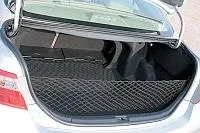
The trunk volume has grown from 520 to 535 liters, with a full-size spare under the mat |
Perhaps if the Camry were tuned for European autobahns, the suspension of the powerful version would be "tightened," and 17-inch wheels would be fitted. But in Europe, the Camry is not officially sold—the large sedan market has long been divided among the "big German three." And even Toyota with its legendary reliability cannot break into this circle.
No, the Toyota Camry was and remains primarily an American car—of the 650,000 cars sold annually outside Japan, 400,000 find owners in the USA. And Russia has become the only stronghold of the Camry on the European continent. For now, we sell Japanese-assembled Camrys, but in a year and a half, a plant in the Leningrad region should start operating. And the first model will be the Camry—in Shushary, they promise to produce 20,000 cars a year. A quite realistic volume: the market is growing, and prices for Russian-assembled Camrys will surely drop. They are acceptable even now—from $30,900 for a car in the well-equipped base R1 configuration with a 2.4 engine and a "manual." The surcharge for the "automatic" and headlight washers (R2 configuration) is $1,600. Want parking sensors and leather seats with electric drives—take the R3 configuration for $34,900. Xenon headlights and a stability control system raise the price to $36,400. And at the top of the range is the top version with a 3.5-liter engine for $43,200. For comparison, the same Audi "six" with a three-liter engine will cost about one and a half times more...
| Toyota Camry (manufacturer's data) |
| Modification |
2.4 |
3.5 |
| Body type |
4-door sedan |
| Number of seats |
5 |
| Maximum trunk volume, l |
535 |
| Curb weight, kg |
1390—1490 |
1465—1545 |
| Length, mm |
4815 |
| Width, mm |
1820 |
| Height, mm |
1460 |
| Wheelbase, mm |
2775 |
| Track front/rear, mm |
1575/1565 |
| Ground clearance, mm |
160 |
| Aerodynamic drag coefficient |
0.28 |
| Engine |
gasoline, with distributed fuel injection |
| Location |
front, transverse |
| Number and arrangement of cylinders |
4, in-line |
6, V-shaped |
| Displacement, cm³ |
2362 |
3456 |
| Compression ratio |
9.8 |
10.8 |
| Number of valves |
16 |
24 |
| Maximum power, hp/rpm |
167/6000 |
277/6200 |
| Maximum torque, Nm/rpm |
224/4000 |
346/4700 |
| Gearbox |
manual, 5-speed
(automatic, 5 speeds) | automatic, 6 speeds |
| Drive | front |
| Front suspension | independent, coil spring, McPherson |
| Rear suspension | independent, coil spring, McPherson |
| Front brakes | disc, ventilated |
| Rear brakes | disc |
| Tires | 215/60 R16 |
| Maximum speed, km/h | 210 (205) | 230 |
| Acceleration 0—100 km/h, s | 9.4 (9.6) | 7.0 |
| Average fuel consumption, l/100 km | 8.5 (9.9) | 9.9 |
| Fuel tank capacity, l | 70 |
| Fuel | AI-95 |