
Alexander DIVAKOV, Pavel KARIN, photos by Stepan SHUMAKHER
As soon as photos of the participants of this test were posted on the website www.autoreview.ru (traditionally, readers were asked to guess the favorite), indignant letters poured into the editorial office: how can you compare cars of different classes? Mondeo and Passat — that's understandable. But Camry? Guys, you mixed up segments D and E, mixed up Avensis and Camry?
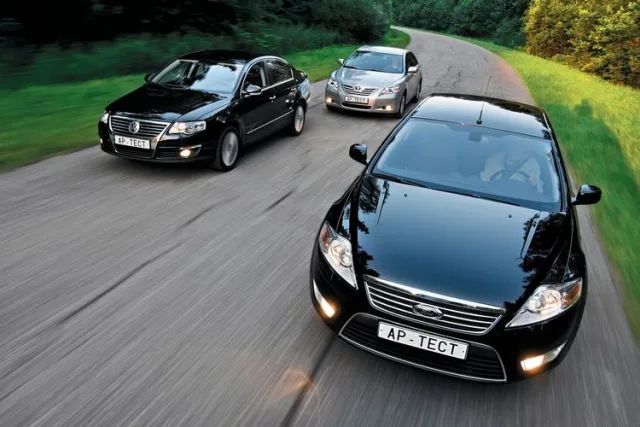
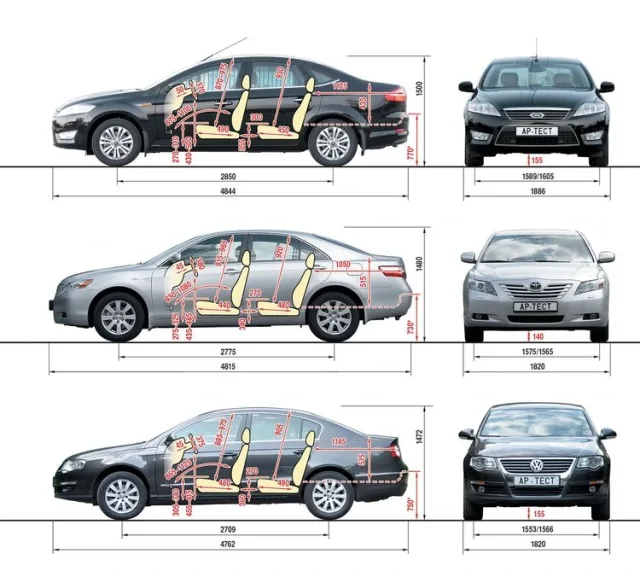
Maybe we really did mix them up. But before relying on our eyes, we turned to the numbers. And here's what they showed: the new Mondeo is 29 mm longer than the Camry! Of course, this is no reason to move the Mondeo into segment E or strip the Camry of its title as the business-class leader, but there's nothing shameful in such a comparison either. Another thing is that we got a Mondeo with a 2.0 petrol engine (145 hp) and a manual gearbox, while the rivals had automatics. The six-speed Aisin for the Mondeo will only appear in October, and even then paired with a 2.0 diesel (130 hp) or a 2.3 petrol (161 hp). Moreover, the Passat was equipped with a 2.0 FSI engine (150 hp), and the Camry — a 2.4, already producing 167 hp. But, as measurements on the dynamometer road showed, power is not all the same...
| Ford Mondeo | Toyota Camry | Volkswagen Passat |
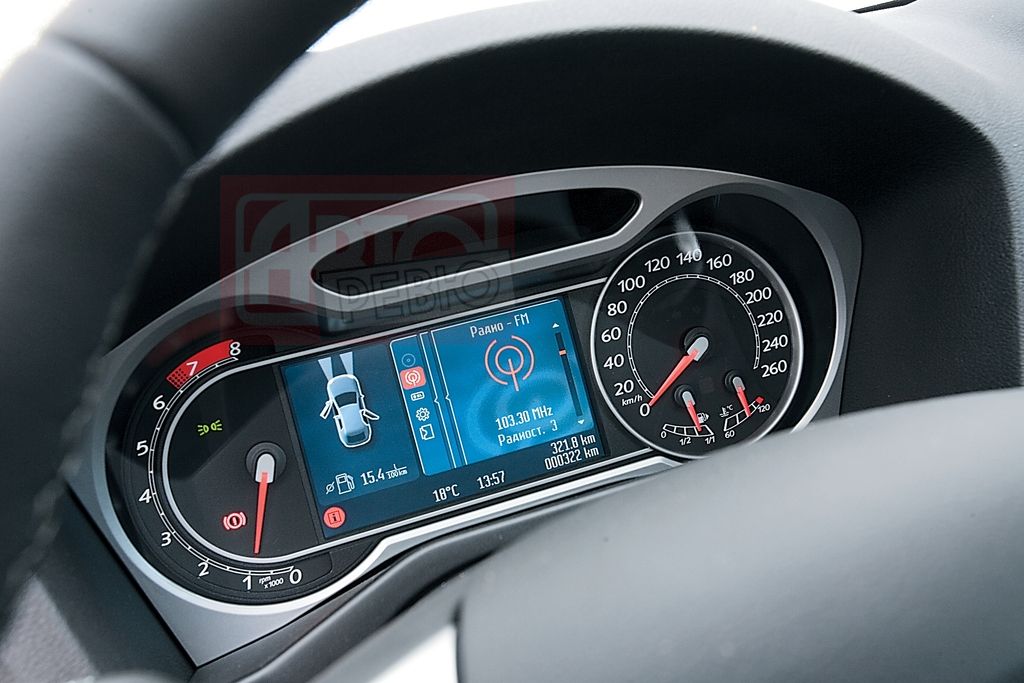 | 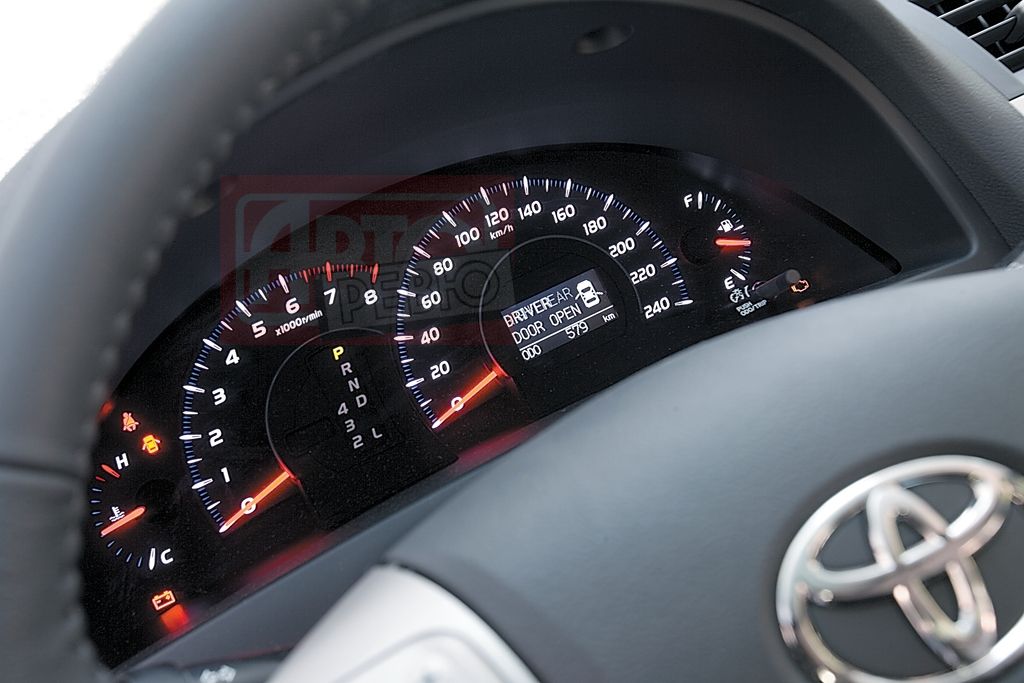 | 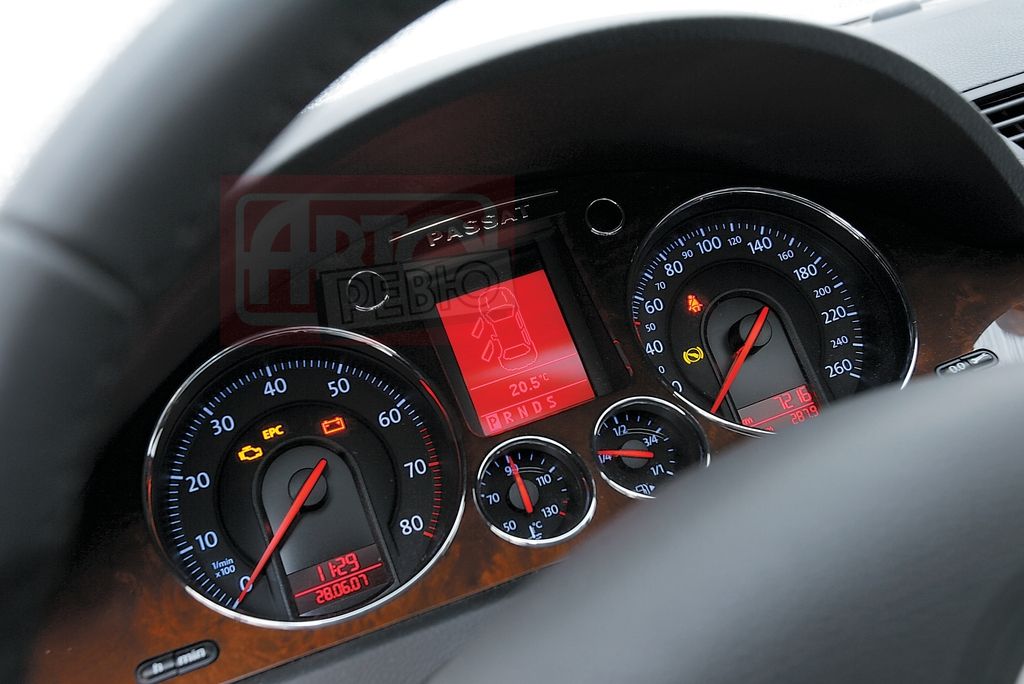 |
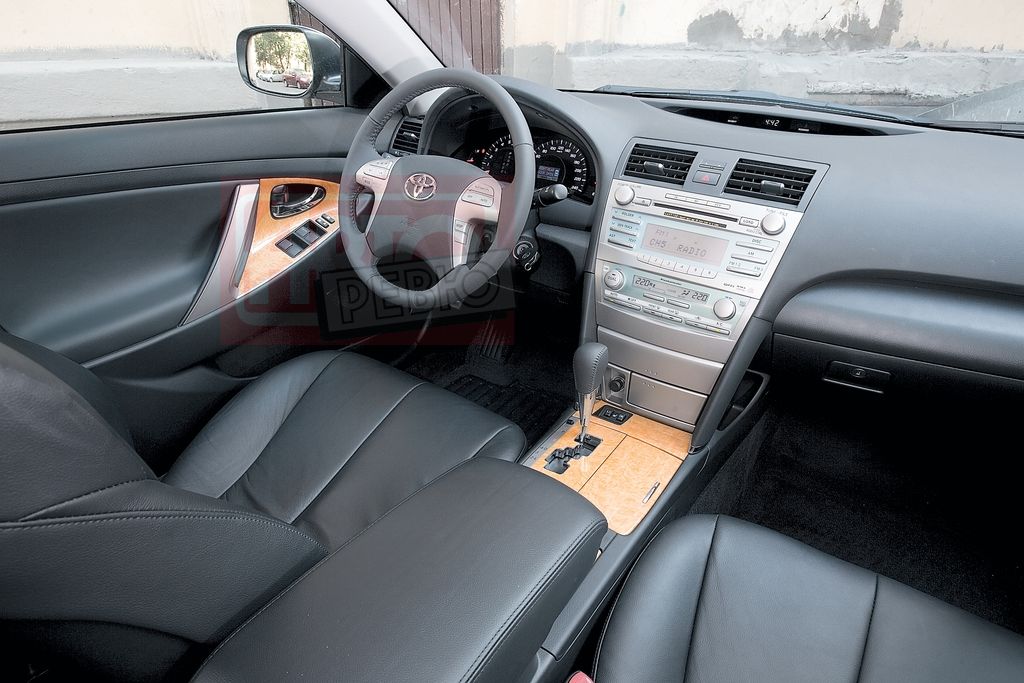
| What we liked most were the optitronic instruments of the Camry — beautiful and informative. Attention from the ringed dials of the Passat is distracted by the bright red display of the onboard computer. And the Mondeo driver (in the Titanium version) looks not so much at the speedometer and tachometer as at the picture of the car and the submenus of the onboard interface | ||
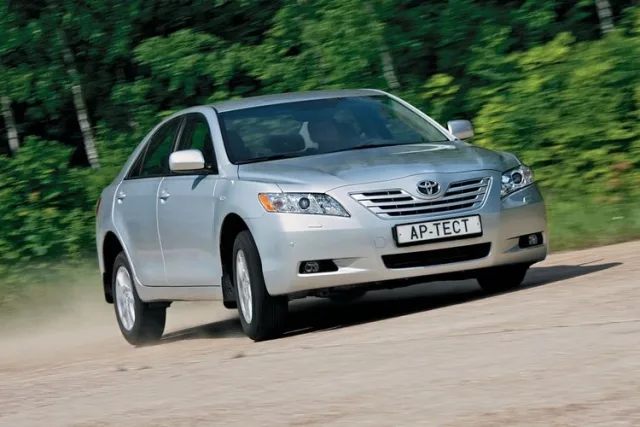
Each of the cars is good in its own way. The current Camry is no longer as faceless as before: dynamic body lines, a funny little face with a sly look — pleasant to look at. And sitting inside is also pleasant! Calm design, neat assembly, decent materials, if not for the eye-catching turquoise plastic on the center console. The soft seat distributes the load well and even allows you to adjust the cushion angle, but lateral support is practically absent (a sign of the business class?), and you can't set the backrest vertically.
The Volkswagen Passat, especially in black, is strict to the point of impossibility! You don't even have to get behind the wheel — it's already clear: this one will do everything right! But we still got in and made sure: that's exactly how it is! In the front seats with developed lateral support and combined upholstery of leather and suede, you sit as if poured in, and the fact that the front edge of the cushion presses under the knees, and you can't tilt it like in the Camry, only makes us think about some problems with our knees... All the instruments, handles, levers, and switches are in place, and overall, from the point of view of organizing the driver's workplace, the Passat is preferable to the Camry.
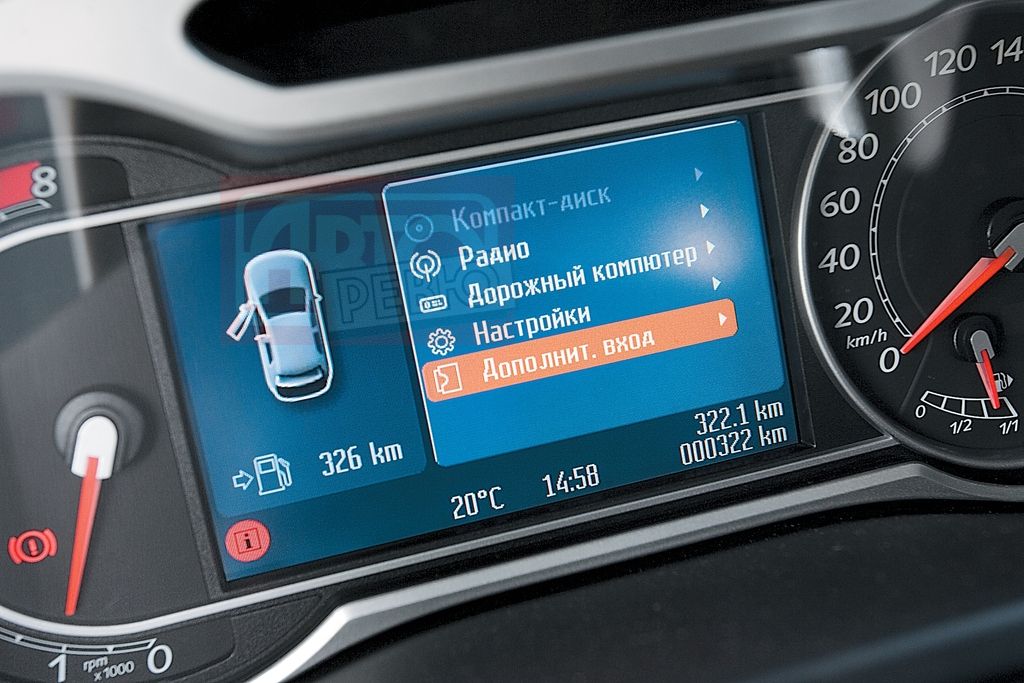 | 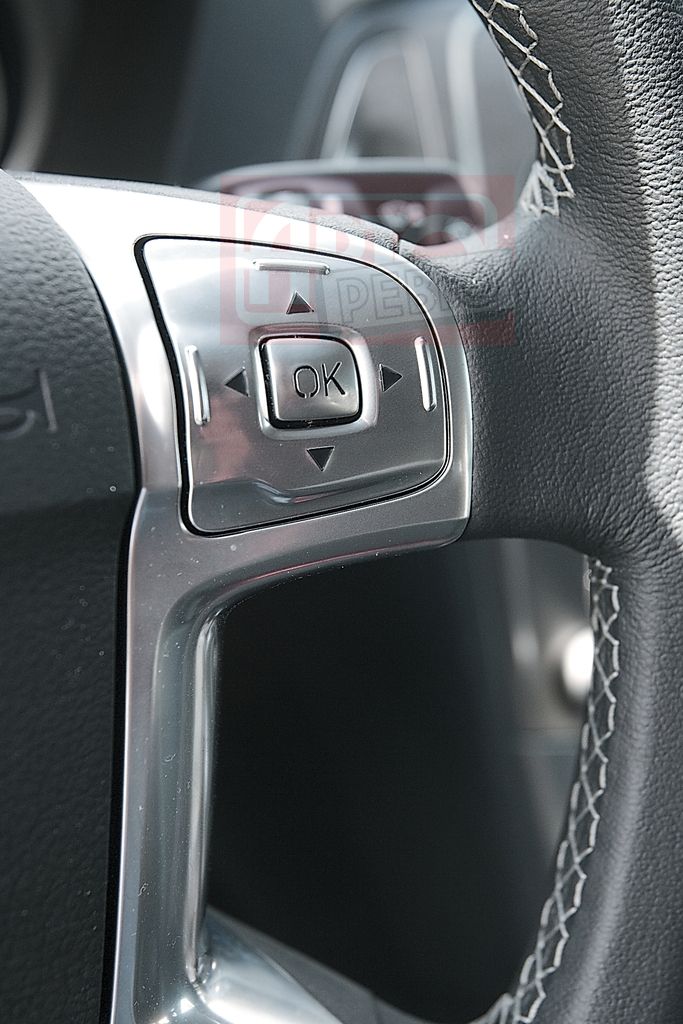 | 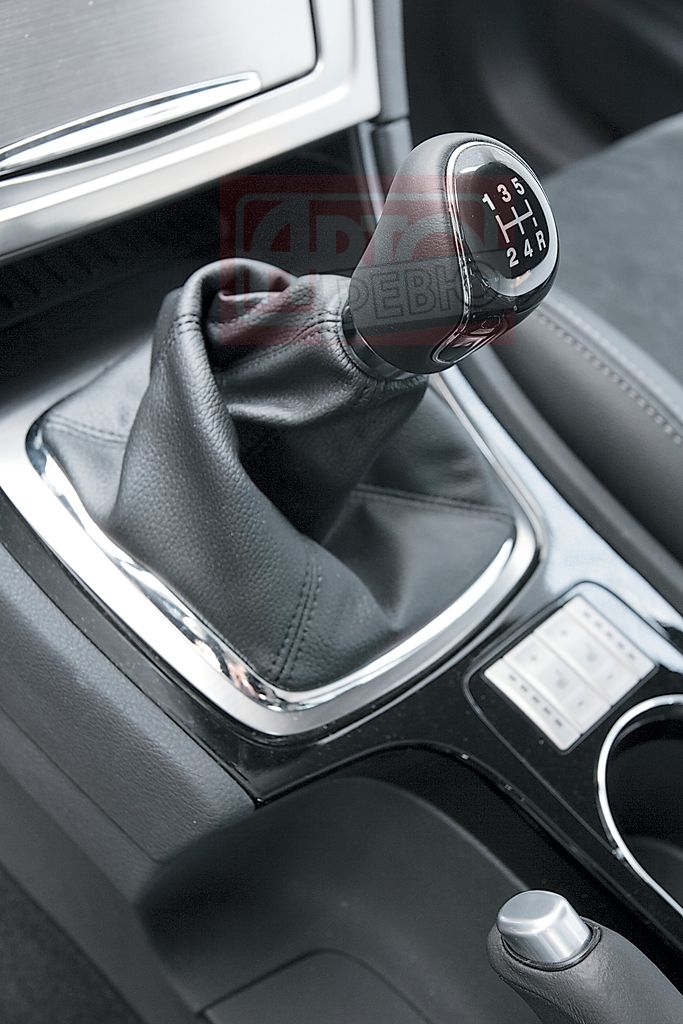 |
| The "instrument" display of the Mondeo can show the navigation map and cruise control readings. But if the car lacks these options, the driver is left to gaze at the onboard computer menu or the frequency of the selected radio station | The Mondeo's onboard computer is controlled by "phone" keys | The Ford manual gearbox is perfectly tuned |
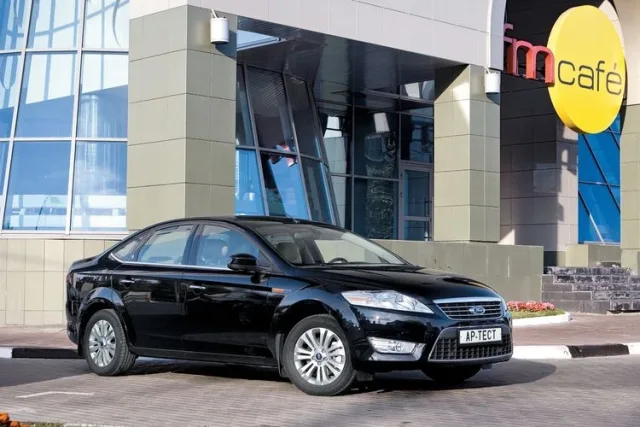
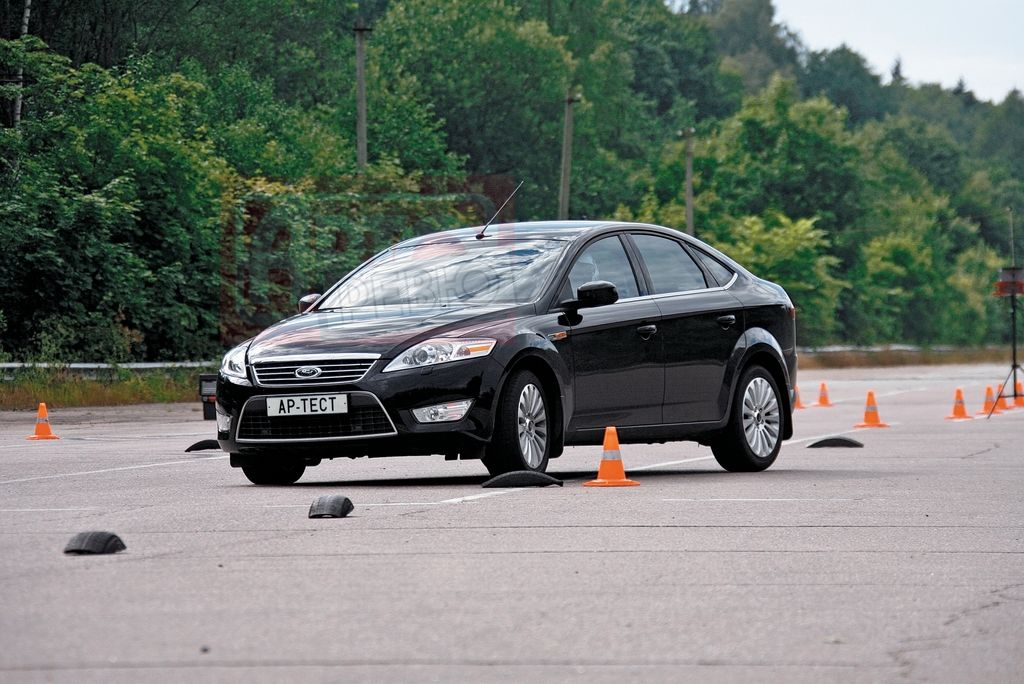
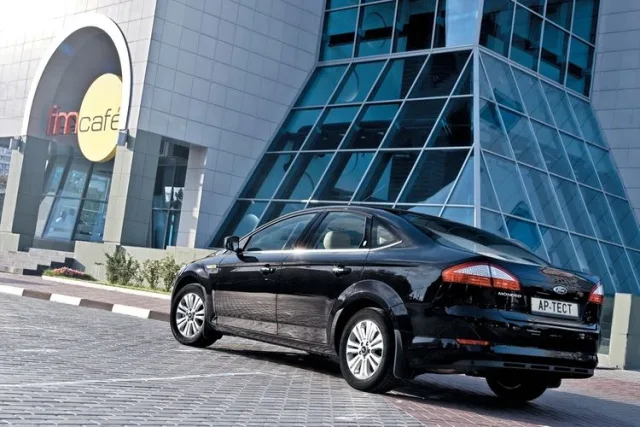
And the new Mondeo... By the time we met it on Russian soil, we had read so many praises of its "kinetic" design that we found no revelations in its appearance. A couple of slanted ribs on the humpbacked hood, slightly bewildered, as if opened by the oncoming airflow, headlight eyes, a plump lip of the air intake in the front bumper, small fins of the rear fenders flowing into the trunk lid... Everything is nice, everything is already familiar. But this won't stop us from admitting that the Mondeo is not only the freshest but also the most interesting car in appearance. And the most dynamic.
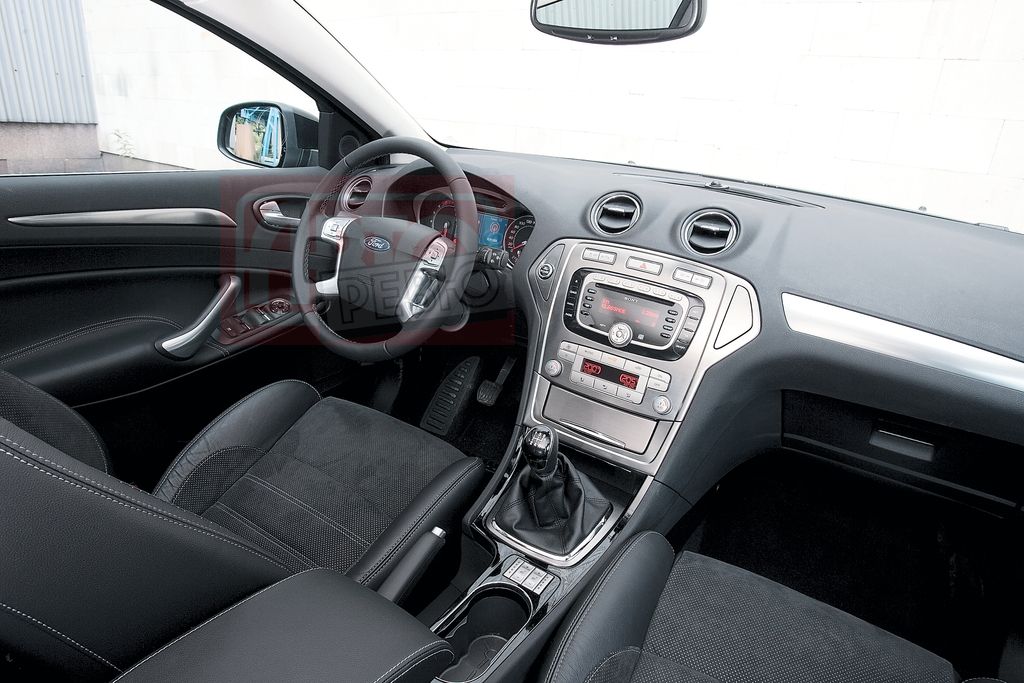 | 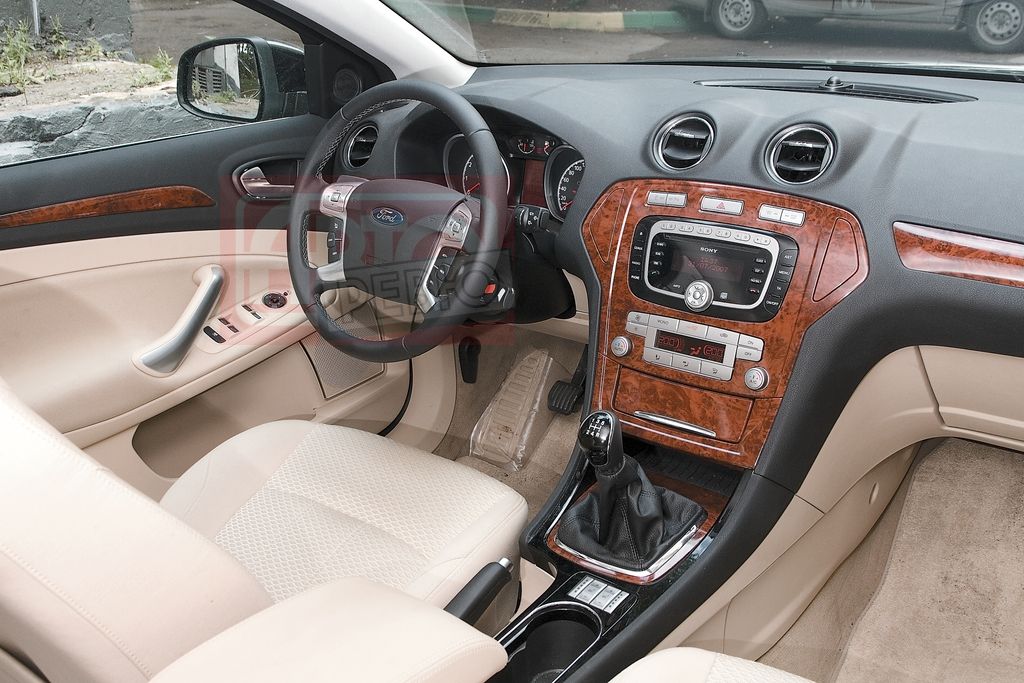 |
| The stylish interior of the Titanium version perfectly supports the "kinetic" mood set by the exterior | But you can't say that about the garish interior of the Ghia version with pseudo-wood. And the instrument cluster here is the most ordinary |
The perception of the Mondeo's interior, more than in any other car, depends on the trim level. We had a Mondeo Titanium in our hands, but we also looked into the Mondeo Ghia. And not in vain: here it is, an example of a complete mismatch between form and content! The driver's seat, practically devoid of lateral support, an abundance of pseudo-wooden inserts... For those over eighty? Against the background of the Ghia's almshouse, the Titanium version is a celebration of life. Stylish trim with unobtrusive "aluminum" decor, excellent seats with combined, like in the Passat, leather-suede upholstery, developed lateral support. Complete harmony with the "kinetic" appearance!
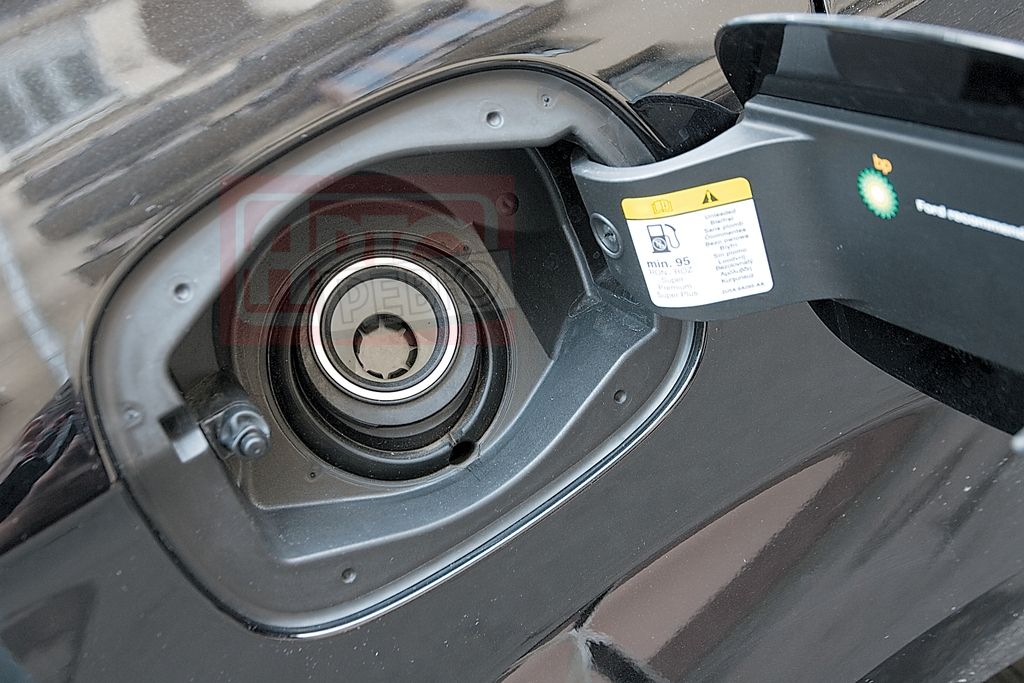 | 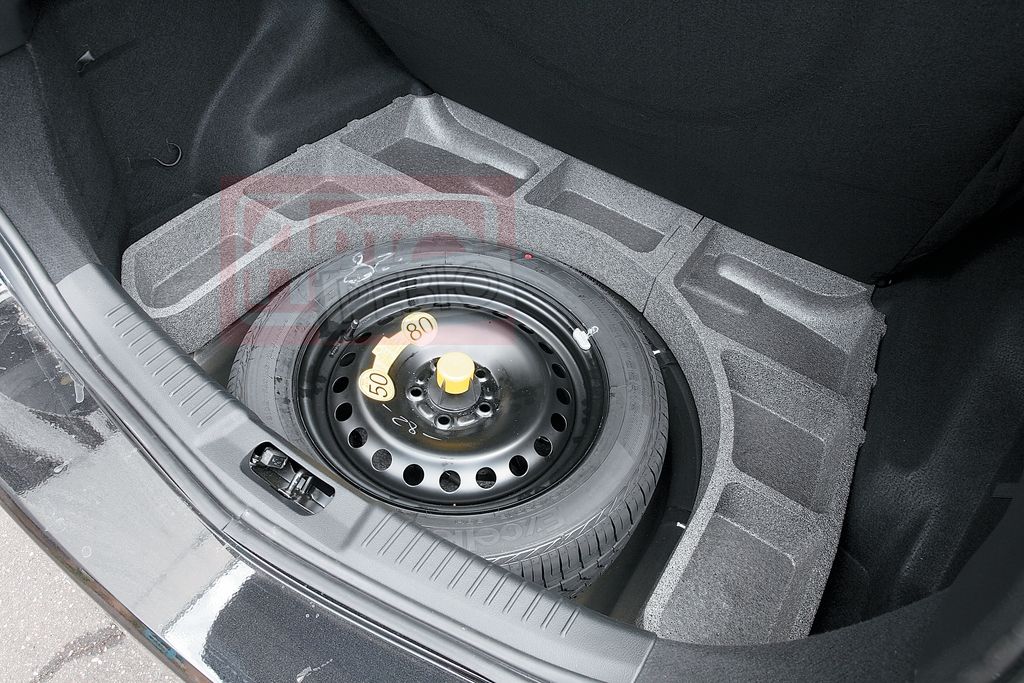 |  |
| The fuel filler neck is without a cap, and the Easyfuel petal system prevents filling petrol cars with diesel and vice versa, "recognizing" fuel nozzles by the diameter of the spout | In the underfloor of the Mondeo's trunk is a full-size spare wheel, for which a thick foam insert had to be laid on the floor | The main "handling" complaint about the Mondeo is the roll on cornering |
Overall, the Mondeo's ergonomics are at the Volkswagen level. Verified seating geometry, large adjustment ranges for the seat and steering wheel, adjustable lumbar support. The pedal assembly is convenient, but for people with small feet, the height difference between the gas and brake pedals may seem too large. And the instrument panel with a color seven-inch display is as original as it is absurd. Ideally, a large display as part of the human-machine interface (HMI) is designed to facilitate control of secondary functions of the onboard electronics — navigation, active radar cruise control... But our Mondeo had none of that: the frequency of the selected radio station loomed before our eyes, and the speedometer and semicircular tachometer huddled forlornly at the edges of the cluster. By the way, on "simpler" Mondeos, normal instruments are installed — with equal-sized wells for the speedometer and tachometer.
The engine of the "Titanium" Mondeo starts with a button bearing the promising inscription "Ford Power". But Power, that is, "might", does not impress. The engine's characteristic is smooth and boring, like an operating manual, and after 5000 rpm — even worse. And the tractive effort is not inspiring either. In second gear, the Mondeo "wakes up" after 2000 rpm, and in higher gears — only after 3500 rpm. That is, for dynamic driving, the two-liter Ford engine is barely enough.
But the Camry and Passat left the same impression — even though nominally they have more powerful engines, and the Camry significantly so! Subjective feelings ultimately coincided with the measurement results: in all "dynamic" disciplines, including maximum speed, all three cars are very close! So, in the "Acceleration dynamics" category, the winner is the one whose speed is more convenient to control. Namely, the Ford Mondeo, the most "powerless"! Everything related to the transmission is done here with a "five": clarity of gear engagement, selection of gear ratios... Second gear accelerates the car to a hundred, third — to 142 km/h. And the clutch works perfectly. But the main thing is the excellent feedback of the accelerator drive: reactions are timely, precise, and smooth.
The Volkswagen Passat may lose to the Mondeo with a manual transmission in terms of speed control precision, but only slightly. The automatic operates predictably, smoothly, and promptly, with hesitations felt only during abrupt downshifts by a couple of gears. However, the many transmission modes compensate for this nuance. Paddle shifters on the steering wheel allow quick downshifts before overtaking, and after a few moments, the transmission automatically returns to automatic mode. In dense city traffic, Sport mode becomes a helpful aid.
 | 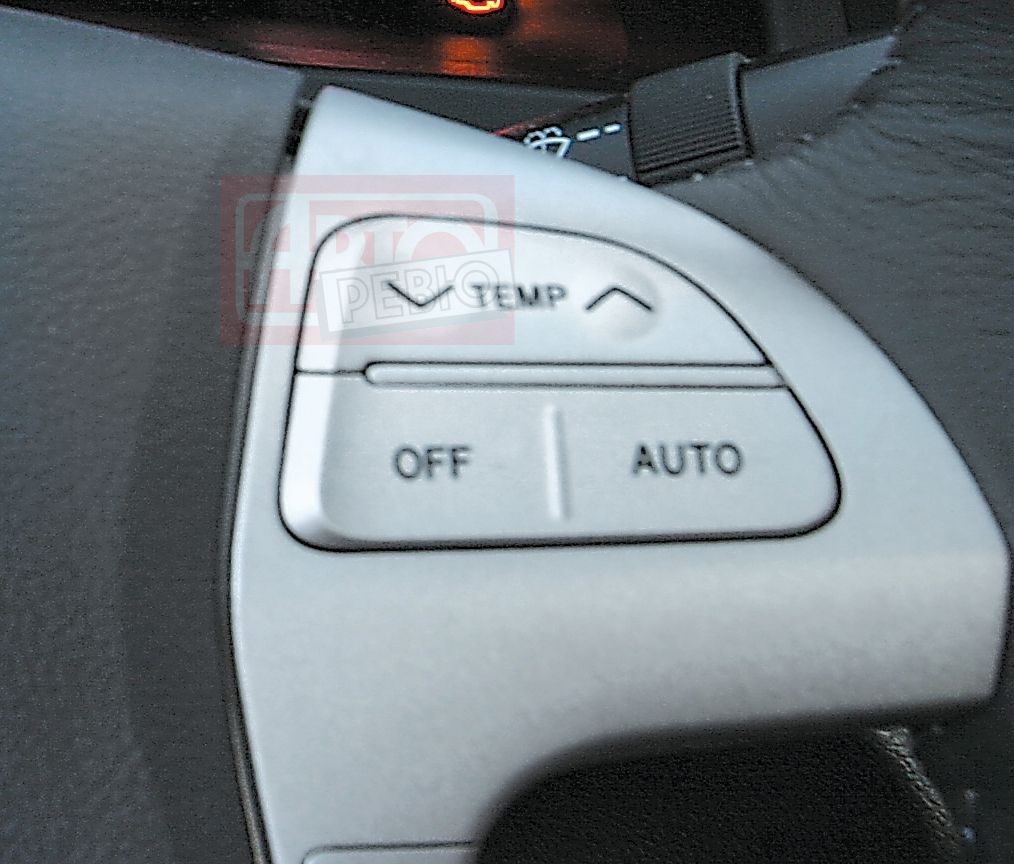 |
| Toyota Camry: calm itself | Climate control from the steering wheel — only in the Camry |
The Camry looks the least exciting in terms of acceleration. The automatic's algorithms provide smooth gear changes, but pauses during downshifts are too long. Moreover, there is less predictability: the gearbox decides on its own which gear to engage, sometimes surprising the driver. The gear ratios are the most widely spaced: in second gear, the Camry reaches 110 km/h, and in third — 165 km/h. Because of this, even with gentle throttle application, the transmission is forced to jump down a gear. Additionally, the accelerator pedal response is sluggish. In short, everything here encourages unhurried and cozy driving.
| Ford Mondeo | Toyota Camry | Volkswagen Passat |
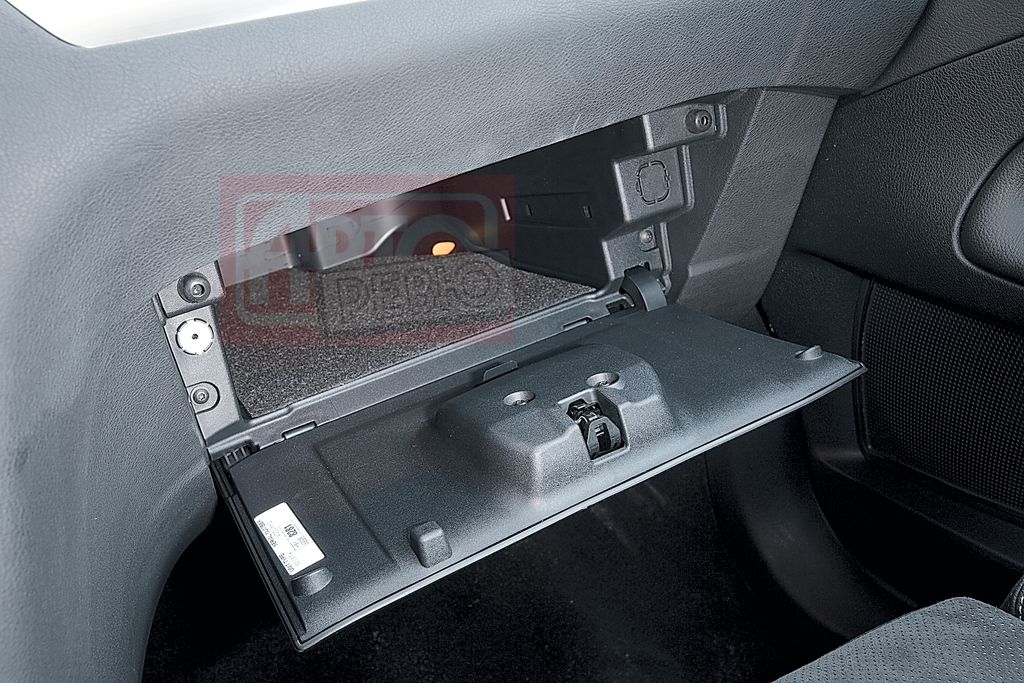 | 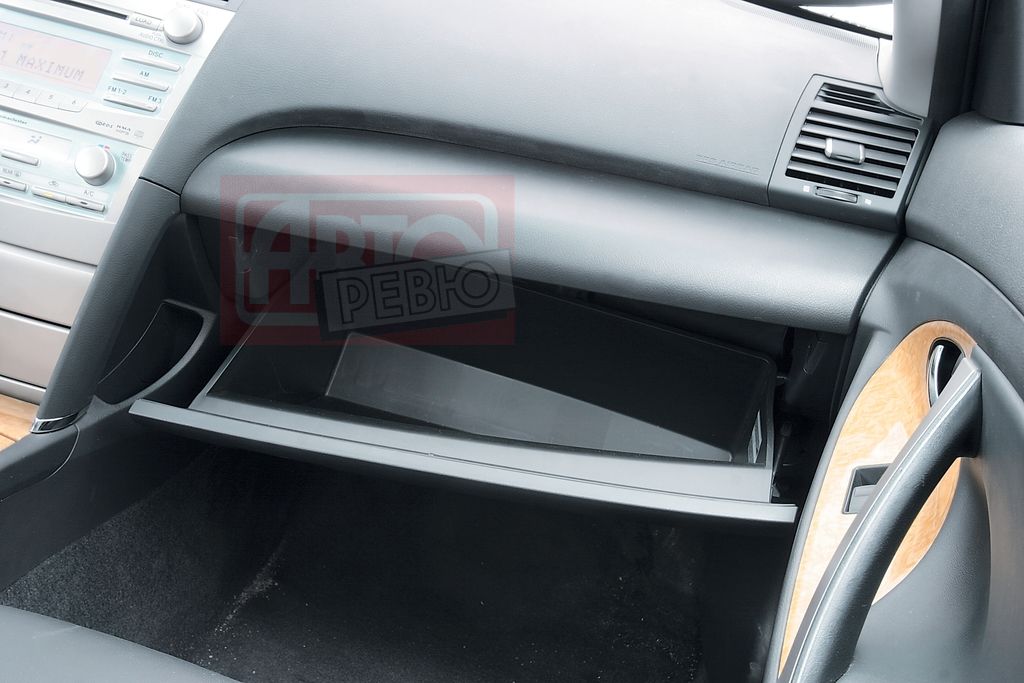 | 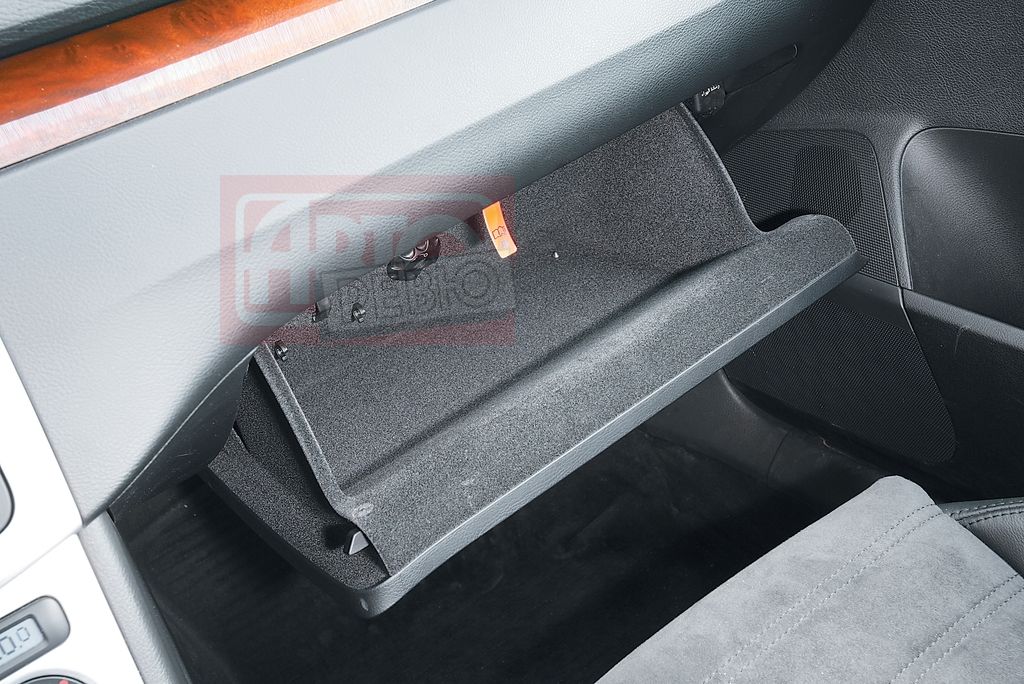 |
| The glove compartments in all three are designed for business documents | ||
In terms of ride smoothness, the Toyota is unrivaled. The car superbly swallows road undulations with a slight rocking motion, smooths out pothole edges, and only rough asphalt occasionally bothers with vibrations. It's also hard to fault the noise insulation: the unobtrusive engine voice is barely audible during energetic acceleration, driving over bumps is almost silent, and acoustic comfort is only disturbed by the rattling of sand grains in the wheel arches. This is the quietest car in the comparison.
| Ford Mondeo | Toyota Camry | Volkswagen Passat |
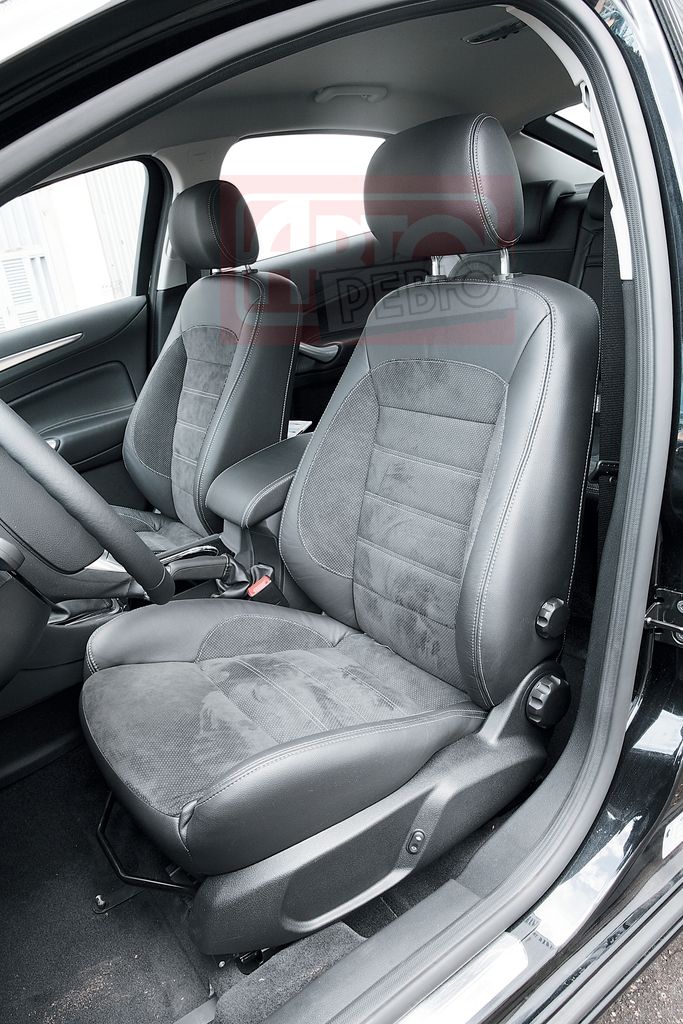 | 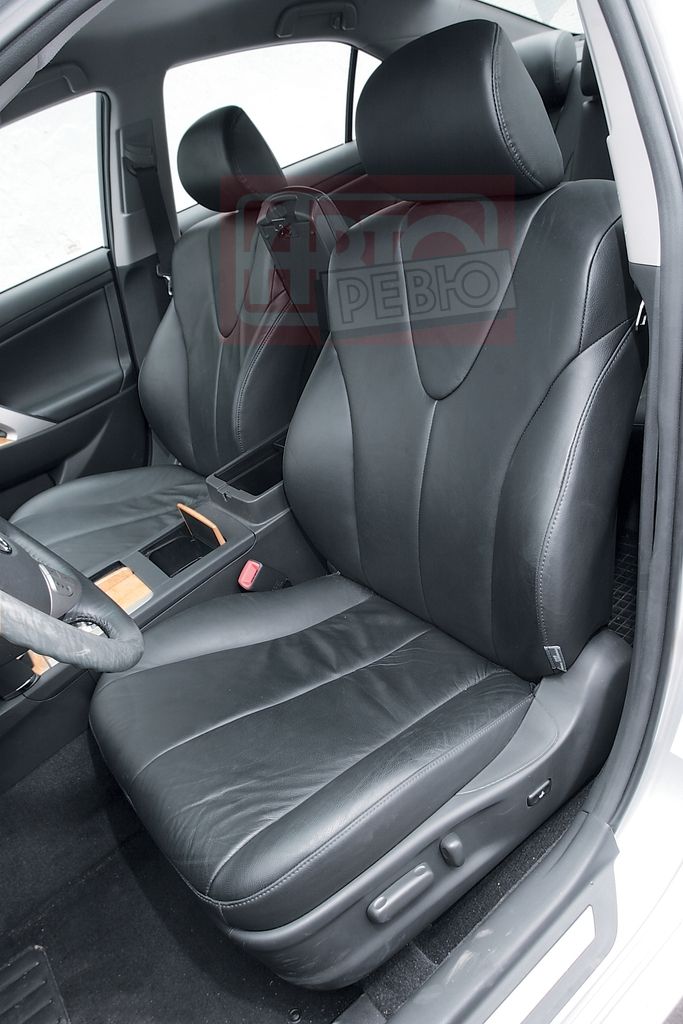 | 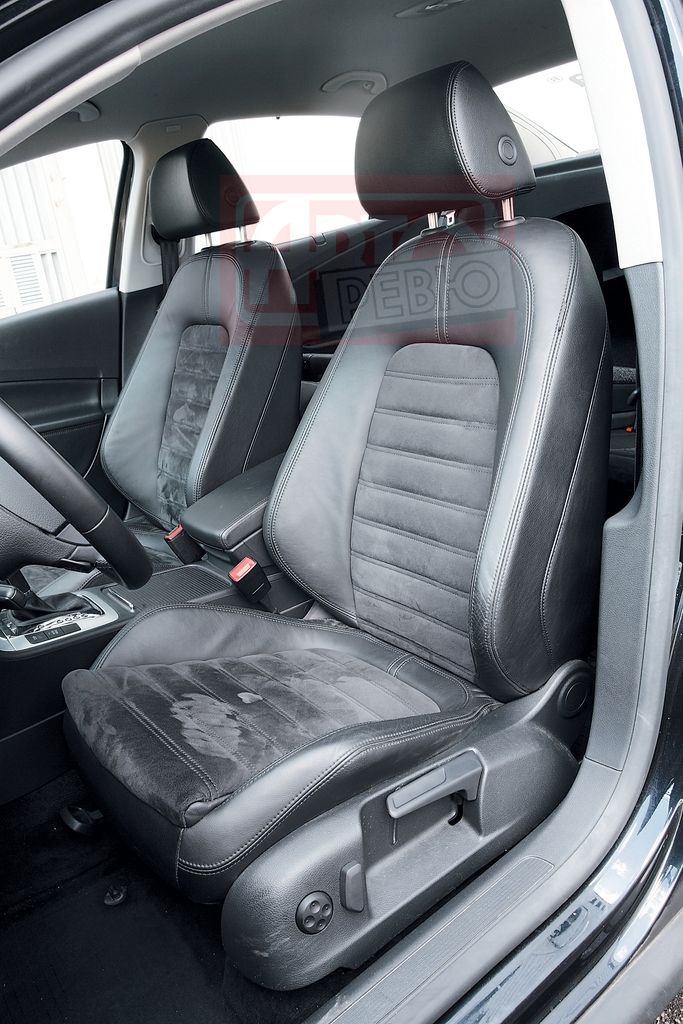 |
| We rated the seats with combined leather-suede upholstery in the Mondeo and Passat as "five" — excellent profile, good lateral support. The soft leather seats of the Camry are also comfortable, but only on straight roads: in corners, you slide off them | ||
The Volkswagen also pleases with comfort. Although the suspension seems somewhat stiff, in return you get an almost Mercedes-like sense of solidity. Small road imperfections are not felt in the cabin at all, large ones are well smoothed, and there is no hint of rocking on undulations. Occasionally, bumps cause slight steering wheel movements, but this does not affect handling. Inside is quiet, and only significant potholes make themselves known with a muffled thud.
The Ford Mondeo pleased less. The suspension transmits all the small details into the cabin, large potholes respond with noticeable jolts, and on undulations, the body also sways from side to side. Acoustic comfort is also not ideal: here you have the noisiest engine, the loudest tires, and the most resonant responses to road imperfections.
| Ford Mondeo | Toyota Camry | Volkswagen Passat |
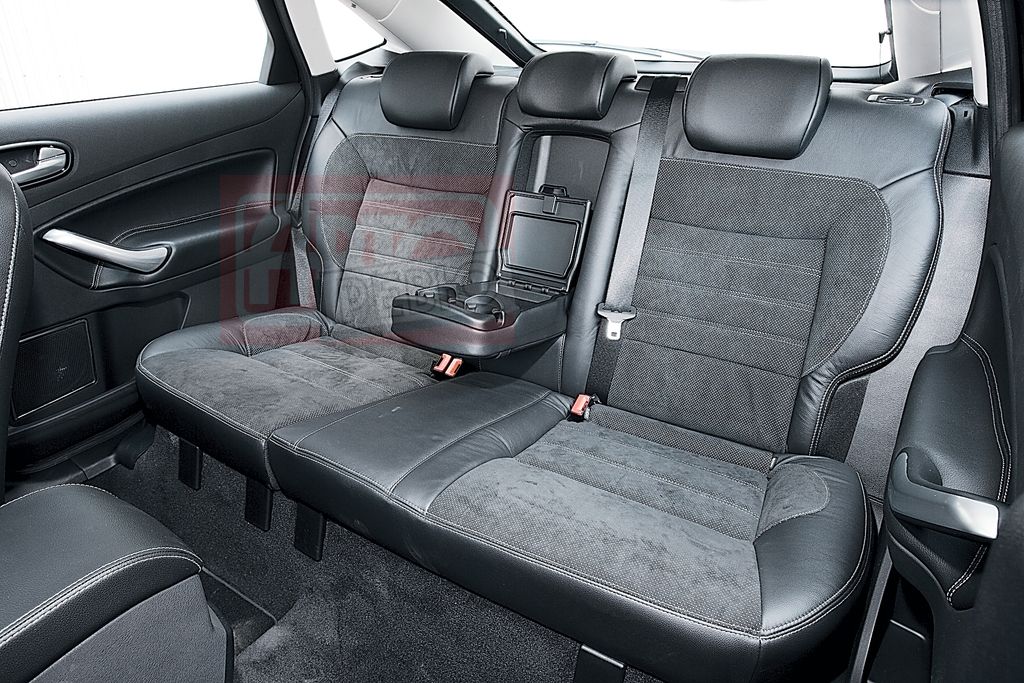 | 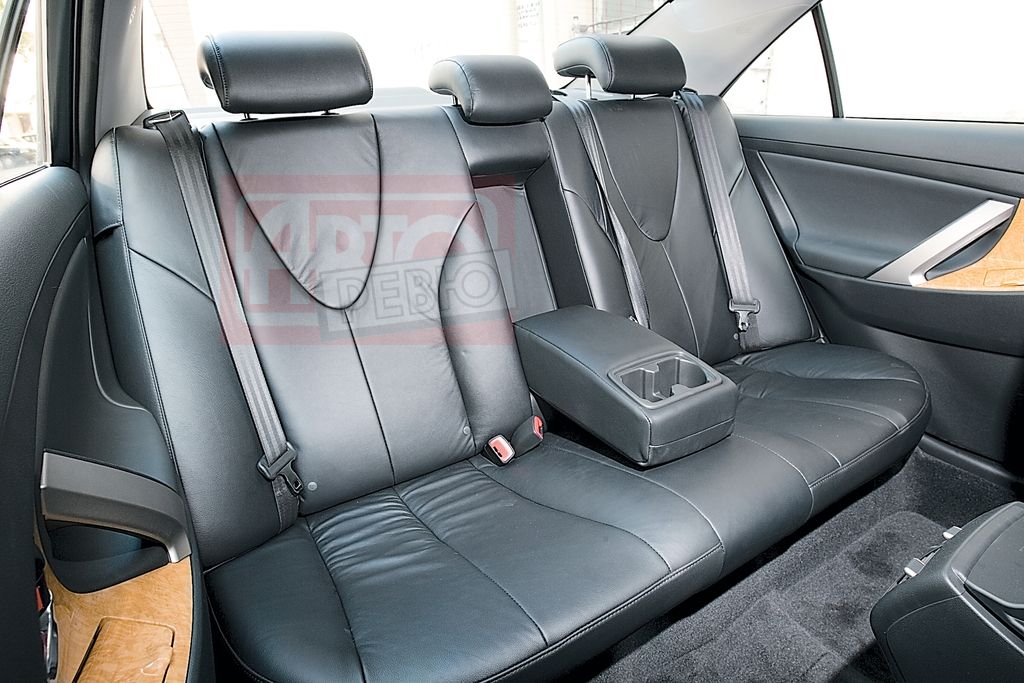 | 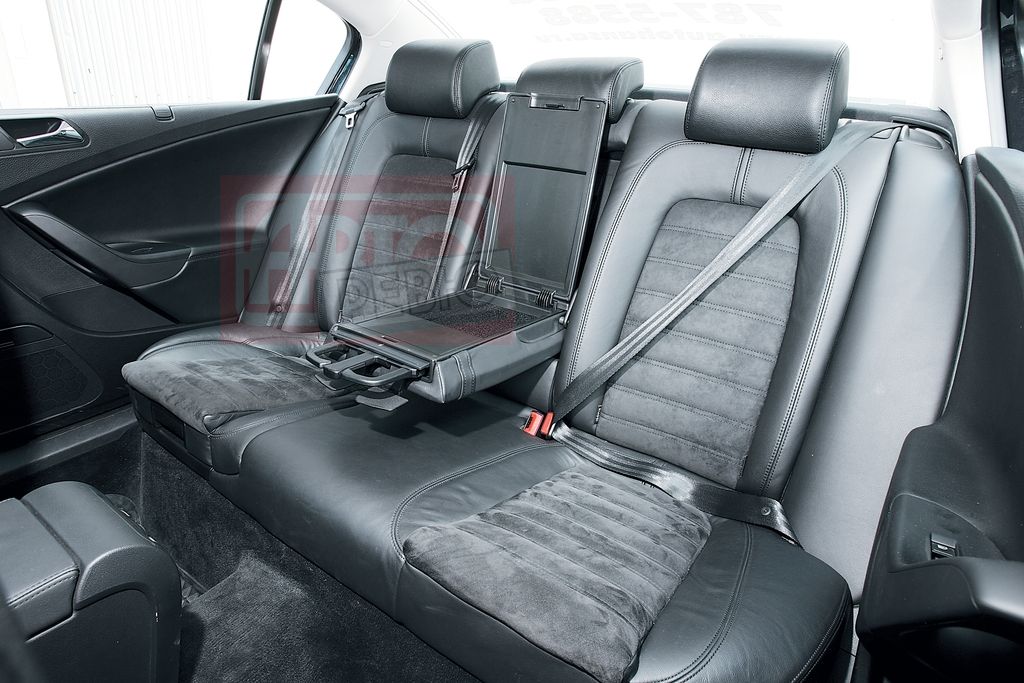 |
| In terms of rear seat comfort, Toyota and Ford lead: the Camry is slightly wider and taller than the Mondeo, but has less footroom. It's harder to get into the Passat's rear bench, which imposes a fixed posture — you can't sprawl out, and it's also tighter for three | ||
The difference in braking distance from 100 km/h among all cars is small — from 42.9 m for the Passat to 44.1 m for the Camry. However, from a braking control standpoint, the Mondeo and Passat look preferable. In the Camry, the start of the pedal travel is poorly felt, leading to delays and nose dives. During hard braking, the Japanese sedan weaves and the steering wheel shudders.
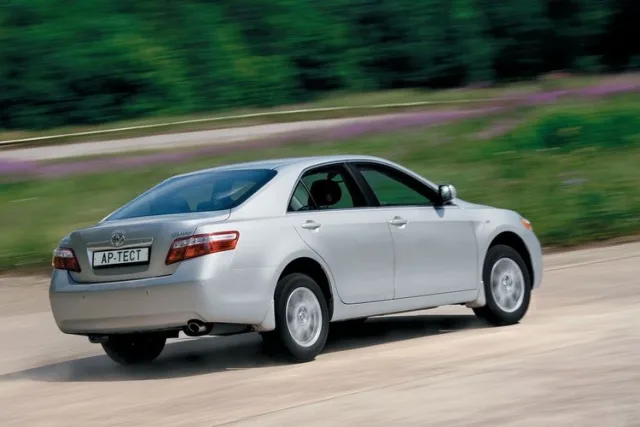
If you don't push the limits, the Camry's handling is calm and clear. At high speed, the car holds a straight line excellently and responds to steering inputs accurately and smoothly. But in sharp corners, feedback weakens. The car noticeably rolls and sways diagonally. And if you enter a corner at the limit of tire grip, then instinctively lifting off the throttle will cause oversteer — albeit smooth and easily correctable, but completely inconsistent with the car's measured and dignified character!
We liked the Mondeo's handling. It flies like an arrow on a high-speed straight, reacts sharply in a sporty manner to actions with an informative steering wheel. But the ambiguity of reactions during lane changes is alarming: as the roll increases, the car "turns in" on its own, sometimes causing the stability control system to intervene. The Mondeo enters fast corners without a shadow of doubt, but the rolls are still somewhat large, and diagonal rocking leads to slight deviations from the trajectory. Fortunately, unlike the Toyota, there is no hint of oversteer here: first all four wheels slide, then understeer. Reliable handling.
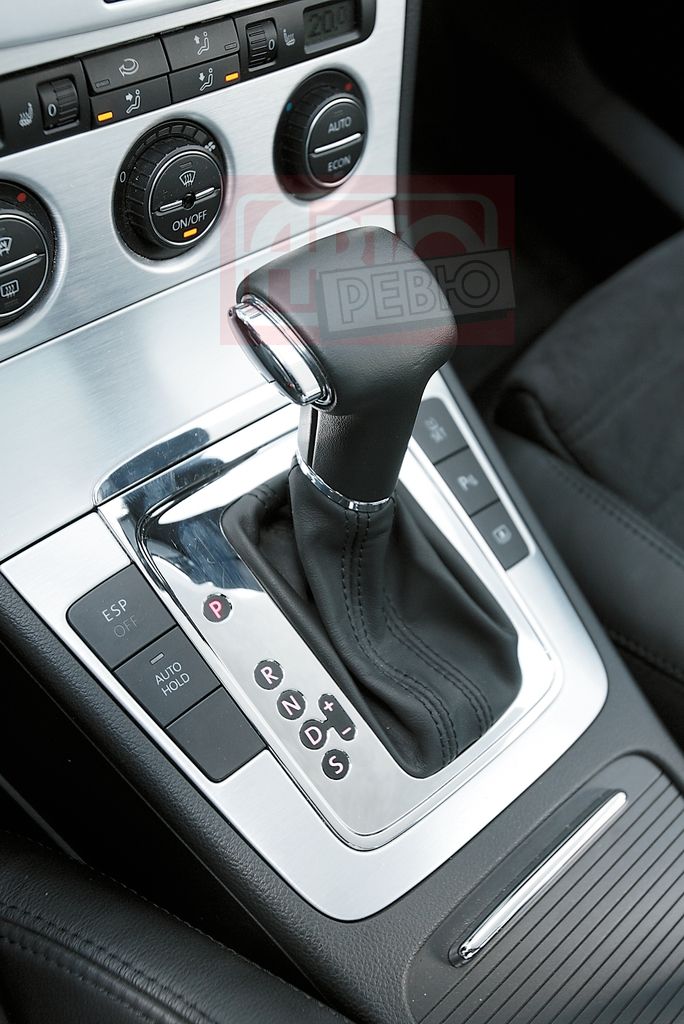 | 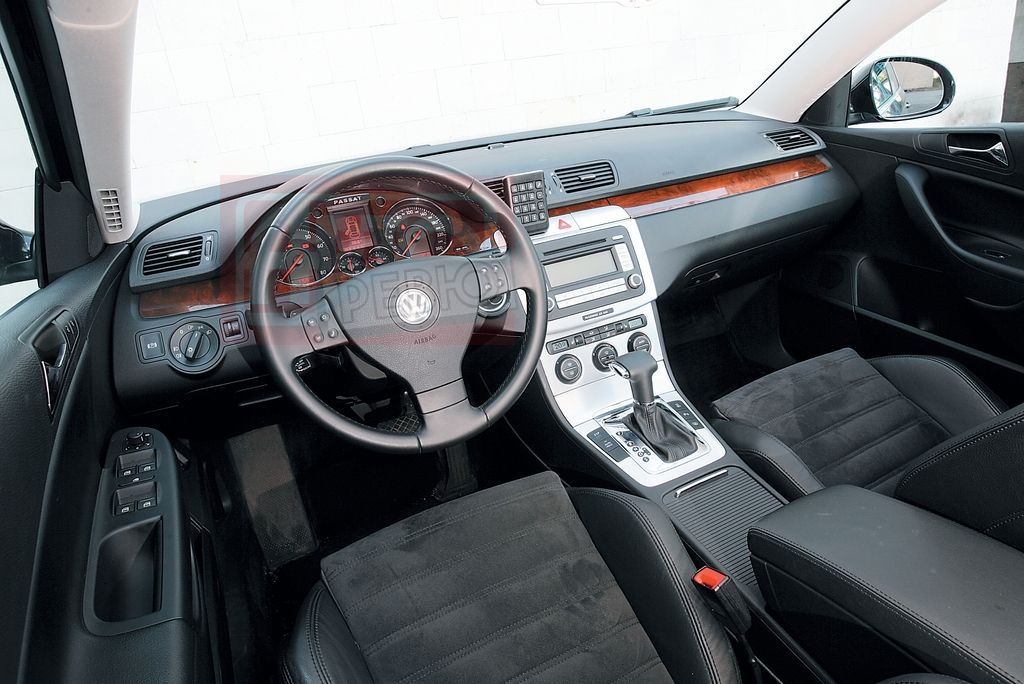 |
| The six-speed Volkswagen automatic works smoothly and promptly | The strict "straight-line" interior matches the Passat's appearance |
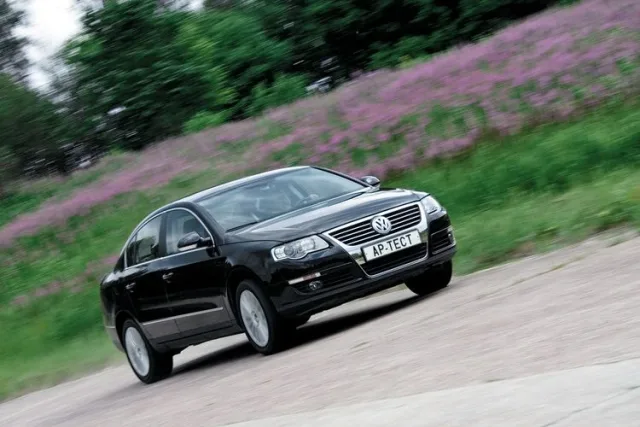
But the Passat is still better. Reactions are quick and always unambiguous, and the steering wheel is the most informative. Rolls, as well as diagonal rocking, are minimal. The most precise car! And only with a significant speed excess does the Passat frankly push its front end wide out of the corner.
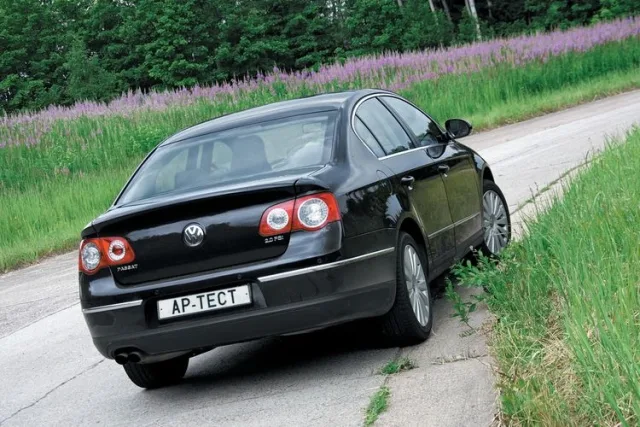
In terms of total points for driving disciplines, the Volkswagen is unrivaled. Behind it is the Ford, and the Toyota closes the trio. But can the former D-class graduates, the Mondeo and Passat, match the Camry in cabin space?
The most inconvenient access to the rear seats is in the Passat: high sills and a tunnel get in the way. And the seat, convex in the lumbar area, assumes a "strict" posture — you can't sprawl out here. Also, the Passat is a bit tight in the shoulders.
| Ford Mondeo | Toyota Camry | Volkswagen Passat |
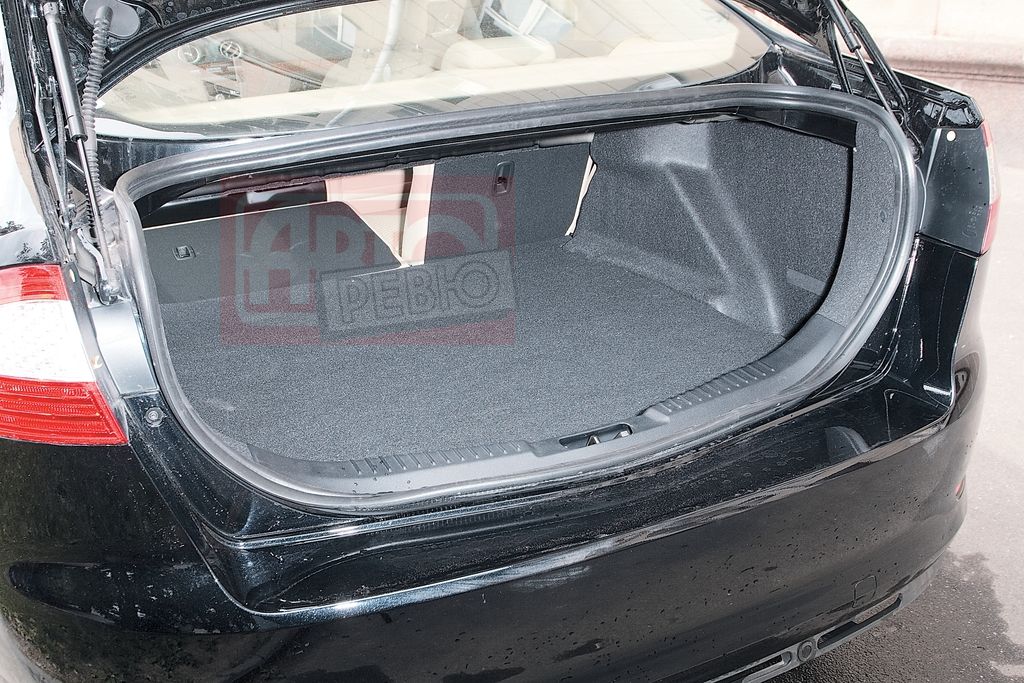 | 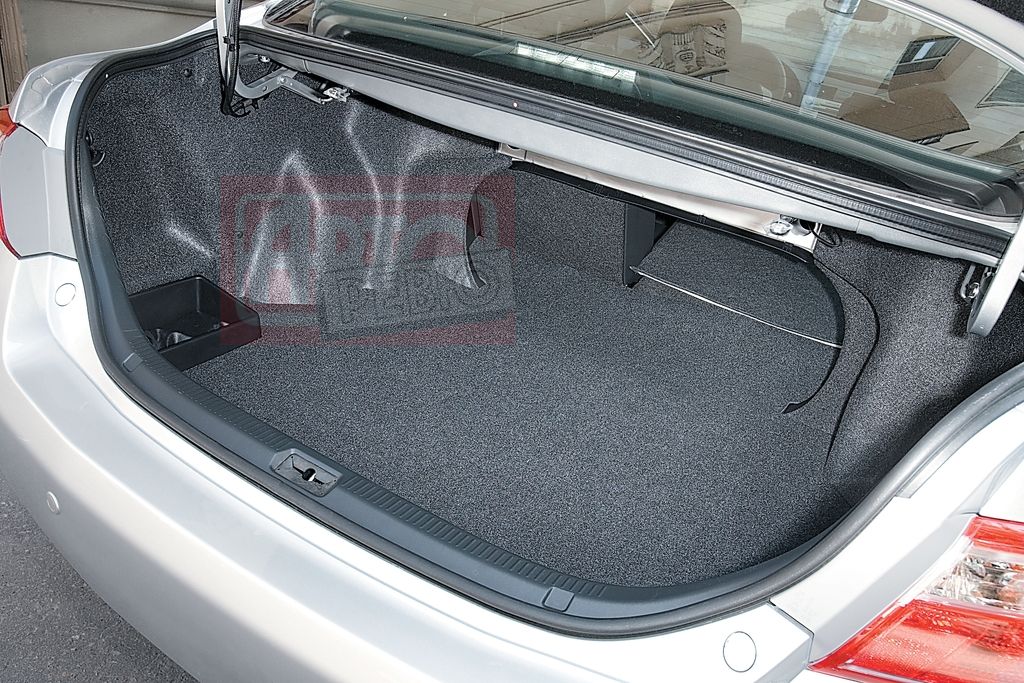 | 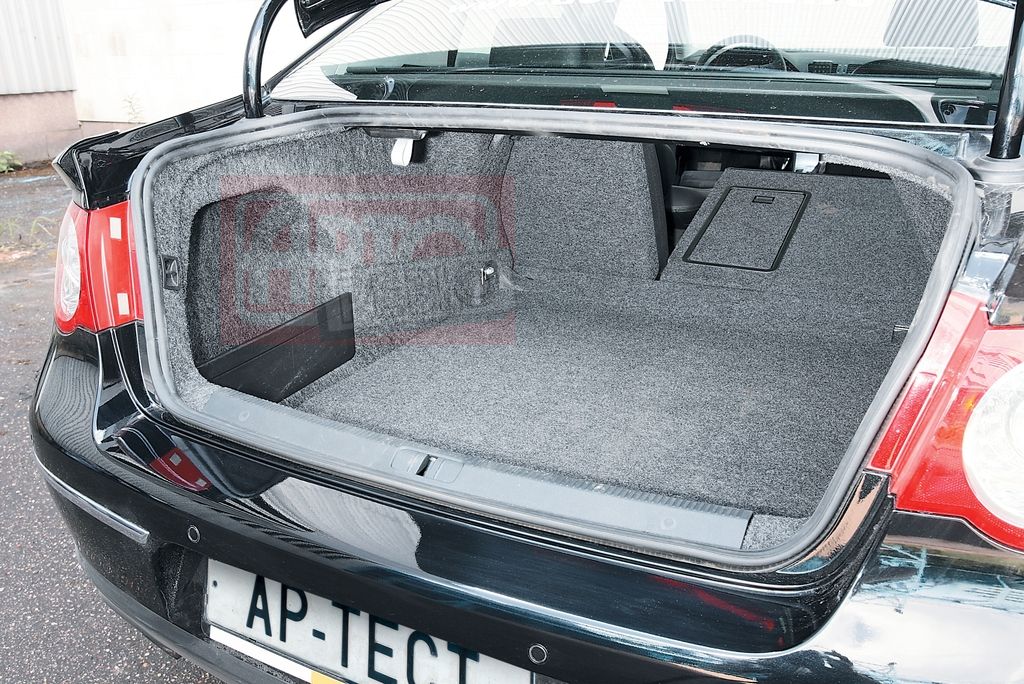 |
| We would prefer to transport suitcases in the Passat — it has the most spacious (560 L) and neat cargo area. The Mondeo's trunk (493 L) is slightly less convenient. And the Camry's sizable compartment (535 L) has a narrow opening, an awkward shape, and simple trim | ||
But the Mondeo competes with the Camry on equal terms. The Toyota is slightly more spacious in width, but there is little room for feet under the front seats, and low roof slopes hinder entry and exit. It's easier to get into the Ford's rear seats, there's more footroom, but less headroom.
However, the Passat has the best trunk: it's spacious (565 L) and convenient. The Mondeo's cargo area (493 L) is "spoiled" by a small opening and limited height due to the "underfloor" insert, although the quality of trim is also top-notch. The Camry's medium-sized trunk (535 L) is the least practical: the opening is narrow, the shape is awkward, and the upholstery is cheap.
So what do you say now — was our comparison of such different classes of cars justified? Look at the final expert scores, and you'll agree: yes! Cars from Europe came out on top. But does that mean that, say, the ambitious Ford Mondeo, having outgrown its segment, will start luring buyers not only from D-class competitors but also from representatives of the so-called business class? It will, but not right away. After all, stereotypes about class affiliation of cars (and often class is also a matter of prestige) don't change overnight. So there's no need to worry about the Camry's fate. Here are the numbers. In the first half of 2007, 11,921 Camry sedans were sold. That's almost four times more than the Nissan Teana (3,055), which takes second place in the E segment, and the superiority over the Passat is overwhelming: in the same period, only 4,884 buyers chose the Volkswagen Passat. Undoubtedly, reputation plays a key role: Toyota regularly leads reliability surveys. This is confirmed both by our editorial experience and by stories from acquaintances. And reliability in Russia is a stronger argument than design, space, interior comfort, driving performance, or even service intervals or costs... But based on the results of this test, we at least confirmed that the formal division of cars into segments is becoming increasingly conditional. Both the Passat and the Mondeo have no less right to be called business-class cars than the Camry. Such neoclassicism.| Specifications | |||
| Parameters | Cars | ||
| Ford Mondeo | Toyota Camry | Volkswagen Passat | |
| Body type | 4-door sedan | 4-door sedan | 4-door sedan |
| Number of seats | 5 | 5 | 5 |
| Trunk volume, l | 493 | 535 | 565 |
| Curb weight, kg | 1402 | 1450 | 1418 |
| Gross weight, kg | 2090 | 1985 | 2030 |
| Engine | petrol, with distributed injection | petrol, with distributed injection | petrol, with direct injection |
| Location | front, transverse | front, transverse | front, transverse |
| Number and arrangement of cylinders | 4, in-line | 4, in-line | 4, in-line |
| Displacement, cm³ | 1999 | 2362 | 1984 |
| Cylinder bore/piston stroke, mm | 87.5/83.1 | 88.5/96.0 | 82.5/92.8 |
| Compression ratio | 10.8:1 | 9.8:1 | 11.5:1 |
| Number of valves | 16 | 16 | 16 |
| Max. power, hp/kW/rpm | 145/107/6000 | 167/123/6000 | 150/110/6000 |
| Max. torque, Nm/rpm | 185/4500 | 224/4000 | 200/3500 |
| Gearbox | manual, 5-speed | automatic, 5-speed | automatic, 6-speed |
| Gear ratios | |||
| I | 3.67 | 3.94 | 4.15 |
| II | 2.14 | 2.20 | 2.37 |
| III | 1.48 | 1.41 | 1.56 |
| IV | 1.11 | 0.98 | 1.16 |
| V | 0.85 | 0.70 | 0.86 |
| VI | — | — | 0.69 |
| reverse | 3.73 | 3.15 | 3.39 |
| final drive | 4.07 | 3.39 | 3.87 |
| Drive | front | front | front |
| Front suspension | independent, spring, McPherson | independent, spring, McPherson | independent, spring, McPherson |
| Rear suspension | independent, spring, multi-link | independent, spring, McPherson | independent, spring, four-link |
| Front brakes | disc, ventilated | disc, ventilated | disc, ventilated |
| Rear brakes | disc | disc | disc |
| Tires | 205/55 R16 | 215/60 R16 | 205/55 R16 |
| Maximum speed, km/h | 210 | 205 | 208 |
| Acceleration time 0—100 km/h, s | 9.9 | 9.6 | 10.2 |
| Fuel consumption, l/100 km | |||
| urban cycle | 11.2 | 14.1 | 12.6 |
| extra-urban cycle | 6.0 | 7.4 | 6.4 |
| combined cycle | 7.9 | 9.9 | 8.7 |
| Fuel tank capacity, l | 70 | 70 | 70 |
| Fuel | petrol AI-95 | petrol AI-95 | petrol AI-95—98 |
| Equipment of participating cars | |||
| Options | Models | ||
| Ford Mondeo | Toyota Camry | Volkswagen Passat | |
| Base version price, $ | 27000 | 33490 | 29650 |
| Front airbags | + | + | + |
| Front side airbags | + | + | + |
| Driver knee airbag | + | – | – |
| Curtain airbags | + | + | + |
| ABS | + | + | + |
| Traction control system | O | O | + |
| Stability control system | O | O | + |
| Power steering | + | + | + |
| Automatic transmission | – | O | O |
| Paddle shifters on steering wheel | – | – | O |
| Multifunction steering wheel | + | + | O |
| Steering column with height and reach adjustment | + | + | + |
| Leather-wrapped steering wheel | O | + | O |
| Heated windshield | O | – | + |
| Power front seats | O* | O | O** |
| Heated front seats | O | + | + |
| Auto-dimming rearview mirror | O | + | O |
| Built-in phone | O | – | O |
| Central locking with remote control | + | + | + |
| Keyless entry | – | – | O |
| Security alarm | O | – | O |
| Dual-zone climate control | O | + | O |
| Heated and power side mirrors | + | + | + |
| Power folding mirrors | – | + | O |
| Front power windows | + | + | + |
| Rear power windows | O | + | O |
| Split-folding rear seat | +*** | + | + |
| Pass-through for long items | – | – | O |
| Audio system with CD | + | + | + |
| CD changer | – | + | O |
| Push-button engine start | O | – | +**** |
| Light and rain sensors | – | + | O |
| Tire pressure monitoring | – | – | O |
| On-board computer | + | + | + |
| Cruise control | – | O | O |
| Front parking sensors | O | O | O |
| Rear parking sensors | O | O | O |
| Rear head restraints | + | + | + |
| Combined seat upholstery | O | – | O |
| Leather interior | – | O | – |
| Wood trim in interior | – | + | O |
| Remote trunk release | – | + | + |
| Remote fuel filler door release | – | + | + |
| Xenon low beam | O | O | O |
| Bi-xenon headlights | O | – | O |
| Adaptive headlights | O | – | O |
| Fog lights | O | + | O |
| Headlight washers | O | O | O |
| Rear sunshade (power) | – | – | O |
| Side sunshades | – | – | O |
| Alloy wheels | O | + | O |
| Full-size spare tire | + | + | + |
| Metal engine underbody protection | – | – | + |
| Metallic paint | O | O | O |
| Test car price, $ | 38858 | 38400 | 44040 |
| * Only driver's seat height | |||
| ** Only driver's seat backrest recline and lumbar support | |||
| *** Together with cushions | |||
| **** By pressing the chip key | |||
| (+) Included in base equipment | |||
| (–) Not available even as an option | |||
| (O) Option on test cars | |||
| Autoreview expert ratings | ||||
| Criteria | Max score | Models | ||
| Ford Mondeo | Toyota Camry | Volkswagen Passat | ||
| Exterior and interior | 180 | 150 | 140 | 145 |
| Body design | 90 | 75 | 70 | 70 |
| Interior design | 90 | 75 | 70 | 75 |
| Ergonomics | 170 | 140 | 140 | 140 |
| Driver's seat | 90 | 75 | 70 | 75 |
| Visibility | 80 | 65 | 70 | 65 |
| Driving performance | 280 | 230 | 215 | 235 |
| Acceleration response | 90 | 70 | 65 | 70 |
| Braking efficiency | 100 | 85 | 80 | 85 |
| Road behavior | 90 | 75 | 70 | 80 |
| Ride comfort and noise | 210 | 160 | 185 | 175 |
| Ride smoothness, vibration isolation | 80 | 60 | 70 | 65 |
| Cabin quietness | 70 | 50 | 60 | 55 |
| Climate | 60 | 50 | 55 | 55 |
| Practicality | 160 | 135 | 130 | 135 |
| Passenger space | 80 | 70 | 70 | 65 |
| Trunk | 60 | 50 | 45 | 55 |
| Interior versatility | 20 | 15 | 15 | 15 |
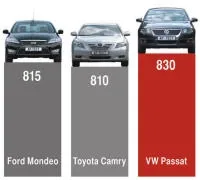
| Total score | 1000 | 815 | 810 | 830 |
Before starting this comparative test, we conducted a survey on the website www.autoreview.ru, asking visitors which of the three cars they prefer.
The votes were distributed as follows:
Ford Mondeo 39.67%
Volkswagen Passat 30.49%
Toyota Camry 29.84%
9953 people took part in the survey
Autoreview verdict
"Moose test"
Traditionally, the maneuver simulating avoiding a sudden obstacle was performed in two stages. At the first stage, five drivers who had already familiarized themselves with the cars in normal mode tried to avoid the "moose" at a speed of 65 km/h on their first attempt. Then an expert, through a series of runs, determined the maximum possible pace of the maneuver. Let me remind you: this year, an element of surprise was added to the exercise — traffic lights indicate the direction of the detour, right or left.
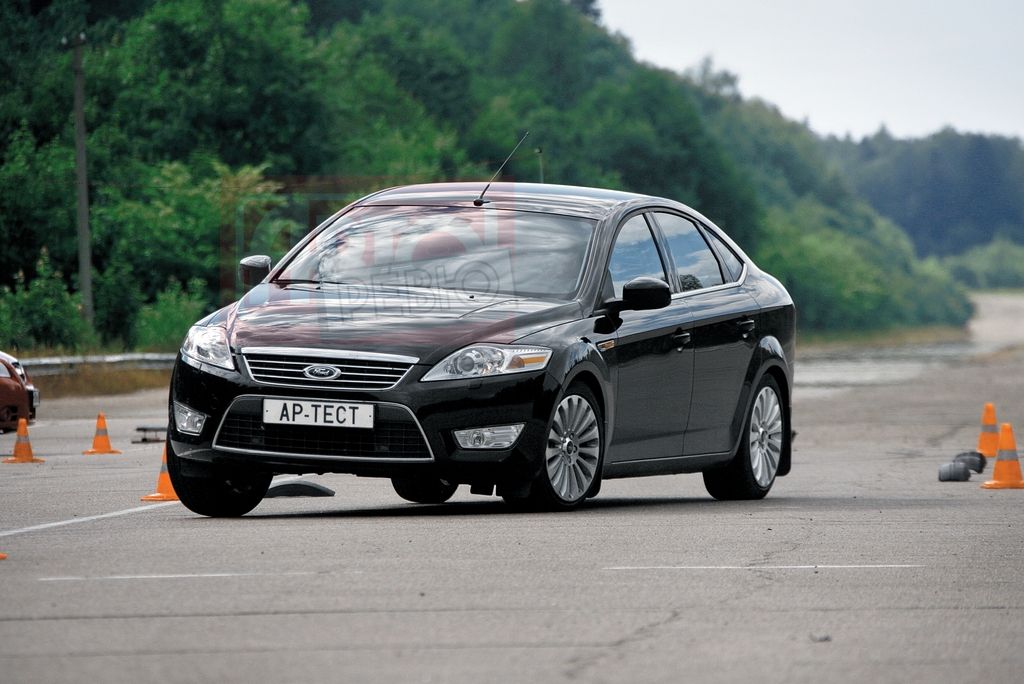 | 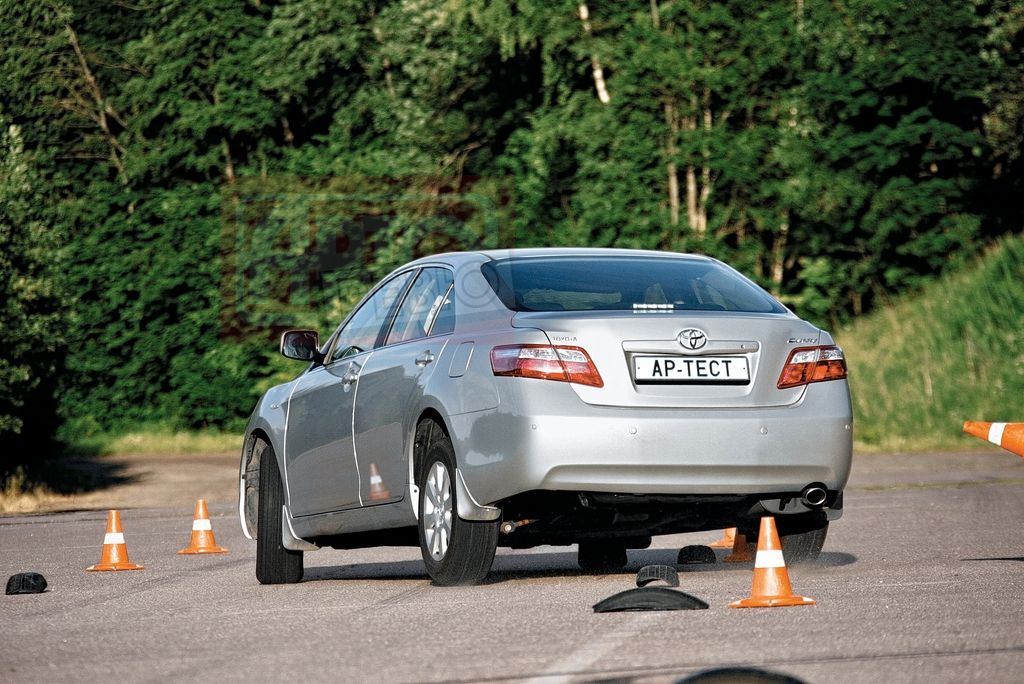 | 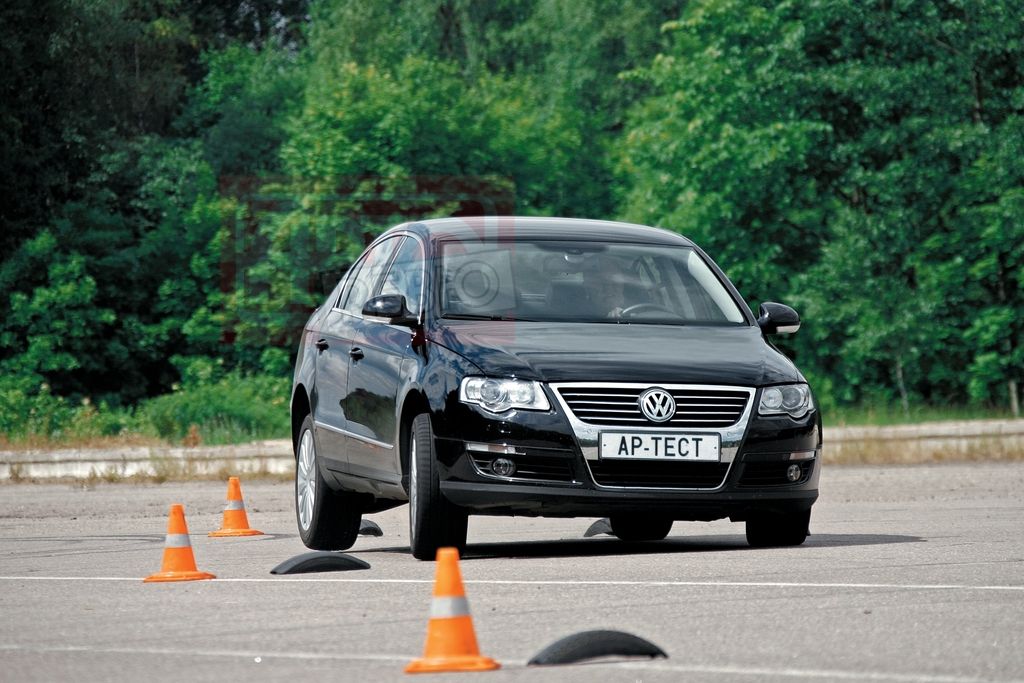 |
| Ford Mondeo: most predictable behavior in the moose test | Toyota Camry: delayed reactions, deep understeer | Volkswagen Passat: no surprises and best result of 75.3 km/h |
The best maximum speed in the "moose test" was demonstrated by the Volkswagen Passat — 75.3 km/h. Further progress was hindered by insufficiently informative steering and a noticeable change in effort on the steering wheel during sharp movements. The electronic stability control system also did not impress: it did not cope with skids in the best way. However, even in critical situations, the car behaved predictably and did not present surprises — the nature of reactions remained expected. Of the five drivers unfamiliar with the car, only one made a mistake.
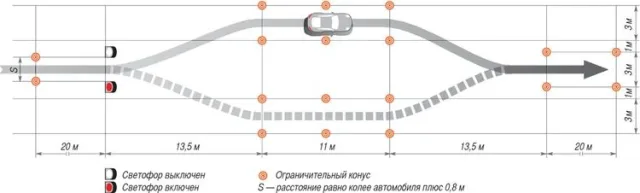
Ford Mondeo turned out to be very close to the leader — 74.9 km/h. At the same time, the drawbacks inherent in the Passat are absent here: the steering pleases with sensitivity, and the step on the power steering is barely noticeable. The car obediently follows the set trajectory, and the stability control system works correctly. The main limiting factor was the tires' grip properties. Among the five volunteers, two failed the task: one found the car's reactions too sharp, the other did not fully feel the dimensions.
The Toyota Camry sedan turned out to be an outsider: it showed the lowest speed (70.3 km/h) in the expert's hands, and for ordinary drivers it was the most treacherous — four out of five could not perform the maneuver even at 65 km/h. The reason was the sluggish steering responses, devoid of feedback, and insufficient directional stability, which manifested in deep skids. The tester also noted the inefficiency of the stability control system. Perhaps the Yokohama tires played a role: on winter Pirelli Winter Carving tires and wet asphalt, this Camry behaved noticeably more compliantly (see AR No. 2, 2007).
| Maximum speed of performing the "moose test", km/h | |
| Cars | Speed |
| Ford Mondeo | 74.9 |
| Toyota Camry | 70.3 |
| Volkswagen Passat | 75.3 |
| "Moose test" on the first attempt at a speed of 65 km/h | |
| Cars | Maneuver completed |
| Ford Mondeo | 3 drivers out of 5 |
| Toyota Camry | 1 driver out of 5 |
| Volkswagen Passat | 4 drivers out of 5 |
Visibility
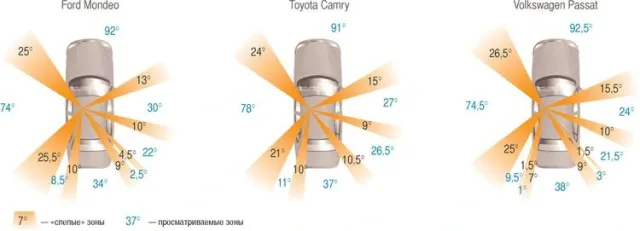
The best visibility was in the Camry: the heavily raked and forward-set windshield pillars hardly obstruct the view, and the rear window opening, despite its average size, is practically not blocked by head restraints. In the Mondeo, the front pillars create more obstruction, and in the Passat, the rear opening is compressed in height, and the head restraints significantly limit visibility.
| Car | Total viewing angle, deg. | Total angle of "blind" zones, deg. |
| Ford Mondeo | 263 | 97 |
| Toyota Camry | 270.5 | 89.5 |
| Volkswagen Passat | 264 | 96 |
| Ford Mondeo | Toyota Camry | Volkswagen Passat |
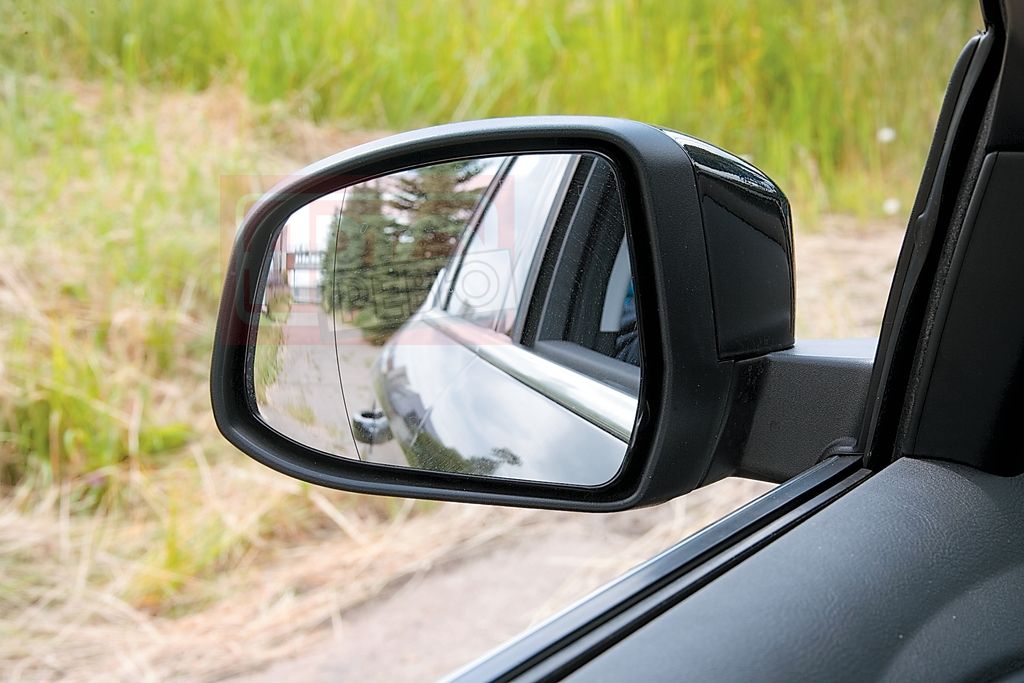 | 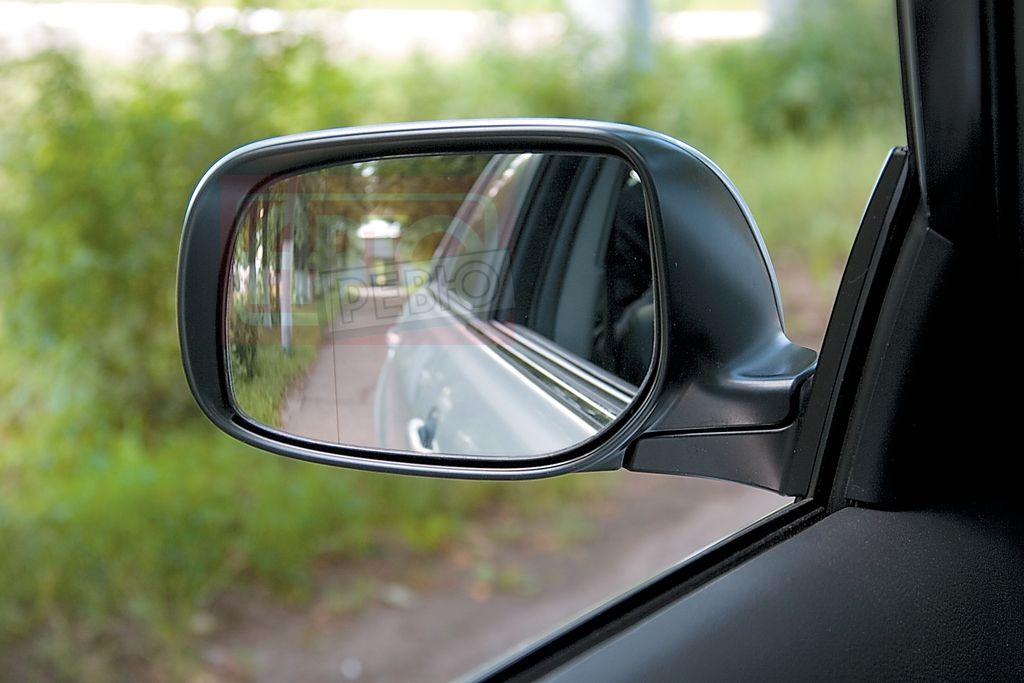 | 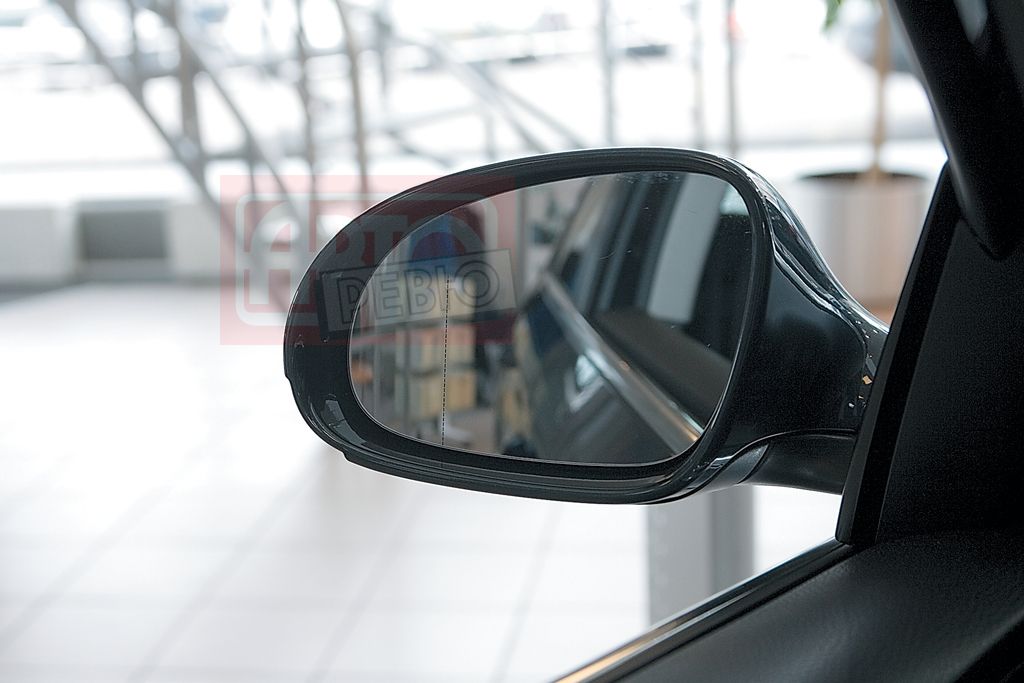 |
| We liked the large exterior mirrors of the Toyota the most. The Ford ones are inferior due to the larger area of the "dioptric" section, and the Passat mirrors are too small for city driving | ||
Light output
Night photography of cars from the same point gives an idea of the effectiveness of the headlights. In our case, the Ford and Volkswagen are equipped with bi-xenon headlights, while the Toyota uses "xenon" only for "low beam". The best low beam is in the Mondeo: from 80 meters, a pedestrian standing on the roadside is clearly visible. The Camry's headlights illuminate the pedestrian slightly less brightly, and the Passat shines "shorter". The high beam is equally good in all cars. During the photo shoot, only the driver was in the cars; the xenon headlight levelers are automatic.
| Ford Mondeo | |
| Toyota Camry | |
| Volkswagen Passat | |
| Low beam. A pedestrian stands on the roadside 80 meters from the car | High beam. A pedestrian stands in the center 160 meters from the car |
Acceleration graphs
| Some measurement results of Autoreview | ||||
| Parameters | Cars | |||
| Ford Mondeo | Toyota Camry | Volkswagen Passat | ||
| Maximum speed, km/h | 195.6 | 201.3 | 197.9 | |
| Acceleration time, s | 0—50 km/h | 3.7 | 3.7 | 4.1 |
| 0—100 km/h | 11.5 | 10.8 | 11.3 | |
| 0—150 km/h | 27.3 | 24.4 | 26.9 | |
| over 400 m | 17.9 | 17.7 | 18.0 | |
| over 1000 m | 32.8 | 32.1 | 32.9 | |
| 60—100 km/h (III) | 7.7 | — | — | |
| 60—100 km/h (IV) | 11.4 | — | — | |
| 80—120 km/h (V) | 18.7 | — | — | |
| 60—100 km/h (D) | — | 6.3 | 7.2 | |
| 80—120 km/h (D) | — | 7.8 | 8.8 | |
| Coast-down, m | from 50 km/h | 717 | 649 | 602 |
| 130—80 km/h | 1170 | 1179 | 1114 | |
| 160—80 km/h | 1744 | 1778 | 1644 | |
| Braking from 100 km/h | distance, m | 43.3 | 44.1 | 42.9 |
| deceleration, m/s² | 8.9 | 8.7 | 9.0 | |
| Braking from 150 km/h | distance, m | 95.2 | 96.1 | 94.9 |
| deceleration, m/s² | 9.1 | 9.0 | 9.1 | |
| Speedometer accuracy | |||||||||
| Cars | Speedometer readings, km/h | ||||||||
| 40 | 60 | 80 | 100 | 120 | 140 | 160 | 180 | 200 | |
| True speed, km/h | |||||||||
| Ford Mondeo | 38 | 58 | 77 | 97 | 116 | 135 | 154 | 173 | 192 |
| Toyota Camry | 36 | 56 | 75 | 93 | 110 | 130 | 150 | 170 | 190 |
| Volkswagen Passat | 38 | 57 | 76 | 96 | 116 | 136 | 155 | 174 | 194 |
Some measurement results of Autoreview

Acceleration graphs
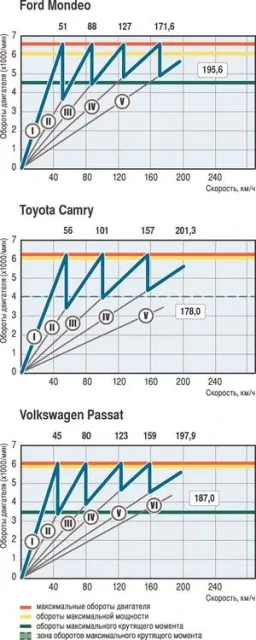
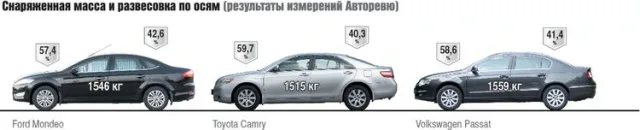
Black indicates manufacturer data, red indicates Autoreview measurement results
* Loading height
What costs how much?
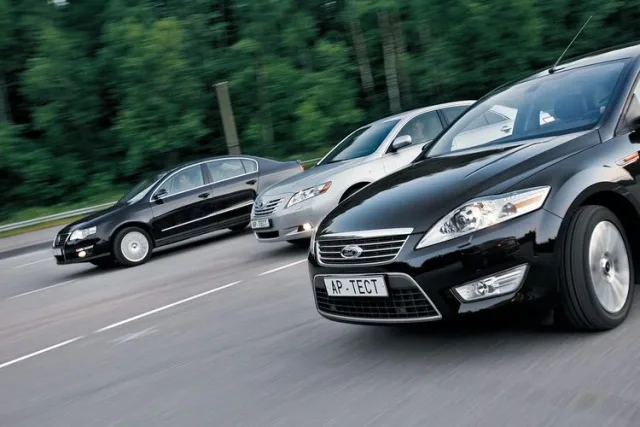
The new Ford Mondeo in the base Ambiente version with a 1.6-liter engine (125 hp) is priced at 615 thousand rubles ($23,930*). Standard equipment includes seven airbags, air conditioning, CD stereo, front electric windows, as well as heated and power-adjustable mirrors. If you choose the two-liter engine with 145 hp, the price rises to 694 thousand rubles ($27,000*). The version with the 2.3 engine (161 hp) is available exclusively with a six-speed automatic and costs from 785 thousand rubles ($30,540*). The turbo-diesel Mondeo with a 2.0-liter engine is offered either with a manual for 741 thousand rubles ($28,830*), or with an automatic for 798 thousand rubles ($31,050*) — the power in the first case is 140 hp, in the second — 130 hp. The Trend trim, which adds stability control, dual-zone climate control, fog lights, and rear electric windows, will cost 22 thousand rubles ($860*) more. Also in this trim, the most powerful five-cylinder 2.5T engine (220 hp) is available — it costs from 879 thousand rubles ($34,200*). For the Ghia and Titanium versions, you will have to pay an additional 62 thousand rubles ($2,410*): they include alloy wheels and heated front seats. The difference between them is that the Ghia has wood trim, cruise control, and light and rain sensors, while the Titanium features a seven-inch display in the instrument panel and aluminum inserts in the interior. The top modifications Ghia X and Titanium X additionally get a leather or leather-suede interior and push-button engine start — the first is distinguished by power-adjustable driver's seat, and the second by adaptive headlights. The surcharge for them is 118 thousand ($4,590*) and 123 thousand rubles ($4,790*) respectively. You will have to wait about four months for the ordered car, and cars with automatic transmissions will begin to be delivered in October.
The warranty on the Ford Mondeo covers 2 years or 100,000 km. The brand's dealer network includes 134 showrooms in 85 Russian cities.
The Volkswagen Passat in the base version is more expensive than the Mondeo — from 668,460 rubles ($26,010*), but for this money you won't get an audio system, and the 1.6-liter engine produces only 102 hp. However, the base already includes stability control and heated front seats. The version with the 1.6 FSI engine (115 hp) is priced at 704,410 rubles ($27,410*), and with the two-liter 2.0 FSI (150 hp) — from 761,950 rubles ($29,650*). The modification with the turbocharged 2.0 TFSI (200 hp) starts at 1,016,430 rubles ($39,550*). The most powerful Passat with a V-shaped "six" 3.2 FSI (250 hp) costs 1,287,700 rubles ($50,110*). There are also two turbodiesels — 105 hp for 779,360 rubles ($30,330*) and 140 hp for 820,630 rubles ($31,930*). In addition to the base Trendline trim, the mid-level Comfortline is available, which adds electric driver's seat adjustment, cruise control, and a full electric package — the surcharge will be 19,400–33,100 rubles ($755–1,290*) depending on the engine. For a similar amount, you can get the Sportline version with a three-spoke leather steering wheel and modified interior trim. The top Highline trim with leather interior, dual-zone climate control, rain sensor, and alloy wheels will cost 77,270–104,840 rubles ($3,010–4,080*) more. The "automatic" costs from 57,180 rubles ($2,220*) to 71,520 rubles ($2,780*), while the preselective DSG gearbox and all-wheel drive are available only on powerful versions with the 140-hp diesel or gasoline "six." The waiting time for an ordered car is three to four months.
The warranty on the Passat is 2 years without mileage limit. Volkswagen is represented in Russia by 54 dealers in 35 cities.
| Approximate prices for original spare parts at Moscow dealers* | |||
| Parts | Cars | ||
| Ford Mondeo | Toyota Camry | Volkswagen Passat | |
| Oil filter | 13 | 14 | 27 |
| Fuel filter | — | 51 | 178 |
| Air filter | 21 | 31 | 56 |
| Cabin filter | 28 | 92 | 27 |
| Spark plug | 13 | 19 | 28 |
| Front brake pads | 132 | 124 | 156 |
| Rear brake pads | 106 | 78 | 115 |
| Front shock absorber | 212 | 162 | 315 |
| Rear shock absorber | 181 | 174 | 220 |
| Front headlight | 579 | 525 | 319 |
| Rear light | 175 | 156 | 158 |
| Front fender | 239 | 311 | 241 |
| Front bumper | 724 | 383 | 514 |
| Hood | 508 | 467 | 506 |
| Windshield | 643 | 451 | 599 |
| * Prices are in US dollars | |||
The Toyota Camry turns out to be more expensive than both German sedans. The starting price is 860,600 rubles ($33,490*) for the Comfort version with an inline two-liter engine (167 hp) and a five-speed manual. The equipment includes six airbags, dual-zone climate control, electric package, heated front seats and mirrors, light and rain sensors, audio system with CD changer, and Plasmacluster air ionizer. The Comfort+ trim with automatic transmission costs 902,200 rubles ($35,110*) — a similarly equipped Ford Mondeo 2.3 Ghia turns out to be cheaper by 55,200 rubles ($2,150*). For leather interior trim, electric front seat adjustment, and parking sensors, you'll have to pay an extra 62,400 rubles ($2,430*). The version with cruise control, xenon headlights, and stability control will cost 1,011,400 rubles ($39,350). The flagship Luxury modification with a V6 3.5 engine (277 hp) and six-speed "automatic" costs 1,198,600 rubles ($46,640*). An ordered car will be delivered in about four months.
The Toyota Camry comes with a warranty of 3 years or 100,000 km. The brand is represented by 46 dealers in 31 Russian cities.
| Cost of scheduled maintenance with consumables and parts* | ||||
| Scheduled service | Cars | |||
| Ford Mondeo | Toyota Camry | Volkswagen Passat | ||
| Cost of standard hour | 66 | 62 | 56 | |
| Mileage, km | 10,000 | — | 242 | — |
| 15,000 | — | — | 233 | |
| 20,000 | 114** | 343 | — | |
| 30,000 | — | 242 | 428 | |
| 40,000 | 114** | 623 | — | |
| 45,000 | — | — | 233 | |
| 50,000 | — | 242 | — | |
| 60,000 | 114** | 343 | 428 | |
| 70,000 | — | 242 | — | |
| 75,000 | — | — | 233 | |
| 80,000 | 114** | 661 | — | |
| 90,000 | — | 242 | 428 | |
| Total | 456** | 3,180 | 1,983 | |
| * Prices are in US dollars | ||||
| ** Base cost | ||||
* At the exchange rate of $1=25.7 rubles.
What else?
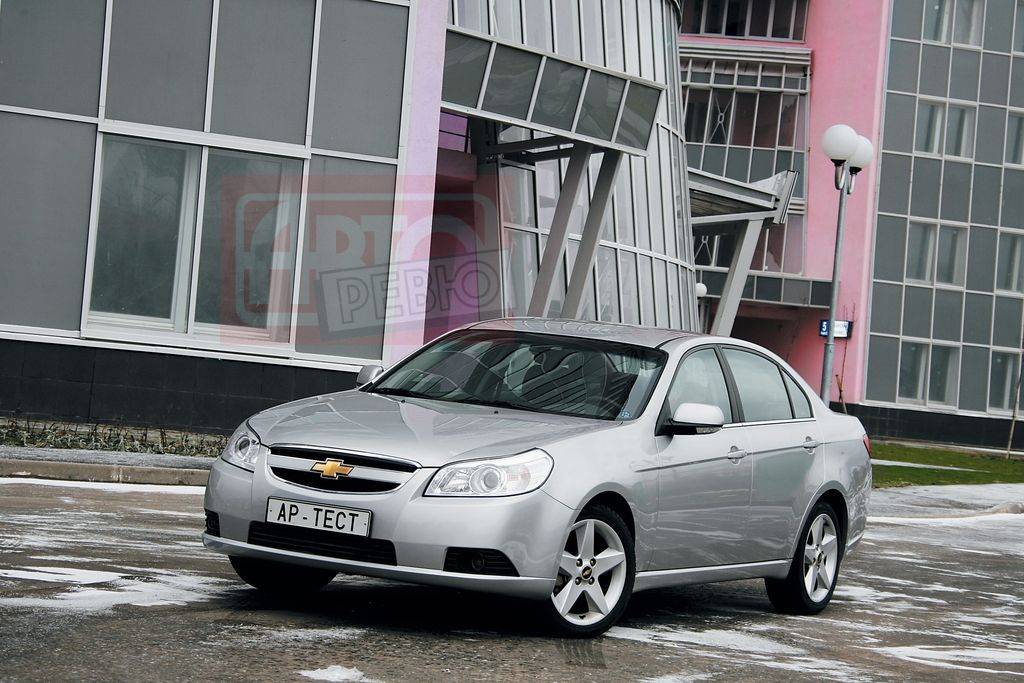
If you want to save money when buying a mid-size business-class sedan, it's worth paying attention to Korean models: the Chevrolet Epica, as well as the Hyundai NF and Kia Magentis built on the same platform. Hyundai has already participated in a comparative test with the Honda Accord and Volkswagen Passat (see AR No. 15, 2006), but lost to them in almost all parameters. The version with a two-liter engine (145 hp) and "automatic" costs 687,900 rubles ($26,770*). A similar Magentis is more expensive by 34,220 rubles ($1,330*). The Chevrolet Epica 2.0 (143 hp) with automatic transmission is sold for $28,540, but in terms of overall consumer qualities, the large Korean sedan does not surpass the Hyundai NF (see AR No. 5, 2007).
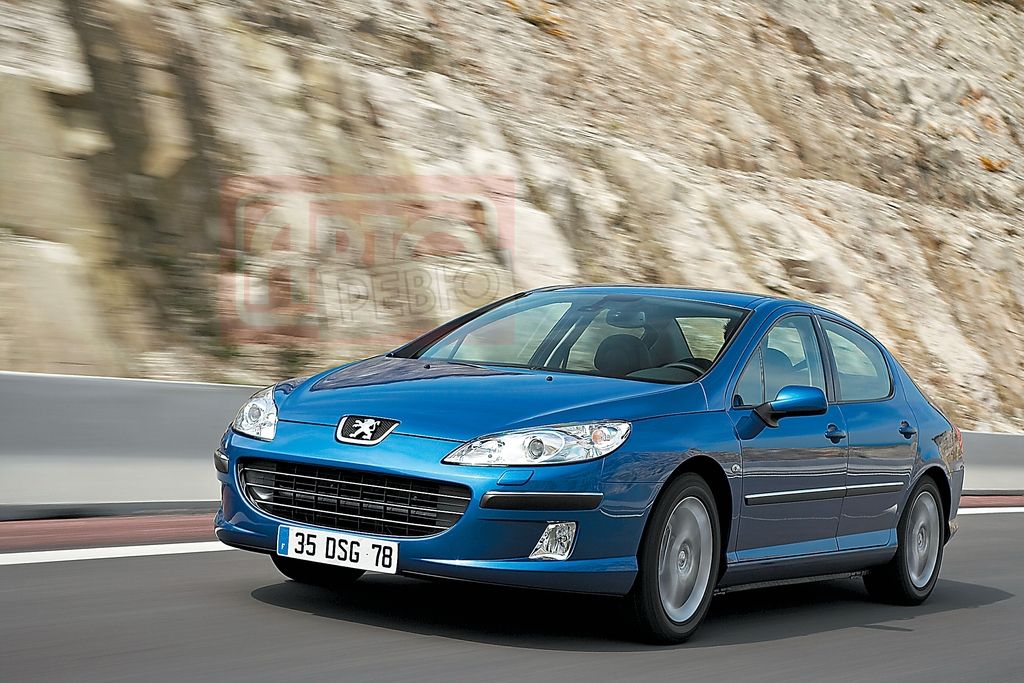
Among European and Japanese cars of segments D and E, the most affordable is the Peugeot 407 — the version with a two-liter engine (143 hp) and "automatic" is offered for 720,800 rubles ($28,050*). The French car stands out with its expressive design, but the rear seat is quite cramped. Another drawback is the outdated four-speed gearbox, which doesn't work too briskly. More details about this — in AR No. 16, 2005.
The Mazda 6 is already living its last months on the assembly line — the second-generation model will soon appear. For now, the "automatic" sedan with a 2.0 engine (147 hp) is sold for 738,000 rubles ($28,720*).
 | 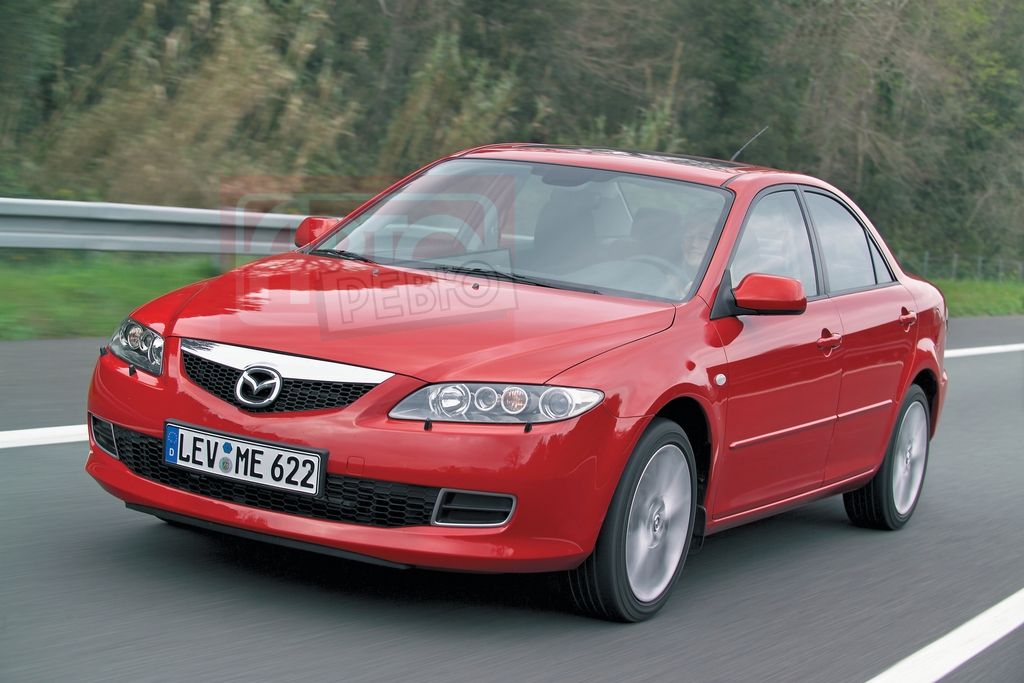 |
| Honda Accord | Mazda 6 |
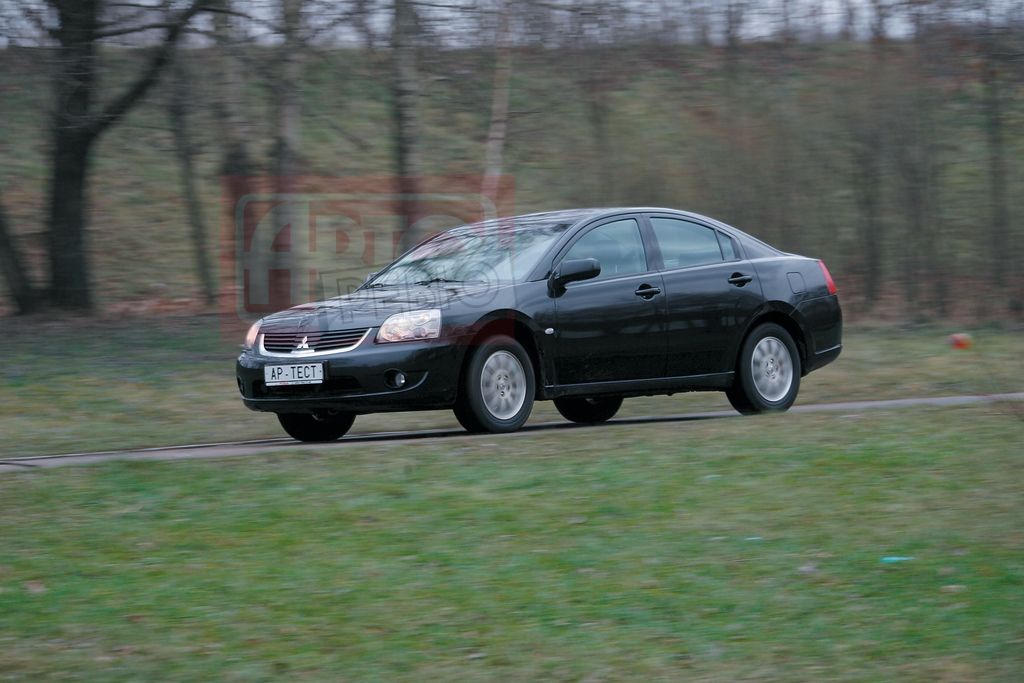 | 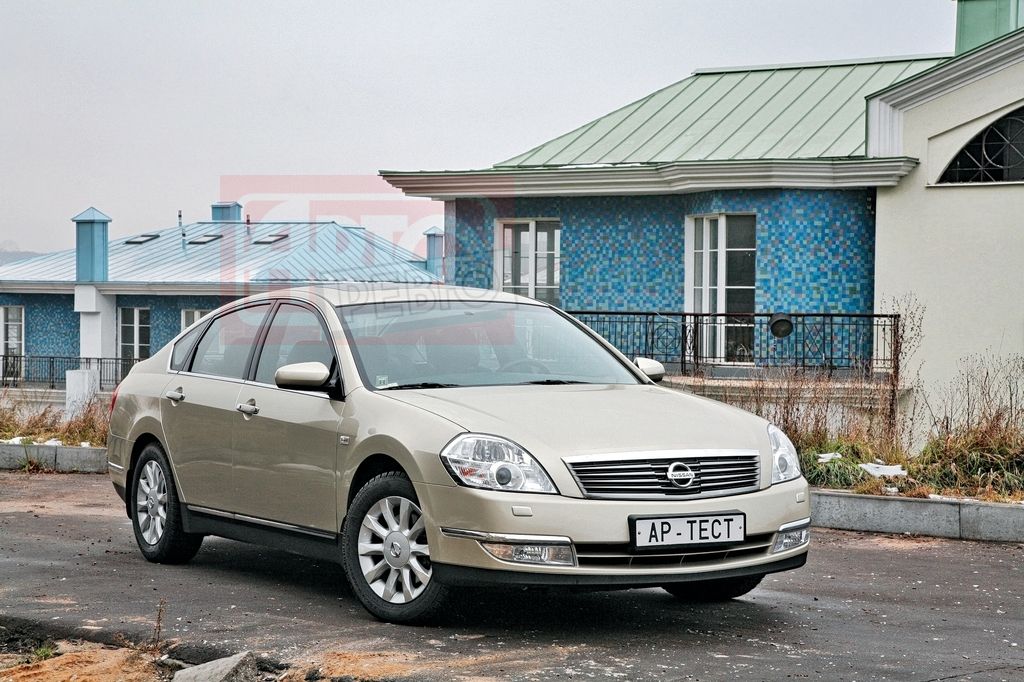 |
| Mitsubishi Galant | Nissan Teana |
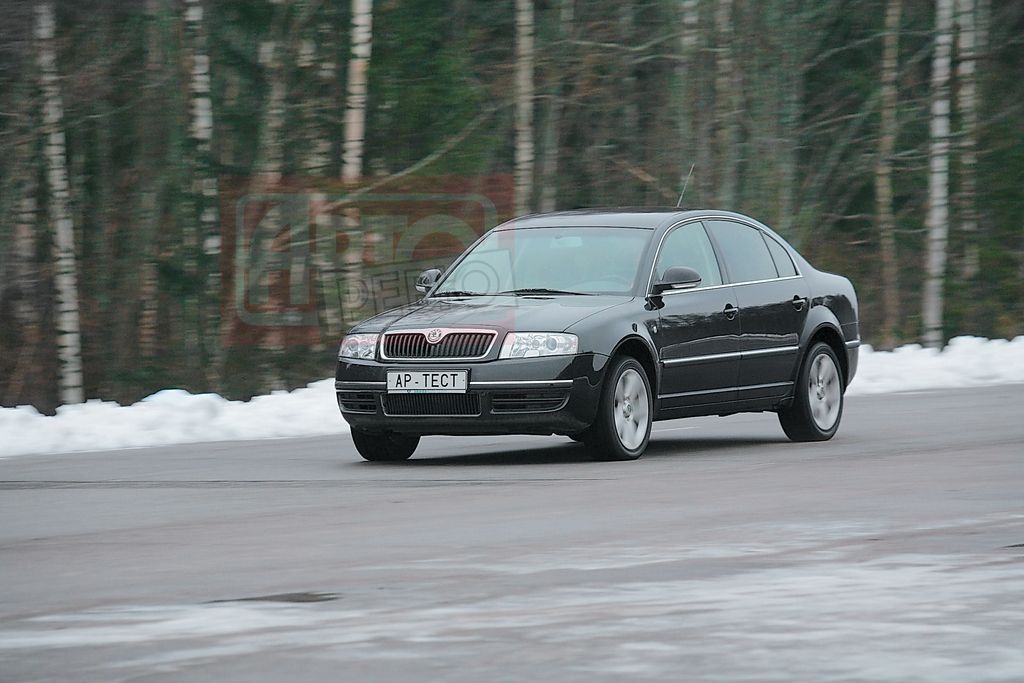
The Skoda Superb with a turbocharged 1.8T engine producing 150 horsepower and a five-speed "automatic" starts at $29,190. The interior of the Czech model is designed restrainedly and without excesses, but the rear row offers passengers truly royal space. It was this car that won our comparative test (see AR No. 2, 2007), beating, among others, the "American Japanese" Mitsubishi Galant (2.4 L, 158 hp), whose price was 761,120 rubles ($29,620*). The sedan can boast thoughtful ergonomics, but its appearance is inexpressive, and the quality of finishing materials doesn't reach a high level. The main drawback is that the electronic stability control ESP cannot be ordered even for an extra charge. Detailed acquaintance with the model — in AR No. 2, 2007.
The Opel Vectra with a 2.2 engine (155 hp) and automatic transmission is priced at a minimum of 761,520 rubles ($29,630*). After the 2005 restyling, the car's appearance became more attractive and dynamic, but the interior remained overly strict, although its ergonomics are still top-notch. Our experts have only dealt with pre-restyling cars — all details in AR No. 17, 2002 and AR No. 13–14, 2004.
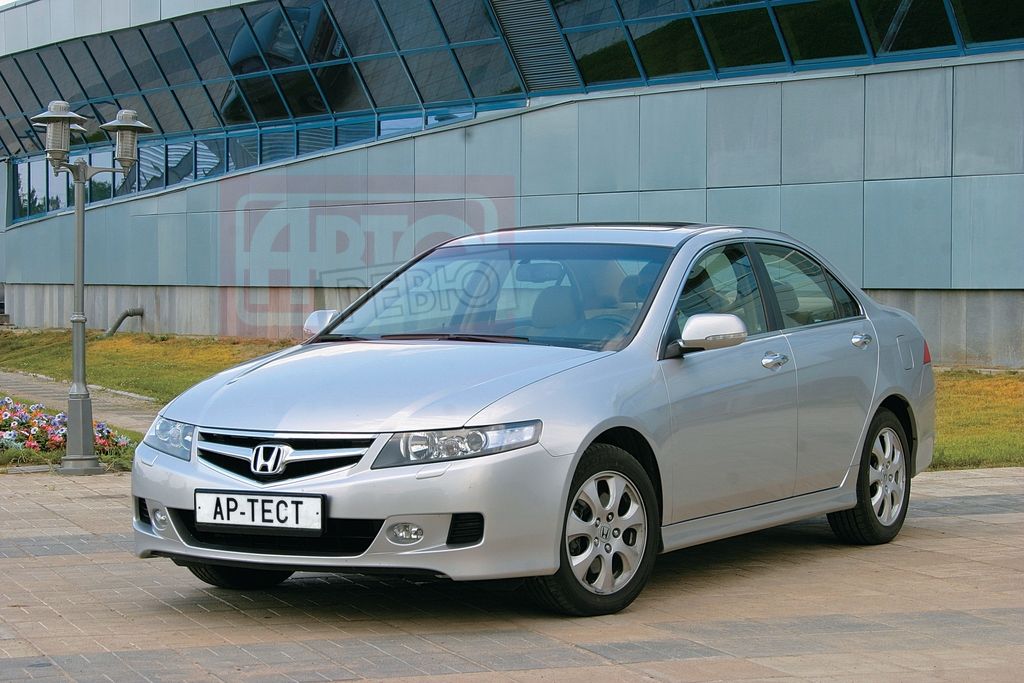
For the striking Honda Accord sedan, equipped with a two-liter unit (155 hp) and a five-speed automatic transmission, you'll have to pay 820,960 rubles ($31,940*). The whole car is literally imbued with a sporty character. Even the rear seat reminds of this — only two can sit comfortably there, a third will be extra. Details — in AR No. 15, 2006.
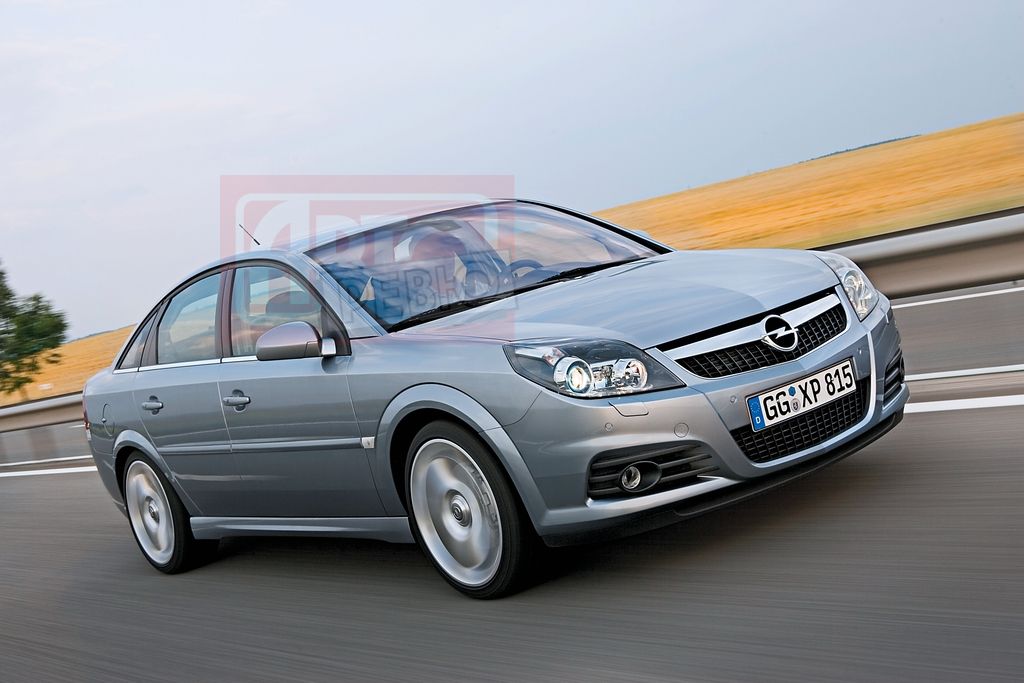 |  |
| Opel Vectra | Peugeot 407 |
 |  |
| Saab 9-5 | Skoda Superb |
 |  |
| Chevrolet Epica | Chrysler Sebring |
Nissan Teana is positioned in a more prestigious niche, which is reflected in prices — the base version with a weak two-liter engine (136 hp) costs 811,940 rubles ($31,590*), while the version with a 2.3 engine (173 hp) is already priced at 893,420 rubles ($34,760*). The Teana has an original appearance, a respectable interior, and options such as a rear-view camera and ottoman seat are absent in all competitors. Read in AR No. 2, 2007.
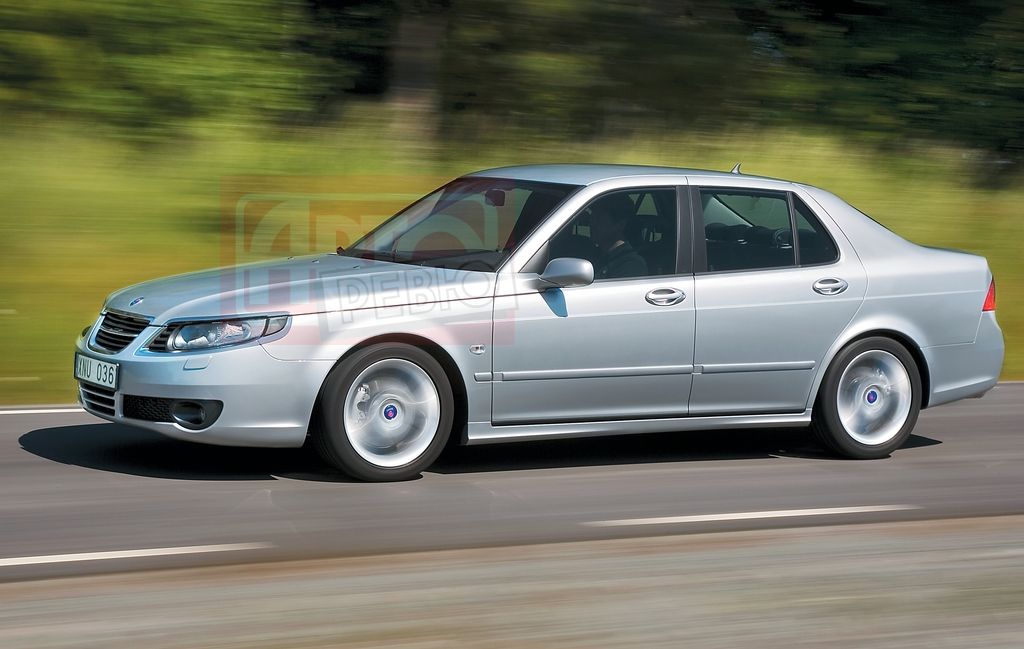
Saab 9-5 celebrates its tenth anniversary this year, although the model has undergone restyling twice during this time. The outdated interior most reveals its age. You can become the owner of a Swedish sedan with a two-liter turbo engine (150 hp) and a five-speed automatic for $34,100.
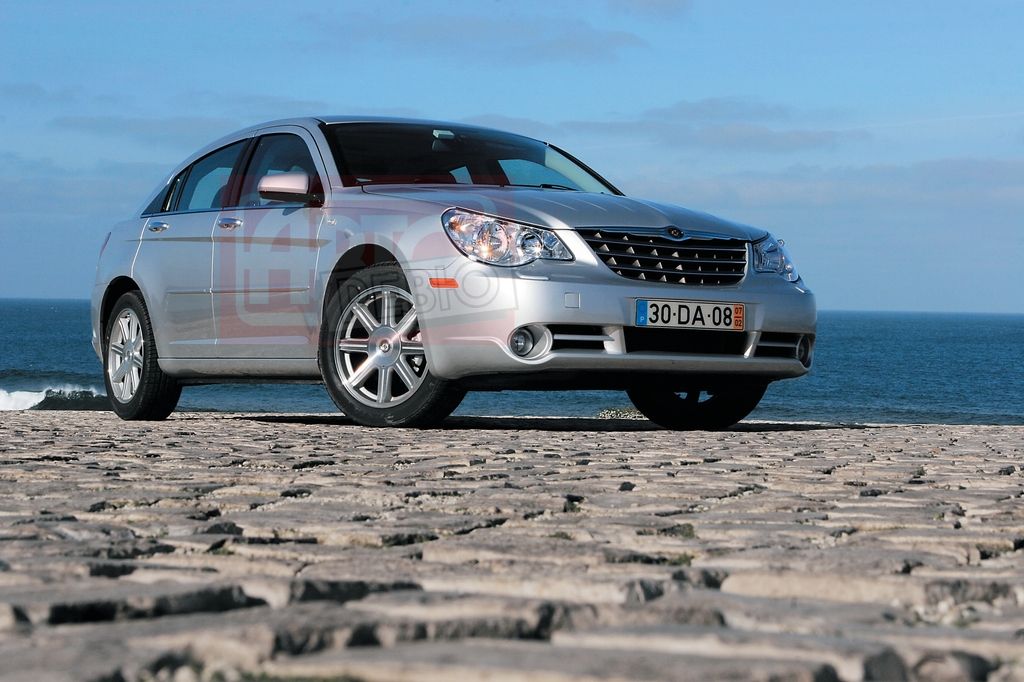
The American Chrysler Sebring of the new generation, equipped with a 2.4-liter four-cylinder engine (170 hp) and automatic transmission, is priced at 906,500 rubles ($35,270*), and very soon its relative Dodge Avenger will appear on the Russian market, with a starting price of 815,500 rubles ($31,730*).
* Exchange rate $1 = 25.7 rubles.
Business Safety
 |
| Volkswagen Passat |
Modern business-class sedans are typically equipped with an extensive arsenal of active and passive safety systems. Among this trio, the leader in equipment is the Volkswagen Passat: even in the base version it gets ABS, EBD, stability control, six airbags (including front, side, and curtain), pretensioners, and Isofix anchors. The Toyota Camry and Ford Mondeo in base trims do not have stability control — you will have to pay extra for it. At the same time, the Mondeo is standardly equipped with a driver's knee airbag.
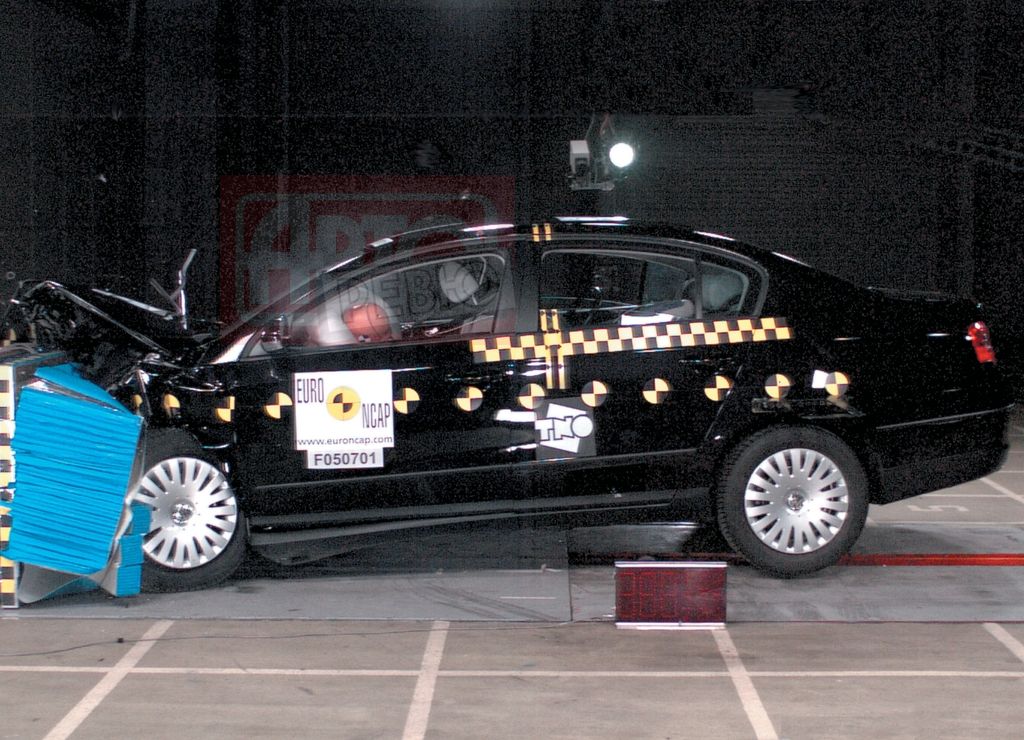
The Volkswagen Passat underwent independent crash tests according to the EuroNCAP methodology and received the highest rating — five stars. A slight reduction in points in the frontal impact is associated with the risk of injury to the driver's legs from the steering column cover. Side tests were passed with the maximum result, though engineers had to refine the curtain airbags and conduct a repeated pole impact. Protection for child passengers is rated at four out of five stars, while pedestrian safety turned out to be average — two out of four stars. Notably, according to the US NHTSA methodology, the Passat performed somewhat worse, receiving four stars (out of five) for a frontal collision with a concrete wall at 56 km/h.
The Toyota Camry was tested in Australia under the ANCAP protocol, which fully replicates EuroNCAP. As a result, the car received only four stars — penalty points were given for the hazardous front panel. The side impact was more successful, but due to the absence of curtain airbags on the test car, the pole impact was not conducted, which cost the sedan a couple more points. Pedestrian protection was below average. According to the NHTSA methodology, the Toyota Camry earned five out of five stars.
The new Ford Mondeo has not yet undergone independent crash tests.
| Volkswagen Passat* | ★★★★★ |
| Overall rating | 34 points |
| Frontal crash test | 14 (88%) |
| Side crash tests | 18 (100%) |
| SBR** | 2 |
| Child passenger protection | 38 (78%) |
| Pedestrian protection | 17 (47%) |
| Curb weight | 1447 kg |
| * Tests conducted according to EuroNCAP methodology | |
| ** SBR — presence of seatbelt reminder | |
| Volkswagen Passat* | ★★★★ |
| Driver protection in frontal impact | ★★★★ |
| Passenger protection in frontal impact | ★★★★★ |
| Driver protection in side impact | ★★★★★ |
| Rear passenger protection in side impact | ★★★★ |
| Rollover rating | ★★★★ |
| Curb weight | 1518 kg |
| * Tests conducted according to NHTSA methodology | |
| Toyota Camry* | ★★★★ |
| Overall rating | 26.5 points |
| Frontal crash test | 12.3 points |
| Side crash tests | 14.2 points |
| Pedestrian protection | 14.5 points |
| Curb weight | 1440 kg |
| * Tests conducted according to ANCAP methodology | |
| Toyota Camry* | ★★★★★ |
| Driver protection in frontal impact | ★★★★★ |
| Passenger protection in frontal impact | ★★★★★ |
| Driver protection in side impact | ★★★★★ |
| Rear passenger protection in side impact | ★★★★★ |
| Rollover rating | ★★★★ |
| Curb weight | 1458 kg |
| * Tests conducted according to NHTSA methodology | |