
In the Old World, large sedans without a three-pointed star, a propeller, or four rings on the hood interest almost no one. But across the ocean and in Russia, the Toyota Camry is a true people's favorite. Unsurprisingly, the "American" rivals of the Camry — the Nissan Teana and Mitsubishi Galant — are increasingly seen on our roads. What's good for an American is a point of pride for a Russian!
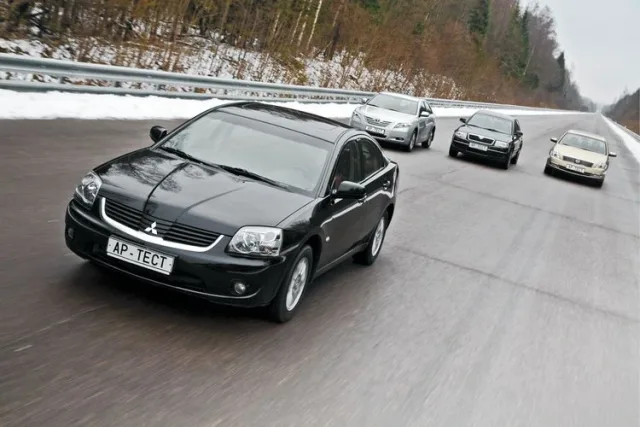
We arranged a face-to-face meeting of the Camry, Teana, and Galant — all with 2.3–2.4 liter engines and automatic transmissions. The honor of the European school was to be defended by the Skoda Superb 1.8T. Although the Superb itself is essentially a lengthened Passat of the previous generation, it was created not so much for Europeans as for the Chinese market…
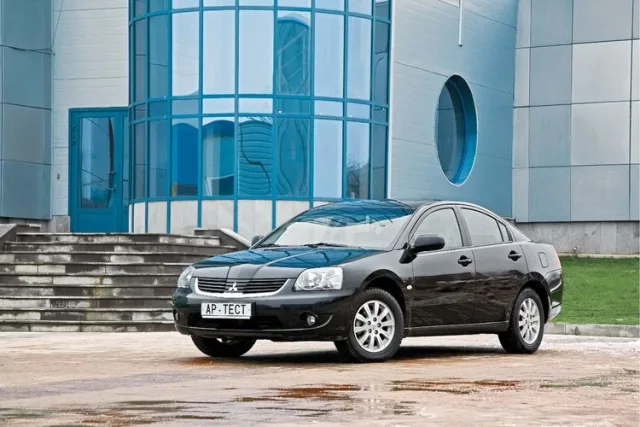
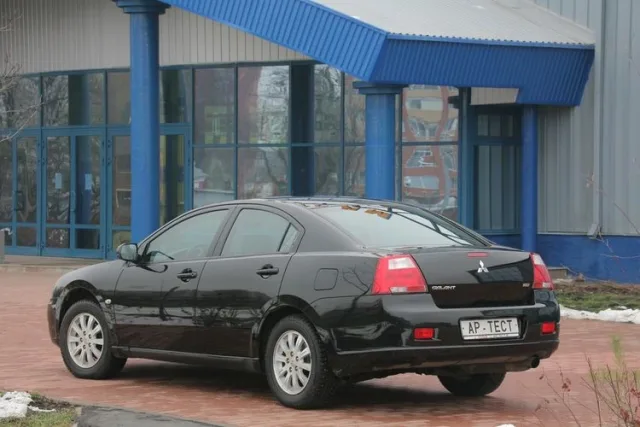
Elegance and style are definitely not about the ninth-generation Mitsubishi Galant. Its appearance is sculpted according to the patterns of overseas automotive fashion. And that, it must be said, is quite peculiar… No wonder the Galant's native "face" resembles a boxer's after a tough fight and absolutely doesn't get along with the angular rear end?
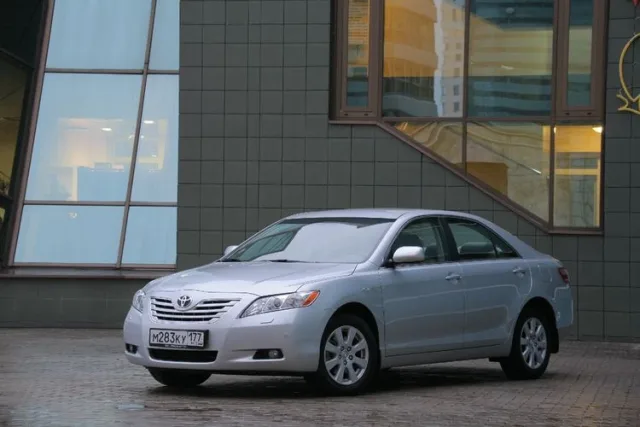
Next to the Mitsubishi, even the somewhat heavy Nissan seems a model of grace, and the Toyota Camry, with its clear kinship with Lexus, looks even more advantageous. Even the plain-looking Superb, restrained and strict, looks decent against the "Japanese-American" company — as befits a true European.
The dark interior of the Mitsubishi oppresses with gloom and discomfort. Materials are cheap, panels are fitted imprecisely, the backlighting is poisonous blue… It's good that the intensity of this "chemical glow" can be dimmed.
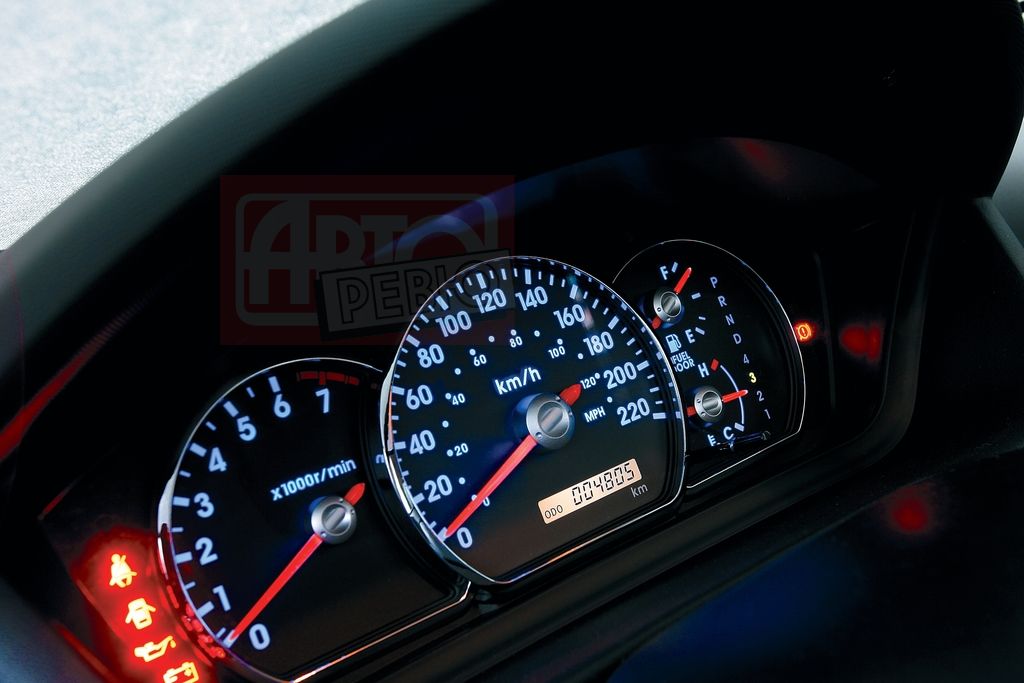 | 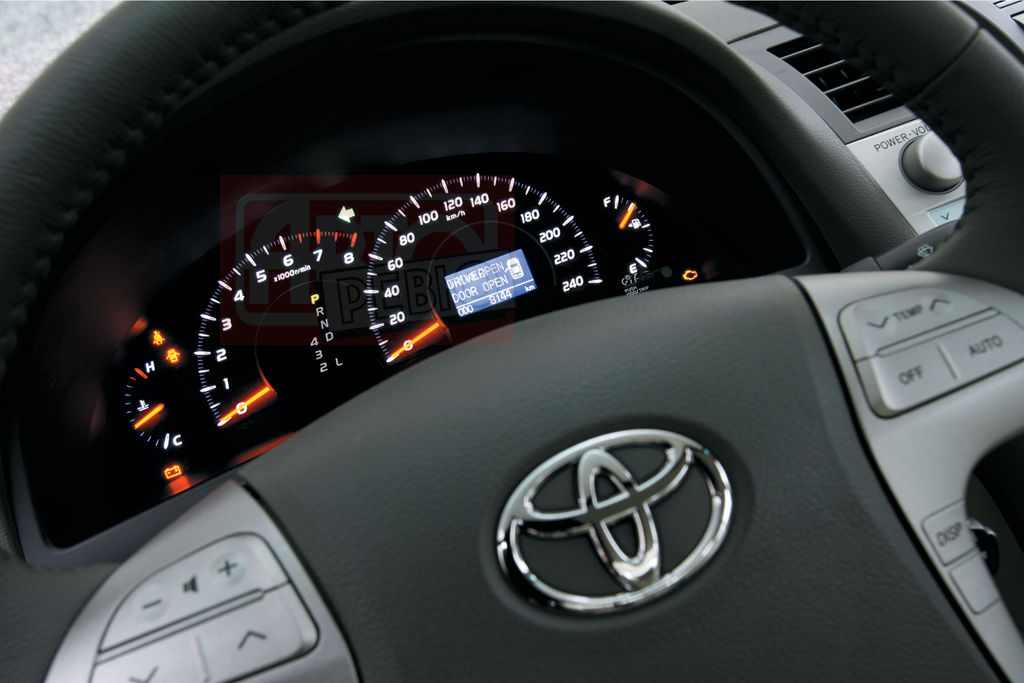 |
| The simple and clear instruments of the Mitsubishi are spoiled by an extra scale in miles and harsh backlighting | The optitron scales of the Camry are mesmerizing. And the music and climate are easy to control without taking your hands off the wheel |
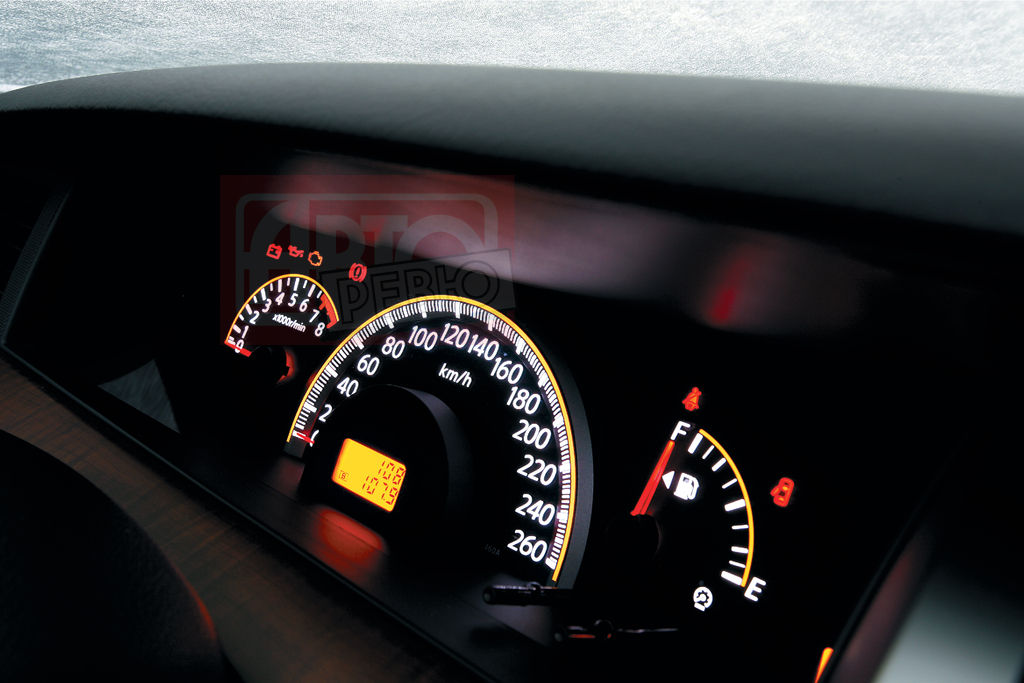 | 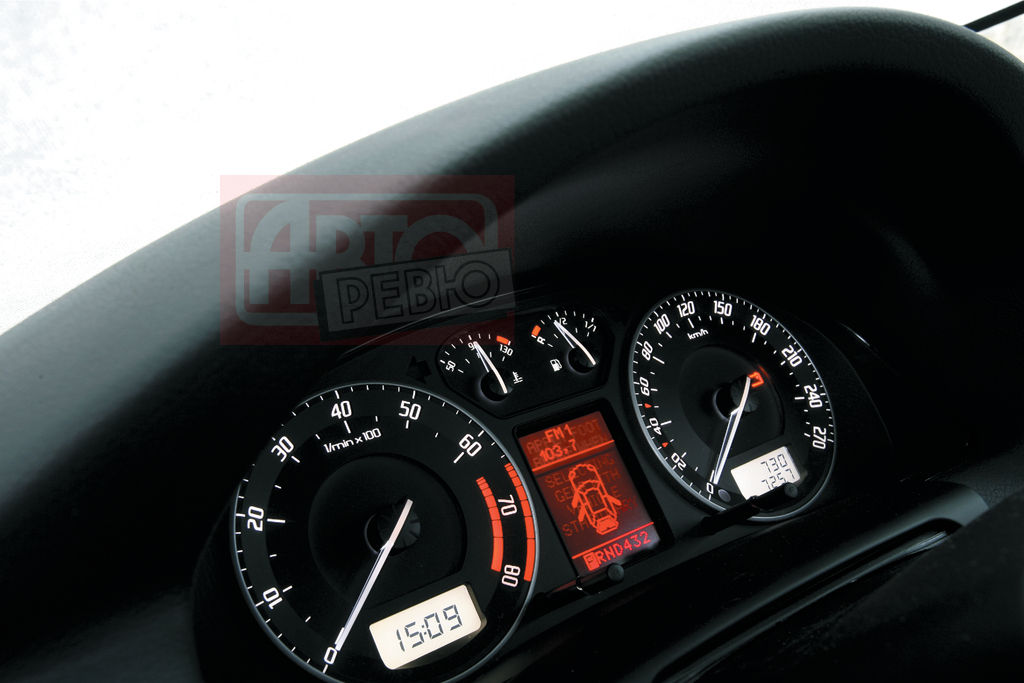 |
| The Nissan has minimal information — you can't even find an engine temperature gauge | After the update, the Skoda abandoned fancy scales — everything is strict and clear |
The steering wheel in the Mitsubishi looks plain, adjusts only for height, but sits comfortably in your hands. The seats are excellent, with the right profile, but upholstered in rough leatherette. And so it is in every detail: from the "crutch" handbrake to the undamped grab handles on the ceiling that rattle against the headliner. In the end, the ergonomics and seating position are well thought out, but the execution let it down…
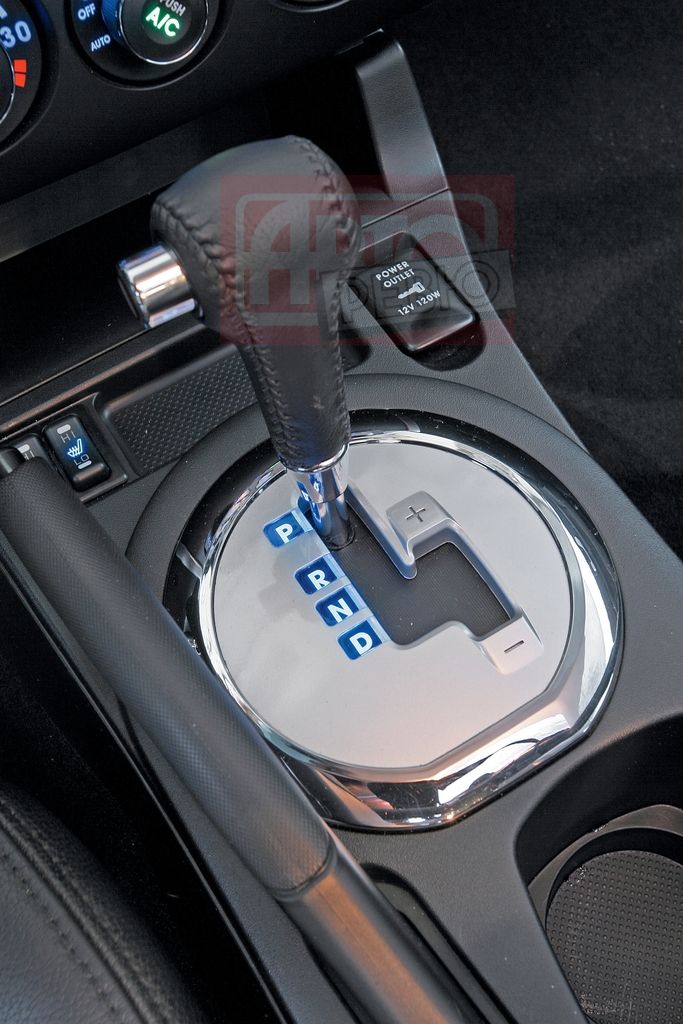 | 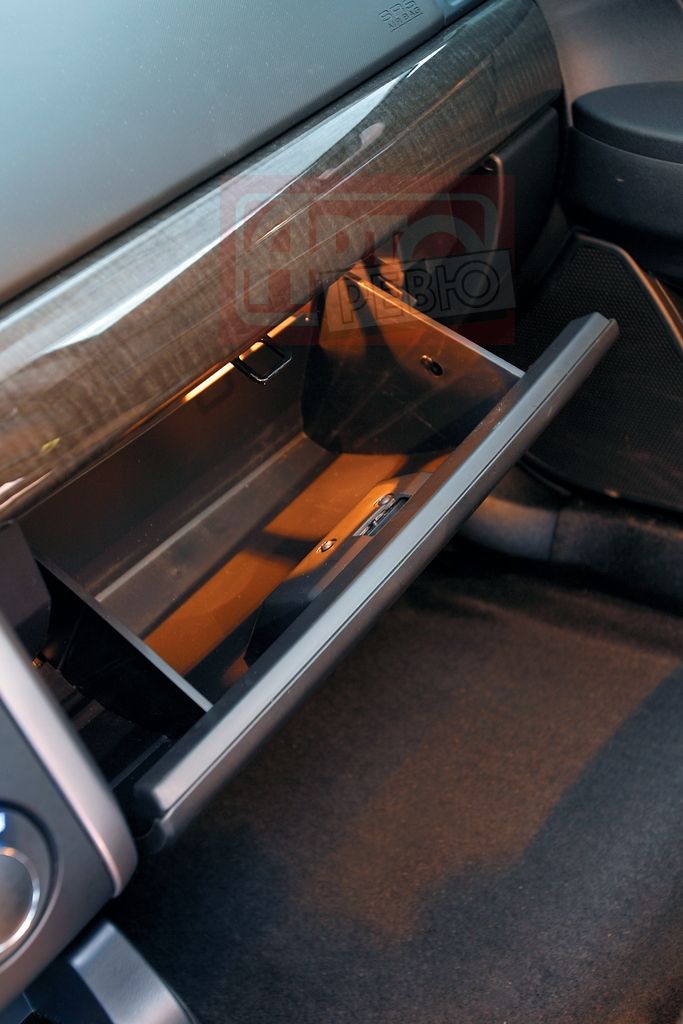 | |
| The Mitsubishi's automatic is decent, and the selector is convenient: the lever rests in Drive, and the selected mode is visible on the instrument panel | The Galant's glove box is spacious | Sagging headliner and a protruding wire in the Galant's cabin. Made in the USA? |
The Skoda Superb, that is, the Passat of ten years ago, also doesn't impress with originality inside. But here everything is done with quality and taste. And the ergonomics inherited from the Passat are simply brilliant. The small steering wheel fits perfectly in your hands and adjusts in two planes with a wide range; in the firm seats with combined upholstery, you sit as if molded; all buttons and levers operate with precise effort. It's just a pity that the notorious Volkswagen "monophonic" climate control unit from the fourth Golf, which we've all these years criticized for its small buttons, narrow display, and poor placement, hasn't changed a bit.
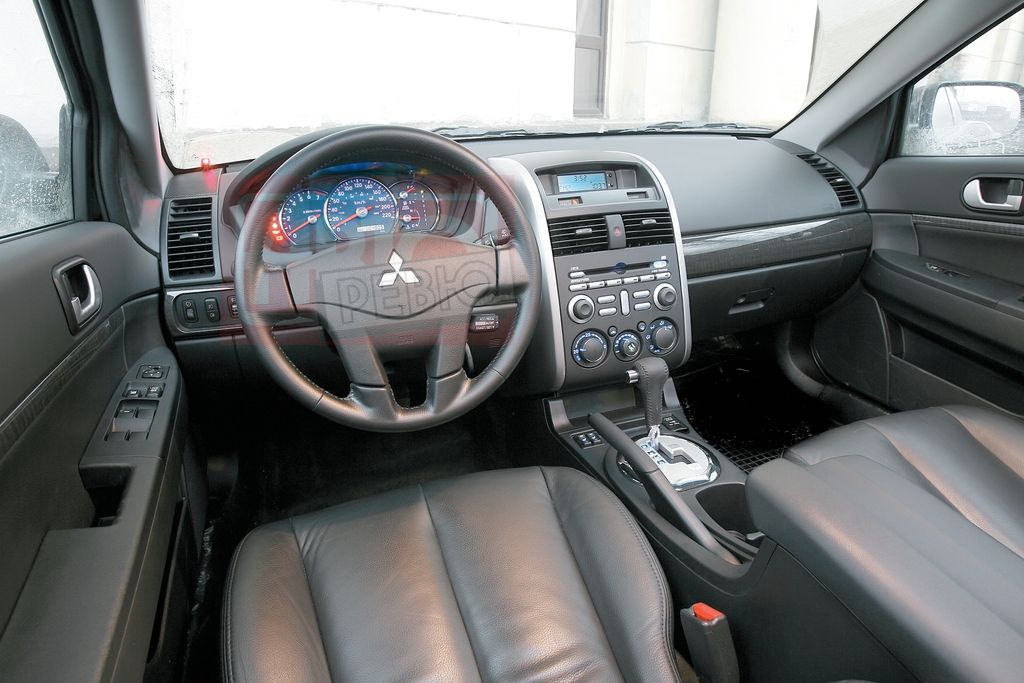 | 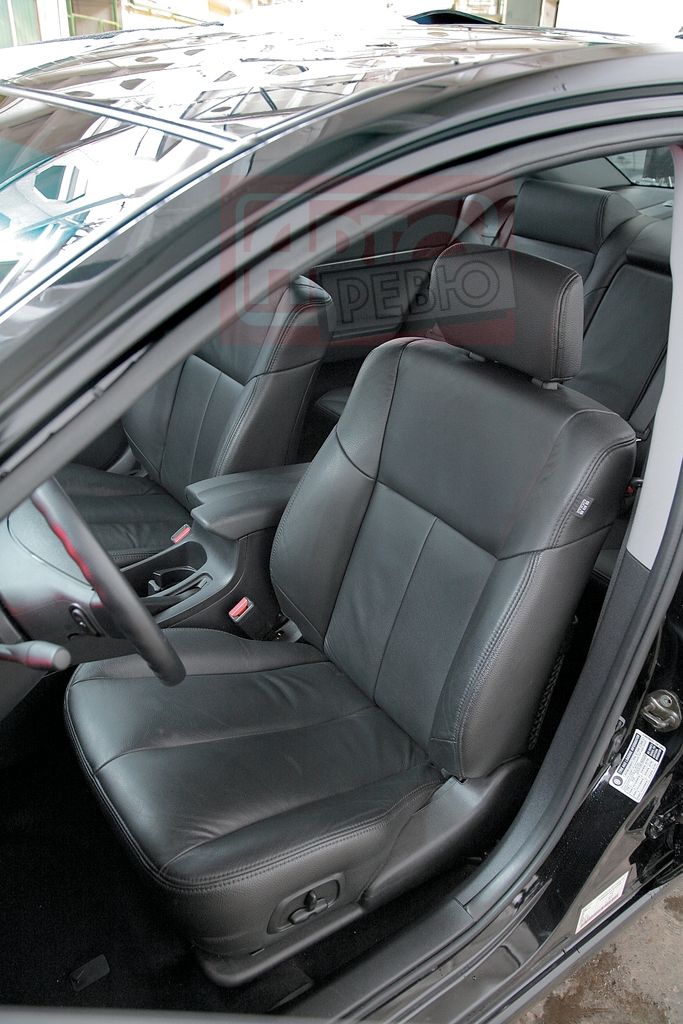 |
| The interior of the overseas Galant, both in design and execution, resembles cars of a lower class | The seats with good lateral support and profile are decent, despite the rough leather |
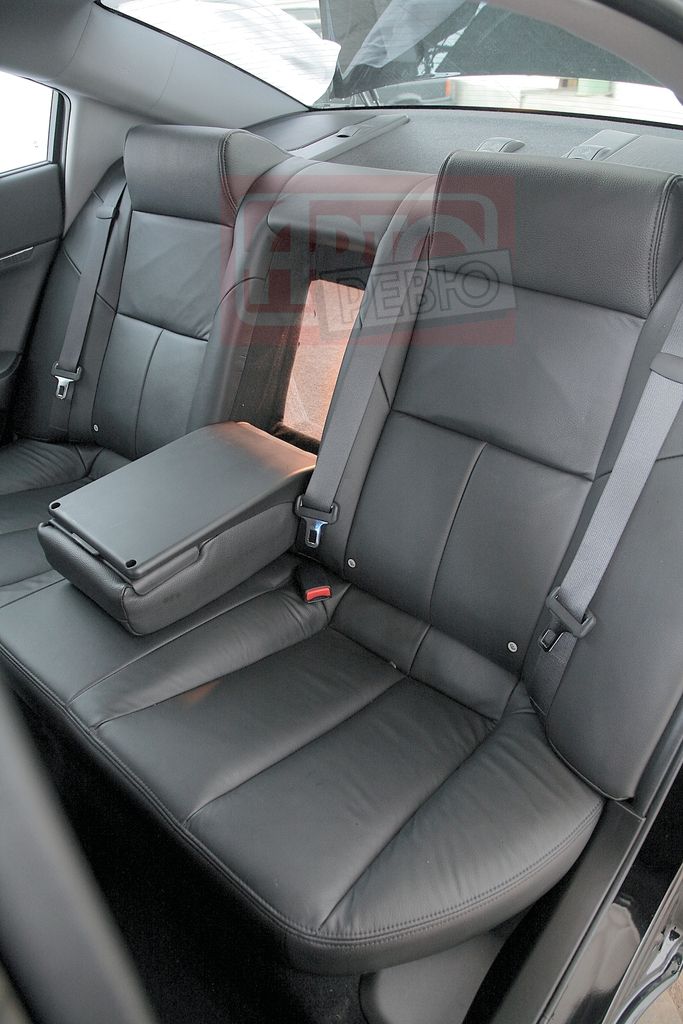 | |
| The rear bench in the Mitsubishi is less spacious and cozy than in its rivals | This is more of a fold-down table for a cup than an armrest |
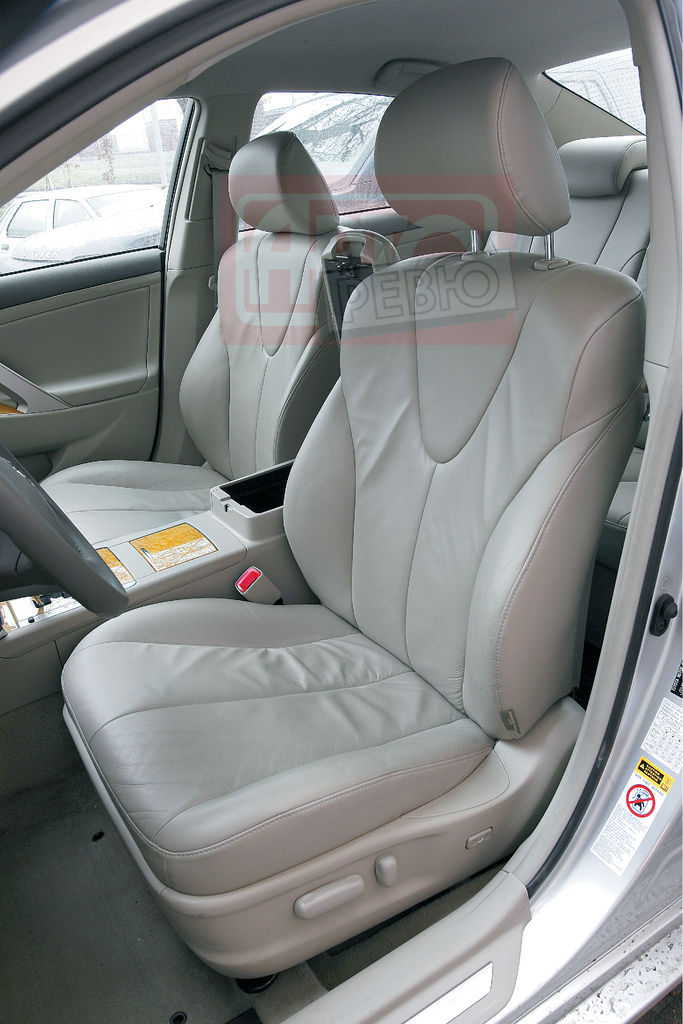
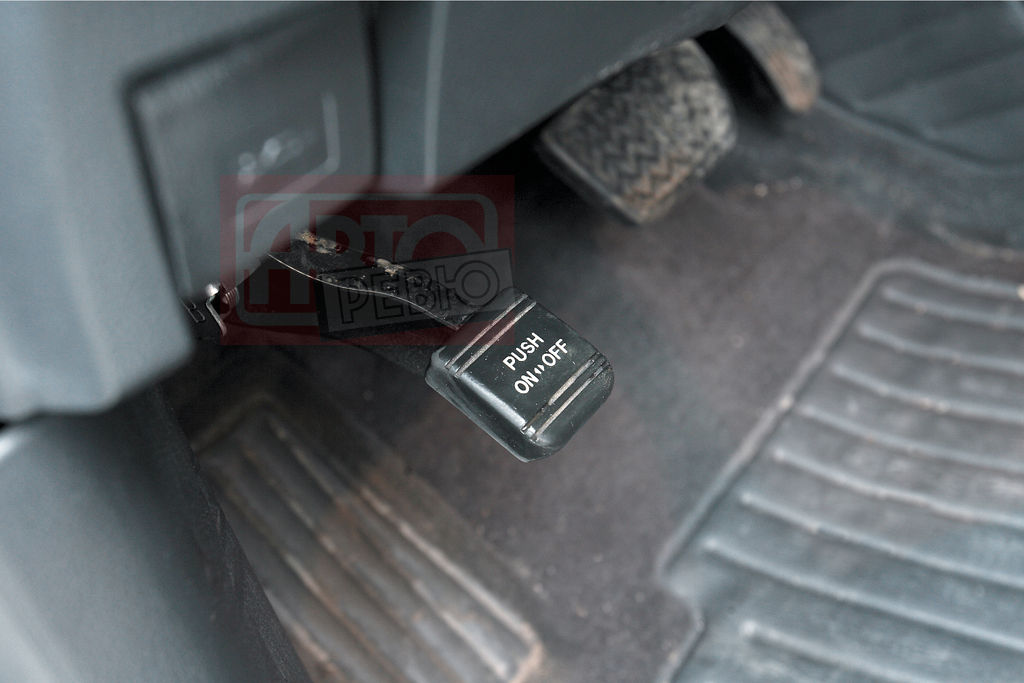
But time doesn't stand still. A vivid example is the Camry, where the dual-zone climate can be controlled directly from the steering wheel. And overall, the Toyota's interior with its striking optitron instruments looks beautiful and modern. The optimally sized steering wheel with a comfortable rim adjusts in two planes, all buttons and levers are at hand... The nitpicks are minor: the seat is a bit soft and doesn't provide as confident support as in the Galant or Skoda; it's easy to confuse the automatic's modes at first; and to press the parking brake pedal, you have to lift your leg high.
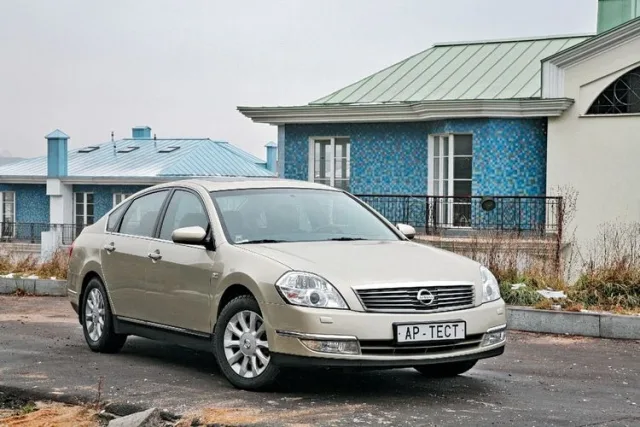
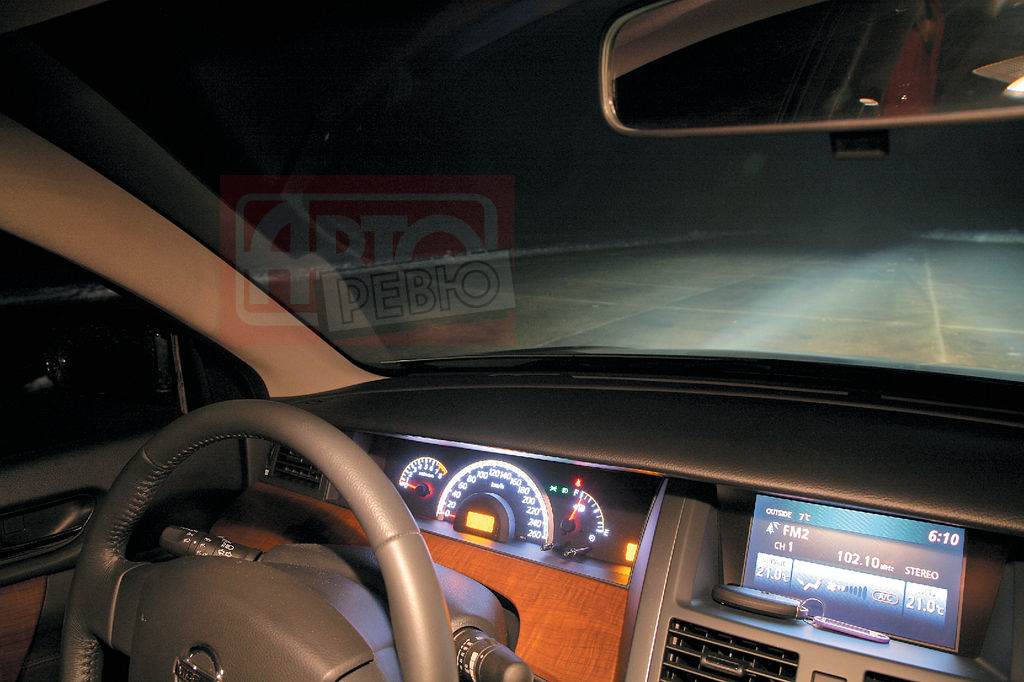
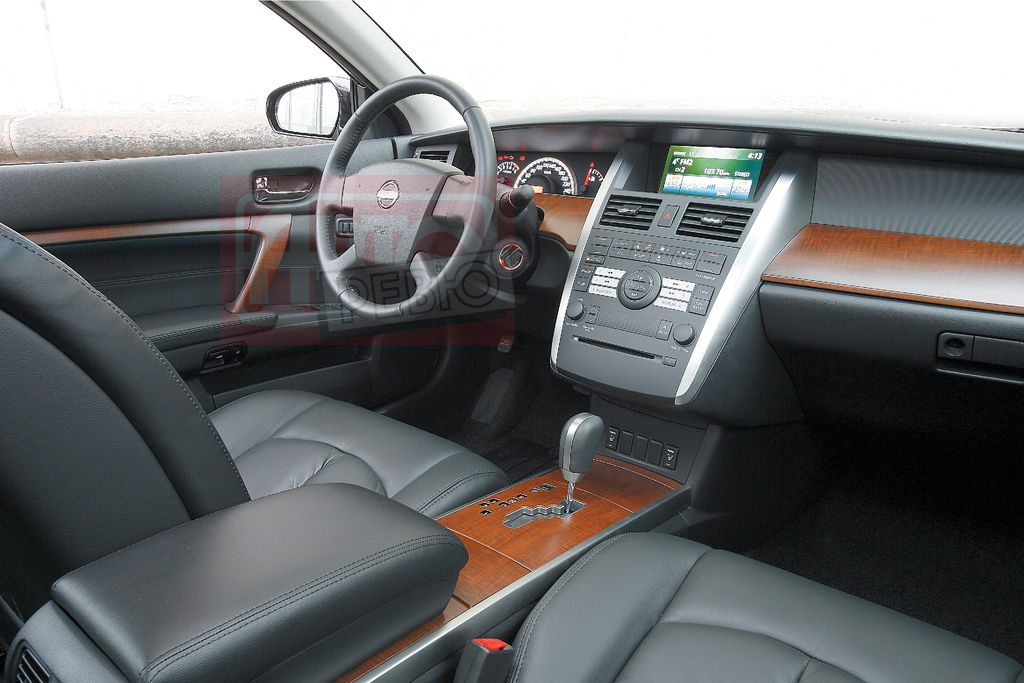
The most impressive impression from the inside is made by the Teana. The massive front panel, wide "wooden shelves," the overhanging cliff of the center console — stylish and unconventional. The instruments are simple but informative, and the buttons for the dual-zone climate and the decent audio system are easy to use. But why is the shapeless seat here even softer than in the Toyota? Why is the range of longitudinal adjustment limited, and the driver's shoulders remain without support due to the poor profile? And the thin steering wheel adjusts only for height — like in the Mitsubishi. But if in the Galant, despite this, you sit comfortably right away, in the Teana, not everyone will find a comfortable position.
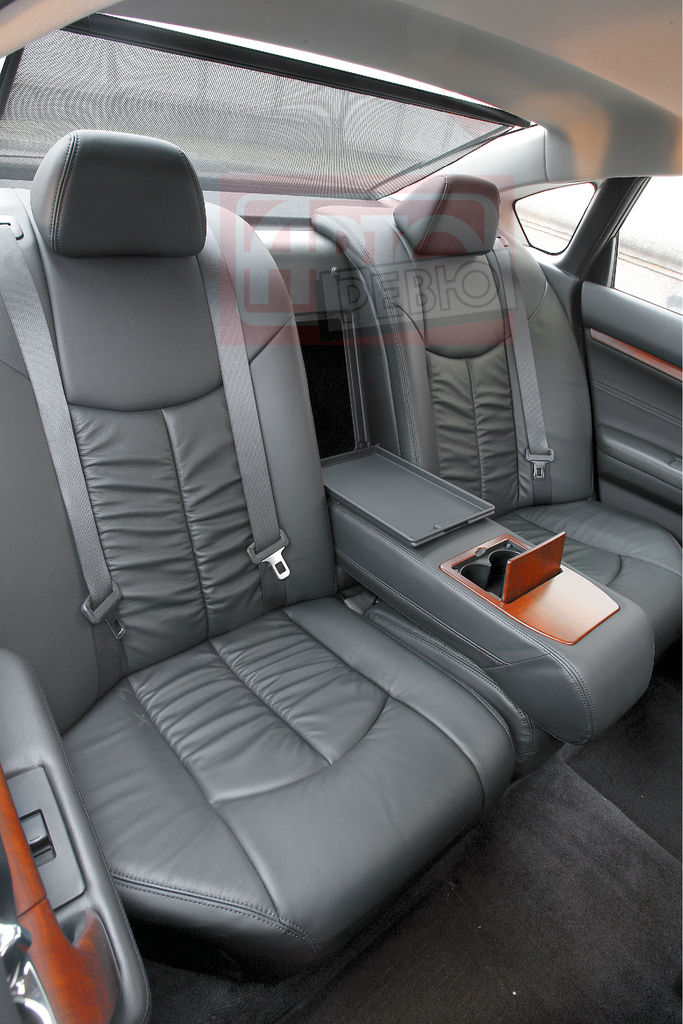
Maybe the Teana is primarily designed for passengers? There's some truth to that. In the back, there's plenty of knee room, and the comfortable armrest has cupholders with a lid. In the other two "Japanese" cars, the armrests are shorter and have no lids — your elbow can fall into the cupholders. But in the Toyota, there's more shoulder room if traveling three abreast. And the Skoda Superb offers almost limousine-like comfort: there are even footrests. And only the Skoda has rear door sill lighting and footwell lighting, a 12-volt outlet, a cigarette lighter, and heated seats.
Against this backdrop, the Mitsubishi's rear row, even without air vents and with only a single pocket on the back of the driver's seat, looks poor. And the Galant doesn't add space either — passengers' knees almost touch the front seatbacks. Yet the ninth Galant is 20 mm longer than the Nissan Teana and the same amount wider than the Toyota Camry!
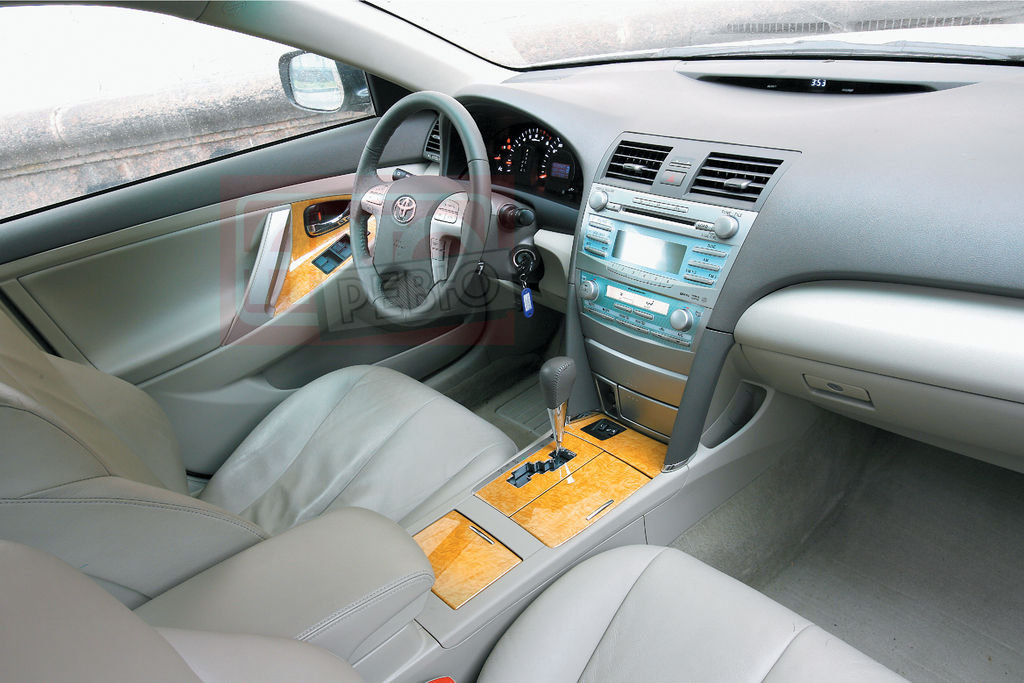 | 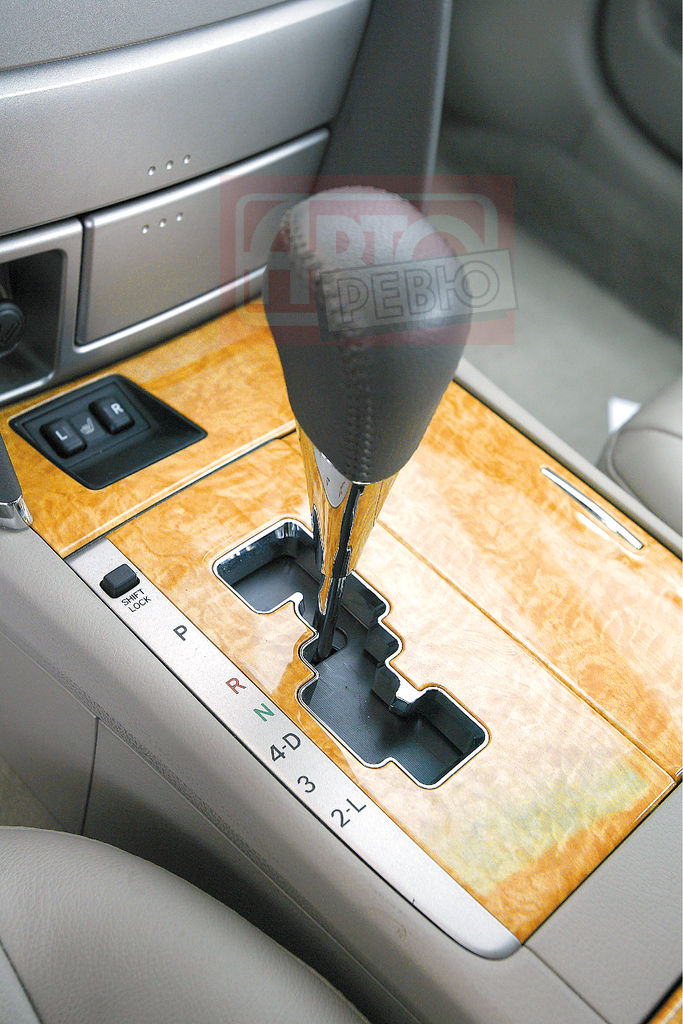 | |
| The soothing light interior of the Camry can't be spoiled even by the bluish plastic and cheap "wood" inserts | Soft armrests for the driver are present in all cars in the quartet | The Camry's automatic is decent, but the shift algorithm could be more logical |
So where did all those millimeters go? Maybe into the trunk? Not at all — in the Galant, it's the smallest. Moreover, the shape is inconvenient, the upholstery is sloppy, the opening is narrow, and the loading height is the highest — a full 780 mm. Using the trunks of the Nissan and Toyota is much more convenient, despite the protruding wheel arches. And the most practical cargo area is in the Skoda: flat walls, neat upholstery, wide opening. Europe! In terms of transformation, the Skoda and Toyota can boast folding rear seatbacks (the Superb's for an extra charge), while the Teana and Galant only have narrow ski hatches.
Racing around in large sedans with relatively "small" engines isn't interesting — and it's not required. But if comparing acceleration dynamics, the fastest is the Skoda Superb, despite its most modest power (150 hp versus 158–173 hp for the competitors). And the most convenient throttle control is in the Mitsubishi Galant, even despite its most archaic four-speed automatic.
 |
 |
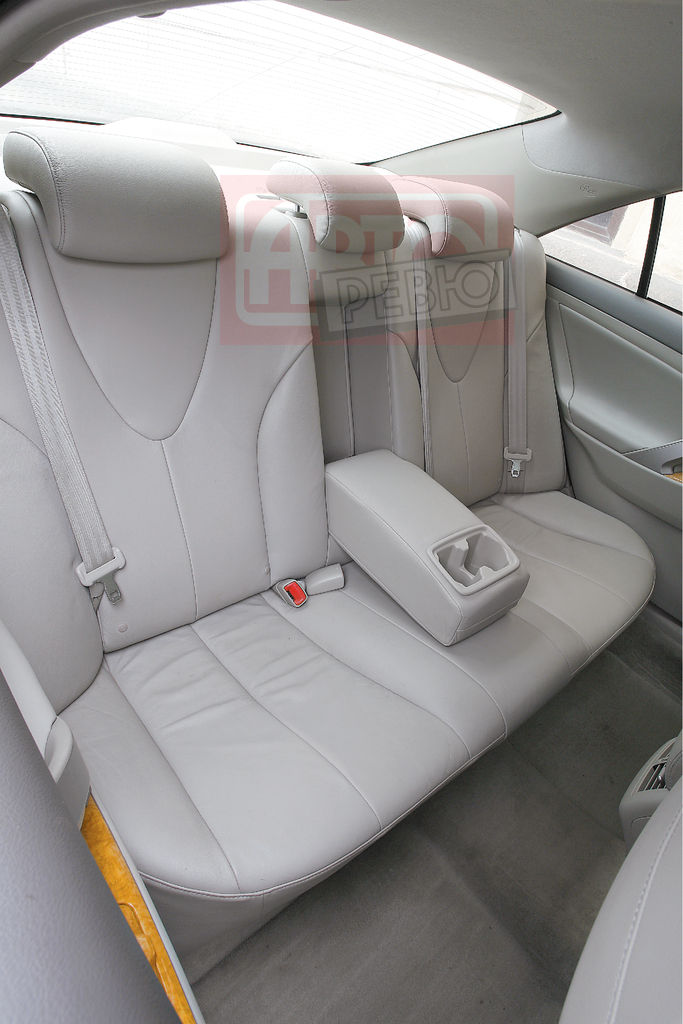 |
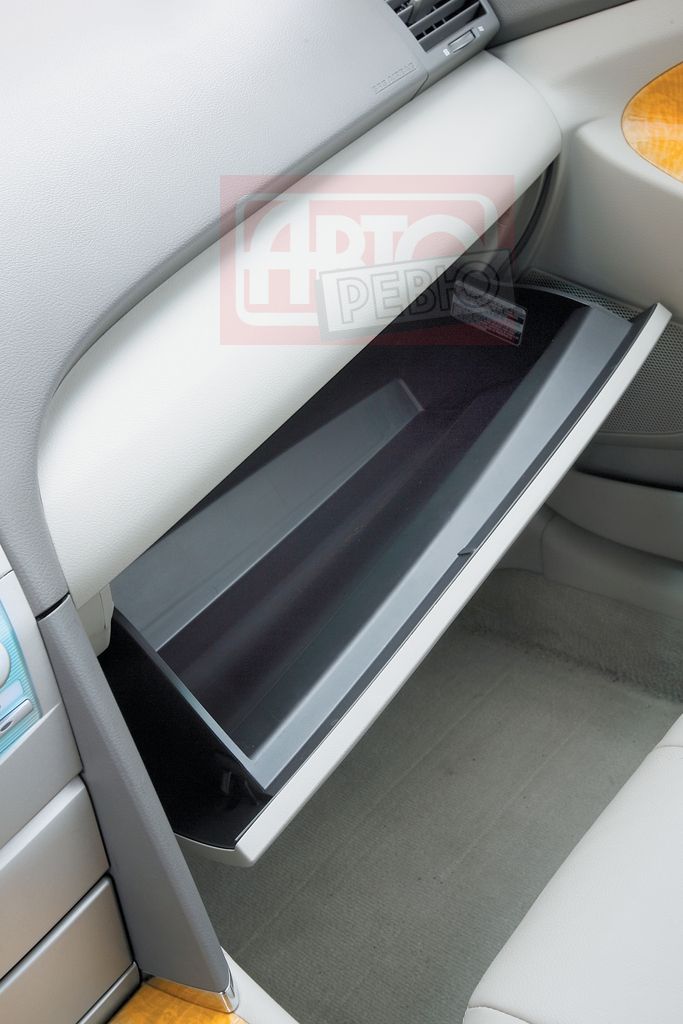
| Only papers will fit in the modest glove box | The soft and wide Camry seat is designed for people in the prime of life | For a complete sense of comfort, only a proper armrest is missing |
It would seem everything should be the other way around!
However, the numbers speak for themselves. When we started simultaneously, flooring the gas pedals, the Superb confidently pulled ahead, leaving the Camry half a car length behind, and the Teana and Galant already a full car length behind. But as soon as you give up racing ambitions and just drive at a normal pace, the Skoda starts to annoy: the automatic transmission seems to hesitate before every shift, and the gas pedal responds with excessive delay. What a twist!
 |
|
| Foot-level air vents for rear passengers are present in all cars except the Mitsubishi | The "foot rest" is an Americanism that distinguishes the Camry and Teana |
The Teana and Camry have a slightly shorter pause between pressing the gas and the forward surge, but it is still noticeable, yet their transmissions work more briskly. The Toyota, however, has its own quirk: press the pedal a bit harder, and the car suddenly jerks as if stung.
You get into the Galant and enjoy yourself. The time-tested INVECS-II allows the engine to show its character, and when needed, it engages lower gears without delay and very smoothly. No delays whatsoever. The brakes are exemplary…
The Skoda's brakes are also in perfect order. But the Camry and Teana raise questions: during hard braking, the pedal noticeably sinks, which undermines confidence.
In terms of handling, the palm of supremacy again goes to the Skoda and Mitsubishi.
The Superb is a spitting image of a Volkswagen, and that is a compliment. On a straight line, it stands as if nailed down, ruts barely exist for it, it responds to the steering wheel instantly and precisely, and in sharp corners, it eagerly screws into the arc. Clear steering effort combined with mild understeer is simply a song! And if you overdo the speed, the electronics gently and timely correct everything.
This is what the European school of chassis tuning means…
But the Mitsubishi Galant, which the Japanese built for Americans, lags behind the leader only slightly. The steering is informative, and the car behaves predictably and reliably in corners. The only thing is that on a high-speed straight, stability is slightly worse (though all cars were fitted with studded tires). And we would even have liked the smooth drift when lifting off the gas in a fast turn — if the Galant had a stability control system. But ESP cannot be ordered even as an option. Therefore, we had to lower the handling score by ten points at once: for an inexperienced driver, such a tendency to oversteer is a real threat! And the moose test only confirmed our fears: the Galant knocked down more cones than all other participants combined.
 |
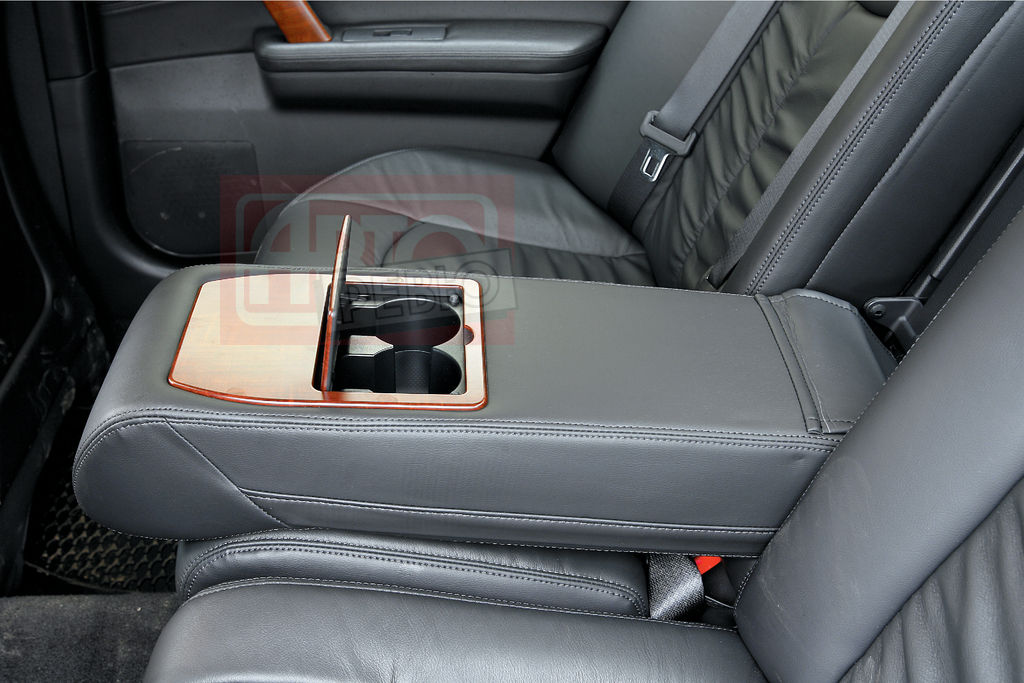 |
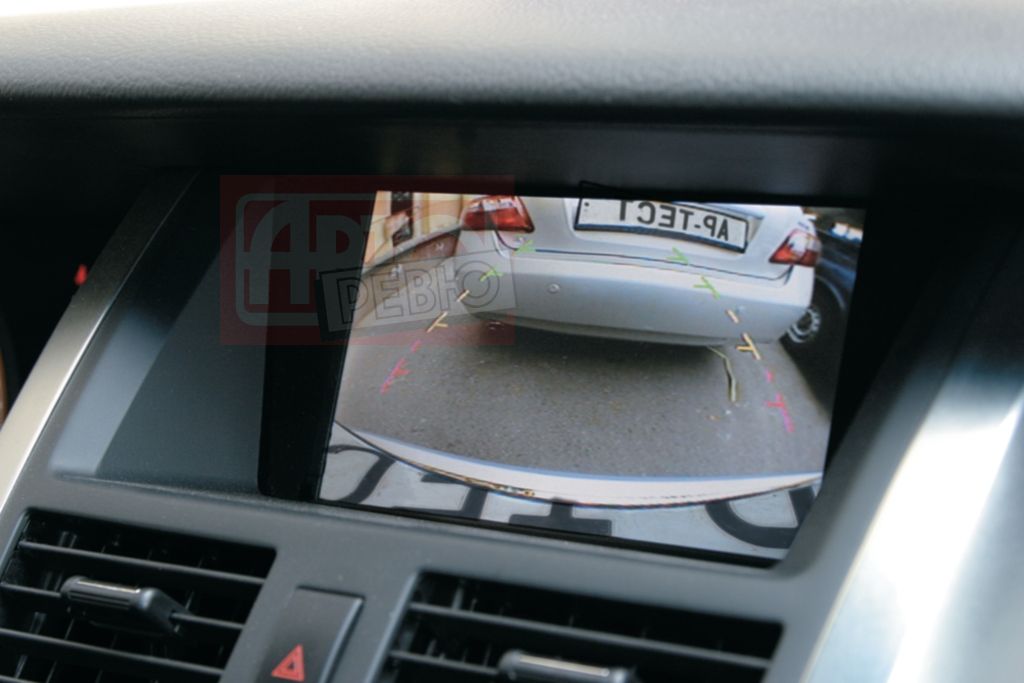
| The rear-view camera in the Teana is a privilege of the expensive Premium version for $40,206 | A convenient armrest running the full length of the seat cushion — only in the Nissan |
 |
 |
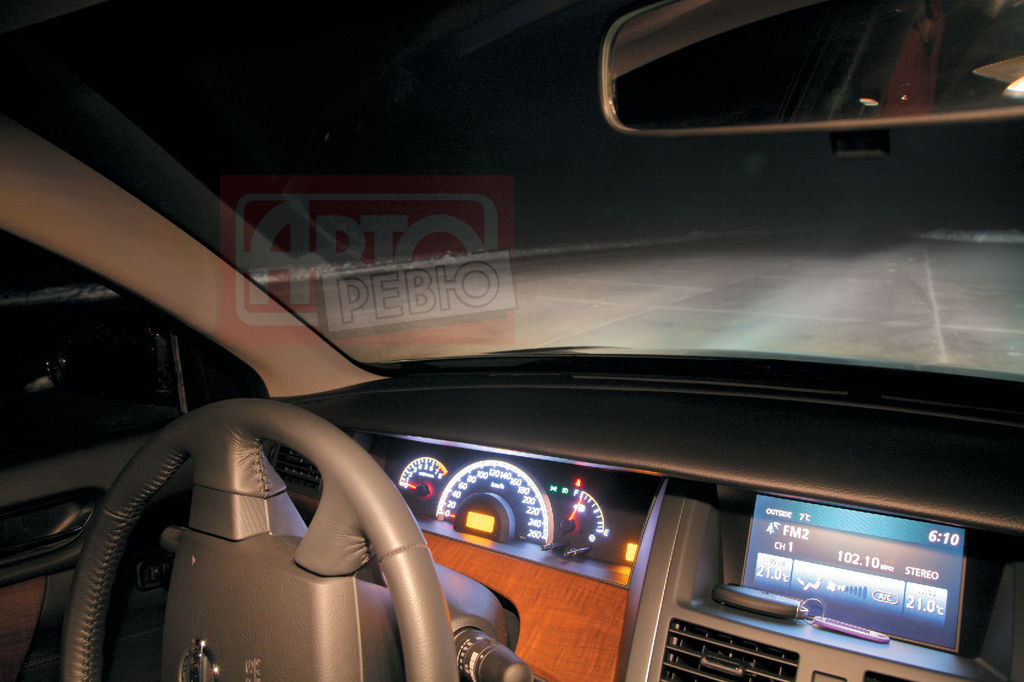
| Turn the steering wheel, and the Teana in Premium version will turn on bright side lighting | |
The Toyota Camry is a completely different story. You drive it calmly and steadily, but it responds sluggishly to corners, the steering is completely uninformative, and any desire to fool around disappears. And if you overestimate the speed in an unfamiliar corner and panic-yank the wheel, the smooth drift will be instantly interrupted by the electronic "collar" — the stability control system intervenes roughly and uncompromisingly. Safety above all!
 |
 |
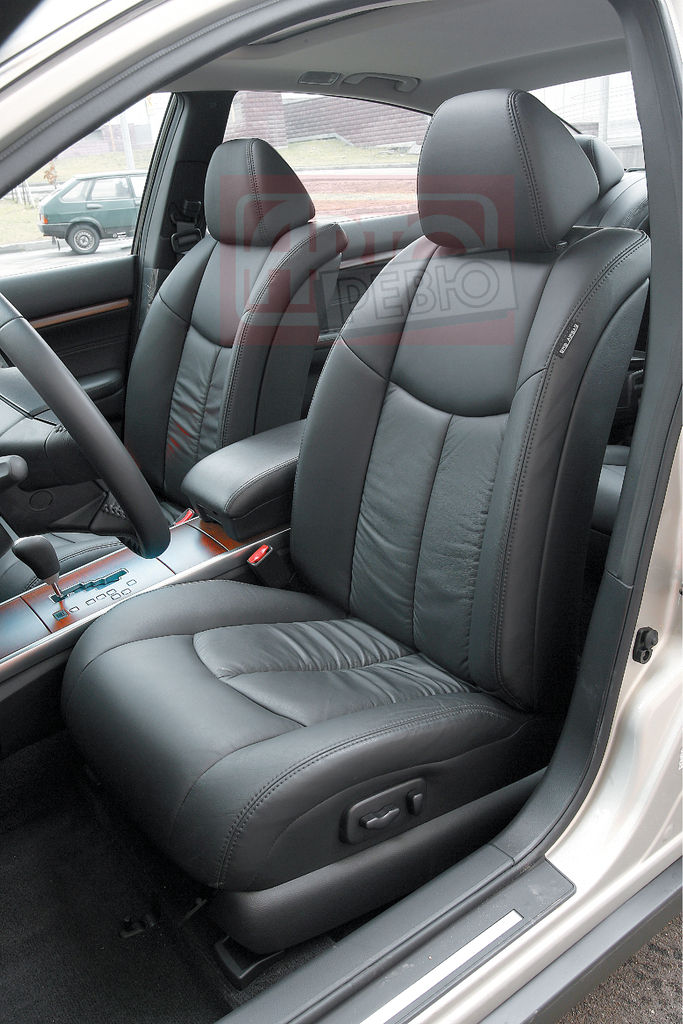 |
| The Nissan's interior will delight fans of faceted, monumental forms | The soft and spacious Teana sofa invites an afternoon nap | The excessive pliability of the seats does not compensate for their poor profile |
But the Teana disappointed us the most. The very nervousness at high speed that we noticed back in the summer (see AR No. 16, 2006) only intensified in winter, combined with studded tires — the Nissan unpleasantly "floats" along the highway. And the reactions to the steering wheel are ambiguous: first a sluggish response to the turn, then a sharp additional turn, and you have to frantically catch the trajectory. And since the steering effort is even less than in the Camry, you have to guess the direction. The wide drifts of winter tires dampened the Nissan's oversteer but did not eliminate it completely. Lift off the gas after a long front-end drift, and the Teana willingly turns sideways until the crude stability control system puts an end to this outrage.
A rather low level…
 |
 |
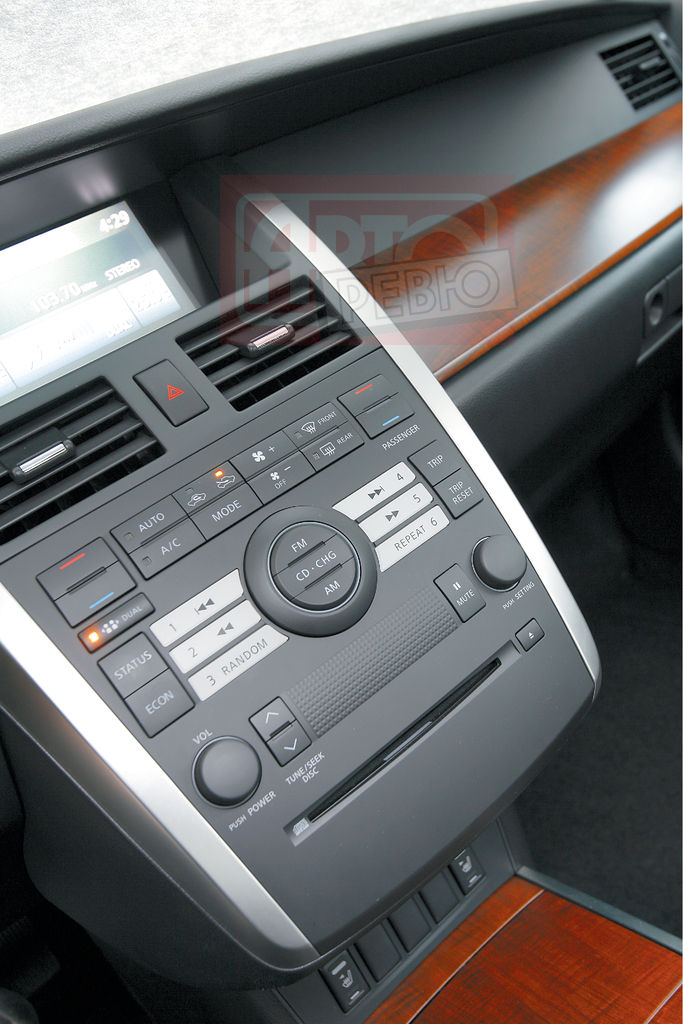 |
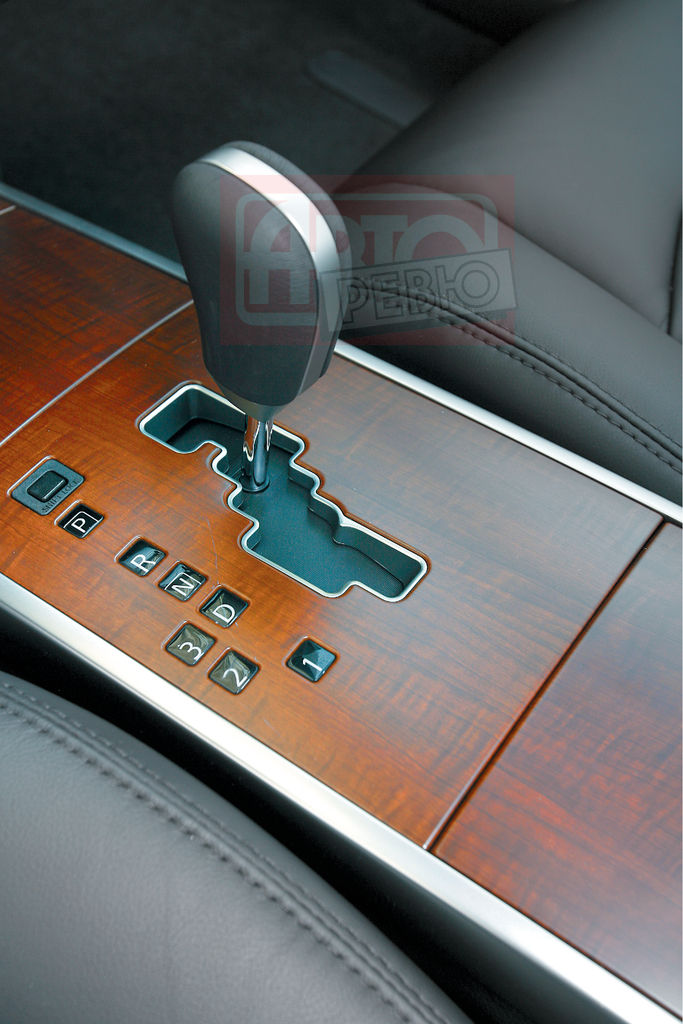
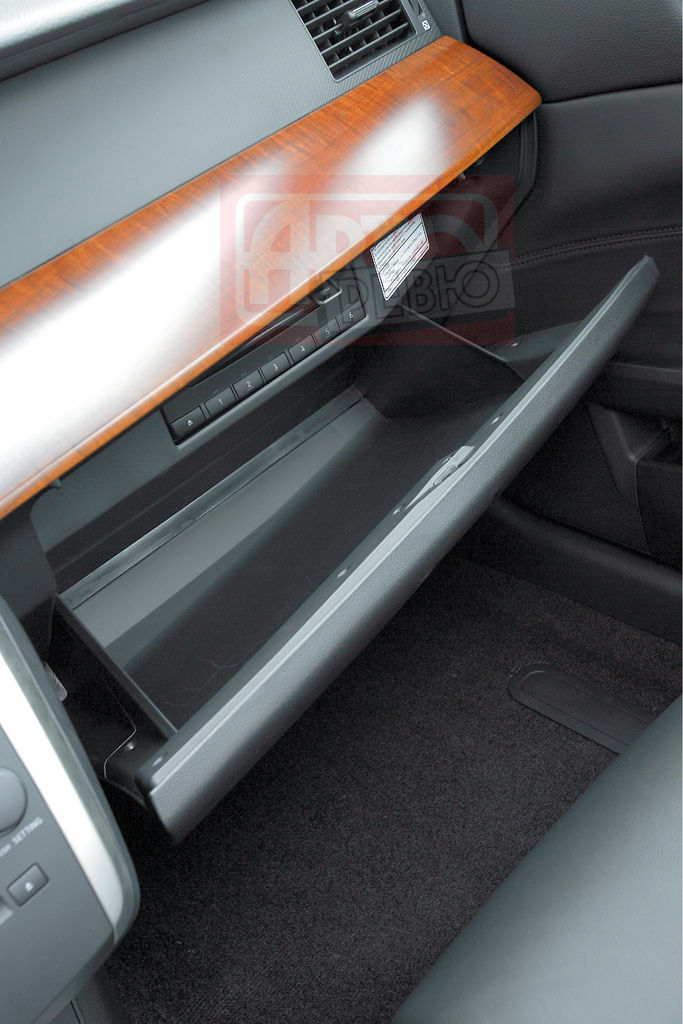
| The Teana's automatic transmission works smoothly and unhurriedly | The CD changer hidden at the top reduces the glove box volume | Thanks to the protruding "cliff" of the console, using the buttons is very convenient |
But in terms of ride smoothness, the Teana is the undisputed leader of this quartet. And in our road conditions, especially for a large sedan, this is an argument of paramount importance.
The Teana excellently "digests" Russian asphalt. It seems not to notice small cracks and bumps, and it successfully copes with large ones. On "waves," the body barely rocks. And only deep potholes with sharp edges cause noticeable impacts — the suspension's energy is no longer enough.
 |
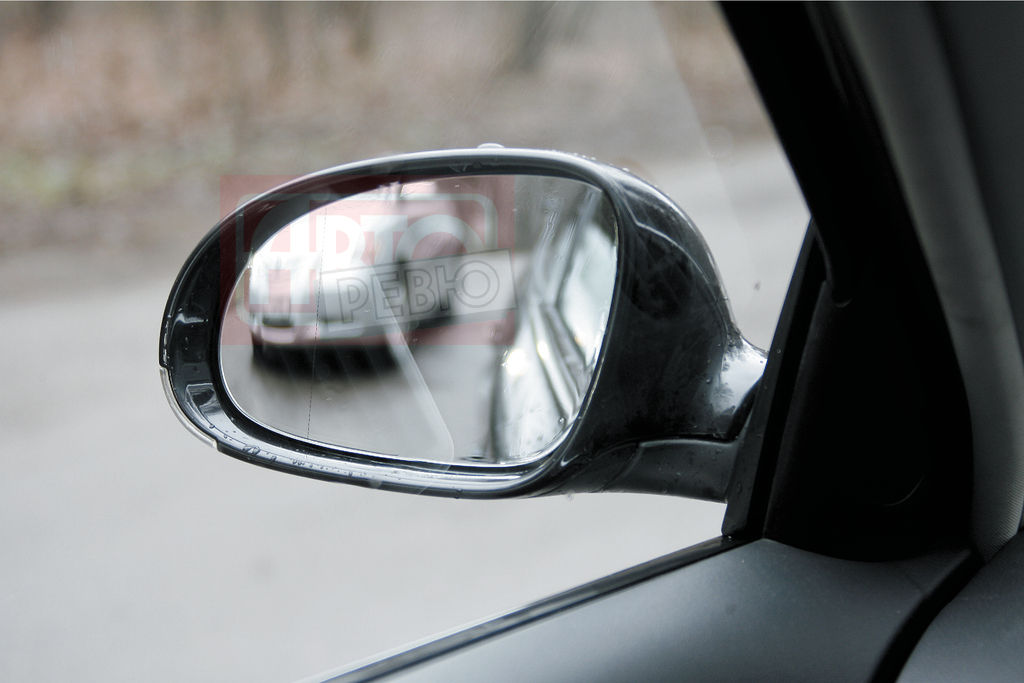 |
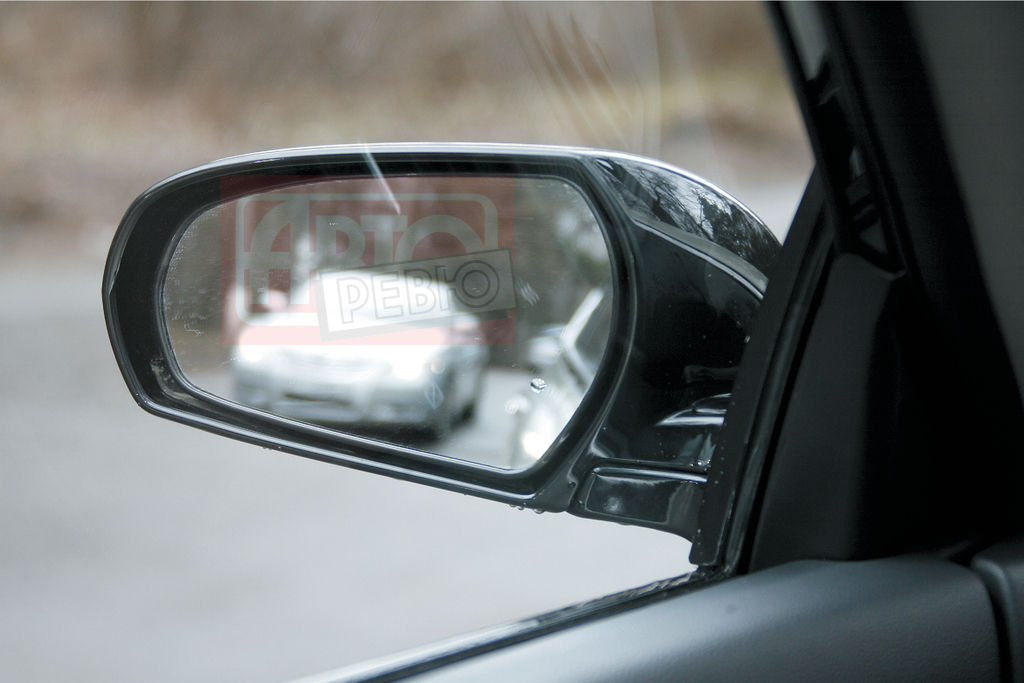
| Through the low, elongated mirrors of the Teana, you cannot see much | The stubby mirrors have been carried over unchanged from the Passat to the Skoda |
 |
|
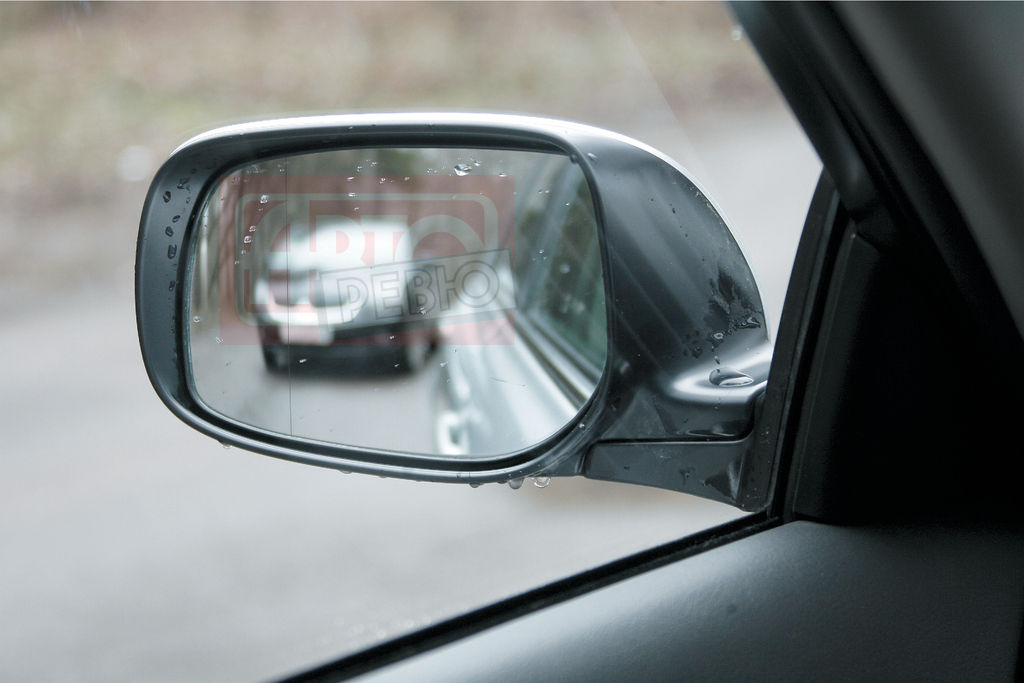
| The tall and wide mirrors of the Mitsubishi (left photo) and Toyota provide excellent visibility | |
The Toyota's ride smoothness is no worse, and the suspension's "strength" reserve is even greater — it "swallows" potholes even more confidently. True, on the Camry's seats, you constantly feel fine vibration from road "small stuff."
The Galant is inferior to both "Japanese" cars in ride smoothness, but the shaking here is somehow "balanced," smoothed out, especially in combination with such good handling. But the Skoda — alas, is a classic example of a compromise in suspension tuning. For the refined behavior in corners, you have to pay with shaking: the Superb meticulously collects every grain of sand from the road and noticeably tosses passengers on large bumps. Plus, vibration from the engine is constantly felt in the cabin. The only consolation is the absence of rocking and decent energy intensity — the Skoda flies over speed bumps without paying attention to them.
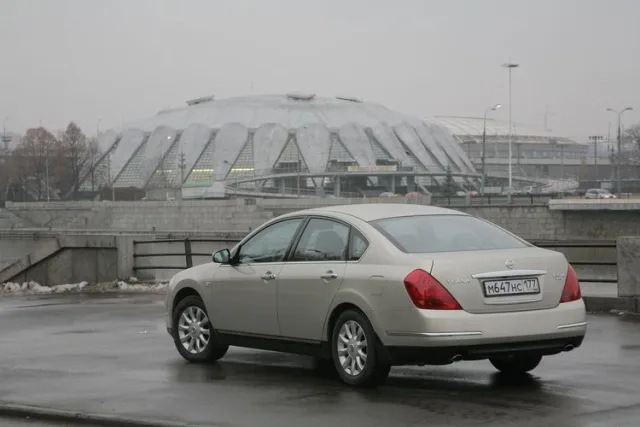
But the Superb is quiet, like the Toyota Camry. Except that in the Toyota, the sound of sand hitting the wheel arches is slightly more distinct, and in the Skoda, the bassy voice of the engine is more audible.
In the Mitsubishi, the noise levels are also fairly well balanced, but overall sound insulation is slightly worse. And the loudest of all is the Nissan Teana. Rear passengers get it the worst: they constantly hear the pitter-patter of sand, the clicking of studs, and the howling of the wind. In the three-liter top version, I recall, it was noticeably quieter inside (see AR No. 16, 2006).
So who won?
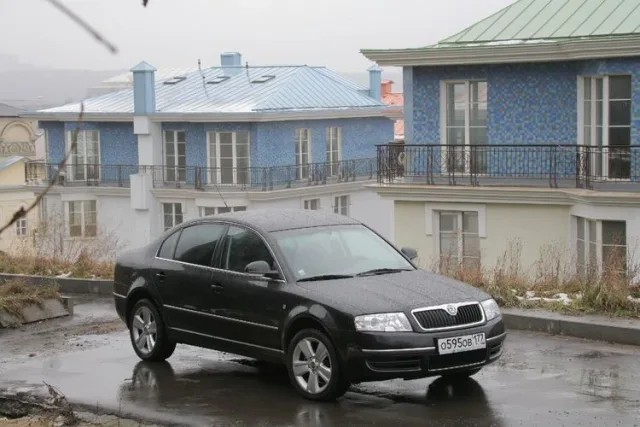
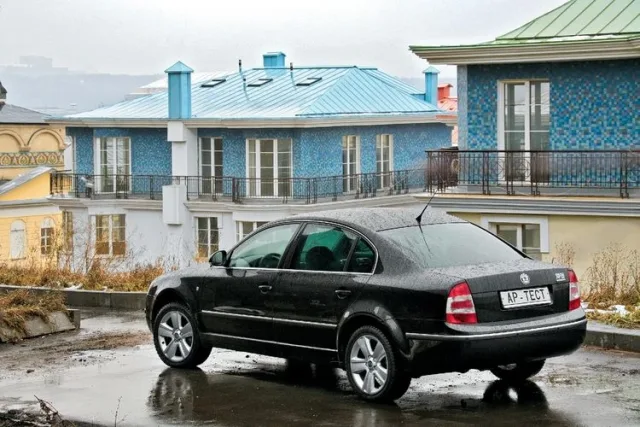
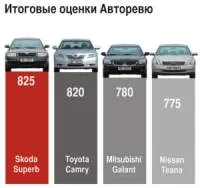
In this quartet, there is no flawless car. If we sum up the expert ratings, the Skoda Superb leads by a minimal margin in points. Quality finishing, confident road behavior, plenty of space in the back, and a spacious trunk... And the price is quite reasonable—from $27,190 for the version with the 1.8-liter turbo engine.
However, the Skoda still looks dated, the "European" suspension shakes quite a bit, and the unfortunate pairing of the 1.8T engine with the automatic transmission hinders smooth throttle control. It's no surprise that Superb sales here are sluggish—only 570 cars were sold over the past year.
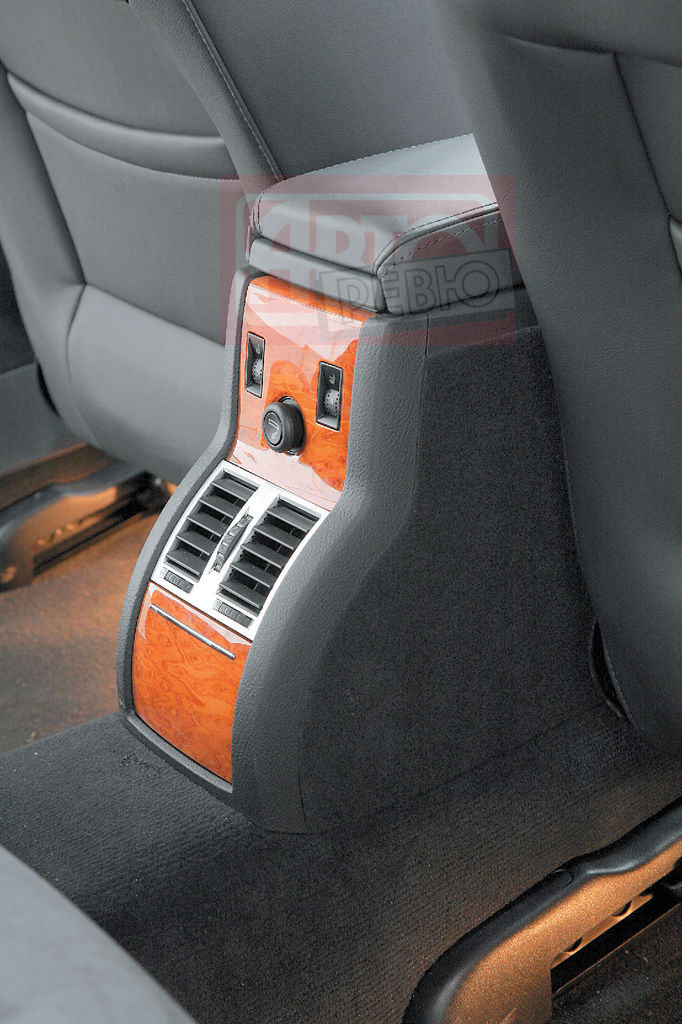 | 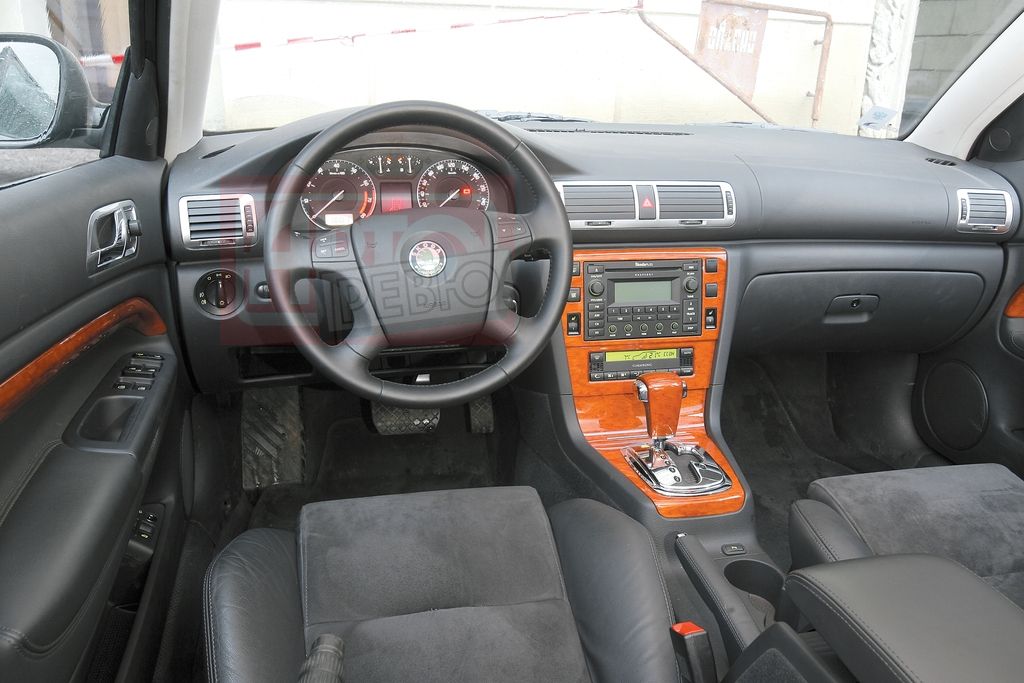 | 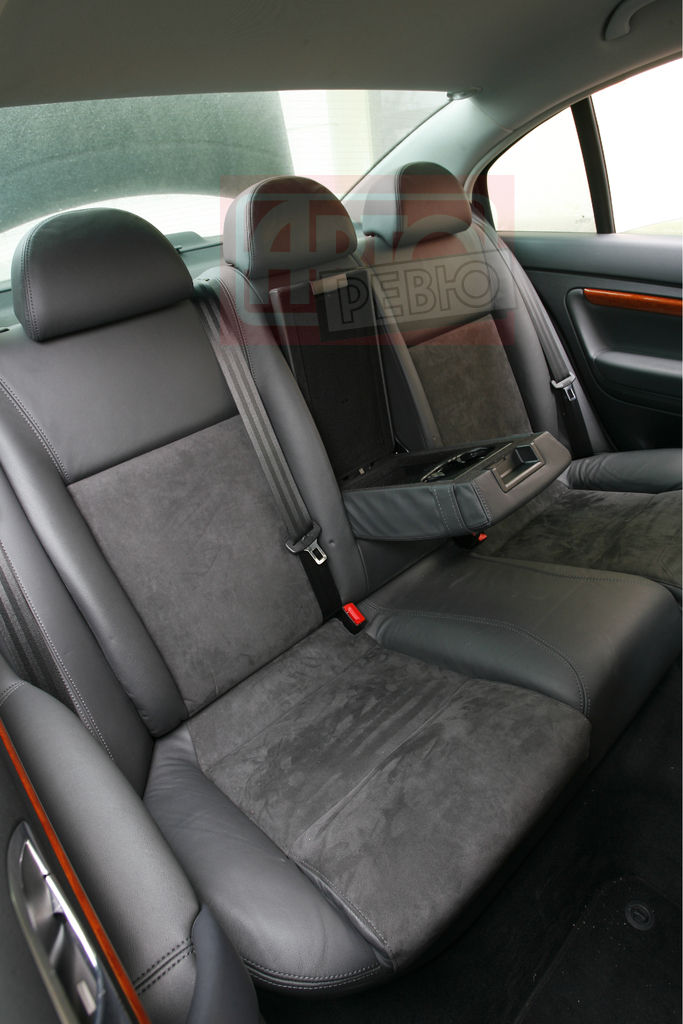 |
| In the back of the Skoda—air vents and adjustable rear seat heating | The laconic interior is nicely enlivened by polished "aluminum" | For three in the back, the Skoda is a bit tight in the shoulders, but for two—it's a limousine! |
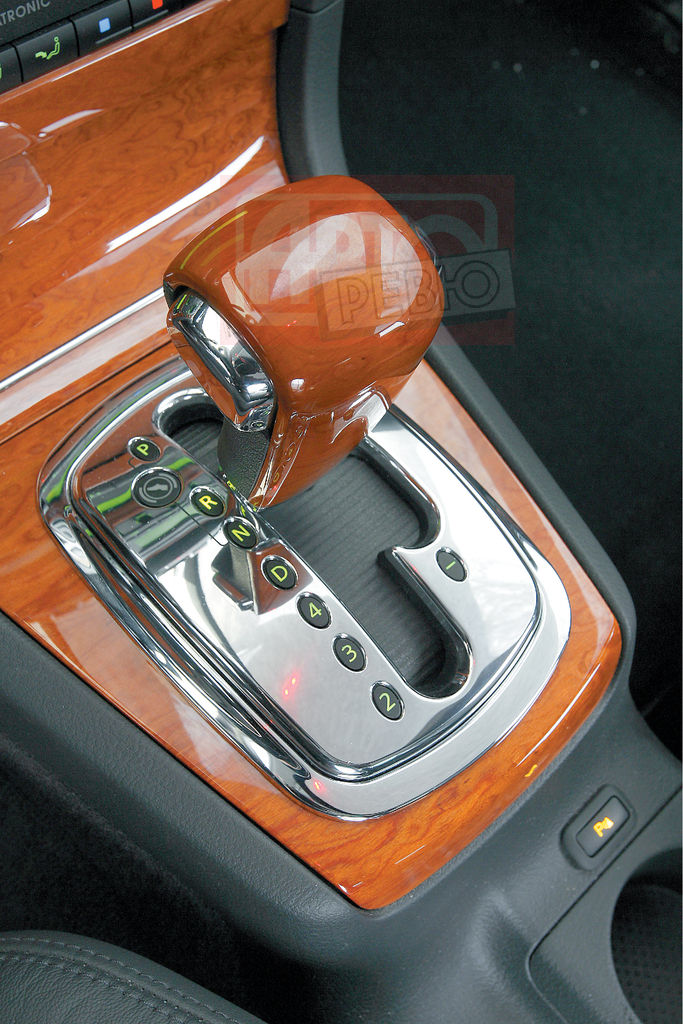 | 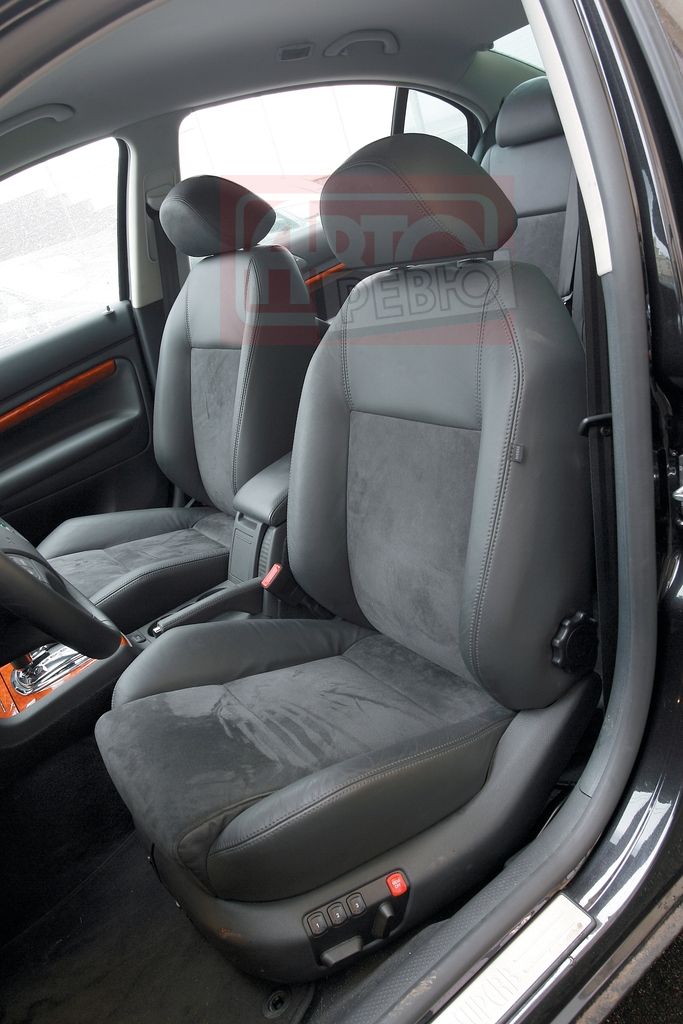 | |
| The illogical shifts and huge delays of the Skoda's "automatic" spoil the impression of decent dynamics | The seats are German-style firm—not everyone will like them. But the leather-Alcantara upholstery will be appreciated even by the most discerning |
The "American" Mitsubishi Galant is just starting its journey in our market. But there's no hype around it, even though for that money ($31,700) it offers an excellent combination of size, equipment, and price. Among its clear advantages are well-thought-out ergonomics, a solid chassis, a good engine, and high ground clearance. However, the drawbacks are also obvious: the rear is not too spacious, the trunk is small, the finish is not the best, and ESP is absent.
The Nissan Teana 2.3, unlike the Mitsubishi, cannot boast a polished driving character. But it has original design, a solid interior, and options like cornering lights and a rearview camera that rivals don't have at all. True, the price is correspondingly higher—the Teana is the most expensive in this quartet. But that doesn't scare buyers: 2,934 cars were sold last year.
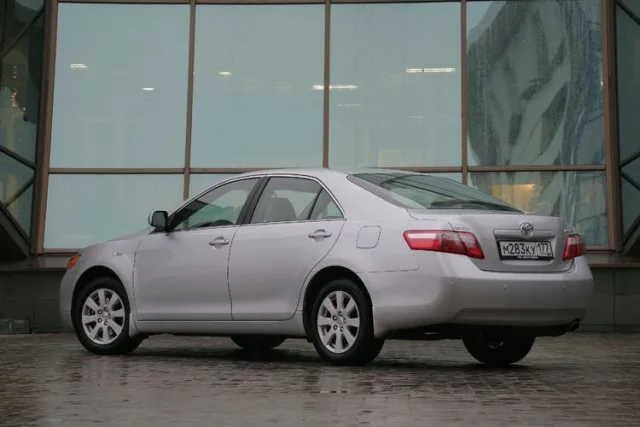
The Toyota Camry is the undisputed segment leader with 15,935 cars sold. And that's no accident. In our test, the Toyota lost to the Skoda by only five points, but it didn't fail in any category. Yes, the Teana is smoother, the Superb is faster and more engaging on twisty roads, the Galant is more convenient in throttle control... But it was the Camry that proved to be the most balanced—and at a reasonable price. After all, balance matters not only to accountants...
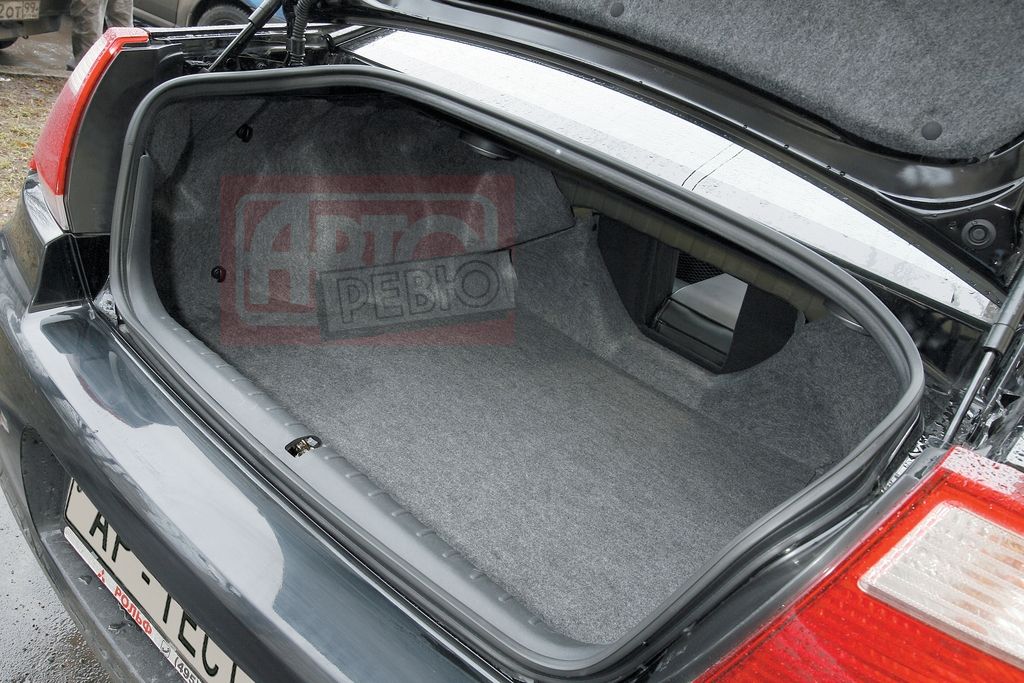 | 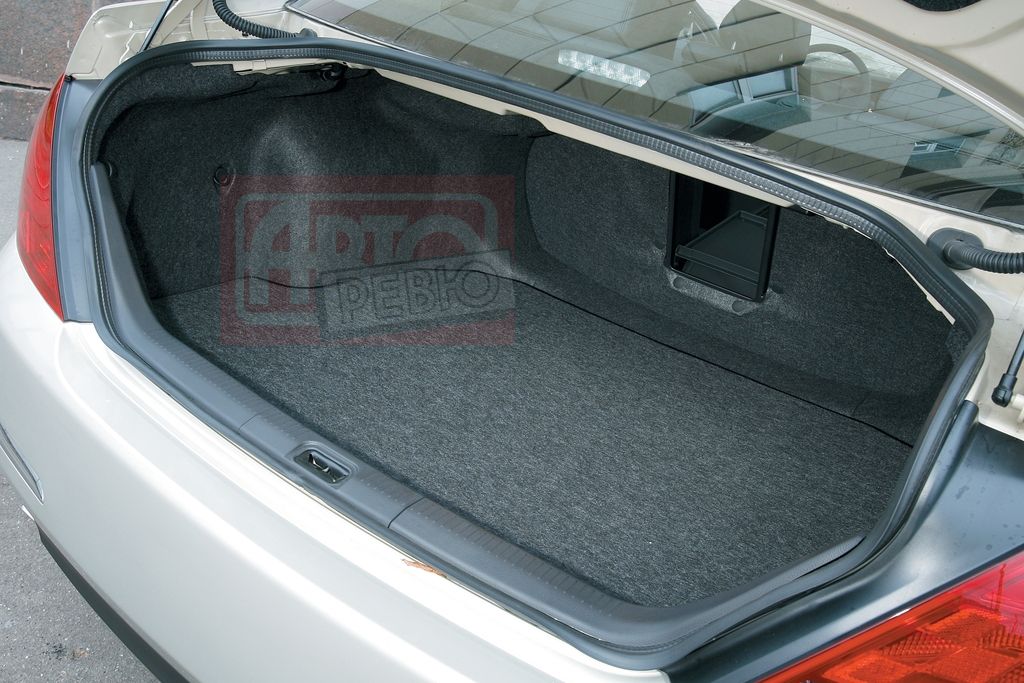 |
| The Mitsubishi's trunk is the most modest, largely due to protruding arches and reinforcements | The Nissan's cargo area is only spoiled by protruding arches |
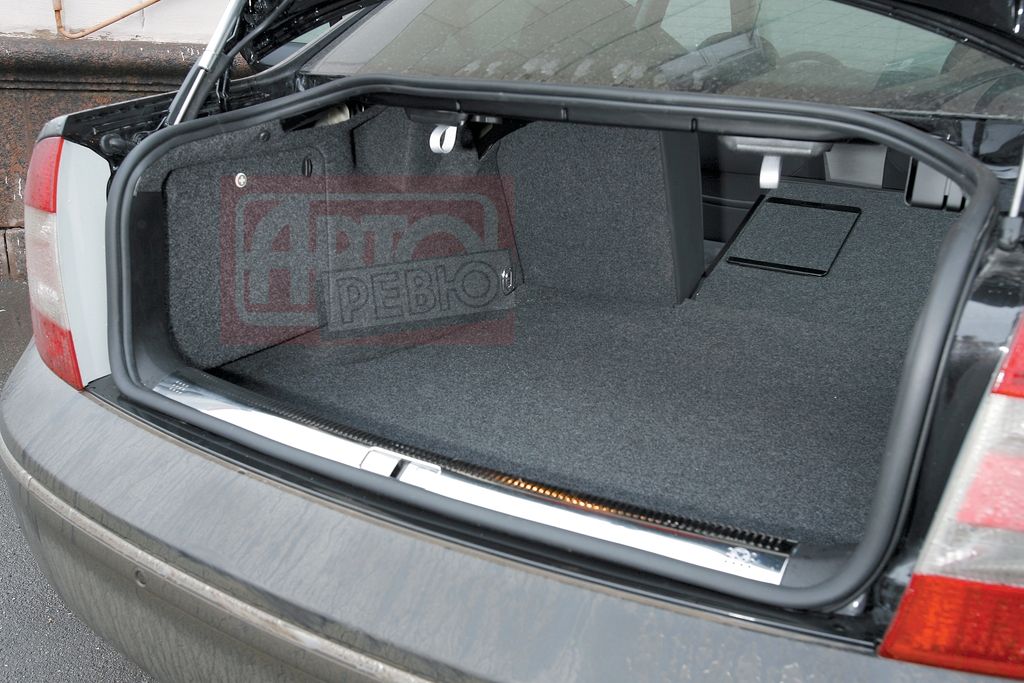 | 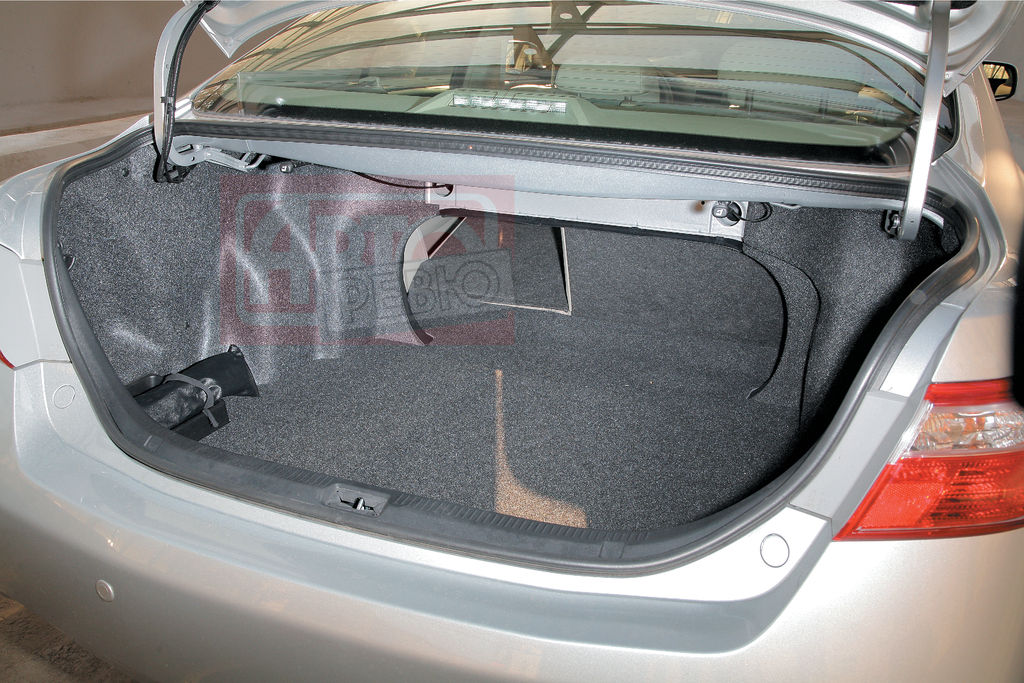 |
| The Skoda has an exemplary trunk: large, with flat walls, quality upholstery, and loops for securing cargo | The Camry's huge trunk can't be loaded to the brim: protruding hinges will crush the luggage |
All-Round Visibility
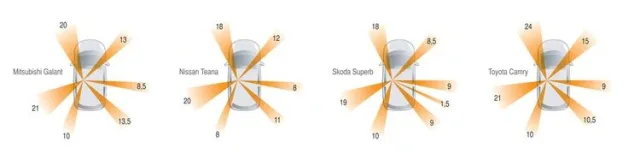
All four sedans pleased with good visibility—the experts rated them "good" and "excellent." For measurements, we used an optical protractor that allows determining "blind" zones with accuracy to a degree.
The best visibility turned out to be in the Toyota Camry and Mitsubishi Galant, although their total viewing angles are the smallest—270.5° and 274°, respectively. The wiper cleaning zones are wide, the pillars, though massive, do not obstruct the view, and the rear window opening is clearly visible. The mirrors are successful in both shape and size.
The Teana has a larger total viewing angle (283°), but the situation is spoiled by small mirrors—they distort the image and have "diopters." Additionally, in slush, the Nissan's side windows get dirty faster than those of competitors.
And the Skoda Superb, despite having the largest viewing angle of 285°, ends up last in the visibility ranking—due to small mirrors and a rear window opening blocked by headrests.
"Moose Test"
This winter was abnormally warm, so the "moose test" again had to be performed on studded tires, but on asphalt. Due to the wet surface, we reduced the "passing" speed from 65 to 60 km/h. Everything else is traditional: one attempt for each of the five volunteers who performed the emergency maneuver in these cars for the first time.

The safest in emergency maneuvering was the Toyota Camry—all drivers dodged the imaginary moose, despite the insensitive steering and a "step" in effort during sharp wheel turns. The reason lies in the Camry's lazy reactions in normal modes, which subconsciously sets the driver up for active steering work in a critical situation, as well as in the effective operation of the strict stability control system.
The Skoda Superb is also on top: only one of the volunteers hit the limiting cone. The others, thanks to the "transparent" steering and phenomenal directional stability, along with delicate ESP, managed the maneuver without problems.
The Nissan repeated the Skoda's result—four out of five drivers completed the task. But the Teana is more difficult to control: the completely "empty," uninformative steering wheel and a tendency to oversteer get in the way—the Nissan's stability system worked non-stop.
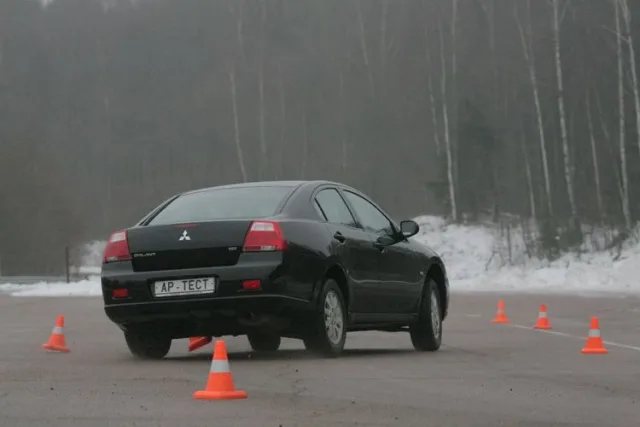
But the Mitsubishi Galant, alas, turned out to be the worst: despite a well-tuned chassis, three out of five drivers could not cope with deep slides, and the Galant doesn't even have a stability system as an option.
| "Moose test" on the first attempt at 60 km/h* | ||
| Car | Tires | Maneuver completed |
| Mitsubishi Galant | Nokian Hakkapeliitta 5 | 2 out of 5 drivers |
| Nissan Teana | Goodyear UG500 | 4 out of 5 drivers |
| Skoda Superb | Nokian Hakkapeliitta 5 | 4 out of 5 drivers |
| Toyota Camry | Pirelli Winter Carving | 5 out of 5 drivers |
| Surface—wet asphalt, tires—winter studded | ||
| * Five drivers took part in the tests | ||
Autoreview Readers' Forecast
Before this test, we asked visitors of www.autoreview.ru which car from the participants they would prefer.
The votes were distributed as follows:
Toyota Camry 57.17%
Nissan Teana 19.59%
Skoda Superb 15.28%
Mitsubishi Galant 7.96%
A total of 12,878 people voted
Passively Safe?
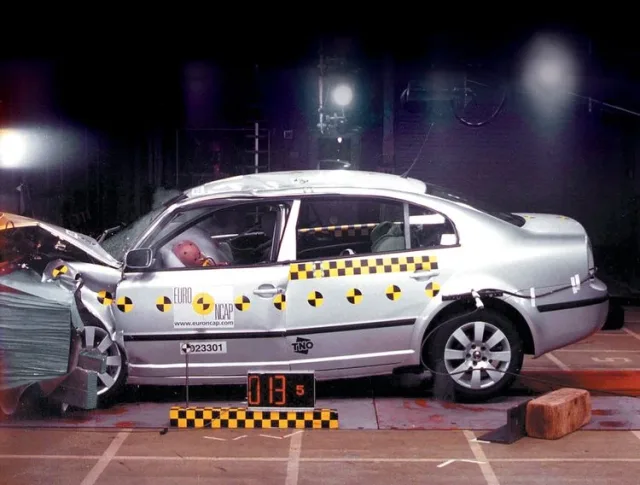
Of all four cars, only the Skoda has undergone independent EuroNCAP crash tests. Although the Superb is essentially a rebadged Volkswagen Passat B5 with a longer wheelbase, its results were worse than its predecessor's: 26 points (four stars out of five) versus 28. In a frontal impact, the "driver" dummy pierced the airbag and hit its chest on the steering wheel, and its knees struck the dashboard. Additionally, after the impact, the floor and roof noticeably deformed. The "children" in special seats in the back are well protected. But the Superb doesn't spare pedestrians—zero points for pedestrian protection.
Mitsubishi Galant and Toyota Camry were tested according to the methodology of the American National Highway Traffic Safety Administration (NHTSA) — a frontal impact into a concrete wall at 56 km/h and a side crash test, in which a trolley with a deformable barrier hits the car at 62 km/h at an oblique angle. Both cars passed the tests excellently — five out of five stars in all disciplines.
Crash tests: how passengers are protected
The Japanese organization JNCAP conducted a series of tests on the Nissan Teana, including two frontal impact scenarios: a collision with a concrete wall at 55 km/h and a 40% overlap impact into a deformable barrier at 64 km/h. In Japan, side collisions are simulated strictly at a right angle, but the trolley accelerates to 55 km/h — 5 km/h faster than European standards. The Teana's results were pleasing: the dummies were excellently protected, although Nissan received only a "two" for pedestrian safety.
For comparison, data from other test participants are provided. The Skoda Superb was tested according to EuroNCAP methodology and earned 26 points in the overall rating: frontal impact brought 9 points (56%), side impacts — 17 points (94%). Child protection was not assessed, and pedestrians scored zero points. The Superb's curb weight is 1490 kg.
The Mitsubishi Galant and Toyota Camry underwent American NHTSA tests, where both received five stars for driver and passenger protection in frontal impact, and the same for side collisions for front and rear passengers. The rollover rating for both sedans is four stars. The Galant weighs 1548 kg, the Camry — 1458 kg.
For the Teana, according to JNCAP methodology, the overall driver protection rating was 87%, passenger — 94%. In frontal impact — 82% and 90% respectively, in overlap impact — 80% and 91%, in side impact — 99% for the driver. Curb weight — 1460 kg.
What costs how much?
The Skoda Superb with a turbocharged 1.8T engine producing 150 hp and a manual gearbox starts at $27,190* — however, for this money, a modest Classic trim is offered with four airbags, climate control, and heated front seats. An automatic transmission will add $2,000 to the price. A package including cruise control, parking sensors, rain sensor, stability control, xenon headlights, CD/mp3 stereo, and alloy wheels is priced at $3,000. Another $3,000 will have to be paid for a CD changer, wood trim, electric front seat adjustments, and heated rear seat. The test car additionally had leather upholstery and a split-folding rear seat — totaling $37,900. The flagship Laurin&Klement version with different leather and wood and side curtain airbags costs from $37,290. Also available are a V6 2.8 L (190 hp) with automatic transmission from $36,790 and a 1.9 TDI turbodiesel (131 hp) from $28,590. Orders will have to wait two months.
The warranty on the Skoda is two years without mileage limit. In Russia, the brand is represented by 44 dealers in 27 cities.
The Mitsubishi Galant in the base Intense version surprises with its rich equipment: six airbags, climate control, CD/mp3 stereo, heated front seats, cruise control, and alloy wheels — all for $31,700. The test car was in the Instyle trim (there are only two) with leather interior, electric driver's seat adjustment, Rockford Acoustic stereo with changer, and sunroof — $35,740. Only one engine is offered — a gasoline 2.4 L four-cylinder (158 hp) with a four-speed automatic. There are no queues for the Galant.
Warranty — 3 years or 100,000 km. Mitsubishi's network — 85 dealers in 62 cities.
The Nissan Teana with a two-liter engine (136 hp) and automatic transmission costs from $32,875 — more expensive than rivals, but the base version only has two airbags. The 2.3 (173 hp) Luxury version adds side airbags, electric driver's seat adjustments, and alloy wheels — $36,175. The top Premium for $40,206 includes leather with wood, CD changer, rearview camera, stability control, and bi-xenon. The test Teana 2.3 Premium with sunroof came to $40,950. Optional extras include an ottoman seat with massage for the front passenger, heated rear seat, and cruise control. The flagship with a V6 3.5 (245 hp) and CVT costs $47,727. Waiting time — two to three months.
Warranty — 3 years or 100,000 km. Nissan is sold by 35 dealers in 20 cities.
The Toyota Camry 2.4 (167 hp) in the base Comfort costs $32,925 — like the two-liter Teana, but with a five-speed manual. However, the equipment is impressive: six airbags, climate control with Plasmacluster ionizer, rain and light sensors, CD/mp3 changer. An automatic transmission is an extra $1,600, leather with electric seats and parking sensors — $2,400. In the version with cruise control, xenon, and stability control (like the test car), the price rises to $38,784. The top Camry V6 3.5 (277 hp) — $46,056. You'll have to wait at least six months for the car.
Warranty — 3 years or 100,000 km. Toyota is represented by 29 dealers in 17 cities.
* Prices are calculated at an exchange rate of $1=26.3 rubles, including dealer commission. Toyota dealers add 1% to the Central Bank rate, Mitsubishi and some Nissan dealers hold the rate at $1=27.9 rubles. Only Skoda calculates honestly — at the Central Bank of the Russian Federation rate.
What else?
If you want to save as much as possible while maintaining prestige and space, it's worth remembering other models. Classic representatives of the D class — Mazda 6, Ford Mondeo, Honda Accord, Toyota Avensis, Volkswagen Passat — have already been tested by Autoreview. But there are also non-standard options.
The Chevrolet Epica is a large Korean sedan that has just appeared on the market. With an inline six-cylinder 2.5 L (157 hp) and five-speed automatic, it costs from $30,040. Details — in upcoming issues.
The Hyundai NF has already participated in a comparison with the Accord and Passat (AR No. 15, 2006) and lost to them in almost everything: design, build quality, handling, and ride comfort were weaker. With a 2.4 L engine (161 hp) and four-speed automatic, the NF is priced at $31,480.
The Kia Opirus is another "Korean" for $31,600, which is larger and equipped with a V6 3.0 L (189 hp) with five-speed automatic. If its appearance, reminiscent of a caricature of the Mercedes E-class, doesn't bother you, it's worth a look.
The Saab 9-5 is already aging — this year the model turns ten. Its reputation as an expensive-to-maintain and not very reliable car affects sales. But now such a sedan with a 2.0 L turbo engine (150 hp) and automatic can be had for $34,560.
When you hold the final table of expert assessments of four business sedans in your hands, you involuntarily start looking for patterns. And they are found. The Skoda Superb scores 825 points out of 1000 possible, the Toyota Camry lags by only five points, while the Mitsubishi Galant and Nissan Teana noticeably trail the leaders — 780 and 775 points respectively. Interestingly, the Superb and Camry scored almost the same, although they approached this in completely different ways.
It's immediately noticeable that the Skoda wins due to design — 155 points against 150 for the Camry. But the Superb's main trump card is the interior. Here, the Czech sedan gets 135 points for passenger seat comfort, while the Camry settles for 115, and the Galant even drops to 100. Particularly telling is the comparison of trunks: the Superb scores 50 points, the Camry — 40, the Teana — 40, and the Galant only 35. And interior transformation — here the Superb is unrivaled with 15 points, while the Galant and Teana get a meager 5.
However, in ride comfort, the Camry leads — 175 points against 165 for the Teana, 160 for the Galant, and only 155 for the Superb. This is an interesting point: the Superb, which wins overall, loses precisely in ride smoothness. In vibration protection, the Czech sedan gets only 55 points, while the Camry and Teana get 70 each. But in acoustics, the picture is reversed: the Superb scores 55, while the Teana drops to 45.
In dynamics, the Superb is again ahead — 240 points. Its handling is rated at 80 points, noticeably higher than competitors: the Camry gets 75, the Galant — 70, and the Teana only 65. Acceleration dynamics are roughly equal for all: 70 points for the Superb, Galant, and Camry, 65 for the Teana. The Galant has the best brakes — 90 points, although the Superb is not far behind with 90.
Ergonomics is an area where the Galant and Camry feel confident, scoring 150 points each. The Superb and Teana lag by 10 points. The driver's workplace is best in the Galant — 75 points, and visibility is also the best here — also 75. Interestingly, the Superb, which wins overall, gets only 65 points for visibility — the worst indicator in the quartet.
Now about the technical content. All four cars are front-wheel-drive sedans with five seats, but then differences begin. Under the hood of the Galant is a gasoline naturally aspirated engine with a volume of 2.4 liters (2378 cm³) producing 158 horsepower with a four-speed automatic. The Teana is equipped with a V6 with a volume of 2.3 liters (2349 cm³) producing 173 hp, also with a four-speed automatic. The Superb is the only one in the quartet with turbocharging: its 1.8-liter engine (1781 cm³) produces 150 hp, but torque of 210 Nm is available from 1750 rpm. The Camry is again naturally aspirated: 2.4 liters (2362 cm³), 167 hp, and a five-speed automatic.
Acceleration to 100 km/h is not the strongest side of this quartet. The Camry shows the best result — 9.6 seconds. The Teana — 10.7, the Superb — 10.9, and the Galant — 11.5. The maximum speed is highest for the Superb — 212 km/h, while the Camry reaches 205, the Galant — 200, and the Teana — 196.
Fuel consumption in the combined cycle: Galant and Superb — 9.5 liters per 100 km, Camry — 9.9, Teana — 10.3. In the urban cycle, the picture is similar: 13.5 for the Galant and Superb, 13.7 for the Teana, and 14.1 for the Camry. On the highway, the Superb is the most economical — 7.1 liters, slightly more for the Galant — 7.2, Camry — 7.4, and Teana — 8.3.
The fuel tank of the Teana and Camry holds 70 liters, the Galant — 67, the Superb — 62. Fuel: the Galant is satisfied with AI-92, the rest require AI-95. The curb weight is highest for the Galant — 1585 kg, the Teana — 1550, the Superb — 1492, and the Camry is the lightest — 1450 kg.
The suspensions differ fundamentally. The Galant, Teana, and Camry have McPherson struts up front, while the Superb has double wishbones. The Superb's rear suspension is semi-independent, whereas the others have multi-link (the Camry also has McPherson). All brakes are disc, ventilated at the front. Tires: 215/60 R16 for the Galant and Camry, 205/65 R16 for the Teana, and 205/55 R16 for the Superb.
Trunks: the Camry has the largest at 535 liters, the Teana has 476, the Superb has 462, and the Galant only 435.
And here's what's interesting: in the final table, the Superb scores 825 points, the Camry 820, the Galant 780, and the Teana 775. But if you add up the scores across all parameters, it becomes clear that the Superb wins not because of any single factor, but due to consistently high results in almost everything. The Camry is a compromise: it's good in comfort but falls short in dynamics and interior. The Galant and Teana are outsiders, yet they have their strengths: the Galant has the best ergonomics, and the Teana offers decent ride comfort. But overall, the Superb looks like the most balanced offering in this quartet.