
Toyota Avensis. Everything ingenious is simple
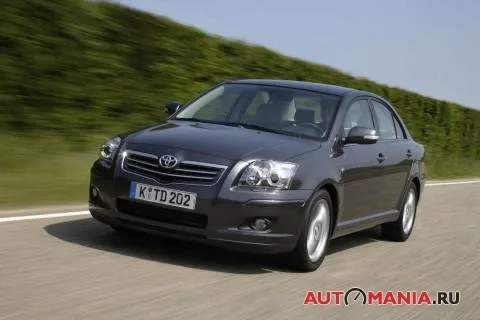
I think few will be surprised if we say that for most of our drivers the concept of a “Japanese car” is associated primarily with Toyota, rather than Nissan, Mazda or Honda. I don't want to belittle the merits of other brands from the Land of the Rising Sun, but it so happened that after the market opened, it was Toyota cars that reached us almost first. Why argue — even the current fifteen-year-old Carina E is still considered a quite worthy car. Therefore, the people's love for this brand is quite understandable. And confirmation of this is the dry statistics: last year Toyota finished on the Russian market with a 1.5-fold growth and a record 95,317 cars sold for itself. Impressive, isn't it? Of course, one might recall that the market as a whole was growing, and the company updated three models during this period. Moreover, two of them — RAV4 and Camry — quite qualify for the role of “locomotives” of the entire “Japanese lineup”. I won't argue: sales of the “crossover” are currently clearly limited by quotas allocated for us, and the Camry in its segment is second in popularity only to the “Volga”, and even then only because the Gorky sedan is still half sold through state orders. However, the best-selling Toyota in 2006 was the outgoing Corolla, which crossed the 30,000 mark. And not at all because of affordability or beauty. Far from it — Toyota cars have not been cheap for a long time, and the Corolla's appearance even then looked like an anachronism, but facts are stubborn things…
Against this background, the achievements of our today's hero — the Avensis — look more modest: just over 13 thousand. But the paradox is that even with such a result, it became the most popular family sedan, beating not only the eternal rival Nissan Primera, but also the Taganrog Sonata, which led in the D-class. Comments, as they say, are unnecessary.
Honestly, until I myself got behind the wheel of the Avensis, such popularity was a mystery to me. Our people love with their eyes, and here we have a rather boring, if not plain, design with a standard set of refreshing details — powerful stampings on the sides, aggressively chiseled optics, and a strongly sloping profile for visual swiftness. Overall, not bad, but it doesn't catch the eye. A typical “workhorse” appearance, though with a slight hint of respectability. Last year's facelift hardly changed the picture. Bumpers, mirrors, and the radiator grille, refined by specialists from the European studio Toyota ED2 (wheels and hubcaps, of course, don't count), do not, to put it mildly, qualify as a restyling. There were more questions than answers. But as soon as I found myself inside, everything changed dramatically.
And the point here, as you might have guessed, is not in the design, but, strange as it may sound, in its absence. Yes, exactly in its absence. Looking at the exterior and interior of the Avensis, it seems as if it was modeled from start to finish by a computer. Strict, simple, sometimes banal, and completely devoid of emotion, but at the same time everything is drawn so precisely and clearly that looking for flaws is useless. If there should be a button here — it will be here; if a lever should travel twenty millimeters, not twenty-five — it will travel twenty. Instruments — exactly before your eyes, controls — at hand, pedals — exactly under your feet… Design, as a product of creativity, cannot, in my opinion, be equally flawless by definition. As for build quality, Toyota stopped making mistakes back in the last century when they fully automated the assembly line. A buyer may complain about mediocre plastic or unpresentable fabric seat upholstery, but never about uneven gaps or creaking panels. You won't find such flaws in the Avensis (or in other Toyota cars, for that matter).
The same computer-like origin, it seems, applies to comfort. At its core is a spatial calculation verified to the millimeter, anatomically precise, complemented by unprecedented adjustment ranges. Literally anyone can fit in the seats, regardless of height and build. There's also enough room in the back, especially for two. There will be space for a third in the center, but honestly, calling the sofa a three-seater, the Japanese were a bit disingenuous (though who is without sin). But they didn't deceive with the trunk — it really can fit a couple of sizable tourist suitcases. In short, the capacity is there, if there's the desire.
By the way, if you consider the Avensis as a car for travel, ignoring the question of its “armament” would be the height of recklessness. In the base version, under the hood is an inline 1.8-liter engine producing almost 130 hp. It's clear that with a weight of 1,300 kilograms, such a car is not particularly brisk. Especially if instead of the 5-speed manual you choose the rather aged 4-speed automatic, which is somewhat thoughtful in its shifts. But no matter how calm it may seem, it will still reach the second “hundred” in 10–11 seconds (depending on the transmission), outpacing, by the way, most competitors. If that's not enough, the Japanese will offer a middle option — a 2-liter 147-horsepower engine with direct injection, also known from the Toyota RAV4. It accelerates faster and has better elasticity, though the transmission options are the same — a standard manual and a 4-speed automatic. A modern 5-speed automatic, which, by the way, has no alternative, is available only with the most powerful 2.4-liter 163-horsepower engine on our market. Given that the same units are also installed on the flagship Camry and the top RAV4, excellent dynamics combined with relatively low fuel consumption are guaranteed for the Avensis owner.
However, whichever option he chooses, he will definitely not be disappointed with the behavior of his car on the road. Integrity and composure are another advantage of this car. The engineers additionally worked on the suspension and steering, including during the restyling. As a result, they managed to find that golden mean that all automakers strive for. In general, the car holds the road excellently, obeys the driver unquestioningly, and easily handles most of the “misunderstandings” that fall under the wheels (though it's still not worth crossing speed bumps at full speed).
Now about the cost. Already by established tradition, the Avensis is offered here in three fixed trim levels: “Terra”, “Sol”, and “Lux”. The base “Terra” with a 1.8-liter engine and a manual will cost $24,500 today. The list of standard equipment includes ABS, EBD, Brake Assist, traction control (TRC), vehicle stability control (VSC), and seven airbags, including driver's knee protection. Among the “comfort” options are power windows, air conditioning, radio, and a CD player with mp3/WMA support and steering wheel controls. The “Sol”, depending on the engine (1.8 or 2.0) and transmission type, is priced by dealers in the range from $27,200 to $31,300. True, here we can already talk about such “features” as climate control, auto-dimming mirror, multi-information onboard system with two screens displaying average speed, fuel consumption, and range, headlight washers… The most expensive version will cost at least $33,100 (the version with the 2.4 engine — $36,100), but here you get the full “deal”, including all available equipment and leather interior trim.
Yuri Goryachev
Technical specifications:
The test drive featured the updated Toyota Avensis. I'll say right away: this is no longer the car we used to see before. The car has become noticeably more interesting both in design and in driving feel.
On the outside, the new model is easy to distinguish by its more aggressive front end with narrow headlights and a massive radiator grille. The profile remains recognizable, but the rear now looks fresher. Overall, the car has gained in solidity, though it hasn't lost its practical essence. The interior has also been reworked: materials have become softer, and the build quality still pleases — nothing creaks or wobbles. The front panel looks strict and laconic, but the center console, in my opinion, turned out to be somewhat overloaded with buttons. But you quickly get used to it.
Under the hood, we have a 1.8-liter gasoline engine producing 129 horsepower. For everyday tasks, this is enough: in the city, the car starts briskly from traffic lights, and on the highway it confidently holds speed. The claimed 10.3 seconds to 100 km/h are not impressive, but the acceleration feel is quite comfortable — the engine pulls smoothly, without dips. The gearbox is a five-speed manual, working clearly and understandably. Fuel consumption during the test stayed around 7.2 liters per 100 km, which is quite acceptable for such a car.
But the suspension, let's be honest, is a bit stiff. On small bumps and asphalt joints, the car noticeably shakes. However, at speed in corners, body roll is minimal, and the steering is filled with pleasant effort. The Avensis seems made for long trips on good roads — there it reveals its best side. The handling is honest and predictable, which has always been an important trump card for this model.
The trunk volume of 520 liters is simply excellent. It can easily fit suitcases for the whole family, and if necessary, the rear seats fold down, increasing the space. The cabin is spacious both in the back and in the front: second-row passengers won't complain about a lack of legroom. The ergonomics of the driver's seat are well thought out, though the seats could be softer — after a long trip, the back gets a bit stiff.
As for equipment, everything depends on the trim level. Base versions offer a quite sufficient set of options, while top versions with xenon, leather interior, and navigation already cost noticeable money. The price range on the Russian market is from $24,500 to $36,100. For this money, the buyer gets a reliable, practical, and well-balanced car that, admittedly, doesn't shine with emotions, but doesn't let you down in the little things.
The bottom line is simple. If you need a solid family sedan with a time-tested reputation and no surprises, the Avensis will be the right choice. But if you expect driving excitement and vivid impressions from a car, it's better to look at competitors. This is a workhorse car that honestly does its job.