
Toyota Auris. Disinherited
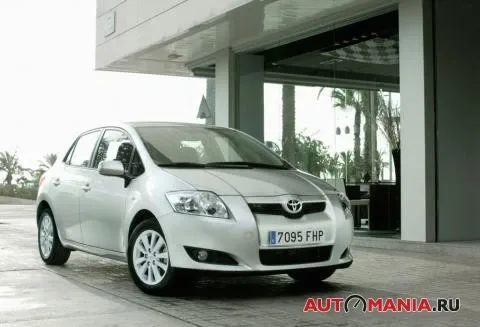
The update of the legendary Toyota Corolla family has dragged on. However, the Japanese usually do not rush to change what sells well anyway. But time spares no one, and even the strongest models gradually become outdated. As a result, the Corolla did eventually get its changes, but Toyota's marketers approached this issue unconventionally. One could expect anything from them, but not that they would split the famous family into two independent branches. Although today this is already a fait accompli.
In short, the Corolla hatchback will disappear from the market, at least if a similarly revolutionary reunion does not happen in the next five or six years. The legendary name remains with the sedan — now only it bears the proud name Corolla. The hatchback now sports the "Auris" badge on its rear, and despite its direct kinship with the "usurper," the newcomer claims not just its own niche but also an independent path of development.
The logic of the split is simple: the sedan is aimed at conservative and developing markets, such as the American or our Russian one. Places where big, solid cars with a "normal" trunk are valued. The hatchback, on the other hand, is designed for pragmatic Europeans, who mostly prefer more practical five-door cars. The Japanese also took into account that residents of the Old World, besides functionality, pay attention to design, so it was Auris that was initially a priority project for them. Unlike the sedan, the hatchback received a look that references not the flagship Camry but the compact Yaris, which Europeans love.
Of course, it did not come to direct copying. But some features of the "little one" are visible in the newcomer's exterior to the naked eye: the shape of the hood or the headlight cut, for example. Overall, one gets the feeling that the car was assembled from different models: the profile and rear part are from the old Corolla, the optics are from the Yaris, the side ribs are from the Mazda 3, and the window line with front "quarter windows" has been seen somewhere before. The Japanese themselves joke that in car design, as in music, there are only seven notes, so repetitions are inevitable. But this rule apparently does not apply to the interior. In this component, the Japanese managed to literally surpass themselves. The Auris interior is a real revolution, not only compared to the Corolla but for the entire compact class. Europeans will surely be pleased: dynamic shapes, futuristic details, bold solutions. Interestingly, the interior was designed not by a European but by Takayuki Nakajima from Toyota's main studio. However, these are details. While preserving the classic layout of most elements, the stylist managed to completely transform the front part of the cabin with a few strokes, turning the boring panel into an ultra-modern cockpit clearly divided into two zones. We have seen the gear selector suspended between the floor and ceiling many times, but the center console tilted at 45 degrees and the almost vertical "handbrake" lever are truly new.
The stylistic individuality of the interior, however, did not hinder its functionality, which, unfortunately, is rare in modern cars. Finding fault with the ergonomics or quality in the Auris is simply ridiculous. If the Yaris could be criticized for frankly cheap trim materials, the newcomer is free from such shortcomings. Everything is assembled from hard but quite decent plastic, and it is done precisely and neatly. The only thing that slightly spoiled the impression was comfort, or rather, the seats. They did not impress. Quite hard, "sporty" with strongly protruding side bolsters, with a wide range of adjustments — it would seem, what more could you need? Alas, the cushions and backrests are a bit short for a tall driver, and the Japanese overdid the firmness. The "ears," on the contrary, turned out to be too pliable — they barely hold in corners. The rear seats are profiled more simply, but I would not call them less comfortable. It is clear that comfort depends on the seating of front passengers, but overall, traveling in them is no worse.
By the way, about traveling. Or about driving — whichever you prefer. It is no secret that the Auris, like the previous Corolla, is available to domestic buyers only with two engines — a base 1.4-liter "four" and a four-cylinder 1.6-liter engine. While the first almost completely repeats its predecessor, the second is a completely new development with a dual variable valve timing system Dual VVT-i, which allowed extracting not 110 but 124 "horses" from the same displacement, along with quite decent 157 Nm of torque.
Without going into unnecessary details, I will say: such an engine pulls quite decently, so given the stiff, almost sporty suspension and adequate brakes, the Toyota is unlikely to disappoint an active driver on the move. But the transmission is less unambiguous. The proprietary robotic manual transmission MultiMode that I got is quite practical in city traffic, causes no complaints even in aggressive slalom. But all this is only true for manual mode. The "automatic," clearly tuned for economical driving, acts too straightforwardly, shifting up at every opportunity. I hope there is no need to explain what it means to find yourself in the middle of an intersection when the light is blinking green, with the speedometer showing "40" and the "robot" having just engaged "fifth." The only salvation is the ability to influence its behavior manually, since the automatic allows the driver to intervene even without nominally switching to manual mode, and formula-style "paddles" would not hurt in such a case. In general, this "gearbox" clearly requires getting used to, although the buyer always has a choice. Despite automakers' love for robotic transmissions, they are not yet going to abandon alternative engines or traditional "mechanics." Otherwise, the Corolla would hardly have turned into the Auris.
In conclusion, it is worth mentioning the price. Contrary to expectations, the newcomer, despite its ultra-modernity and sportiness, costs no more than its conservative relative. The base version with a 1.4-liter engine, manual transmission, ABS, EBD, Brake Assist, four power windows, air conditioning, radio, and seven airbags will cost $20,100. The same trim but with the 1.6 engine — $21,850. Another $1,000 extra for the robotic MultiMode "gearbox," and finally, the top version with the 1.6-liter engine, "robot," all listed options, climate control, "cruise," light and rain sensors, as well as a smart key and engine start system — $24,700. The sum is already considerable, but if compared with the Honda Civic — the Auris, in my opinion, looks preferable.
Specifications:
| Dimensions: | Toyota Auris |
| Length (mm) | 4220 |
| Width (mm) | 1760 |
| Height (mm) | 1515 |
| Wheelbase (mm) | 2600 |
| Weight (kg) | 1230 |
| Trunk volume (l) | 354 |
| Engine displacement (cm³) | 1598 |
| Max. power (hp) | 124 at 6000 rpm |
| Max. torque (Nm) | 157 at 5200 rpm |
| Max. speed (km/h) | 190 |
| Acceleration 0–100 km/h (s) | 10.4 |
| Average fuel consumption (l/100 km) | 7.1 |
| Price ($) | 19,650–24,200 |
"Autogid" magazine, July 6, 2007, No. 23(23)
Source — www.automania.ru