

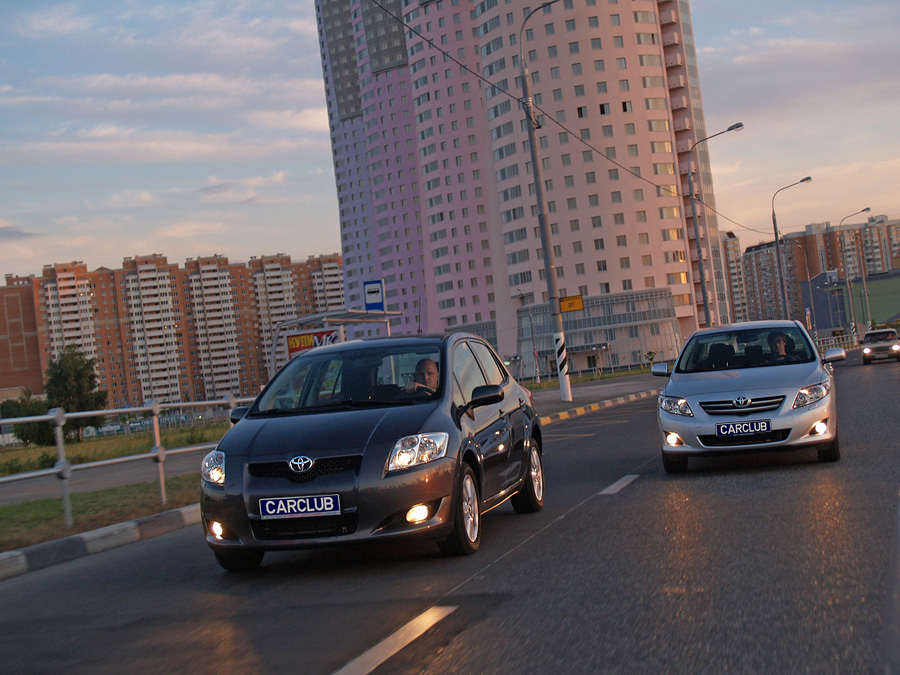
 The anniversary, tenth generation of the Toyota Corolla bestseller was decided to be split. The sedan is still called Corolla, while the golf-class hatchback, built on the same chassis, got its own name – Auris.Comments (12)
When the Toyota Corolla production run exceeded thirty million units and it officially became the best-selling car on the planet, Japan decided it was time to take a break. The tenth, anniversary generation of the model was decided to be split into different niches: the sedan, assembled in Turkey, kept the familiar name Corolla, while the hatchback of the same golf class on the same platform, but rolling off the line in England, was named Auris.
To figure out the difference between these two cars so similar in price and purpose, we organized a parallel test. The word "comparative" is not quite appropriate here, but the spirit of rivalry between the cars was felt from the first minute.
When my partner and I picked up the keys, we had to decide who got which car. I had business meetings coming up where first impressions matter a lot, so a solid appearance was a priority. It would seem that a sedan is ideal for this, but the Corolla's resemblance to the older Camry worked against it: getting into such a car is like admitting that you didn't have enough for a full business class and had to settle for a stripped-down version. So I chose the Auris and never regretted it. It looks fresh and unusual, and even the fact that from a distance it can be mistaken for the younger Yaris doesn't bother me at all. Up close, you can see both the serious dimensions and the funny triangular window in front of the front door. Besides, this is the new face of Toyota, and in a couple of years, most likely, many European models of the brand will look like this.
Both cars came to us in top trims and with the same engines – a boosted 1.6-liter unit producing 122 horsepower, paired with a Multi-Mode robotic gearbox.
Prices differ slightly: the Corolla is priced at 602,680 rubles, and the Auris at 642,200. The lower price of the sedan is explained by modest equipment. For example, the hatchback has dual-zone climate control, while the sedan only has single-zone. In the Auris, we counted seven airbags, including a knee airbag for the driver and window curtains throughout the cabin, whereas the Corolla has only four. But the absence of even a simple traction control system, let alone full stability control, looks like outright saving on safety. In summer, such electronics are not needed, but in winter on suburban highways, they would be very useful for beginners.
Inside, the cars differ not as much as outside, but there are differences. The Corolla is a classic golf class that tries to seem a bit larger than it actually is. All controls are laid out in familiar places, nothing catches the eye – just a solid car. The Auris is much more interesting: just the central console pipe transitioning into the tunnel is something. The selector of the "robot" is raised high, which brings to mind sports cars, but this bulk almost completely ate up the space where pockets, compartments, and cup holders are usually hidden. As a result, there is nowhere to put a phone or wallet. However, the cup holders built into the side vents allow you to heat or cool drinks with the airflow – a nice bonus. The storage problem is partially solved by two glove boxes in each car, but I would still like more open niches near the driver. The quality of the plastic in both cases also disappointed: from a car for $25,000 with a small engine, you expect better materials. It seems Toyota engineers got the directive to save on everything, and marketers simply set the price based on the brand's value.
Surprisingly, the rear row turned out to be more spacious in the Auris. The sofas are the same, but the headroom in the hatchback is significantly greater – in the Corolla, passengers over 180 centimeters already hit their heads on the ceiling. You immediately feel that this is not a business class. Luggage compartment measurements add points to the hatchback: the shape of the cargo area is more successful, and the cabin transformation offers more possibilities. The Corolla's trunk turned out to be shallow, and when folding the seats, the opening from above is limited by a massive beam. In addition, there is no handle on the trunk lid for closing – in winter, you will have to dirty your hands. Again, this unforgivable saving at such a price.
On the move, the cars behave very similarly. Starting simultaneously from a standstill, the Corolla and Auris go level, and the difference can only be due to the weight of the drivers or the load in the trunk. At first, the Multi-Mode operation is quite annoying. The jerks and pauses during shifts make you think that behind the wheel is not just a beginner, but an outright poor student. The manual mode with paddle shifters on the steering wheel or the sport algorithm saves the day. In manual mode, if you time the gas pedal, you can avoid the jerks, although the shifts themselves still take a considerable amount of time.
Sport mode shifts gears less often, almost not using fifth, and downshifts in advance to have a reserve of traction when exiting a corner. This transmission is, of course, far from real sport, and even the participation of Toyota race cars in Formula 1 is not an argument here. By the way, sport mode does not affect acceleration at all: with the pedal to the floor, the engine steadily revs up to almost seven thousand rpm, slightly entering the red zone.
But the engine truly pleased. There is, of course, not enough traction at the bottom, but it revs beautifully, and at the top you can't believe there's only 1.6 liters under the hood. Outside the city, both cars easily accelerate to 190 km/h – classmates with the same engines can only envy.
We found only one advantage of the "robot" – higher efficiency compared to traditional "automatics." Hence the low consumption: in the city, even with active driving, the car fits into 9 liters per hundred. Plus a slightly higher top speed.
Handling also differs only in details. On smooth asphalt, both cars fly confidently, but in ruts they start to wander from side to side. The informative steering wheel with good reactive effort saves the day. As expected, the hatchback holds better in corners: it is tuned for Europe, and its suspension is slightly stiffer. This almost does not affect comfort, but the behavior in bends is more stable. The sedan, with its increased ground clearance, sometimes starts to rock diagonally on an arc, and it is harder to control. Where the Auris goes through a corner without a hint of sliding, the Corolla already balances on the edge: just a sharper release of the gas – and the rear breaks away. The skid develops smoothly and predictably, but a stability control system would clearly not hurt here, of course, with the ability to turn it off.
The victory in our test goes to the Auris. It has a brighter and more original design, a more interesting and spacious interior, and a more convenient trunk. In addition, the audio system sounds better in the hatchback, and parking in the city is easier due to better visibility, although parking sensors would not hurt it. However, I would choose a manual gearbox or look for a version with a normal "automatic": "robots" are still far from ideal. But the trims are arranged so that the "mechanics" are only available in base versions, so you will have to choose between sparse equipment and patience with Multi-Mode.
Text: Leonid Pavlov