
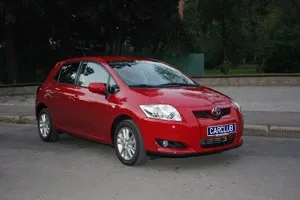
Toyota Auris is a car that leaves a good impression, and even a scattering of minor flaws cannot overshadow the positive experience of interacting with it.
Toyota Auris is one of the most sought-after city cars. The secret of its popularity is obvious: restrained and attractive looks, decent road behavior, a reasonable price, and signature reliability. On August 17 this year, Russian dealers began selling the facelifted “Auris”, which received new powertrains and gearboxes. For the test, we got a version with a 1.33-liter engine and a six-speed manual.
Of course, the car turned out to be red. Although why “of course”? It could just as easily have been black or silver – these are the shades most often seen on the Auris in city traffic. No flashy yellows, rich greens, or sky blues. The Auris is not a ladies' compact hatchback, but a quite serious golf-class car, essentially a Corolla in a different body.
Smooth body contours, headlights with crisp edges, a neat spoiler on the fifth door – there is nothing outstanding about the Auris's appearance for its segment, yet Toyota's corporate handwriting and recognizable look are unmistakable. The interior also makes a purely positive impression: quality materials, a calm, thoughtful design, and appropriate accents. The center tunnel deserves special attention – it seems to float in the air and conveniently raises the gear lever toward the driver. Under it, there is space for a pull-out ashtray. However, the handbrake is placed unusually, and reaching for it is not very convenient.
Another ergonomic miss is the seat heating buttons. From the driver's seat, you have to reach around the handbrake to get to them, and since both buttons are side by side and can only be distinguished by their letter markings, you will initially be constantly distracted to avoid pressing the wrong one.
The second drawback of the otherwise comfortable and pleasant cabin is the lack of places for small items. There seem to be two spacious glove boxes and door pockets, but there is nowhere to put a phone so that it is always at hand. You could, of course, put it in the niche under the armrest, but then the armrest itself loses its purpose. On the other hand, the hidden cup holders tucked under the air vents are a very successful solution.
However, all these little things do not spoil the overall picture: the Auris cabin sets a positive tone. You quickly get used to everything here; everything seems familiar and native. The feeling of “known for a hundred years” only intensifies when driving.
You sit comfortably behind the wheel right away, despite the somewhat stiff seat back, and the gear lever, raised by the tunnel, is exactly at hand. The seating position in the Auris, as befits a self-respecting city hatchback, is high and comfortable. Good visibility is aided by the triangular windows in the front pillars – they noticeably reduce blind spots in corners. The instrument panel is illuminated with a warm orange light, and the scales are clear and easy to read. Between the speedometer and tachometer is an indicator that suggests the optimal gear shift point for fuel economy.
The new six-speed manual makes you want to shift just for pleasure – the gears engage so crisply and predictably! The pedals also encourage this – they are responsive and informative. Even though the displacement is modest – 1.33 liters – the engine briskly delivers 101 hp, and the Auris feels confident in city traffic. On smooth surfaces, the hatchback drives stably and comfortably, delighting with responsiveness and increasing steering effort in corners, although in ruts the car starts to wander. The car handles speed bumps elastically, without annoying passengers. In the back, two people will sit comfortably, and a third will be superfluous on a long trip. Sound insulation is excellent – almost no outside noise penetrates the cabin, adding to the feeling of coziness.
But even here, there is a fly in the ointment. First, the audio system control buttons on the steering wheel strangely lack a quick mute button, which is sometimes essential – you have to reach for the stereo itself. Second, from the driver's seat while driving, the right climate control window is not visible.
The Auris's luggage compartment is arranged according to the classic scheme: in the standard state, when the rear seats are in place, there are only 350 liters, but when you need to transport something more serious than supermarket bags, the volume easily increases to very respectable values. The seatbacks fold simply and quickly, forming an almost flat floor.
Overall, the Toyota Auris leaves a pleasant impression – the minor flaws, of which there were quite a few in detail, do not overshadow the overall positive background from interacting with the car. The combination of the new 1.33-liter engine with 101 horsepower and the six-speed manual works excellently and smoothly: in the city, you can confidently keep up with traffic, and on the highway, you do not feel shortchanged.
The price of the base version of the Auris starts at 710,000 rubles, and for “metallic” paint you will have to pay an additional 10,000. The amount is considerable, but even in the initial trim there are fog lights, a full-size spare wheel, electric adjustment and heating of the side mirrors, air conditioning, front and rear electric windows, heated front seats, a leather-wrapped steering wheel, steering wheel audio controls, an audio system with six speakers, ABS, EBD, front and side airbags, as well as a driver's knee airbag. Mid-level trims, which add alloy wheels and dual-zone climate control to all this, cost from 814,500 to 860,500 rubles. The top Prestige version with light and rain sensors, cruise control, and the Smart Entry & Push Start keyless entry and engine start system will cost at least 896,000 rubles, and again plus 10,000 for “metallic”.