
Suzuki SX-4
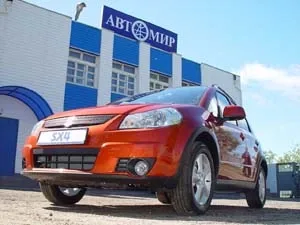
Suzuki for any season
Engine — 1.6-liter VVT
Peak power — 107 hp at 5600 rpm
Maximum torque — 145 Nm at 4000 rpm
Top speed — 170 km/h
Acceleration from standstill to 100 km/h — 11.5 seconds
Fuel consumption (l/100 km):
in the urban cycle — 8.9
on the highway — 6.1
in combined mode — 7.1
Fuel tank capacity — 50 liters
Drive — front-wheel drive only
Wheelbase — 2500 mm
Body length — 4100 mm
Width — 1730 mm
Height — 1560 mm
Ground clearance — 175 mm
Curb weight — 1145 kg
Tires — 205/60 R16
The history of Suzuki began when Michio Suzuki founded the company in the tiny village of Hamamatsu on the Japanese coast. The initial goal was modest — to create weaving looms that would be more convenient for people. The plan succeeded: over the first three decades, Suzuki assembled a team of talented engineers, and the results soon followed. Looms appeared that outperformed the British and Dutch counterparts that dominated the market at the time. For his contribution to the economy and industrial developments, Michio Suzuki was even awarded the Blue Ribbon Medal by the Japanese government.
But the founder was not going to stop there — he understood that the company had to explore new directions. When demand for small cars began to grow, Suzuki decided that producing a compact car would be the most sensible step, given the company's financial situation and existing experience. Work started in 1937, and by 1939 several prototypes were ready. These cars were equipped with four-stroke four-cylinder liquid-cooled engines that produced an impressive 13 hp for those times with a displacement of less than 800 cubic centimeters. Everything stalled when the government declared passenger cars a "non-essential commodity" and ordered production to stop. After the end of the Pacific War in 1945, Suzuki returned to weaving looms, but due to material shortages and unstable demand, it was impossible to reach pre-war volumes. To survive, the company directed its technical capabilities toward everything in demand: agricultural equipment, farm tools, heaters, and even musical instruments. In 1946, the American government began supporting loom production, and things improved thanks to new orders and contracts with local textile manufacturers. However, in 1951, the cotton market collapsed.
Facing new difficulties, Michio Suzuki again thought about what an ordinary Japanese person needed — an affordable means of transportation. Thus, the Power Free motorized bicycle appeared. It was made simple and cheap to produce and maintain, equipped with a two-stroke engine of 36 cc. The main highlight was a two-star drive system: you could either pedal to assist the engine, or disengage the pedals and ride solely on the engine.
The idea was so successful that the government granted Suzuki a subsidy for further developments in motorcycle manufacturing. Soon, the Power Free gained a two-speed gearbox. By 1954, the company was producing 6,000 motorcycles monthly and changed its name to Suzuki Motor Co., Ltd. Encouraged by success, the company took on its first car — in 1955, the Suzulight was released. It featured truly bold solutions: front and all-wheel drive, independent suspension, and rack-and-pinion steering. Four decades later, all this became the world standard.
In 1963, Suzuki entered the American market with new motorcycles, and success came quickly: the bikes were more reliable and faster, suitable for both rough roads and everyday riding. By the late 70s, having established itself as a manufacturer of two-stroke motorcycles, Suzuki shifted to four-stroke street models, starting the famous GS series. By the early 80s, the company was firmly established as a leading manufacturer of powerful, reliable, and fast road machines.
In 1985, Suzuki made a real breakthrough by bringing cars to the American market. Over three decades, the Japanese earned a reputation as creators of world-famous small cars. The all-wheel-drive Samurai entered the US market — it was bought by hundreds of thousands who wanted sporty and practical transport.
From a small group of engineers starting with weaving looms, Suzuki grew into a global corporation with nearly 15,000 employees, with products sold in more than 170 countries. Every year, over 1.8 million Suzuki cars and sports products are sold worldwide — more than BMW, Mercedes, or Saab. More than 2 million people choose the brand's motorcycles each year. The company continues to improve its products today, and the SX4 crossover is direct proof. It is built on the platform of the Suzuki Swift hatchback and is designed as a versatile youth city car, available in both front-wheel-drive and all-wheel-drive versions. With a ground clearance of 19 cm and short overhangs, the car is quite capable of driving on dirt roads and light off-road.
Under the hood of the SX4 is a 1.6-liter gasoline engine with 108 hp. On the all-wheel-drive version, it works in tandem with a five-speed manual, while an automatic gearbox can only be ordered for the front-wheel-drive variant.
Even the base trim includes the electronic stability program ESP. Standard equipment also includes six airbags and ABS with electronic brake-force distribution EBD.
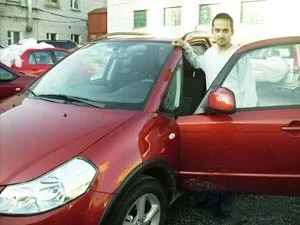
Askar Kushaev, bank employee. Driving experience — 10 years
Tired of fighting endless potholes on our roads? More and more drivers are switching to SUVs. Marketers of global automakers foresaw this and are actively expanding their model ranges to meet growing demand. But even with constantly increasing supplies to Russia, queues for popular models stretch for months. The Suzuki SX-4 is one of the players in the compact crossover class, where competition is serious: Nissan Qashqai, Dodge Caliber, Skoda Roomster Scout, VW Cross Polo, Subaru Forester.
For the test, the dealer provided a version with a 1.6-liter gasoline engine producing 106 hp, a five-speed manual, and front-wheel drive.

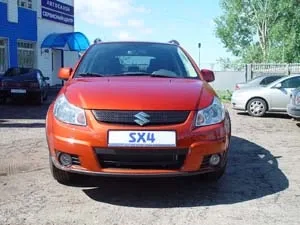
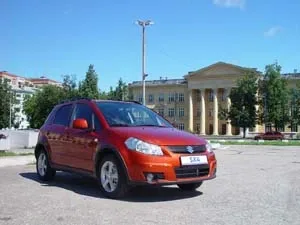
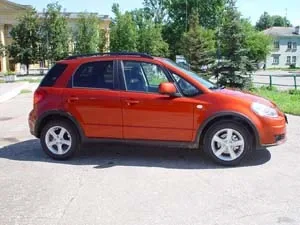
The exterior looks modern: slanting elongated headlights, and a ground clearance of 190 mm is quite SUV-like.
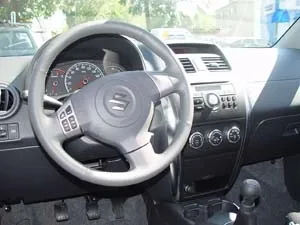
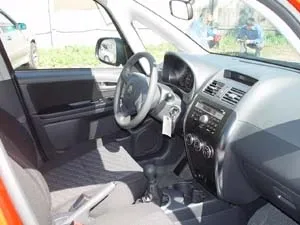
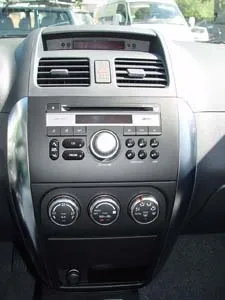
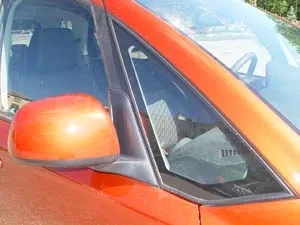
Inside, everything strongly resembles the Suzuki Grand Vitara — the older model that has already won over the most demanding audience. The instrument panel is made in the same style and with the same quality: everything is convenient, everything is at hand. Gears shift short and crisp, the steering wheel has leather trim, and the adjustments of the steering wheel and seats allow even a person of slightly smaller build than Nikolai Valuev to sit comfortably. The rear is also spacious: ceilings are high, and you don't press your knees into the front seat back. The built-in stereo with steering wheel controls no longer surprises anyone — cars of this level come with this by default. Visibility is good thanks to well-positioned mirrors, but the wide frame between the windshield and the front vent window sometimes gets in the way. ABS and the electronic brake-force distribution system EBD help even not the most experienced driver feel confident in difficult weather conditions.
Six airbags and a safety rating of 4.5 according to the European NCAP system are, of course, a significant plus for potential buyers.
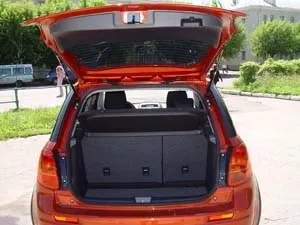
But the trunk is clearly too small for families who like to spend weekends in nature with active recreation, or for those who are used to saving on transporting large loads. However, if you fold the rear seats — which requires no special effort — then, say, a small refrigerator will fit without problems.
For the tests, we chose the Nagorny settlement — there is both normal asphalt, broken dirt roads, potholes and bumps, and speed bumps. In short, all Russian road reality in miniature.
The main thing that catches the eye: the car is one hundred percent created for our city roads. The only thing is not to set impossible tasks for it, like deep mud or high curbs. The engine is quite lively, although far from racing. The tenacious brakes were a separate delight, and small artificial bumps can be driven over without slowing down at all — the suspension allows it. In corners, the car stands confidently, without rolls or swaying. The only noticeable drawback is sound insulation: when the revs rise above average, the engine hum is clearly audible in the cabin. Overall, the SX-4 won't let you down: it will get you to the dacha, to a picnic, and to fishing. True, it's better to choose good weather and not the most remote places for this.
I really want to try the all-wheel-drive modification, especially when autumn and winter come, to test the car to its full potential. I hope Suzuki dealers will give us such an opportunity.
Design
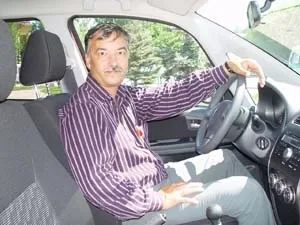
Vadym. A neat little crossover with stylish front optics. Just the looks alone will please the owner every day. Inside, the front seats are spacious and comfortable, everything is at hand, convenient to use. The side support could have been deeper, but that's a matter of taste. The steering wheel only adjusts for height — a shortcoming, but it didn't stop me from getting comfortable behind the wheel. But what a view the rearview mirrors provide! I'm increasingly convinced that "elephant ears" are the best solution. Try driving on a rainy evening with narrow stylish mirrors — and you'll love "elephant ears" too. But in the back, it's not as roomy. To keep rear passengers' knees from pressing into the front seatbacks, the second row was pushed back, which slightly reduced the trunk. But that's only half the trouble. Now the seat is located right above the wheel arch, and getting out of the car without dirtying your clothes is impossible. However, the same issue exists in other compact five-doors — take the Opel Corsa D, for example. I noticed that the rear window tinting is done neatly, without flashy blackness. Stylish and tasteful.

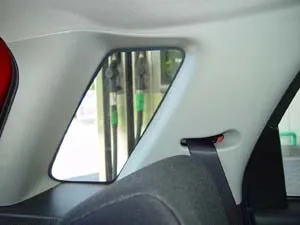
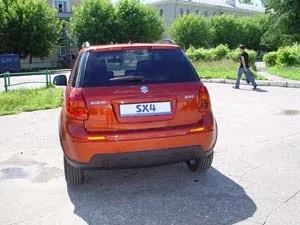
Alfred. And how could the design not be liked? This is the work of Italdesign studio! Calm, pleasant body lines. The small windows in the front pillars are not just decoration; they also compensate for the loss of visibility. The factory tinting of the rear window makes the look cohesive, although there's actually a small vent window hidden there too. I admit, I was a bit disappointed when I saw the car: I expected an all-wheel-drive version, but the showroom had a front-wheel-drive one. And they're easy to tell apart at first glance. The all-wheel-drive version has a black plastic skirt around the entire perimeter. Also, the 4WD has more ground clearance, and the wheels seem larger. I'd even argue that this is more of a golf-class hatchback than a crossover. To be called a crossover, it needs all-wheel drive.
This time, I started my acquaintance with the car from the back row. It's quite cramped there — even for me, a person of below-average height and build, it's not very comfortable, but tolerable. I agree with Vadym about the wheel arches and would add that the rear door is a bit narrow. But when you move to the front, the sensations are completely different. The seats are pleasantly firm, with enough space for both tall and heavy-set people. Keyless entry, bright red instrument lighting — all in fashion. In the center of the panel are the familiar Suzuki "three circles" of climate control. Moreover, the system not only maintains the temperature but also chooses the direction of airflows according to its own algorithm. We turned on the stock audio system — the sound is predictably average, a three out of five.
Engine
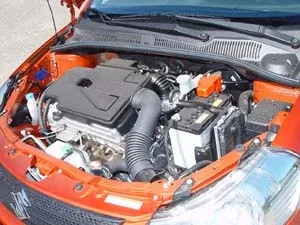
Vadym. Under the hood is a 1.6 16V with VVT variable valve timing system. It provides good low-end torque, which is important in the city. Plus fuel savings — no need to constantly rev the engine. On the highway at 100 km/h, the revs stay below 3000 (hard to say more precisely — the scale divisions are small). But VVT, regardless of the manufacturer, has a common drawback — increased noise at 3000 rpm and above. In the SX-4 cabin, this hum is noticeable, sometimes even annoying. So additional sound insulation for the engine bay definitely wouldn't hurt. Surprisingly, there's almost no noise from the rear arches, even though the tires here are far from the best, and the arches aren't lined with felt. The most comfortable way to drive with this engine is calmly and steadily, while having a solid reserve under the pedal to accelerate when needed. I also tried an aggressive style — with sharp accelerations and overtakes: it pulls well, responses to throttle input are instantaneous, you can even have some urban "races." But... unhurried driving is still more pleasant. However, I didn't like the gearbox: the gears engage too stiffly. Such a short throw and precision would suit a 2.3-liter turbo engine better, but why here, on a 1.6, I don't understand. Because of this, that aura of calm is somewhat lost.
Alfred. The short-throw gearbox is more of a plus; many will like it, especially since the engine here is lively and elastic, almost provoking active driving. True, first gear sometimes engages with effort. Perhaps due to the short throw, I release the clutch too early — I can't say for sure; I'd need to try again.
Suspension
Vadym. I won't express my opinion, but the suspension is the main trump card of the SX-4. Together with 205/60 R16 tires, it works wonders: you can cross railroad tracks without spilling your coffee! Perfect for our roads. Potholes and bumps are also unlikely to disturb passengers much. On such a tall car with 175 mm ground clearance, I didn't risk taking corners quickly — better safe than sorry. But in normal, standard maneuvers, the suspension performed excellently: minimal body roll, confident tracking. I liked it.
Alfred. I recall that Vadym on the VW Passat B6 test boldly threw the wheel on a narrow road, but here he suddenly got scared. And I'm sure the car wouldn't have let us down. Apparently, it's no coincidence that the factory Suzuki team chose this model for the WRC — albeit the all-wheel-drive version. The suspension is more stiff than soft, but at the same time very "muscular." And despite the tall body, there's no body roll. And since Vadym liked it — it means it's really good. Another important plus for me is the steering. It has an electric power steering that fills with pleasant heaviness at speed. Moreover, the feedback from the wheels is clearly felt — unlike the Toyota Corolla, for example. The sharp steering pairs perfectly with the grippy suspension, lively engine, and sporty gearbox.
Trim levels
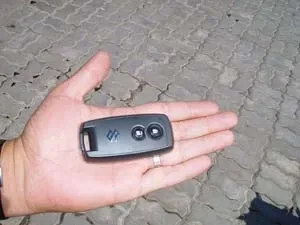
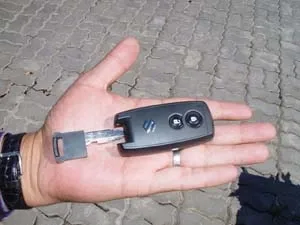
Vadym. In the base version for 570 thousand — central locking with remote, all power windows and heated seats, air conditioning, roof rails, fog lights. Essentially, everything you need without excess. The top trim for 645 thousand adds all-wheel drive, a CD changer, climate control, alloy wheels, ESP, and ground clearance grows to 190.
This is an excellent city car that isn't afraid of dirt roads and feels quite confident on snowy streets. Comfortable, economical, spacious. I think it will be gladly taken both as a first family car and as a second one — for the wife.
Alfred. I'll add that the car will also appeal to young people. A great opportunity to head out into nature with friends, having quite decent driving capabilities and a reasonable price. As they say, inexpensive and with a breeze. Just be careful with the front bumper — it has a large overhang and is made of a single piece of plastic. If you damage it, you'll have to replace almost the entire "face."