
Suzuki SX4 Sedan

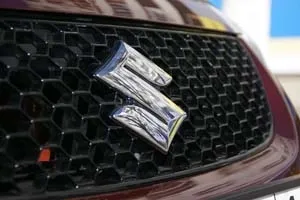
Suzuki SX4
Engine - 1.6L VVT
Max power - 107 hp/5600 rpm
Max torque - 145 Nm/4000 rpm
Max speed (km/h) - 170
Acceleration time
0-100 km/h - 12.3 sec.
Fuel consumption (l/100 km):
city - 9.8
highway - 6.4
combined - 7.6
Fuel tank capacity (l) 50
Front-wheel drive
Wheelbase - 2500 mm
Length - 4490 mm
Width - 1730 mm
Height - 1545 mm
Ground clearance - 165
Curb weight - 1205 kg
Tire size - 195/65 R15
Suzuki's history began with weaving looms — that's what the company's founder Michio Suzuki initially designed in the Japanese village of Hamamatsu. He managed to assemble a team of talented engineers, and within three decades their looms surpassed British and Dutch counterparts in performance. For his contribution to the economy and industry, Suzuki even received the Blue Ribbon Medal from the government. However, he understood that the company needed to diversify. When demand for small cars grew, he decided that a compact car would be the most practical project, given the company's financial situation and experience. Work began in 1937, and by 1939 several prototypes were ready with a four-stroke, four-cylinder liquid-cooled engine producing 13 hp with a displacement of less than 800 cubic centimeters. But the government declared civilian cars a "non-essential commodity," and production had to be halted.

After the war in the Pacific, in 1945, Suzuki returned to weaving looms, but due to material shortages and unstable demand, they couldn't reach pre-war levels. To survive, the company directed its technical resources to everything in demand: agricultural equipment, heaters, even musical instruments. In 1946, the American government supported loom production, orders came in, and things improved. But in 1951, the cotton market collapsed.
Then Michio Suzuki again thought about affordable transport for the Japanese and created the Power Free motorized bicycle. It was equipped with a 36cc two-stroke engine, and its highlight was a two-star system that allowed either pedaling to assist the motor or riding on engine power alone. The government appreciated the rationality of the design and provided a subsidy for further development. Soon, the Power Free received a two-speed gearbox, and by 1954 Suzuki was producing 6,000 motorcycles a month and changed its name to Suzuki Motor Co., Ltd. The first car was the 1955 Suzulight with front and all-wheel drive, independent suspension, and rack-and-pinion steering — all of which became world standards decades later.

In 1963, Suzuki entered the US market with new motorcycles — fast, reliable, designed for both rough roads and everyday riding. By the late seventies, having established itself as a manufacturer of two-stroke motorcycles, the company transitioned to four-stroke street models, laying the foundation for the legendary GS series. By the early eighties, Suzuki was firmly associated with powerful, reliable, and fast road machines.
In 1985, Suzuki made a breakthrough by entering the US car market. Over 30 years, the company earned a reputation as a creator of world-renowned compact cars. The all-wheel-drive Samurai sold in hundreds of thousands of units — Americans appreciated its sportiness and practicality.
From a small engineering group making weaving looms, Suzuki grew into a global corporation with nearly 15,000 employees, selling products in more than 170 countries. The company sells over 1.8 million cars and sports products annually, outpacing BMW, Mercedes, and Saab in sales. More than 2 million people choose Suzuki motorcycles each year. And today the company continues to develop, as confirmed by the SX4 crossover. It is built on the Swift hatchback platform and positioned as a versatile youth city car with front or all-wheel drive. A ground clearance of 19 cm and short overhangs allow confident driving on dirt roads and light off-road.
The SX4 is equipped with a 1.6-liter petrol engine producing 108 hp. On the all-wheel-drive version, the engine works with a 5-speed manual gearbox, while automatic transmission is available only on front-wheel-drive modifications.
Even in the base trim, the car gets an electronic stability control system ESP. Standard equipment also includes six airbags and ABS with electronic brake-force distribution EBD.
Vadim Sadykov,
"Autoclub-Kazan"
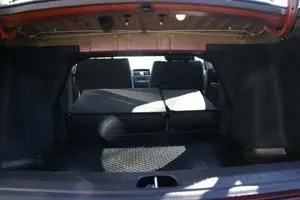
We already met the SX4 in August 2007, but then it was a hatchback with a manual. Differences are immediately noticeable — for example, the front bumper has become much more attractive, and it can boldly be called a body kit. Hatchback owners take note: this bumper fits their car too, the mounting points match. The sedan's trunk, as expected, is more spacious. In the hatchback, we unanimously noted that the trunk was too small for travel and outdoor activities. I didn't see any major changes in the cabin, except that the angle of the pillars increased: if three people sit in the back, the outer passengers will have their heads against the wall.
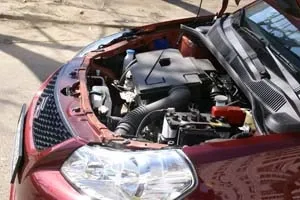
The engine is the same — 1.6 VVT with variable valve timing. What can I say: at low revs, traction is excellent, and at high revs there's also a reserve for fun, but only with a manual gearbox. With the 4-speed automatic, the car's character completely changes. It's now a leisurely car for calm city driving. Gear changes are smooth and almost imperceptible, revs stay at 1500-2000, which ensures fuel efficiency. It seems that when tuning the 4-speed automatic, the developers tried to emphasize the engine's main advantage — good low-end torque. But a 4-speed automatic is always a compromise: you gain at low revs but lose at high revs. Sharp overtakes in the city are no longer as quick as with a manual, and the smoothness of shifts has disappeared. On the highway, we tried overtaking trucks at 80 and 90 km/h as usual. Honestly, for the first time I can't answer myself — is there enough dynamics for overtaking? There seems to be nothing to complain about, but there's no impression. However, regular highway driving pleased: traction is normal, sound insulation is good, suspension is softly elastic. Ideal for long trips. After city and highway driving, the onboard computer showed fuel consumption of 9.3 l/100 km.


Now about behavior in corners. Traditionally, we chose a suburban route with a series of bends, plus we did some maneuvers on an asphalt pad. It's clear that no one expected sporting feats from the SX4. There are at least three reasons for that: noticeable ground clearance, fairly soft suspension, and the body type — a sedan, which in equal conditions always yields to a hatchback. However, something else surprised me: in corners, the body leans noticeably, but the car continues to confidently hold the given trajectory! It's a very understandable and predictable car for the driver.
Let's go over the strengths of the SX4 sedan once more to understand who it would be the best choice for. Excellent stability, forgiveness of minor driver errors, availability of an automatic — this is an ideal set for a beginner's first car. But for experienced drivers, those who have already "burned out," this car also suits: the suspension absorbs bumps well, and if necessary, it helps keep the car in an emergency maneuver; smooth city operation of the 4-speed automatic; good traction and fuel efficiency at 1500-2000 rpm; quality interior materials. The only category for which the SX4 sedan with automatic definitely won't suit is young "racers": the acceleration dynamics will definitely not impress them. Although for them there's a version with a manual gearbox — both sedan and hatchback.

Igor Tolmachev,
"Autoclub-Kazan"
For me, at 185 cm tall, it's always hard to find a car where I'm comfortable both behind the wheel and in the passenger seat. As for the SUZUKI SX4, here I comfortably settled in as a passenger. Inside it's quite spacious: sitting on the rear sofa is comfortable, knees don't touch the front seat backs. And thanks to the glass inserts in the front pillars, the space seems even larger visually. All controls are at hand, no need to reach anywhere.
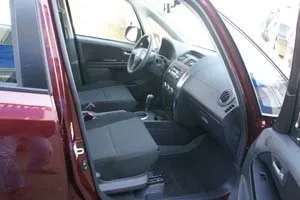
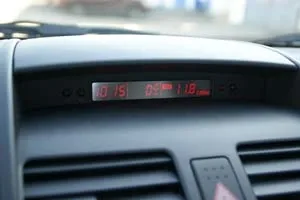
The ceiling light is simple — press it and the light comes on, no switches needed. The lighting is separate: for the driver and the front passenger. The side mirrors were a pleasant surprise. You can see not only the adjacent lane but also the one beyond it. On our roads, this is very useful. However, there were two minor drawbacks. First: the driver's seat adjusts only in height — there's no way to separately raise the front of the cushion or lower the rear. As a result, if you raise the seat entirely, it becomes uncomfortable to watch the road, and if you lower it for a good view, your leg ends up dangling — you can't sit like that for long. The steering column also only adjusts for height, with no reach adjustment. Second: the rear seat back doesn't fold into a flat floor. This might not be critical, since the SX4's trunk is simply huge, but it would be more convenient if large cargo lay on a flat surface. However, all these little things are outweighed by the driving qualities. The car simply doesn't notice small potholes, accelerates excellently from low RPMs, and ESP helps you enter corners confidently.
I liked the car. I'd buy it for my wife, and I'd happily ride in it as a passenger myself.
Alfred Mardanov,
"Autoclub-Kazan"
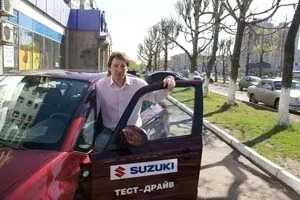
Although Suzuki is primarily associated with all-wheel drive and SUVs, our front-wheel-drive SX4 turned out to be a quite worthy option. If you delve into the history of all-wheel-drive cars in Japan, their true purpose becomes clear. No, they weren't created for conquering off-road terrain or beach trips. Japan is an island nation stretching from north to south across several climate zones. The climate of the northern island of Hokkaido is especially treacherous: rain may fall during the day, but by evening frost can hit, covering the road with dangerous ice, and the terrain there is mountainous. To minimize risks, the Japanese use all-wheel-drive vehicles. In our long winter conditions, all-wheel drive would also be useful, but it noticeably increases both the purchase price and operating costs, so everyone decides for themselves whether it's worth paying extra for it. And our test car is a front-wheel-drive SX4 sedan. Like my colleague Vadim, I've already dealt with the SX4, but that was a hatchback.
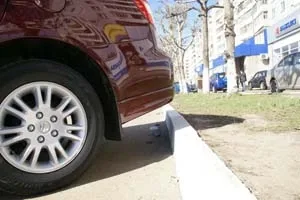

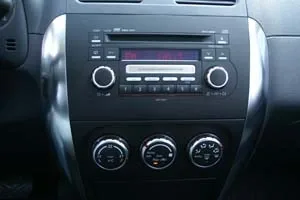
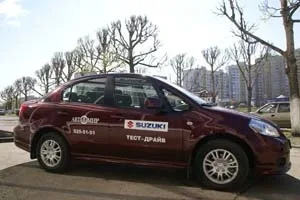
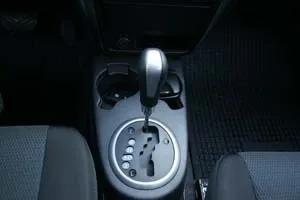
There's no fundamental difference, except for the huge trunk and some exterior changes that, it must be said, have benefited the model. The overall feeling: the car seems designed by an architect in a modern development style. Thank God, it's no longer a "Khrushchevka" or even a "Leningradka," but a kind of "pseudo-elite" building. There's enough space, but not in excess. Sitting is comfortable, but not ideal (for example, the steering wheel adjusts only for tilt, without reach adjustment). The interior isn't luxurious, but functional: the purpose of all buttons and knobs is clear without instructions. Visibility doesn't suffer, despite the side pillar with a triangular window, greatly aided by the huge "burdock" mirrors. The instruments are simple, with large numbers, without overloaded bright-red digital indicators on the panel; in the center is the dashboard. A 6-disc MP3 stereo. Climate control, a neat automatic transmission lever on a thin stem — it seems everything is there and decent, but simple. Since we picked up the car from the dealership in the Nagorny settlement and decided to take photos near the showroom on Yamashchev Avenue, we set off leisurely. Previously, we usually headed straight for the highway and only then drove around the city, but here it was the opposite. We even "shook" the car a bit (as Vadim put it) on the lot. I tried to simulate a sort of moose test, and the car, to my surprise, turned out to be very grippy, despite noticeable body roll.


It feels like you're not in a car but in a small boat: turn — roll — exit, next turn — heeling to the other side — and again a confident exit. Strange, very strange: the rear axle, it would seem, should already break into a slide, but it stubbornly follows the driven axle, gripping the asphalt tenaciously. And the quality of the brakes made me get out of the car and check that the rear has drum mechanisms, not disc brakes. During emergency braking, I didn't expect such confident and rapid deceleration from drums. Do they have some innovative technology there?! So, the lot revealed some behavioral characteristics in terms of stability and handling. By the way, it's noticeable that the car has a very small turning radius and, as a result, good maneuverability. On the highway, the engine's character and sound insulation also showed their traits. Since I spent most of the trip in the back seat, it's simply impossible not to note the low level of aerodynamic noise.
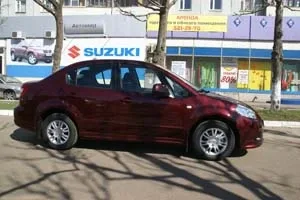

For its class, this is quite decent and acceptable. As for the engine, it's immediately clear: it's as good at low RPMs as it is weak at the top end. What can you say, a clear urban orientation is evident (as I noted at the beginning). This includes a good start, excellent maneuverability, fuel efficiency, which is especially relevant with oil prices at $117 per barrel, and also a pleasant ride smoothness. I wouldn't buy a "bone-shaker" with an engine smaller than 2.5 liters. There's no point in a suspension that exceeds the engine's capabilities. But here everything turned out very harmoniously: a torquey engine and a comfortable ride. Now about the price — perhaps this is one of the main incentives. Our example was built in Japan in the GL-X trim (maximum). It has everything: 6 airbags, ABS, EBD, ESP, an immobilizer with a keyless start system — for 627,500 rubles. The simplest version with an automatic transmission costs 532,500; it lacks the stereo, ESP, Keyless system, has steel wheels, 4 airbags instead of 6, and air conditioning instead of climate control.