Advertising
About the Subaru brand
Japan founded in 1956 Model range
General Information
Subaru (Subaru-Fuji Industries Ltd.) is a Japanese company specializing in the production of passenger cars and trucks, involved in aircraft manufacturing and industrial equipment.The headquarters is located in Tokyo.
Corporate History
In 1956, Fuji Heavy Industries established the Subaru division. "Subaru" is the name of a star cluster in the constellation Taurus, translated from Japanese as "gathering together" or "unite." Initially, Subaru produced Rabbit mopeds. Two years later, the company released the Minicar 360, which was larger than its name suggested. Initially, sales of the Subaru 360 were quite low, but within two years, this figure increased significantly, and Subaru became the leading manufacturer of cars in this class in the country.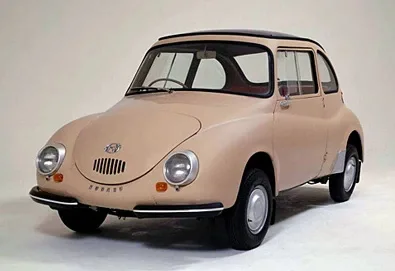
In 1960, alongside the 360cc model, production of the 450 series (called Maja in Japan) began.
In the 1960s, the 360 model continued to be continuously improved: in 1961, engine power increased to 18 hp, and speed to 90 km/h; three years later, the 360 DeLuxe/Custom version debuted with a 20-hp engine, replaced in 1969 by the new generation Subaru 360, known as the R-2.
At the same time, production began of the most powerful modification of the "people's" Subaru - the Sport 360, which, thanks to 36 hp, reached speeds of around 120 km/h. Along with this, the build quality of the brand's cars improved (as with all Japanese automakers, by the mid-1970s surpassing not only American brands but also matching West German ones).
In 1965, the company's production program was supplemented by an entirely new model, the 1000, which became Japan's first production car with front-wheel drive.
In 1969, the car with a 1.0-liter engine was modernized and subsequently designated FF. It was this model, later named Leone, that began the successful expansion of the Hiroshima-based company into foreign markets. In July 1972, Subaru launched two models: the front-wheel drive Leone 1400 FD and the all-wheel drive Leone 1400 4WD. This event became a significant milestone in the brand's history.
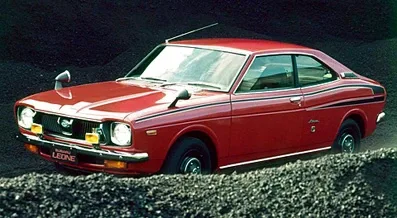
A completely independent development of the company - the front-wheel drive FE model - appeared on the market in 1968. In the same year, the company became part of the Nissan corporation, although it remained an independent brand. Assembly plants were opened outside Japan, particularly in New Zealand and Thailand.
In July 1972, the Subaru R-2 was replaced by the Rex model with a water-cooled engine. In August 1981, the second-generation Rex premiered. At the 1983 Tokyo Motor Show, the lineup was supplemented by the all-wheel drive Rex 4WD.
After the Leone was shown outside Japan in 1974, a real sales boom began. In two years, 100,000 Leones were sold, 30,000 of which went to the USA. From that time on, passenger cars with all-wheel drive became Subaru's specialization.
By the mid-1980s, Subaru's annual production level approached 250,000 vehicles, 53% of which were exported. The company achieved unconditional recognition in the American market, and the USA became the main importer of the brand: America's share was 58.1%.
Meanwhile, the Leone body range expanded, and in addition to the sedan, a station wagon, coupe, and even a pickup named Brat appeared.
In the fall of 1984, the Leone version - the 1800 4WD model with a completely new look and a 90-hp engine - went on sale.
In the 1980s, Subaru had several series of cars in its lineup: the completely updated Rex, the new, slightly larger Justy, the flagship Leone/1800, and the quite original minibus Domingo/Libero, also with all-wheel drive.
Since 1982, the company's engines were equipped with turbocharging. In 1984, the all-wheel drive Justy received an electronically controlled continuously variable transmission (ECVT). The model is produced in 3- and 5-door versions. The car has good traction qualities and is equipped with power steering.
In 1987, the veteran Leone was replaced by the newest model, Legacy. By that time, the Hiroshima-based company had abandoned the disengageable rear-wheel drive and fully switched to 4WD. The new model was presented at the Chicago International Auto Show.
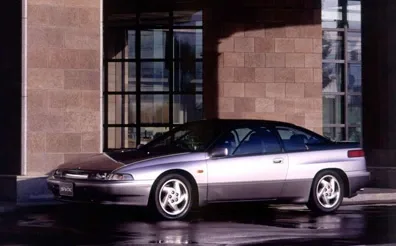
The 1989 Tokyo Motor Show showcased another new product from Subaru: the SVX sports car of the GT class. This is an all-wheel drive sports coupe with a high degree of glazing. In modern execution, the SVX roof is painted in body color.
The Libero cannot be classified into any category due to its tiny size. The car is designed for 6 passengers or 600 kg and can be successfully used for family trips out of town.
In 1990, a new name appeared in the company's lineup: Vivio. A city car of the ultra-small class, it was equipped with the already well-proven ECVT variator. The all-wheel drive super-Vivio accelerated to 100 km/h in 5.4 seconds. Based on this, a rally car was prepared, with which driver Colin McRae successfully competed in the Safari Rally.
Since 1992, Subaru has been offering a new product named Impreza, one of the most legendary and famous cars for its participation in rally competitions. Suffice it to say that in the World Rally Championship, Subaru has five wins in the individual and three in the team standings.
The all-wheel drive Impreza with a 2.0-liter turbocharged engine became a benchmark for other automakers. The Impreza is based on a shortened Legacy platform. In 2000, the Impreza model received a special award "for its excellent car concept and technical features" at the "Car of the Year 2000/2001" competition in Japan.
In 1994, the new generation Legacy appeared. Soon, based on it, the company's engineers created a revolutionary new product. This was the Outback, which opened a new class of cars: passenger sport utility wagons with off-road capabilities. Later, there would be the Audi Allroad and Volvo V70XC, but the Outback, at least in the 1990s, was the first.
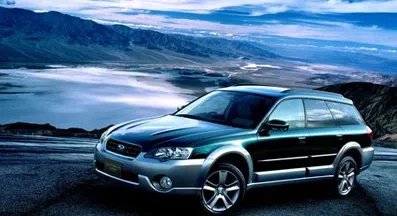
Riding the wave of success, in 1997 the Forester model was developed, another new product from Subaru, falling outside the framework of traditional automotive typology. In September 1997, it was presented at the Frankfurt Motor Show. The car is equipped with a 2.0-liter boxer engine producing 122 hp and a five-speed manual transmission, and is an off-road vehicle.
The Subaru HM-01 concept, created based on the company's first car - the 360, launched in 1958. This microcar has a hybrid powertrain: the front wheels are driven by a tiny gasoline engine paired with an i-CVT variator, while the rear wheels are driven by an electric motor. At the 2002 Detroit Auto Show, the Subaru Baja pickup was shown, built on the basis of the well-known Outback.
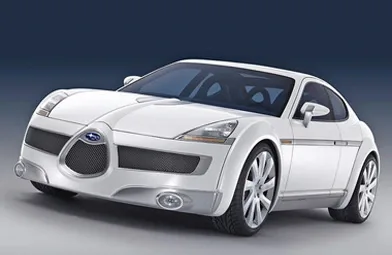
In 2003, at the Geneva Motor Show, the Subaru B11S model was presented. At the beginning of the 21st century, total production of Subaru cars approached half a million. In addition to producing hi-tech cars, Fuji Heavy Industries is also engaged in other activities: from metallurgy and machine tool building to the production of components for jetliners and spacecraft.
Subaru in Ukraine
Since May 2006, a joint venture with foreign investments, "Subaru Ukraine," has been operating on the Ukrainian market, founded by the Japanese trading house Sojitz and official importers in Ukraine "Mega-Motors" and "Mercury." The new company will follow the unified marketing strategy of the manufacturer and ensure high-quality customer service."Subaru Ukraine" will manage the warehouse, wholesale sales of cars and spare parts.
All dealers have received confirmation of compliance with the dealer standards of the manufacturer, Fuji Heavy Industries Ltd.